


We hope that each of you, our readers, will thoroughly enjoy and appreciate this article we present to you about these 3 Captivating Herbaceous Plants of Lithuania. It was certainly our pleasure to gather the information for you. May it provide you with both education and increased awareness.
Certainly, these few wonders listed herein represent only a miniscule portion of the similar marvels found around the world. It’s our belief, though, that they nonetheless serve as excellent representations of these marvels of Nature. Check out some of our other articles for similar species.
Lady’s Slipper Orchid
Public Domain Image
Lady’s Slipper Orchid Facts
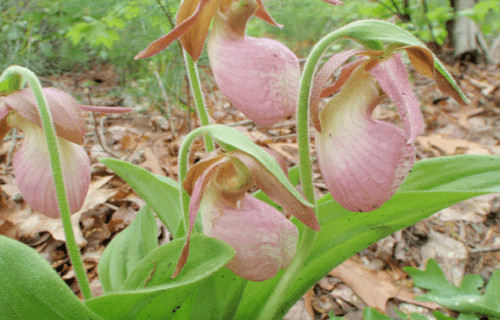
- Starting off this article about these 3 Captivating Herbaceous Plants of Lithuania we present you with the magnificent Lady’s Slipper Orchid.
- It must be pointed out that the enthralling term that we’ve used herein actually refers to an entire Family of orchids. In total, this group contains more than 50 recognized species at this time. An amazing total of more than 30 of them also appear in one part of the world.
- Blessed by Nature in this regard, that region’s the area consisting of North America. In addition to the extraordinary diversity of its Family, every one of the various forms stands our from its kindred. That’s because each species also varies from other orchids in a unique way.
- That holds true due to the remarkable fact that these varieties have been classified by botanists as diandrous. This means that each of these unique plants has two fertile anthers, rather than one, like other orchids. The reason for this evolutionary divergence remains unknown.
- Doubtless, climate change and habitat loss threaten many of these marvelous plants worldwide. Many of these particular species, however, continue to be fortunate. This holds true because twelve species occur on protected National Forest System lands, in the United States.
- Quite unfortunately, this gorgeous Family appears to have nearly disappeared from at least one portion of its range. In Great Britain, only one small population of a single species of Lady’s Slipper Orchid still survives. Thankfully, the site is carefully monitored and maintained.
Public Domain Image
Lady’s Slipper Orchid Physical Description
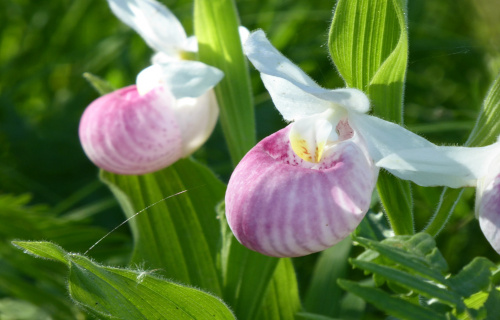
Since so many separate species bear the same common name of Lady’s Slipper Orchid, one simple fact can’t be denied. That’s the knowledge that physical variations invariably naturally occur. In fact, many of the individual members of the remarkable group vary significantly in appearance.
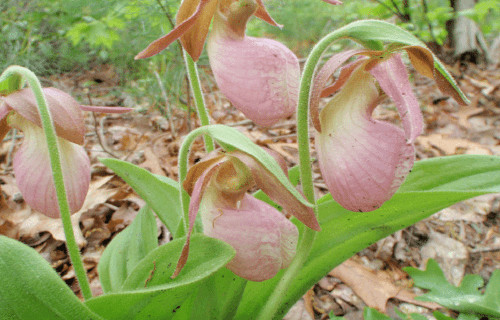
The different members of the group nevertheless still share many general characteristics with each other. Most notably, each of these botanical wonders remains characterized by the presence of slipper-shaped pouches on the flowers. These features of the plants play a key role in pollination.
The stems of the many different species also range greatly in terms of their height. In point of fact, that range varies from an extreme of 8-28 in (20-70 cm). Each of these, furthermore, usually supports 1-2 flowers. Sometimes, though, as many as 3 blooms develop on individual plants.
The numerous different types of Lady’s Slipper Orchid also present the viewer with a wonderful variety of colors. In this, these marvels of evolution follow the example of most related species. Most commonly, these colors include various shades of pink, red, brown, white, yellow, and purple.
The leaves of most member species, meanwhile, present their own distinctive brand of beauty. That holds true due to the fact that this tantalaizing foliage displays a unique light green color. This trait further sets this particular group of amazing floral wonders apart from most forms of orchids.
- Kingdom: Plantae
- Phylum: Tracheophyta
- Class: Liliopsida
- Order: Orchidales
- Family: Orchidaceae
- Genus: Cypripedium
Public Domain Image
Lady’s Slipper Orchid Distribution, Habitat, and Ecology
Most fortunately, the gorgeous Lady’s Slipper Orchid Family possesses a distinct evolutionary advantage over many other flora. That’s due to the relatively extensive habitat range in which the members appear. That holds true since this zone of habitation doesn’t just include North America.
To the wonder of many people who learn of it, that extensive range also includes parts of the continents of Asia and Europe as well. The various species of the group further display extreme levels of adaptability. As a result, the many varieties inhabit temperate, boreal, and tropical forests.
While their unquestioned beauty awes their countless admirers, factors working against them still nevertheless exist. For one, its own growth rate presents problems for those attempting to preserve the family. That’s because experts rank it as one of the slowest-growing plants known to man.
In point of fact, individual specimens of the beauty often require as much as 11 years of growth before reaching maturity and producing flowers. Regrettably, the fabulous Lady’s Slipper Orchid only reproduces via propagation and rhizomes, not with tubers as well, like other orchids.
The tiny seeds these stunning flowers produce also rely upon a very unique symbiotic association. This the plants holds with a mycorrhizal fungus, for its germination. This highly unusual evolutionary development makes efforts to artificially propagate members of the family difficult.
Honeysuckle
Honeysuckle Facts
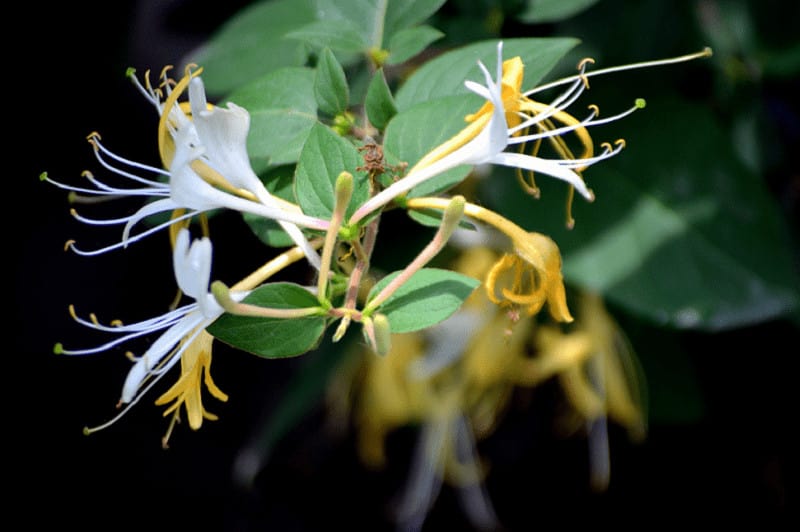
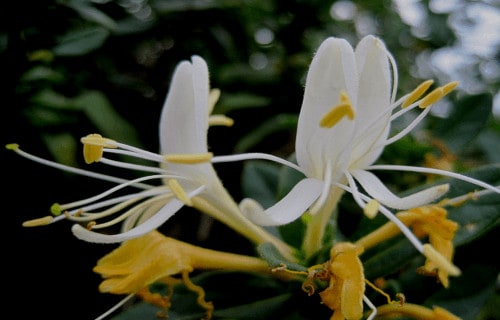
- Our next choice for inclusion in this compendium of 3 Captivating Herbaceous Plants of Lithuania is the sweet flora known as the Honeysuckle.
- Perhaps surprisingly to some, the term Honeysuckle actually names an entire Family of stunningly beautiful plants placed in the Caprifoliaceae family. Due to this nature, each of these beautiful and remarkable species develops as either arching shrubs or twining vines.
- A remarkable total of roughly 180 recognized species of the Angiosperm exist at this time. Numerous other plants, however, remain under consideration for inclusion in the tantalizing group at this time. Consideration of that status remains ongoing by multiple researchers.
- All of the presently acknowledged members of this truly impressive Family of plants additionally share yet another characteristic. This particular one, however, has nothing to do with its amazing biology. That’s due to the fact, in this instance, it’s a matter of geography.
- That’s because all known varieties of this sweet-smelling and brilliantly colored plant evolved as native to various portions of the Northern Hemisphere. This geographical restriction also applies to those species presently being considered for inclusion in the select group.
- As of now, approximately 100 of the recognized Honeysuckle forms evolved as endemic to the country of China, in Asia. The continents of Europe and North America, along with the large country of India, each further serve as home to a total of 20 of the member species.
- The relatively few remaining members of this marvelous botanical Family appear scattered throughout various locations in the continents of Australia and Africa. Members of its group therefore benefit from one of the widest ranges of distribution currently known to science.
Honeysuckle Physical Description
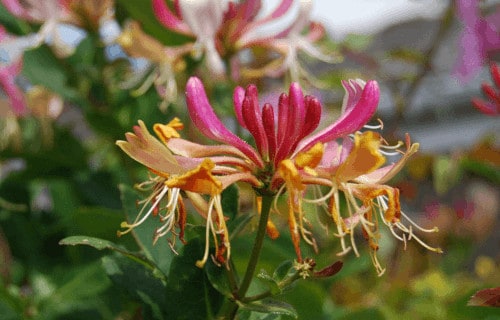
Impressively, the majority of the known types of Honeysuckle evolved as comparatively strong twining climbers in nature. On all of these many varieties, the leaves grow opposite, and develop as very simple ovals. This visually appealing foliage also averages about 4.5 in (10 cm) in length.
Although most of these marvels evolved as deciduous, some actually develop as evergreens. Many of the individual species also produce strongly sweetly-scented flowers. These blooms also produce small quantities of sweet, edible nectar. Most of the delicate flowers develop in clusters of two.
Both shrubby and vining sorts possess strongly fibrous stems which remain suitable for both binding and textiles. Like many beautiful plants, however, Honeysuckle conceals a somewhat darker secret. That’s because the fruit of the Angiosperm possesses a low level of poisonous compounds.
In appearance, these fruits vary, displaying either a spherical or somewhat elongated shape. Yet, the most commonly seen colors of the small fruit include red, blue, and black. Nonetheless, on very rare occasions, specimens produce this aspect of the plant in an even wider range of such hues.
- Kingdom: Plantae
- Phylum: Angiosperms
- Class: Eudicots
- Order: Dipsacales
- Family: Caprifoliaceae
- Genus: Lonicera
Honeysuckle Invasiveness
Amazingly, while the fruit of many varieties of Honeysuckle evolved to be comparatively toxic, this trait does have its share of uses. That holds true due to the fact that, in a few cases, the fruit of the Angiosperm, while quite tiny, can be consumed and even used for types of commerce.
This part of the stunning plants also has other natural uses, though. This remains true because the berries of most forms of the natural beauty also remain extremely attractive to numerous forms of local wildlife. For example, an enormous variety of butterflies and hummingbirds adore them.
Quite unfortunately, however, several species within this remarkable Family have now become considered as invasive. This occurred when human activities introduced them outside their native range. This situation holds particularly true in both New Zealand and the United States.
Honeysuckle Popularity
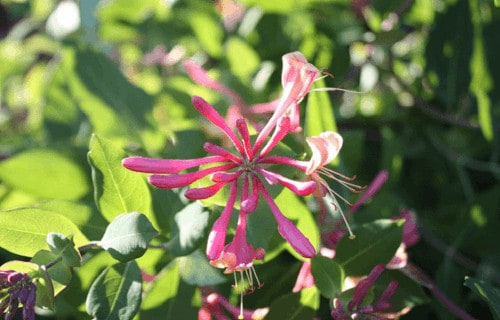
Due to its many qualities, the Honeysuckle has now become extraordinarily popular in many regions of the world. This most commonly manifests itself in using it as a garden decoration. Many people use it both because it smells beautiful, and covers unsightly walls and outbuildings.
This gorgeous and colorful flora has also become quite popular for its sheer pleasure to the different human senses of perception. In fact, a great number of people find it pleasant to use for the numerous blooms it produces in the summer. These form as quite beautiful and highly aromatic.
The hardy climbing types of this botanical wonder do have certain specific needs, of course. That’s because most forms need the roots located in shade, but the tops prefer sunlight or very light shade. The varieties one uses also need to be chosen with great care because most grow prolifically.
Lotus cornuiculatus
Public Domain Image
Lotus corniculatus Facts
- Closing out this listing of these 3 Captivating Herbaceous Plants of Lithuania comes the gorgeous work of Nature known as the Lotus corniculatus.
- This simple term currently serves as the scientific name of a stunning and extremely unusual, small flowering plant. It also goes by several common names, though. These include such unusual titles as the birdsfoot deervetch, and even the comical eggs and bacon.
- But, regardless of the name one uses for it, the gorgeous plant remains a true marvel of Nature and evolution. This actually holds true for many reasons other than just its beauty, however. Believe it or not, the stunning species actually constitutes a member of the pea family.
- You do not want to eat th plant, though, regardless of its remarkable visual appeal. That’s due to one very astonishing fact. That’s the truly startling knowledge that this botanical beauty actually contains naturally occurring trace amounts of the deadly chemical cyanide.
- In extremely small amounts, however, this beautiful and remarkable species actually does have some specific medicinal uses. To the great surprise of many people, though, the beautiful plant also often actually gets widely used as a source of forage for many types of livestock.
- Fortunately for them, the majority of animal varieties kept as livestock have a very specific advantage over human beings. That’s true since many of these creatures have the ability eat the beautiful, yet quite dangerous, Lotus Corniculatus without incurring harmful effects.
- As a rule, most animals have a much greater natural tolerance for small concentrations of cyanide than homo sapiens. Fortunately, the flora also has a comparatively wide range of natural distribution. The IUCN therefore currently has no listing for it on the Red List.
CCL: http://bit.ly/2P4R3Ic
Lotus Corniculatus Physical Description
Astonishingly, though seemingly extremely delicate, the magnificent Lotus Corniculatus surprises most individuals for multiple reasons. That’s due to the fact that this particular variety of Angiosperm conceals a great many marvels. Among those is the fact that it’s actually quite hardy.
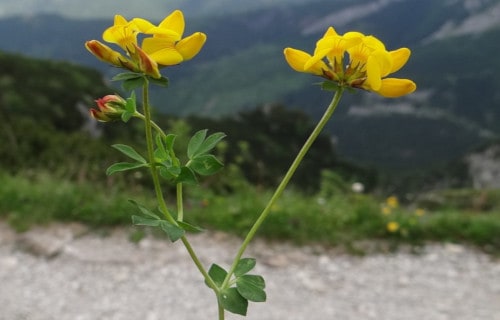
Nonetheless, sheer physical size does not rank as one of the astounding characteristics of the beautiful Angiosperm. That remains true since this beautiful herbaceous plant only achieves a maximum known height of approximately 8 in (20 cm) unless supported by other plants.
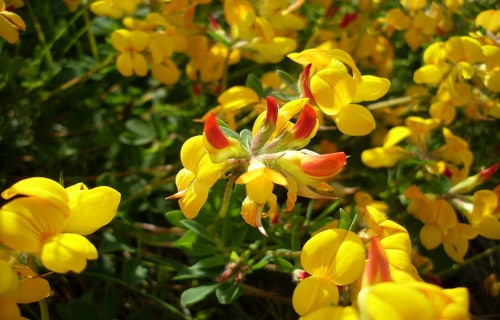
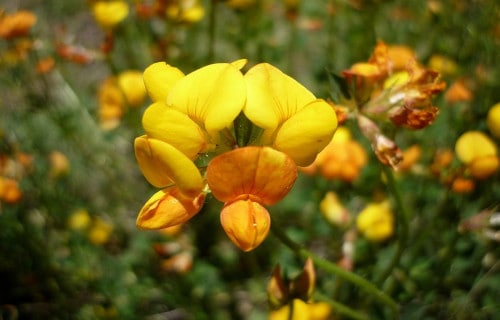
This truly stunning flora also most commonly grows in a highly sprawling manner along the ground. Yet, it very rarely does so over great distances, however. The small flowers of the gorgeous product of Nature additionally display multiple combinations of bright orange and yellow colors.
These stunning blooms also appear in clusters, typically ranging from 2-7 in number. Each flower displays the typical legume structure with a banner, wings, and keel. Each of its stunning blooms remains separately small, though. These structures average 0.4 – 0.8 in (1 – 2 cm) in length.
The leaves of the Lotus Corniculatus also merit a certain degree of interest. These develop as compound, with three main leaflets, and two more the base. In shape, they appear oblong to elliptical, usually with a blunt tip. These develop as green, sometimes with a slight bluish tint.
The leaves of the remarkable plant also most commonly grow in groups of five. Typically, three of these form a natural trefoil pattern over the other two. Not surprisingly, since it constitutes a member of the pea family, the seeds of this wonder develop in small, highly elongated pods.
- Kingdom: Plantae
- Phylum: Angiosperms
- Class: Eudicots
- Order: Fabales
- Family: Fabaceae
- Genus: Lotus
- Species: L. corniculatus
CCL: http://bit.ly/2GGxvUT
Lotus Corniculatus Distribution, Habitat, and Ecology
Surprisingly, the visually breathtaking, as well as scientifically fascinating, Lotus Corniculatus evolved as endemic to a remarkably large section of the globe. In point of fact, the intriguing plant inhabits an impressively wide swathe of the continents of Europe, Asia, and Northern Africa.
Due to its comparative hardiness, farmers often actually use this botanical beauty in cultivation, especially in certain parts of Europe. As a result of this surprising practice, this wonder of Nature has become considered an invasive species in some portions of Australia and North America.
Despite its seeming fragility, the visually captivating wonder of evolution displays an impressive degree of flexibility regarding its choice of habitat. It’s therefore found in a surprisingly broad range of ecosystems within its native range. This provides it with an evolutionary advantage.
It mainly appears in grasslands and meadows. These regions include both natural and semi-natural areas, sometimes including pastures. It also prefers well-drained soils and areas with moderate fertility. Yet, it’s also seen along roadsides, railway embankments, and other disturbed sites.
The remarkably intrepid plant’s additionally frequently spotted at the edges of woodlands, and in clearings within many forests. It generally prefers bright sun, but tolerates shade. Though less common, heathlands and moorlands also serve as another area it sometimes inhabits.
The Lotus Corniculatus achieves its pollination via the actions of a variety of locally prevalent pollinators, including bees, butterflies, and other insects. These creatures also remain crucial for the reproductive success of many plants and contribute to the biodiversity of the ecosystem.
It serves vital purposes where it appears. It provides both habitat and food for many insect species, supporting highly complex food webs. Its seeds and foliage also serve as food for birds and small mammals. Numerous grazing animals, such as rabbits and deer, also feed on the lovely plant.
3 Captivating Herbaceous Plants of Lithuania
We hope that each of you enjoyed reading, and hopefully learning something from, this article we’ve written about these 3 Captivating Herbaceous Plants of Lithuania. It’s also our fervent hope that doing so has left you with either a new or greatly renewed appreciation for such wonders of Nature.
Unfortunately, however, many of their kindred located around the world now find themselves facing very strong threats to their continued existence as a species. Many of those dangers, in fact, stem from the actions of mankind. We must do all we can to protect and preserve every one of them.
Check out our other articles on 5 Fantastic Fauna of Tunisia, Africa’s Many Geological Masterpieces, 5 Stunning Pacific Ocean Sharks, 4 Remarkable Louisiana Reptiles, The Mighty Tornado