


CCL: https://bit.ly/3KnmlVw
We sincerely hope that each of you, our readers, will greatly enjoy and appreciate this article we present about these 3 Remarkable Reptiles of Texas. It was certainly our true pleasure to compile the various information for you. May it provide you with both education and increased awareness.
While amazing, these few species listed herein represent only a portion of the natural wonders found throughout the region, though. Yet, it’s our belief that they serve as fully excellent representations of the wonders found here. Check out some of our other articles for similar marvels.
American Alligator
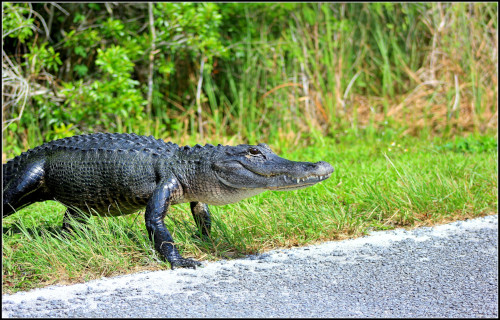
CCL: https://tinyurl.com/ysjddhbz
American Alligator Facts
- Heading up this article about these 3 Remarkable Reptiles of Texas we present the powerful creature known as the American Alligator.
- This remarkable product of evolution remains best known by the informative and descriptive common name of the American Alligator. Yet, it has a few other general titles, too. These include such simple terms as common alligator, and gator.
- Within the scientific community, however, it’s perhaps better known by its technical designation. As so often holds true, though, that’s something of a tongue-twister for the layperson. That’s because it holds the official epithet Alligator mississippiensis.
- The impressive creature received that moniker due to the efforts of François Marie Daudin. The noted French zoologist accomplished the first recognition of it as a separate and distinct species. He managed that scientifically noteworthy deed in 1802.
- This amazing reptile represents one of only two surviving members of its genus. It’s also the larger of the two. In the distant past, however, the world held several other species within this genus. One, extinct millions of years ago, reach 39 ft (11.9 m)!
- Considered endangered as recently as the 1960’s, the population of the awesome American Alligator recovered due to conservation efforts. Due to the result of those concerted efforts, the IUCN currently lists the animal as Least Concern on its Red List.
- The marvel of Nature nevertheless still faces multiple potential threats to its continued existence as a species. Like all forms of life on the earth today, most of those stem from the actions of man. They include the related perils of habitat loss and climate change.
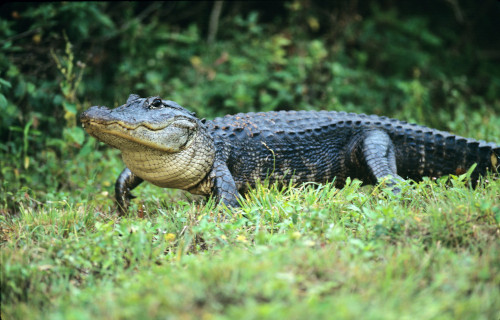
Public Domain Image
American Alligator Physical Description
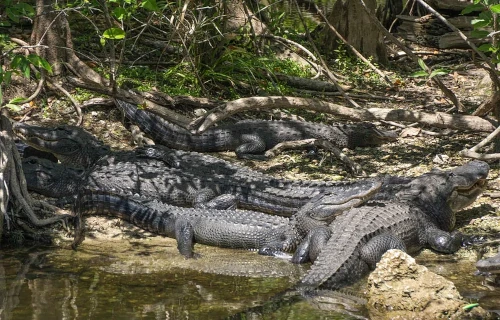
The breathtaking American Alligator certainly captures the attention of those who encounter it. This holds true both in reality and in culture. Unlike some creatures, though, this incredible creation of Nature merits appreciation both for its beauty and its physical size.
In terms of its physical nature, the intriguing Crocodilian follows a pattern of development similar to most others. That’s in the simple fact that it displays a certain amount of the physiological trait known as sexual dimorphism. In its case, this manifests in dimensions.
More precisely, males attain greater average measurements than their female counterparts. This trend extends to both length and weight. Although this gender-based difference presents as less extreme than in many of its relatives, it’s nonetheless still quite notable.
Males attain an average total length equaling about 11.2 ft (3.4 m). Weights for these same individuals measures a mean of 790 lb (360 kg). Exceptional examples exceed both these significantly, though. Some grow to as much as 15.1 ft (4.6 m) and 1,100 lb (500 kg).
Females, meanwhile, reach smaller dimensions in both respects. For this sex, mature individuals manage an average total length of roughly 8.5 ft (2.6 m). Their mass also remains less, typically averaging about 201 lb (91 kg). They’re clearly much slimmer than males.
Otherwise, however, the genders of the American Alligator present the same outward appearance to the observer. The upperside of the body generally displays a range of colors that include brown, gray, black, or olive. The underside, though, usually shows a cream color.
Like its many kindred around the world, its body has a covering of thick, sturdy scales. It’s also well known for its elongated snout. This contains 74 – 80 short yet powerful teeth. It also has relatively short legs. Its front legs develop five toes, but the rear one’s only have four.
- Kingdom: Animalia
- Phylum: Chordata
- Class: Reptilia
- Order: Crocodylia
- Family: Alligatoridae
- Genus: Alligator
- Species: A. mississippiensis
American Alligator Distribution, Habitat, and Ecology
The astounding American Alligator evolved as native to a relatively small expanse of the surface of the earth. Its own name provides information as to where that zone of habitation lies, though. As indicated, the animal is endemic to a small portion of North America.
Within the confines of that continent, however, it only appears naturally in a specific territorial range of the United States. There, it appears in the southeastern region. Its range extends from as far north as North Carolina to as far south as Texas and Oklahoma.
The impressive reptile displays a moderate degree of flexibility regarding its choice of habitat type. Due to this adaptability, it’s seen in a variety of localities and ecosystems. Yet, the wonder of Nature principally resides in streams, rivers, swamps, lakes, and ponds.
The greatest concentration of the animal occurs in Louisiana, followed by the Everglades, in Florida. Although they prefer freshwater, it’s sometimes spotted in brackish water. Amazingly, it’s also shown a willingness to live in the water hazards of golf courses!
As with all related creatures, the American Alligator evolved as a carnivore. It hunts both actively and as an ambush predator. It also feeds opportunistically and indiscriminately. Its diet ranges from small invertebrates to fish, birds frogs, and small mammals.
Breeding takes place in early spring, after which the female lays 20 – 50 eggs in a nest she constructed near the water. Incubation takes about 65 days, during which time the mother remains close by. After hatching, she carries them to the water in her jaws.
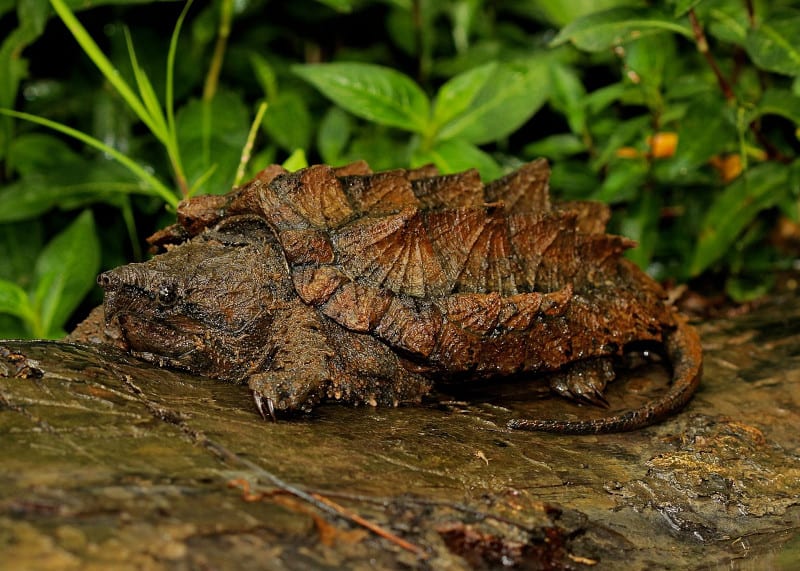
Alligator Snapping Turtle
CCL: https://bit.ly/3KnmlVw
Alligator Snapping Turtle Facts
- Our next choice for inclusion in this compilation of 3 Remarkable Reptiles of Texas bears the distinctive title of Alligator Snapping Turtle.
- This visually astonishing product of natural evolution most frequently goes by the descriptive and informative common name across its native range. For the moment, the amazing creature has no other widely accepted general name. But then, this one says it all.
- Among herpetologists, though, it’s typically referred to by its purely technical moniker. That term, like so many others, however, is quite difficult for the layperson to pronounce. That’s because this wonder of Nature bears the technical title of Macrochelys temminckii.
- The animal received this title due to the efforts of the respected Dutch-American naturalist, Gerardus Troost. He accomplished the first formal recognition of it as a separate and distinct species. He accomplished this scientifically noteworthy action in the year 1835.
- Regardless of which name one chooses to use to refer to the animal, it’s an extraordinary creature. It represents the largest known variety of freshwater turtle on the continent it appears on. Though not a close relative, it’s often associated with the common snapping turtle.
- Sadly, the population of this marvel continues to decline. This unfortunate situation also seem to hold true throughout the entirey of its native range. Due to this trend, the IUCN presently lists the remarkable reptile as Vulnerable on its published Red List of Threatened Species.
- The fabulous Alligator Snapping Turtle faces multiple threats to its existence. It’s hunted for its flesh, and also remains very popular in the exotic pet trade. Habitat loss due to human expansion, also endangers it. It also now finds itself facing the danger of climate change.
Alligator Snapping Turtle Physical Description
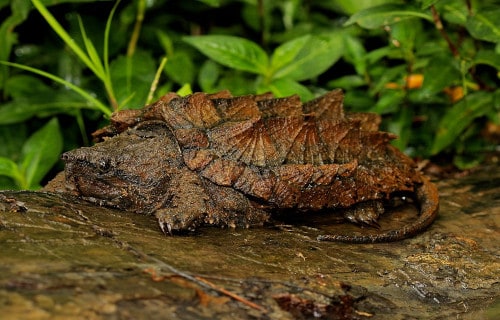
The amazing Alligator Snapping Turtle immediately captures the attention of those individuals who encounter it. Not surprisingly, though, the reptile does so for several reasons. Its pure appearance obviously startles most people. Yet it also impresses one with its sheer physical dimensions.
Like many of earth’s fauna, it also displays a certain degree of the physiological trait of sexual dimorphism. In its case, however, this characteristic manifests itself in terms of length and mass. It also does so to a relatively great degree. Males usually attain much greater measurements.
Fully mature adults of this species average a carapace length ranging from 13. 8 – 31.8 in (35 – 80.8 cm). Males tend to be on the slightly higher end of that range, while females typically hold down the lower end. Exceptional individuals of both genders do naturally sometimes occur, of course.
Average weights also vary widely, in keeping with this pattern. Females average closer to 35 – 50 lb (16 – 23 kg). Their male counterparts, meanwhile, average 176 lb (80 kg). An unconfirmed male specimen, though, reportedly achieved an astounding weight totaling 403 lb (183 kg)!
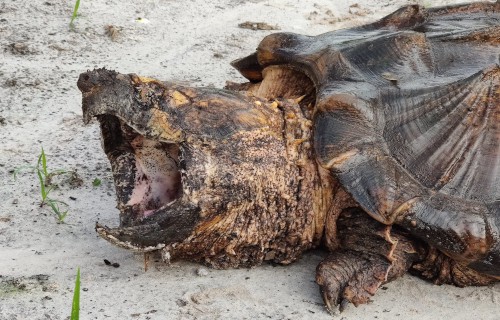
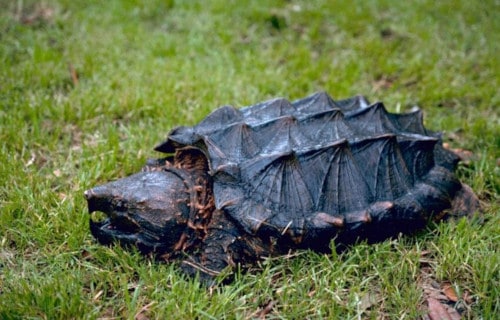
The heaviest confirmed example, a male, actually weighed a remarkable 249 lb (113 kg). Except for the size difference, the two sexes appear nearly indistiguishable. They’re known for the three ridges of large scales on the thick shells. This shows a mix of gray, brown, black, or olive green.
Yet the astonishing Alligator Snapping Turtle evolved even more intriguing physical adaptations. The extremely large, heavy head possesses a sharp, powerful beak. Even the inside of the mouth is camouflaged. Used to lure fish, a worm-like appendage appears on the tip of the tongue.
- Kingdom: Animalia
- Phylum: Chordata
- Class: Reptilia
- Order: Testudines
- Family: Chelydridae
- Genus: Macrochelys
- Species: M. temminckii
Alligator Snapping Turtle Distribution, Habitat, and Ecology
The attention-grabbing Alligator Snapping Turtle evolved as native to a moderately limited region of the world. The precise location of that swathe of the globe, however, might surprise some people. That’s because the natural wonder developed as endemic to a portion of North America.
There, its zone of habitation falls within the confines of the United States. Even there, though, the turtle only appears natively in the southeastern regions of the country. That territorial range extends from Florida west to Texas. From Louisiana that extends north as far as the state of Indiana.
The vast majority of specimens, live in the more southern parts of that range, though. Yet, in all areas it lives in, the animal displays extreme preferences in its choice of habitat. The reptile is typically only found inhabiting bodies of water that eventually flow into the Gulf of Mexico.
This category does include several types of smaller ecosystems, however. These includes areas of creeks, lakes, marshes, canals, and slow-moving rivers. The impressive creature also prefers the presence of features such as beaver dens, submerged dead trees, shrubs, and low-hanging trees.
Not surprisingly, the awesome Alligator Snapping Turtle evolved entirely as a carnivore. It’s also a highly opportunistic feeder. It both actively hunts for its various prey, and scavenges dead organisms. As a general principle, this powerful creature consumes virtually anything it can catch.
The principal components of its diet consist of fish, amphibians, mollusks, and carrion. But it’s also known to regularly consume snails, snakes, worms, insects, and crawfish. It even consumes the occasional plant. Larger individuals even eat such prey as birds, squirrels, and opossums!
Texas Alligator Lizard
CCL: https://tinyurl.com/2dcehfvs
Texas Alligator Lizard Facts
- Closing out this listing of these 3 Remarkable Reptiles of Texas comes the aptly-named wonder called the Texas Alligator Lizard.
- This intriguing product of reptilian evolution most frequently goes by the attention-grabbing common name for the obvious reason. For the moment, this distinctive and remarkable animal has no other broadly accepted general title within its range, despite its popularity.
- Within the scientific world, however, the animal’s perhaps much better known by its technical appellation. Unfortunately, like many such terms, that’s a difficult one for the layperson to pronounce. That’s because the marvel holds the official tag Gerrhonotus infernalis.
- The amazing creature received that moniker due to the efforts of Spencer Fullerton Baird. The respected American herpetologist accomplished the first recognition of it as a separate and distinct species. He achieved that scientifically noteworthy deed in the year 1859.
- This marvelous work of Nature and evolution stands out from its numerous relatives in at least one respect. That’s true since it ranks as one of the largest of all known reptiles collectively called alligator lizards. It’s also the largest lizard in the region of the world it lives in.
- Thankfully, the Texas Alligator Lizard appears to be maintaining a thriving and abundant population base. That pleasant trend also seems to extend throughout its entire range. The IUCN thus presently lists it as Least Concern on its Red List of Threatened Species.
- The impressive creature nevertheless should be considered as facing several potential threats to its continued existence as a species, at least. That’s a lamentable state it shares with all life on earth, though. These include the perils of habitat loss and ongoing climate change.
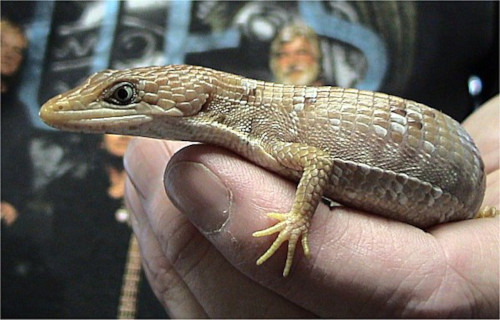
CCL:https://tinyurl.com/ycy72sz6
Texas Alligator Lizard Physical Description
The fascinating Texas Alligator Lizard generally appeals to most of those fortunate enough to encounter it. The animal typically does so, however, due more to its appearance than pure size. That’s true since, though large for its specific kind, it remains only an average-sized lizard.
It follows a pattern of evolution common to most animals on earth, including lizards. That’s in the fact that it shows a certain degree of the physiological characteristic of sexual dimorphism. In the case of this particular species, though, that trait natural manifests in terms of sheer size.
More specifically, the males attain greater overall body measurements than the female of the species. However, that difference remains extremely slight. Distinguishing the genders of individuals based purely on their outward appearance can therefore be difficult for untrained observers.
Taken collectively, mature specimens of this reptile achieve a mean body length roughly ranging from 16 – 18 in (41 – 46 cm). The thin, elongated tail, though, adds an additional average of 8 – 9 in (20 – 23 cm). The tail thus gives it a total mean length of about 24 – 25 in (61 – 64 cm).
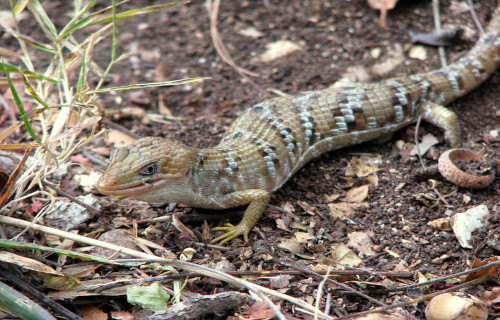
In coloring, both sexes of the mesmerizing Texas Alligator Lizard display the same basic pattern. This primarily consists of a background of yellowish-brown. Yet, the upper back often shows a darker brown, with an off-white checkered pattern present. The stomach appears gray or white.
One other feature, however, also catches the eye, and serves to earn it part of its common name. That’s the presence of stiff, plate-like scales covering much of the body. The legs, meanwhile, develop as relatively short, and its tail can be lost, but regrow over a short span of time.
- Kingdom: Animalia
- Phylum: Chordata
- Class: Reptilia
- Order: Squamata
- Family: Anguidae
- Genus: Gerrhonotus
- Species: G. infernalis
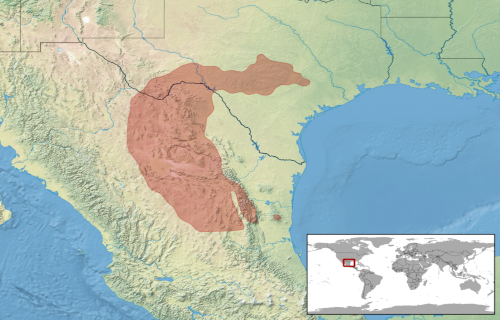
CCL: https://tinyurl.com/33psz7af
Texas Alligator Lizard Distribution, Habitat, and Ecology
The impressive Texas Alligator Lizard apparently evolved as native to only a small swathe of the earth’s surface. But, the exact location of this zone of habitation probably won’t come as a surprise to anyone. That’s true since, as the name itself implies, it’s mainly present in the state of Texas.
This remarkable member of the United States, appears in the approximate south-central portion of the country. Within that area, though, this unique animal only lives in the central and southern sections. It also lives in small portions of the northern regions of the country of Mexico.
Inside of that territorial range, the extraordinary lizard displays a moderate amount of flexibility regarding its choice of habitat. It thus resides in several different types of local ecosystems. Yet, in all of the areas in which it makes its home, it generally lives in either arid or semi-arid regions.
Most frequently, the intrepid reptile lives in regions composed of rocky hillsides and slopes, likely because these provide ample cover. It does dwell in other locations, though. Some of these include such places as inside rocky canyons, and close to comparatively rocky springs or streams.
The aptly-named Texas Alligator Lizard developed as carnivorous in its nature, as well as diurnal. Generally, it consumes smaller sources of nutrition, including insects and other, similar-sized invertebrates. But, the reptile occasionally feeds on small rodents, or even nesting birds.
When not actively hunting its prey, the animal generally spends the majority of its time hiding in the shade. Breeding takes place throughout the year, with several clutches being laid. Females typically remain close to the nest until after hatching occurs, but then ignore their young thereafter.
3 Remarkable Reptiles of Texas
We hope that each of you thoroughly enjoyed reading, and hopefully learning some things from, this article we’ve written about these 3 Remarkable Reptiles of Texas. It’s also our hope that doing so has left you with either a new or renewed appreciation for such awesome wonders of Nature.
Unfortunately, however, many of their numerous kindred situated around the world now find themselves facing strong threats to their continued existence as a species. Many of those dangers, in fact, stem from the actions of mankind. We must do all we can to protect and preserve them all.
Checkout our other articles on 5 Fantastic Fauna of Tunisia, Earth’s Amazingly Abundant Avians, 5 Wonderful North American Wild Canines, Spectacular Dolphins Throughout Our World