


Public Domain Image
We hope that each of you, our readers, will greatly enjoy and appreciate this article we present to you about these 5 Arabian Sea Sharks and Rays. It was certainly our sincere pleasure to gather the information for you. May it serve to provide you with both education and increased awareness.
Certainly, this highly limited number of species listed herein represent only a portion of the similar species found in this intriguing region. It’s our belief, though, that they serve as excellent examples of the members of this Class. Check out some of our other articles for other, similar marvels.
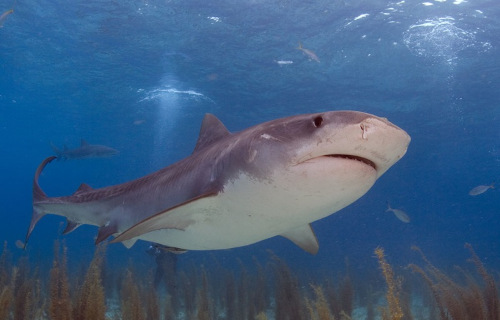
Tiger Shark
CCL: https://tinyurl.com/ysjddhbz
Tiger Shark Facts
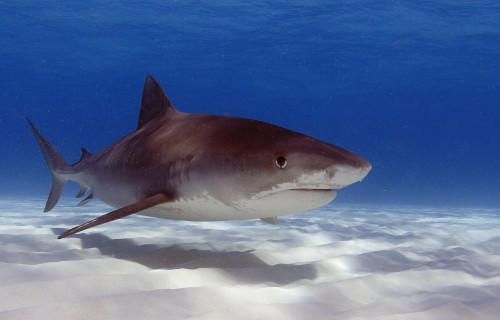
- Heading up this article about these 5 Arabian Sea Sharks and Rays we give you the impressive marvel named the Tiger Shark.
- This majestic product of Nature and evolution most frequently goes by this distinctive, attention-grabbing common name. Yet, the marvel of Nature has many other general titles, as well. These include such terms as spotted shark and leopard shark, just to name a few.
- Within the community of scientific professionals, however, it’s possibly much better known by another one. That’s its technical moniker. Unfortunately, though, that’s a somewhat difficult one for the layperson to pronounce. It holds the official tag of Galeocerdo cuvier.
- The impressive animal received that tongue-twisting epithet after to the actions of the duo of François Auguste Péron and Charles Alexandre Lesueur. The two French naturalists achieved the first recognition of the creature as a separate and distinct species in the year 1822.
- Yet, that was not the name these researchers applied to it. They named the fish Squalus cuvier. Subsequently, later actions changed its designation several times. In 1837, another team assigned it the tag Galeocerdo tigrinus. But, it eventually received its current label.
- Unfortunately, the amazing Tiger Shark presently finds itself in dire straits. Its population base appears to be dwindling rapidly. Regrettably, that state seems to hold true across its entire range. The IUCN thus presently lists the animal as Near Threatened on its Red List.
- It’s currently facing serveral threats to its continued existence as a species. Like other species, most of these dangers stem from the actions of man. It faces the perils of commercial fishing practices, for one. It’s also now facing the dangers posed by habitat loss and climate change.
CCL: https://tinyurl.com/4hvnk4jx
Tiger Shark Physical Description
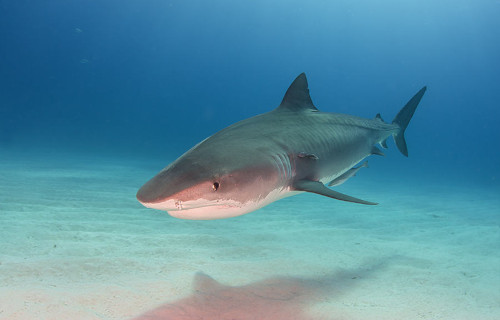
The fascinating Tiger Shark fully merits the appreciation and respect it’s shown by those who encounter this amazing fish. Unlike some relatives, however, it does so not only because of its intriguing apperance. This creature also reaches highly respectable physical dimensions.
In that regard, though, it does maintain the pattern common among its many relatives. That’s due to the fact that the shark displays a certain degree of the physiological characteristic of sexual dimorphism. Yet, in its particular case this evolutionary trait manifests itself solely in terms of size.
More specifically, females of the species attain greater average measurements than their male counterparts. Mature females reach mean lengths of approximately 12.2 ft (3.7 m). Exceptional specimens exist, however. Confirmed examples sometimes grow up to 16.4 ft (5 m).
Weights of females also average greater than males, sometimes significantly so. Exceptional specimens of this sex occasionally exceed the extraordinary mass of as much as 2,900 lb (1,315 kg). Few individuals ever reach this great of a size, though, with most known specimens being smaller.
Males of the remarkable animal, meanwhile, remain somewhat smaller, sometimes much more so. For them, a typical body length measures around 10 ft (3 m). Rarely, an individual exceeds this size, but not greatly. Reliably confirmed reports puts the longest known male at 13.1 ft (4 m).
Since their lengths remain less, it’s only natural that the weight of this gender also measures less. For them, a mean body mass ranges from between 1,200 – 1,400 lb (544 – 635 kg). Naturally, a few exceptional examples do manage to grow beyond this size, but rarely by very much.
Otherwise, the genders of the impressive Tiger Shark present the same general appearance. Above, the overall color scheme generally consists of various shades of either light green or blue. Underneath, however, various shades of a pale yellow predominate, and rarely an off-white hue.
- Kingdom: Animalia
- Phylum: Chordata
- Class: Chondrichthyes
- Order: Carcharhiniformes
- Family: Galeocerdonidae
- Genus: Galeocerdo
- Species: G. cuvier
CCL: https://tinyurl.com/2s4apsss
Tiger Shark Distribution, Habitat, and Ecology
The amazing Tiger Shark evolved as native to a comparatively broad expanse of the marine regions of the globe. The full extent of that zone habitation might surprise you, though. That’s because this wonder currently appears in nearly all of temperate and tropical waters around the world.
The exception to this pattern of habitation remains its lack of presence in the Mediterranean Sea. A few areas of the world do seem to show greater presences, however. Some of these include the Caribbean Sea, the Gulf of Mexico, and offshore of Australia, Indonesia, China, Africa, and India.
Yet, within that vast expanse of numereous seas and oceans, this true biological marvel displays a distinct preference regarding its choice of habitat. That’s true since the fish mainly, though, not exclusively appears relatively close to the coastline. It even approaches the shore after prey.
Even when it does appear somewhat near the shore, however, it generally prefers relatively deep waters. These regions also typically coincide with the presence of reef systems. Although the animal usually stays at relatively moderate levels, it’s been spotted at depths up to 3,000 ft (914 m).
The Tiger Shark feeds as one the apex predators of the oceans. It’s not a selective hunter, though, with a reputation for eating virtually anything. Though its diet principally consists of fish, it also consumes many crustaceans, sea snakes, seabirds, seals, and numerous others.
Given its significant size and power, this majestic denizen of the depths itself has very few natural predators. In fact, the only confirmed natural foe the animal faces in this respect is the Orca. Outside of such fates, it’s not known with any certainty how long the species lives.
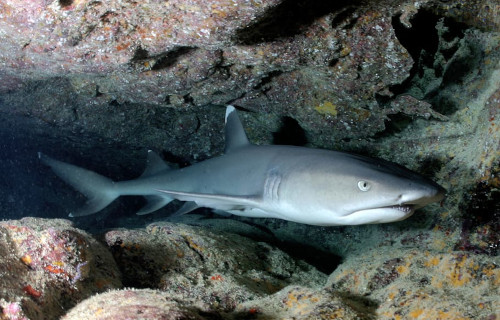
Oceanic whitetip Shark
Oceanic whitetip Shark Facts
- Appearing next in this compendium of 5 Arabian Sea Sharks and Rays comes the intriguing marine marvel known as the Oceanic whitetip Shark.
- This majestic yet dangerous predator of the depths most frequently goes by the somewhat lengthy but very descriptive common name. Yet, the animal also holds less often used titles. These include such terms as nigano shark, brown shark, and simply whitetip shark.
- Within the scientific community, however, it’s perhaps much better known by its formal moniker. But that’s an extremely hard name to pronounce for the layperson. That’s because this marvel of nature bears the complex technical title of the Carcharhinus longimanus.
- A degree of controversy persists inside the halls of science, though, concerning that specific appellation. The first known formal description of the fish occurred in 1831, due to the work of the French naturalist, René-Primevère Lesson, who gave it a somewhat similar name.
- The next description of the fish, however, took place in the year 1861, at the hands of the Cuban zoologist, Felipe Poey. He also provided it with a similar yet different moniker. Given this confusion, and still others, the name used here is generally the most accepted.
- Sadly, the population of the remarkable Oceanic whitetip shark measures quite small. It also appears to be continuing to diminish at an alarming rate. That state apparently holds true throughout its range. The IUCN thus currently lists the fish as Critically Endangered.
- It faces numerous threats to its continued existence. Most of these stem from the actions of man. These include such factors as being actively fished for its meat and fins. The creature also now faces the dual dangers posed by habitat loss and ongoing climate change.
CCL: https://rb.gy/g5f9h
Oceanic whitetip shark Physical Description
The mesmerizing Oceanic whitetip shark immediately captivates many fortunate enough to encounter the animal in its native environment. Unlike some species, though, it does so for several reasons. That’s due to the fact that it’s visually impressive due to both its appearance and size.
In that respect, the shark follows a pattern common among many of its relatives. That’s true since it displays a certain degree of the physiological characteristic known as sexual dimorphism. In its specific case, this trait manifests itself purely in terms of physical measurements.
More precisely, the female of the species attains a slightly greater overall size than her male counterparts. This gender of the intriguing fish reaches an average body length of roughly 12.8 ft (3.9 m). These individuals further grow to an average body mass equaling 374.8 lb (170 kg).
Males of the creature, however, only attain an average length of body measuring about 9.8 ft (3 m). They do tend to have a slightly stockier build than the females, though. Due to this general development, their body mass is an only slightly lighter average of about 368 lb (167 kg).
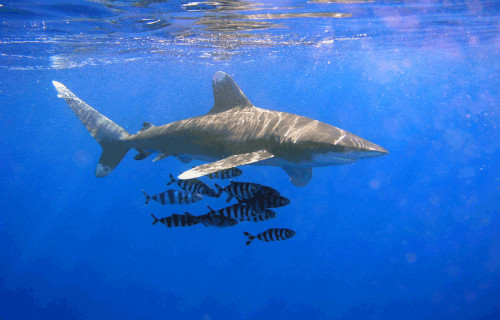
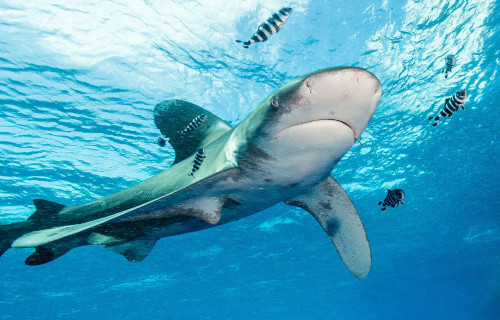
In terms of overall appearance, other than this, however, both sexes of the Oceanic whitetip shark remain virtually indistinguishable at a quick glance. The upper body of the fish typically displays a gray-bronze shade. Its lower body, though, generally manifests an off-white shade.
Yet it’s the fins of the animal that serve as the source of the common name. Most of these display a bright white tip. Each fish also presents a mottled pattern among adults, and black in younger specimens. A patch resembling a saddle somtimes appears between two dorsal fins.
- Kingdom: Animalia
- Phylum: Chordata
- Class: Chondrichthyes
- Order: Carcharhiniformes
- Family: Carcharhinidae
- Genus: Carcharhinus
- Species: C. longimanus
CCL: https://rb.gy/60nbb
Oceanic whitetip shark Distribution, Habitat, and Ecology
The fascinating Oceanic whitetip shark evolved as native to an extremely broad swathe of the globe. The full extent of that zone of habitation might surprise some people, though. That’s because this wonder of evolution lives in oceans worldwide between latitudes 45 N and 43 S.
The vast majority of this range of appearance consists of relatively to extremely deep waters. The creature also displays decided preferences for the temperature of the waters it lives in, as well. It also seems to favor temperatures above 68F (20C), and up to approximately 82F (28C).
Yet it also shows some moderate flexibility in this regard. That’s true since a certain percentage of observed specimens appeared in waters with a temperature equaling about 59F (15C). The animal does, however, seem to studiously attempt to avoid temperatures lower than this.
Despite mainly living in regions of great depths, though, it spends most of its time in the upper layers of the ocean. Most sightings occur at depths of no greater than 490 ft (150 m). Though most individuals remain offshore, some do venture into areas as shallow as 120 ft (37 m).
The beautiful Oceanic whitetip shark typically lives a primarily solitary life, like many. Small, temporary groups do sometimes form, however, for hunting and feeding purposes. The animal also evolved as an active hunter, swimming and seeking out prey by both day and night equally.
As a general principle, the fish usually feeds on an impressive variety of cephalopods, like small squid, and bony fish, such as oarfish and barracuda. Yet it sometimes varies this, adopting a more flexible diet. At these times, it eats such prey as stingrays, birds, crustaceans, and sea turtles.
Spotted Eagle Ray
Public Domain Image
Spotted Eagle Ray Facts
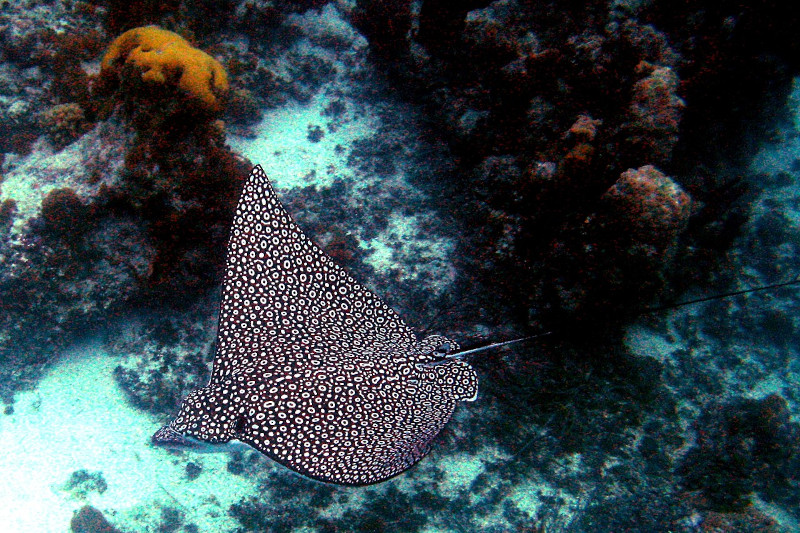
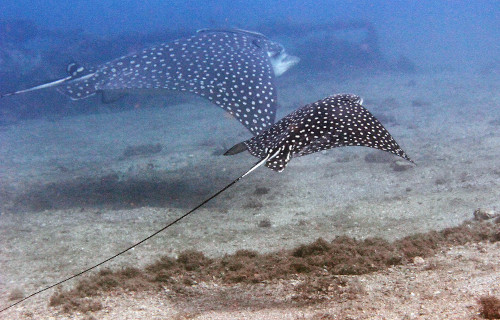
- The third entry into this listing of these 5 Arabian Sea Sharks and Rays is the eye-catching beauty appropriately named the Spotted Eagle Ray.
- This visually stunning product of evolution understandably remains best known by the descriptive common name that we’re using herein. Yet, the fish also has a host of other general titles. These include leopard ray, duckbill ray, and bat eagle ray, among others.
- Inside of the scientific world, however, it’s perhaps more frequently referred to by its technical moniker. That, though, like many such terms, is somewhat hard for the layperson to pronounce. That’s because the fish holds the official tag of Aetobatus narinari.
- The marvel of Nature received that epithet due to the efforts of Bengt Anders Euphrasén. Though actually a Swedish botanist, he nevertheless recorded the first recognition of it as a separate and distinct species. He achieved that scientifically notable feat in 1790.
- At that time, though, he assigned it a very different appellation altogether. That was the designation Raja narinari. Since then, the natural marvel’s actually been renamed several times. This frequently happens, typically due to improved methods of scientific research.
- Unfortunately, the remarkable Spotted Eagle Ray currently finds itself in a somewhat precarious situation. It currently has a reduced population base across the entirety of its native range. The IUCN thus presently lists the animal as Near Threatened on its Red List.
- It now faces multiple threats to its continued existence as a species. Like all forms of life on earth today, most of these stem from the actions of man. In its case, though, this includes being actively hunted, as well the shared dangers of habitat loss and climate change.
CCL: https://tinyurl.com/2s4apsss
Spotted Eagle Ray Physical Description
The gorgeous Spotted Eagle Ray almost immediately grabs the attention of those individuals fortunate enough to encounter one in the wild. It also does so for multiple reasons. That’s true since it’s not just lovely to behold, it also boasts some highly respectable measurements.
In this regard, however, it follows a pattern common to many creatures, including most of its relatives. That’s in the fact that it displays a certain degree of the physiological characteristic of sexual dimorphism. In this case, the females grown larger than their male counterparts.
The gender-based difference, though, typically remains quite minor. Taken collectively, the species grows relatively large, occasionally reaching impressive body lengths of up to 16 ft (5 m). Larger specimens also have wingspans reaching 10 ft (3 m), and a mas of up to 507 lb (230 kg).
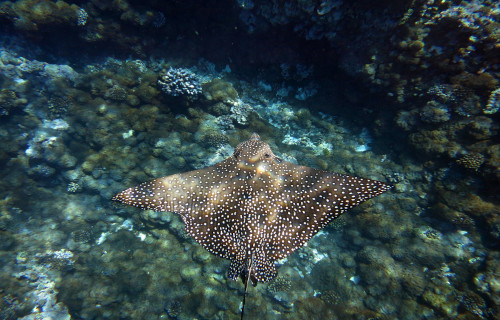
In terms of general shape, however, this wonder of the seas evolved a pattern typical of its kind. That consists of a flattened body, with a strongly disc-shaped structure. However, its pectoral fins developed as notably more elongated than most, giving them a wing-like appearance.
The head of also develops as roughly rounded and features a protruding snout. The animal additionally has small eyes and nostrils. Like its numerous cousins, Nature and evolution also placed its mouth on the underside of its body and equipped it with multiple plate-like teeth.
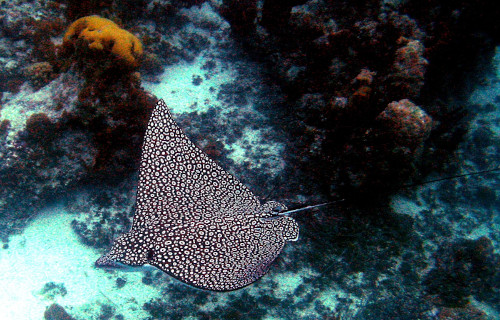
It’s the coloring of the amazing Spotted Eagle Ray that typically garners the most interest, though. It also clearly serves as the source of the common name. The upper surface typically shows blue to black, with white spots. But, its underside usually displays a surprisingly plain off-white.
The animal’s tail, meanwhile, grows long and whip-like, often measuring about twice the length of the body. This appendage usually lacks a stinger, unlike some other ray species. Yet, the creature does have one or more venomous spines located near the base of that long, whip-like tail.
- Kingdom: Animalia
- Phylum: Chordata
- Class: Chondrichthyes
- Order: Myliobatiformes
- Family: Aetobatidae
- Genus: Aetobatus
- Species: A. narinari
Spotted Eagle Ray Distribution, Habitat, and Ecology
The incredible Spotted Eagle Ray has a habitat range that closely mirrors itself. That’s because this amazing fish apparently evolved as native to an extraordinarily large swathe of the marine regions of the globe. In fact, it’s found in temperate and tropical waters across the entire world.
In the Atlantic Ocean, this particularly includes in the western section, along the coasts of the Americas from the eastern United States, in North America, down to Brazil, in South America. From there, though, the anaimal also extends that broad range throughout the Caribbean Sea.
It also inhabits both the Indian and Pacific Oceans, ranging from the eastern coast of Africa, including the Red Sea and the Indian Ocean, to the western Pacific Ocean. This extremely extensive range includes the waters around Southeast Asia, Australia, and the islands of the Pacific.
Thankfully, Nature blessed this marvel with a high degree of adaptability regarding its choice of habitat. It’s therefore found in a wide range of locations and ecosystems alike. All, however, do share the specific trait of being in coastal areas, at depths on no more than 262 ft (80 m).
It’s most frequently spotted swimming over either coral or rocky reefs. Here, the ray finds both shelter and food sources. Yet, it’s also often seen in regions made of seagrass beds or sandy, muddy bottom regions. It’s also proven itself quite fond of estuaries and mangrove swamps.
Like others of its kind, the Spotted Eagle Ray evolved as carnivorous in nature. It actively hunts its prey, which typically consists of smaller animals. That includes a remarkably wide array of species, such as mollusks, crustaceans, bivalves, small fish, and occasionally even octopuses.
Due to its size, the adults have very few natural predators of their own, though the young sometimes face their share of dangers. Among the few species that prey upon mature specimens would be larger sharks. Otherwise, though, they have little to fear from any but man in this regard.
The fascinating creature also developed as ovoviviparous, meaning that embryos develop inside eggs situated within the female’s body until they become ready to hatch. Female rays typically give birth to one to four pups after a gestation period that usually lasts around one year.
Zebra Shark
CCL: https://bit.ly/3iV7BiN
Zebra Shark Facts
- Our next choice inclusion in this compilation of 5 Arabian Sea Sharks and Rays bears the wholly fitting common name of the Zebra Shark.
- In a strange turn of events, this fascinating ocean fish most frequently goes by the unusual, as well as deceptive, common name due to its appearance. Unusually , for the moment, the remarkable sea-dwelling species has no other generally accepted common name.
- Professionals, such as researchers, meanwhile, typically refer to the creature by its scientific name. That term, however, as with many such instances, remains somewhat hard to pronounce. That’s because the fish formal scientific name’s Stegostoma tigrinum.
- The first known official recording of it as a separate and distinct species took place in 1758, due to the efforts of the Dutch zoologist, Albertus Seba. He received the well-deserved accreditation posthumously, however, since the man himself died several years earlier.
- Unfortunately, the population of this amazing creature appears to be declining. Moreover, this regrettable trend seems to hold true throughout the entirety of its known range. The IUCN, therefore, presently lists it as Endangered on its Red List of Threatened Species.
- Presently, the leading culprit for its decline in population continues to be commercial fishing practices. This holds true because the natural wonder continues to be actively sought after across most of its range. It’s principally sought for its meat, liver oil, and fins.
- The impressive Zebra Shark nevertheless faces other threats to its existnce, however. Habitat loss poses an increasing threat, as man intrudes into its domain, of course. The greatest potential threat it faces, though, likely comes in the form of ongoing climate change.
CCL: https://bit.ly/2YLD53V
Zebra Shark Physical Description
The Zebra Shark certainly impresses its fair share of those who encounter the creature in its native habitat. It does not do so, however, due to sheer size. That’s because, in that particular respect, this stunning marvel of Nature represents only a roughly average-sized species of its kind.
It does differ from many of its brethren in that regard, however, This holds true due to the fact that this specific species does not display any noticeable degree of the physiological characteristic of sexual dimorphism. This tendency makes distinguishing the two genders quite difficult.
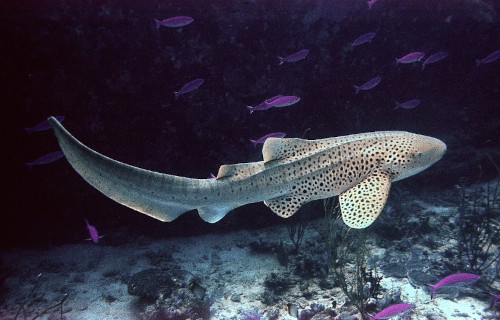
The two sexes therefore present virtually identical sizes and patterns of coloration to the observer. An average body length for a fully mature adult of either sex reaches roughly 8.2 ft (2.5 m). Exceptional specimens, however, do occasionally attain lengths of as much as 11 ft (3.5 m).
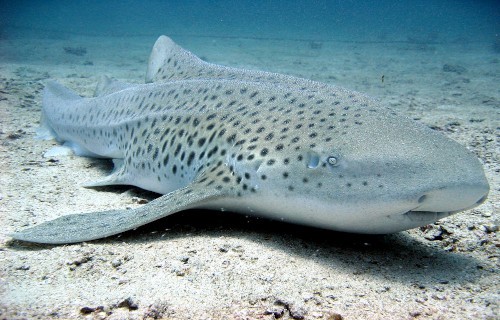
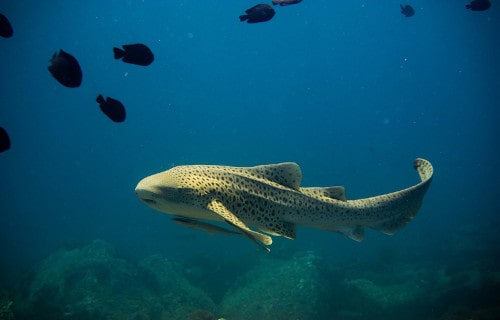
In general, the body of this amazing animal manifests a strongly cylindrical shape. The head usually develops as slightly flattened, and possessed of a blunt, short snout. Its eyes also develop as quite small, and appear on the sides of the head. The species further manifests 5 gill slits.
The somewhat confusing name of the Zebra Shark derives from the appearance of the immature individuals. These examples manifest a distinctly different pattern of coloring that the adults. As the common name clearly implies, the immature shark presents stripes, like a zebra.
The adults of the species, meanwhile, develop a distinctly different pattern as they age. Most mature individuals present a light background, typically various shades of tan. This, though, also has a covering of numerous small spots. These markings appear a dark brown to black in color.
- Kingdom: Animalia
- Phylum: Chordata
- Class: Chondrichthyes
- Order: Orectolobiformes
- Family: Stegostomatidae
- Genus: Stegostoma
- Species: S. tigrinum
CCL: https://bit.ly/3mHT1wc
Zebra Shark Distribution, Habitat, and Ecology
Fortunately, the stunning Zebra Shark appears to be endemic to a relatively wide swathe of the oceans of the world. This further seems to hold true in comparison with many, though, certainly, not all known species of sharks. Yet known range of the fish remains respectable.
More precisely, however, it seems to inhabit specific portions of the Indo-Pacific region. Within that greater range, though, the marvel only makes its home in the tropical waters of the area. That range extends from South Africa, through the Red Sea, to India, and all the way to Australia.
In all the regions of its range that the shark appears in, however, the animal displays decidedly clear preferences for its choice of habitat. In this, it possesses two very specific requirements. The creature only lives within the intertidal zone, and lives as a bottom-dwelling species.
Within that habitation zone, though, the great majority of individuals live their lives in various locations. Specimens appear at maximum recorded depths measuring no more than 203 ft (62 m). Most individuals, in fact, prefer shallower depths. These often swim along the continental shelf.
The Zebra Shark evolved as primarily nocturnal in nature. Most individuals remains comparatively sluggish by day, typically moving very little. These individuals most often appear on the ocean floor, frequently facing into the current. This facilitates their breathing while minimizing movement.
By night, however, the impressive animal transforms into an active, powerful swimmer and hunter. It mainly feeds on small fish, various crustaceans, and possibly sea snakes. Typically a solitary creature, it nevertheless occasionally bands together in large groups for unknown reasons.
Scalloped Hammerhead
CCL: https://bit.ly/40obctb
Scalloped Hammerhead Facts
- Closing out this article about these 5 Arabian Sea Sharks and Rays we present the mot visually distinct of them all, the Scalloped Hammerhead.
- The undeniably attention-grabbing name we’re applying to it serves as the most frequently used common name for this fish. It’s also known by several others, though. Those include terms such as the kinky-headed shark, bronze, and southern hammerhead.
- Within scientific circles, though, the creature’s better known by its formal moniker. Fortunately for the layperson, though, that’s a much simpler term than many of its relatives hold. That’s because it bears the official name in the annals of science of Sphyrna lewini.
- It received that technical name due to the efforts of the team of Edward Griffith and Charles Hamilton Smith. The highly respected pair of British naturalists accomplished the first formal acknowledgement of it as a separate and distinct species. This occurred in 1834.
- The two individuals originally gave it another, different title, however. Before changing it to the term it’s known by now, the pair at first titled it Zygaena lewini. Regardless of which name one chooses to use when referring to it, the shark remains a truly impressive fish species.
- Sadly, however, the population of the remarkable Scalloped Hammerhead presently appears to be in stark decline. This unfortunate trend also seems to hold true throughout the entirety of its known range. The IUCN therefore currently lists it as Critically Endangered.
- The fish faces many threats to its continued existence. Previously, this mostly consisted of overfishing, as it was hunted in some regions. Due to its fragile population numbers now, though, it likely faces its greatest danger going forward from climate change.
CCL: https://bit.ly/3G0Di5C
Scalloped Hammerhead Physical Description
The remarkable Scalloped Hammerhead fascinates most of those fortunate enough to encounter it. Unlike some of its kindred, though, it does so for more than one reason. In this intriguing species, Nature created a true masterpiece that continues to tantalize many researchers even today.
The intriguing species grows to highly respectable physical measurements. It also follows the pattern common among most of its relatives, though, regarding that statistic. That’s true since the animal displays a moderately large degree of the physiological characteristic of sexual dimorphism.
Although the genders present the same general appearance, the size varies significantly between them. More precisely, females of the species typically attain a much greater size than their male counterparts. That’s a trend common among most known species of shark around the world.
The females attain an average body length measuring roughly 8.2 ft (2.5 m). They’re surprisingly light, however. Most of this sex average 80 lb (36.2 kg) in weight. Exceptional individuals do occur, of course. But even these rarely exceed these measurements by any significant degree.
Males of the Scalloped Hammerhead, however, usually remain much smaller in both categories. Body length averages 4.9 – 5.9 ft (1.5 – 1.8 m). They’re body mass ranks appropriately smaller as well. This equals 64 lb (29 kg). The largest specimen on record measured 14 ft (4.3 m) in length.
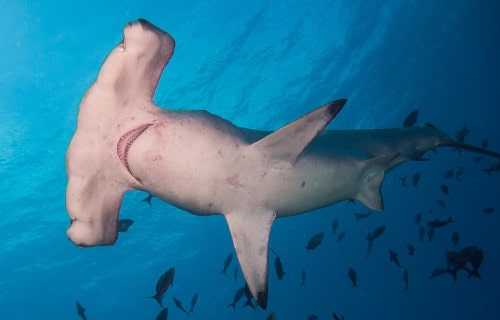
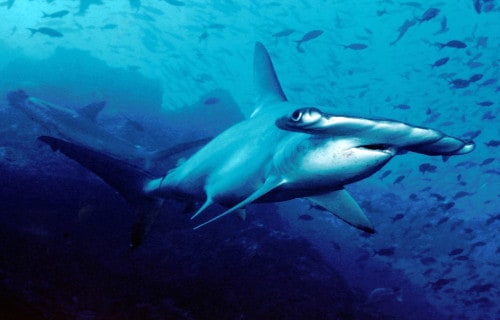
In overall appearance, though, the two sexes remain virtually indistinguishable. The coloring of the remarkable creature generally consists of varying shades of light gray. Its’ most distinctive feature, though, is obvious. That’s the large hammer-shaped head, thus the common name.
- Kingdom: Animalia
- Phylum: Chordata
- Class: Chondrichthyes
- Order: Carcharhiniformes
- Family: Sphyrnidae
- Genus: Sphyrna
- Species: S. lewini
CCL: https://bit.ly/40obctb
Scalloped Hammerhead Distribution, Habitat, and Ecology
The remarkable Scalloped Hammerhead evolved as native to a relatively broad swathe of the marine areas of the globe. The general area, however, likely won’t surprise many people. That’s becasue it evolved as endemic to the section of the oceans that ranges from roughly 46°N to 36°S.
Within that widespread zone of habitation, though, certain areas see greater numbers. These principle regions include the waters off South Africa and Japan. Other zones of concentration include the Indian Ocean, Red Sea, and the warm waters of Hawaii, Tahiti, and Australia.
Inside of that range, however, the impressive animal displays decided and highly specific preferences regarding its choice of habitat. In all areas the shark inhabits, it primarily lives near the coast. It’s most frequently sighted either over or comparatively near the continental shelves.
The marvel of Nature also appears only in either warmer temperate or tropical waters. It’s not a deep-diving species, by any means. A maximum observed depth for the species only equals 3,400 ft (1.03 km). Most often, however, individuals spend their time above depths of 82 ft (25 m).
The Scalloped Hammerhead typically lives in relatively large groups, called schools. Unlike many other related creatures, though, it remains active at all times of the day and night. Compared to some of its many relatives, they’re considered relatively docile in their behavior patterns.
Like all sharks, the wonder evolved as a fully carnivorous species. It principally feeds on prey such as various small fish, octopi, and squid. It’s also an opportunistic hunter, feeding on whatever prey’s locally available. In turn, its own predators mainly consist of larger varieties of sharks.
CCL: https://tinyurl.com/2s4apsss
5 Amazing Arabian Sea Sharks and Rays
It’s our fervent hope that each of you enjoyed reading, and hopefully learning from, this article we’ve written for you about these 5 Arabian Sea Sharks and Rays. It’s also our hope that doing so has left you with either a new or fully renewed appreciation for such wonders of Nature.
Unfortunately, however, many of their numerous kindred around the world now find themselves facing strong threats to their continued existence as a species. Many of those dangers, in fact, stem from the actions of mankind. We must do all that we can to protect and preserve them all.
Check out our other articles on 4 Remarkable Louisiana Reptiles, Africa’s Many Geological Masterpieces, 6 Stunning North American Bees, Spectacular Dolphins Throughout Our World