


CCL: https://tinyurl.com/22y23f9m
We sincerely hope that each of you, our readers, will greatly enjoy and appreciate this article we present about these 5 Astounding Avians of Antarctica. It was certainly our true pleasure to compile the various information for you. May it provide you with both education and increased awareness.
While amazing, these few species listed herein represent only a portion of the natural wonders found throughout the amazing region. Yet, it’s our belief that they serve as fully excellent representations of the wonders found here. Check out some of our other articles for similar marvels.
Gentoo Penguin
CCL: https://bit.ly/1jxQJMa
Gentoo Penguin Facts
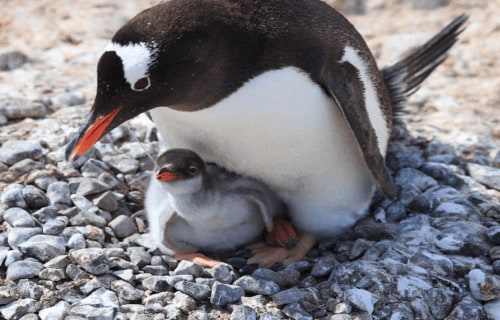
- Starting off this article about these 5 Astounding Avians of Antarctica we present the small but beautiful creature known as the Gentoo Penguin.
- This gorgeous product of Nature and evolution most often goes by the simple yet descriptive common name that we’ve ysed here. It does have a few other general titles, though. These include the equally easy terms of the Johnny Penguin, or sometimes even just the Johnny.
- Within most scientific circles, however, it’s perhaps much more typically known by its official name. Thankfully, that’s a relatively easy term for the layperson to pronounce. That’s because this marvel of biology currently bears the technical moniker of the Pygoscelis papua.
- The animal received that name due to the efforts of the German naturalist, Johann Reinhold Forster. The noted ornithologist accomplished the first formal recognition of the bird as a separate and distinct species. This scientifically noteworthy deed occurred in 1781.
- Regardless of which of these different monikers one chooses to employ when discussing it, the animal remains an impressive species. It ranks as the third-largest of all known penguin varieties. Four acknowledged subspecies of this natural marvel also currently exist.
- Thankfully, it appears to be maintaining a population base that’s both stable and sufficient. That fortunate fact further seems to hold true throughout the entirety of its native range. The IUCN therefore presently lists it as Least Concern on its Red List of Threatened Species.
- Sadly, though, this fabulous bird now faces many potential threats to its continued existence. Most of these stem from the actions of mankind. Fishing, hunting, and even recreational activities pose dangers. Its greatest threat, though, likely comes from climate change.
Gentoo Penguin Physical Description
The remarkable Gentoo Penguin never fails to captivate those individuals fortunate enough to encounter the wonder in its native environment. Yet it doesn’t do so merely due to its amazing appearance. That also occurs due to its impressive physical statue, as has already been mentioned.
The beautiful creature also follows the biological pattern common to many animal species, including avians, regarding physique. That’s in the fact that it displays a degree of the physiological characteristic of sexual dimorphism. In its case, though, this only appears to a minor extent.
Males of the intriguing species attain a greater average size than their female counterparts. These usually reach a maximum weight equaling approximately 19 lb (8.5 kg) prior to moulting. Following that process, however, that measurement frequently drops to as little as a mere 11 lb (4.9 kg).
But the females remain slightly less bulky in their general form. Members of this gender generally grow to a maximum mass totaling roughly 18 lb (8.2 kg). After their moulting process, that usually reduces to about 9.9 lb (4.5 kg). Exceptional individuals nevertheless do sometimes occur.
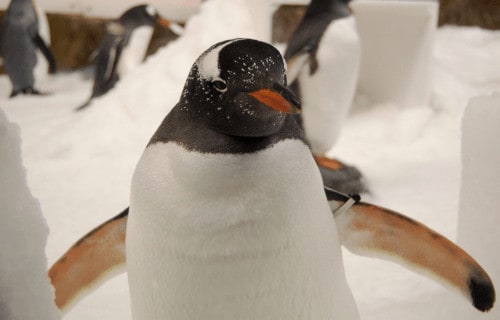
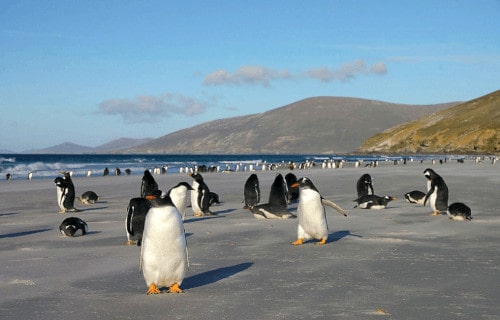
Otherwise, specimens of both genders of the visually distinctive Gentoo Penguin present the same overall appearance. One combination of features specifically stands out in this regard, though. That’s the presence of a wide white stripe that extends across the head, and its orange-red bill.
The remainder of the body of the animal displays a pattern of coloring typical among its many brethren across the globe. It mainly displays black on the back and sides, and white on the stomach. It does, though, show whitish-pink feet, and the most prominent tail of all species of penguin.
- Kingdom: Animalia
- Phylum: Chordata
- Class: Aves
- Order: Sphenisciformes
- Family: Spheniscidae
- Genus: Pygoscelis
- Species: P. papua
CCL: https://bit.ly/1jxQJMa
Gentoo Penguin Distribution, Habitat, and Ecology
The appealing Gentoo Penguin evolved as indigenous to a moderately broad expanse of the surface of he earth. The exact location of this region comes as no great surprise, though. That holds true since this product of eons of development lives in the region now known as Antarctica.
This includes, of course, the peninsula itself. Yet, many of these petite marvels also make their homes on various of the numerous sub-Antarctic islands prevalent in this part of the world. The largest concentration appears on South Georgia, itself a member of the Falkland Islands group.
The flightless bird displays decidedly strong and clear preferences regarding its choice of habitat type. Surprisingly to many, depsite the prevalence of ice in the cold climate the animal resides in, it typically chooses to live on various surfaces that remain principally free of icy coverings.
These settings typically consist of regions such as flat, rocky areas. Many individuals choose to live on or around low-hanging cliffs, or even between clumps of grass. In both instances, though, these geographical features most frequently lie situated within relatively shallow coastal sections.
Like its many relatives, the Gentoo Penguin evolved as a purely carnivorous creature. It primarily feeds on quantities of crustaceans, such as shrimp and krill. The birds generally supplement this with various species of fish and cephalopod. They also tend to feed extremely opportunistically.
After mating, the female almost exclusively lays two eggs. Both of the parents share in the incubation, alternating daily. Hatching usually requires between 34 – 36 days. Seabirds, though, often prey on the eggs or chicks. Adults fall vicitm to sea lions, leopard seals, and orcas in the water.
Albatross
CCL: https://bit.ly/1p2b8Ke
Albatross Facts
- Next up in this compendium of 5 Astounding Avians of Antarctica comes the winged wonder simply known to most people as the Albatross.
- This very short term actually represents the most frequently used common name for any of the members of an entire Family of seabirds. The group does have other general titles by which it’s known, though. These include the terms mollymawk, gony, gooney bird, and snowbird.
- Collectively, this grouping presently contains a total of 22 recognized members. Each of these stands out in various ways, but nevertheless shares certain attributes. Among them ranks the fact that these remarkable avians list as some of the largest winged wonders on earth.
- These marvels of Nature and evolution belong to the Family Diomedeidae. They received this placement due to the efforts of George Robert Gray, who assigned the name. The highly respected English ornithologist undertook his work in this regard in the year 1840.
- Intriguingly, at least from a purely scientific standpoint, even the number of species within the Family itself remains a matter of some heated debate. Placement of avian species within it by various experts range in number from 13 – 24, with 21 being the most common number.
- Presently, however, the IUCN recognizes a total of 22 members of the group. Unfortunately, though, 21 of these works of Nature list at some level of concern with the organization. These different ranks appear on the organizations published Red List of Threatened Species.
- Each of them faces multiple threats to their continued existence as a species, of course. Some remain specific to them, while others they share with their brethren, and all forms of life on earth. These dangers chiefly include the perils of habitat loss and ongoing climate change.

Albatross Physical Description
Regardless of which individual species of Albatross one observes, these marvels of evolution never fails to capture the attention of the viewer. This occurs due to several reasons. Every member of the group varies, to be certain, but they’re all beautiful, as well as impressive, winged wonders.
Each also follows patterns in that respect typical among its numerous kindred around the globe. That’s reflected in the fact that it displays a certain degree of the physiological characteristic of sexual dimorphism. In all instances, though, that trait admittedly remains relatively minor.
This gender-based physical difference mainly occurs in regard to terms of simple size, not any outward coloring. Males of the Family do tend to be slightly larger and heavier than the females, though the difference typically stays minimal and not noticeable without close measurement.
Males of a few of the individual member species do also develop slightly larger bills than their female counterparts, however. Otherwise, though, individuals of both genders present the same basic dimensions. This often makes distinguishing the sexes at a casual glance difficult.
Given the number of different species carrying the name of Albatross, measurements naturally vary, occasionally quite significantly. Accordingly, however, body length generally ranges from roughly 2.2 – 4.5 ft (0.7 – 1.4 m). Weights additionally range from approximately 5.5 – 26 lb (2.5 – 12 kg).
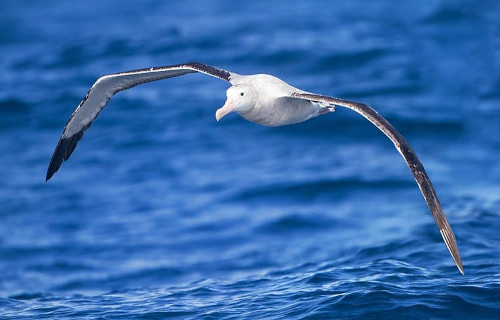
Their stunning wings also evolved as comparatively long and narrow in their structure. This natural design, in fact, ranks as the most impressive feature of these wonders of Nature. Depending on the specific species observed, wingspans actually range from an amazing 6.5 – 11 ft (2 – 3.4 m).
The pattern of colors of these breathtaking avians also serves as a source of endless wonder for many people. This characteristic, too, varies among the member species. The overall pattern, however, mainly consists of a brilliant shade of white, with smaller areas of darker shades in places.
- Kingdom: Animalia
- Phylum: Chordata
- Class: Aves
- Order: Procellariiformes
- Family: Diomedeidae
CCL: https://bit.ly/1p2b8Ke
Albatross Distribution, Habitat, and Ecology
Between the various members of the Albatross Family, these remarkable birds inhabit an extraordinary swathe of the surface of the earth. The nature of that zone of habitat remains specific, though. That’s because the remarkable birds maintain a predominantly circumpolar distribution.
In the Southern Ocean, this territorial range includes around both Antarctica and the subantarctic islands, including South Georgia, the Falkland Islands, and the Kerguelen Islands. The waters around New Zealand also serve as host to several sighted member species of this amazing Family.
Southern Australia qualifies as yet another very important habitat, particularly for species like the aptly-named Shy Albatross. Meanwhile, the coasts of both Chile and Argentina continue to be routinely frequented by several species, including the aptly-named Black-browed Albatross.
The intrepid product of evolution also appears within the Northern Hemisphere, in several differing areas. The coasts of the states of Alaska and California, in the United States, rank as frequently significant habitats for species such as the Laysan Albatross and the Black-footed Albatross.
Several North Pacific islands and the marine waters near Japan and Russia also host several members of this remarkable group of birds. These islands continue to represent extremely crucial breeding sites for the exact same combination of both the Laysan and Black-footed Albatrosses.
Every version of Albatross understandably shares certain evolutionary traits. Among those is the fact that it spends much of its life gliding over the open ocean, far from land. The animal’s extremely well adapted to long-distance flight, and can easily travel thousands of miles in search of food.
The astonishing creature consumes a wide range of prey. This does, however, mainly consist of fish, cephalopods, crustaceans, and zooplankton. It sometimes feeds on carrion, when available. Though it usually feeds near the surface, it’s not opposed to diving to depths of up to 41 ft (12.5 m).
Though the winged wonder spends much of its time far out at sea, when it breeds it does so as a colonial creature. This most commonly occurs on isolated islands. The size of these also varies between the different species in the Family. Most of the recognized species live for up to 50 years.
Emperor Penguin
CCL: https://tinyurl.com/22y23f9m
Emperor Penguin Facts
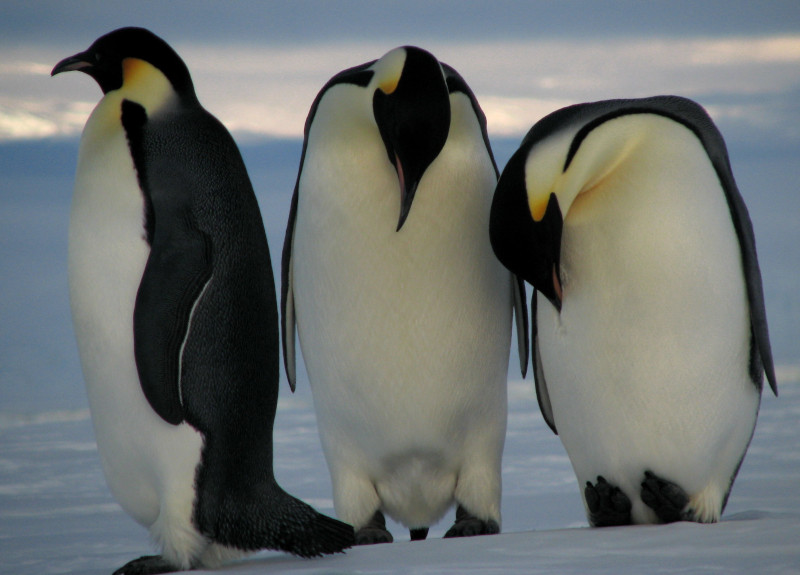
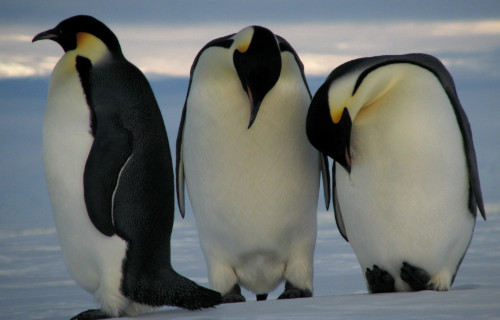
- Our next choice for inclusion in this listing of these 5 Astounding Avians of Antarctica is the beautiful, an aptly-named, Emperor Penguin.
- This remarkable flightless bird, a giant among its kind, most frequently goes by the fitting common name applied to it herein. The flightless bird does have a few other general titles, though. These include the very similar Royal Penguin, Great Penguin, and Imperial Penguin.
- Inside of the scientific community, however, the animal’s perhaps much better known by its technical moniker. That particualr term, though, remains somewhat difficult for the average layperson to pronounce. That’s because it bears the formal epithet of Aptenodytes forsteri.
- The creature received that designation due to the efforts of George Robert Gray. The highly respected English zoologist accomplished the first formal acknowledgement of it as a separate and distinct species. He managed that scientifically noteworthy deed in the year 1844.
- This marvel’s extremely notable among scientists for a number of reasons. Among them ranks the fact that it represents one of only two surving members of its genus. It’s also the only known penguin variety on earth to breed during the winter season in its region of the world.
- Sadly, the amazing Emperor Penguin now finds itself in a precarious position. It’s dealing with a greatly reduced population base. This unfortunate state also appears to extend across the entirety of its range. The IUCN therefore currently lists the avian as Near Threatened.
- This biological wonder obviously faces mulitple threats to its continued existence as a species. Like all forms of life on earth today, most of those dangers stem from the actions of man. In its case, these include reduced food availability, and the effects of ongoing climate change.
Emperor Penguin Physical Description
The majestic Emperor Penguin immediately captures the attention of those individuals fortunate enough to encounter them, especially in the wild. In their case, this occurs for several reasons. That’s true since they’re not just beautiful creatures, but also possessed of highly impressive size.
In that respect, the bird also follows a pattern common to many species around the world. That’s in the fact that it displays a certain degree of the physiological characteristic of sexual dimorphism. In its case, this trait manifests itself in the males being larger than their female counterparts.
Though the males typically attain greater average measurements in terms of both height and mass, the difference usually remains relatively minor. Overall, however, the stunning species reaches a mean height of 3 ft 7 in (1.1 m). In body mass, an average range equals 49 – 99 lb (22 – 45 kg).
The amazing feet of the flightless avian also evolved as fully webbed, which aids in swimming propulsion. These also developed as uniquely adapted for walking on ice. That’s because they have small fleshy patches on the underside to provide it with excellent traction on the slippery surface.
The intriguing product of Nature additionally possesses distinctive flipper-like wings that evolved as adapted for swimming rather than flying. These wings remain quite short and stiff, serving as efficient paddles in the water. They do not, however, allow it the ability to fly in any manner.
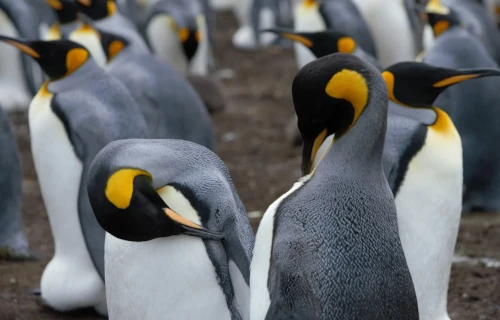
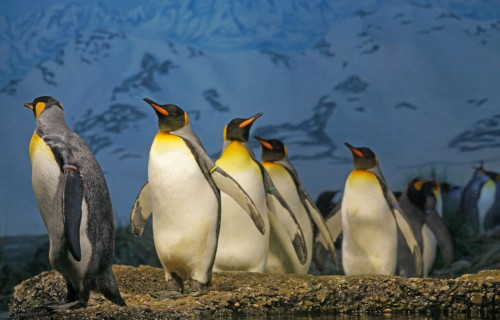
Doubtless, however, one of the most striking features of the breathtaking Emperor Penguin remains its color pattern. This begins with a black head, back, and wings. Yet, it also includes a belly and chest that shows a bright white. There’s also a yellow-orange patch on each side of the neck
Those same feathers further lie extremely densely packed close to the body, and also developed as waterproofed in nature. The body has a streamlined shape. On the front of the animal’s head, a relatively long, black beak appears, measuring an average of approximately 3.1 – 3.5 in (8 – 9 cm).
- Kingdom: Animalia
- Phylum: Chordata
- Class: Aves
- Order: Sphenisciformes
- Family: Spheniscidae
- Genus: Aptenodytes
- Species: A. forsteri
Emperor Penguin Distribution, Habitat, and Ecology
Lamentably, the fabulous Emperor Penguin evolved as endemic to a comparatively restricted portion of the surface of the earth. The precise location of that zone of habitation, though, likely won’t surprise many people, given its very nature. The animal’s native to parts of Antarctica.
Yet, even within the confines of this already limited region, the wonder of Nature only inhabits very specific sections. The creature appears most frequently in East Antarctica, West Antarctica, and the Antarctic Peninsula. Smaller concentrations do, however, occasionally appear elsewhere.
Much like many of its numerous cousins, this truly awesome bird also displays decidedly strong and clear preferences regarding its choice of habitat. Yet, even among its brethren, it stands out in this regard. It requires a unique habitat that’s very tightly linked to the icy environment of the area.
The marvel of evolution’s clearly specially adapted to live on and breed on sea ice. It breeds during the harsh winter, choosing sites on stable pack ice or fast ice near the coastline. These areas provide a comparatively solid platform for nesting and also protect the individuals from predators.
Breeding colonies are typically located along the coastline, where sea ice routinely forms and provides a stable habitat for nesting purposes. Some colonies, however. appear on large ice shelves that extend out from the continent into the Southern Ocean, providing surfaces for its breeding.
Like its kindred in yet another way, the incredible Emperor Penguin feeds entirely as a carnivore. Its main prey consists of smaller varities of fish, squid, and krill, which it catches while diving in the waters of the Southern Ocean. In turn, its own predators often include the leopard seal and orcas.
It lives as a colonial breeder, forming large colonies for that purpose during the winter. These groupings appear on stable sea ice or ice shelves near the coastline. They provide safety in numbers, with adults taking turns to incubate their eggs and raise the chicks while others forage for food.
Arctic Tern
Arctic Tern Facts
- Now appearing in this compilation of 5 Astounding Avians of Antarctica comes the next flighted species, the stunning Arctic Tern.
- The short yet informative title for the bird serves as the most frequently used common name for this beautiful winged wonder. The amazing bird does have at least one other general title by which it’s known, though. That’s the occasionally locally used term of sea swallow.
- Within the scientific community, however, it’s possibly significantly better known by its entirely technical designation. Although appealing, that’s slightly more difficult for the layperson to pronounce. That’s because it holds the appellation of Sterna paradisaea.
- The winged wonder received that epithet due to the efforts of Erik Ludvigsen Pontoppidan. Intriguingly, the Danish author and Lutheran bishop recorded the first recognition of it as a separate and distinct species. He achieved that scientifically noteworthy deed in 1763.
- This marvel of the winged world earns high merit for a multitude of reasons, to be certain. Chief among them, though, ranks its extraordinary migratory habits. It undertakes the longest known migrations of any animal on earth. These average 30,300 mi (48,700 km) per year!
- Fortunately, the magnificent Arctic Tern appears to be maintaining both a stable and sufficient population base. That pleasant state also seems to hold true throughout its entire range. The IUCN therefore presently shows it as Least Concern on its Red List of Threatened Species.
- The surprising animal nevertheless still faces several potential threats to its continued existence as a species, at least. Like all forms of life on earth today, most of these many perils stem from the actions of mankind. They include the perils of habitat loss and climate change.
Public Domain Image
Arctic Tern Physical Description
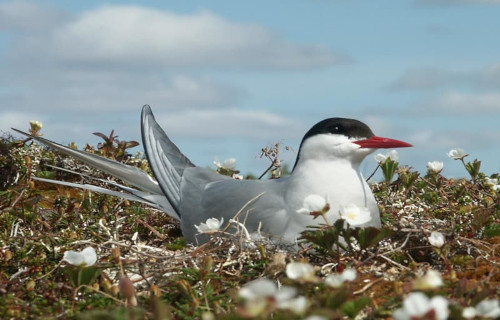
The beautiful Arctic Tern quickly draws the eye of those individuals fortunate enough to encounter the airborne marvel. It does not typically do so, however, due to its sheer size. That’s simply due to the fact that, in that particular regard, it only ranks as a small-to-medium variety of bird.
Yet, Nature cares nothing for such insignificant matters. Regardless of physical dimensions, it puts on a remarkable presence for the observer. The bird also does so without regard to gender, since, unlike many animals, it shows little or no evidence of the characteristic of sexual dimorphism.
Individuals of both sexes thus achieve the same general body measurements. This includes a length averaging approximately 11 – 15 in (28 – 39 cm). It also boasts a modest mean wingspan equaling roughly 26 – 30 in (65 – 75 cm). Exceptional examples occur, though they remain quite rare.
Nature and evolution also provided the smaller bird with a natural feature that many of its larger cousins lack. That’s in the nature of its tail. This appendage develops with a distinctive combination of being strongly forked, relatively long and slender, and possessing elongated outer feathers.
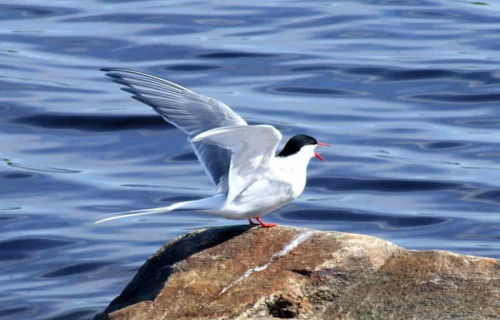
The coloring of the lovely Arctic Tern additionally represents a point of interest among its many observers. That’s due to the fact that this trait is actually quite variable by nature. During breeding season, the animal presents a mostly white body with a light gray shade on the mantle and back.
The amazing winged animal also has a black cap on their head that extends down to their eyes. Its wings show gray with a noticeable black trailing edge. The bill usually displays red with a black tip. Outside of breeding season, however, the plumage becomes significantly duller in coloring.
- Kingdom: Animalia
- Phylum: Chordata
- Class: Aves
- Order: Charadriiformes
- Family: Laridae
- Genus: Sterna
- Species: S. paradisaea
Arctic Tern Distribution, Habitat, and Ecology
The astonishing Arctic Tern, despite its common name, actually inhabits an astounding swathe of the earth’s surface. The full extent of that expansive zone of habitation, in fact, might surprise you. It’s broken up, though, due to the fact that it inhabits different regions in different seasons.
During the southern summer, the Northern Hemisphere’s winter, this winged wonder quickly becomes distributed widely across the Southern Ocean. There, more precisely its range extends, from the Antarctic pack ice to the waters off the coasts of South America, Africa, and Australia.
During the Northern Hemisphere’s winter, however, the creature migrates to the Antarctic region, where it spends the southern summer. This incredibly extensive migration takes the captivating avian from its breeding grounds in the Arctic all the way to the Southern Ocean around Antarctica.
During its breeding season, the intrepid creature displays a moderate degree of flexibility pertaining to its choice of habitat. It’s thus found residing within a reasonably wide range of ecosystems at this time. All of these environments, however, tend to be either in coastal or near-coastal regions.
This frequently includes such settings as coastlines, including various rocky shores, sandy beaches, and even gravelly or grassy areas located near the shore. It also frequently chooses small islands or even islets for nesting. It does so since these provide moderate protection from its predators.
Yet, in some regions, the amazing product of evolution sometimes nests inland on tundra habitats found near freshwater lakes or ponds. In such settings, the selective avian most often prefers open areas with short vegetation where it can easily spot predators and access its nesting sites.
The fabulous Arctic Tern feeds as a pure carnivore, like its many kindred. The vast majority of its diet consists of a variety of smaller fish species. It does, though, augment this with the occasional crustaceans, mollusks, and other small marine organisms. It hunts in a range of several ways.
In turn, it faces its own naturally evolved threats, including avian predators such as skuas, gulls, and jaegers, as well as mammalian predators like foxes and rats. Nest predation can be a significant challenge, leading it to prefer to nest in locations that provide some level of protection.
Adelie Penguin
Adelie Penguin Facts
- Closing out this article about these 5 Astounding Avains of Antarctica we give you the next penguin species selected, the lovely Adelie Penguin.
- This fabulous product of Nature and evolution remains best known by the its short yet informative common name for good reason. For the moment, the natural marvel has no other broadly accepted general title. Though not entirely unknown, that’s slightly uncommon.
- Within the scientific community, however, the animal’s perhaps markedly better known by its purely technical designation. Unfortunately, though, that’s an extremely difficult one for the layperson to pronounce. That’s because it holds the official title Pygoscelis adeliae.
- The gorgeous creature received that title due to the combined efforts of two men. The French naturalist Jacques Bernard Hombron and the French zoologist Honoré Jacquinot recorded the first recognition of it as a separate and distinct species. He achieved this feat in 1841.
- This wonder of the flightless world earns distinction for several reasons. Among those stands the fact that it ranks as the most widespread of all known penguins. Yet, it’s also the most southerly distributed of its brethren. It’s named after Adelie Land, a French territory.
- Fortunately, the remarkable Adelie Penguin appears to be maintaining a population base that’s both stable and sufficient. That pleasant state of affairs further seems to hold true across its entire range. The IUCN thus now lists the avian as Least Concern on its published Red List.
- It nevertheless still faces several potential threats to its continued existence as a species, at least. In this, it faces the same dangers as all species on earth today. Most of these stem from the actions of mankind, and include habitat loss and the peril of ongoing climate change.
Adelie Penguin Physical Description
The beautiful Adelie Penguin certainly captures the attention of those individuals fortunate enough to encounter the wonder of Nature. Yet, this typically occurs due to its appearance more than pure size. That’s true since this wonder ranks as one of the smallest of all currently known penguins.
In this specific regard, the amazing creature also follows the same pattern typical to its many kindred around the world. That’s in the fact that it displays a certain degree of the physiological characteristic of sexual dimorphism. This trait mainly manifests itself in two very distinct ways.
In terms of its height, both genders of the species attain the same approximate range, though this does vary significantly among individuals. Fully mature specimens average anywhere from 18 – 28 in (46 – 71 cm) tall. Though exceptional individuals occur, they rarely exceed this by very much.
Body mass, however, represents one of the areas in which the sexes distinguish themselves. Taken overall, the species ranges from between 6.6 – 13.2 lb (3 – 6 kg) in mass. The females, though, tend to be on the lower end of this range, while the males tend to appear on the higher end of it.
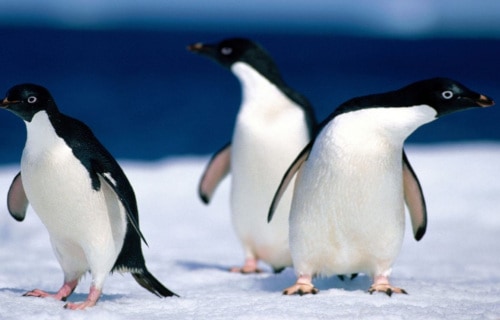
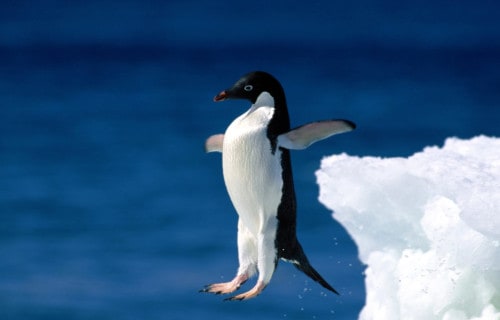
Both sexes of the Adelie Penguin, though, present the same basic color pattern. This comprises a visually striking appearance, largely composed of a black head and back, and a white belly. It also has distinctive white rings surrounding its eyes, which contrast sharply against the black head.
The beak, meanwhile, developed as comparatively straight in shape, orange, and with a hook at the end. It’s here where the females distinguishes herself again, having a shorter beak on average. The amazing animal also evolved fully webbed feet, with extremely sharp claws located at the ends.
Though flightless, the remarkable bird does possess wings, the feathers of which eveloved as extremely densely packed to provide strong protection against the cold. Being also waterproof, these structures serve to work like flippers, and it uses them for swimming, as opposed to flying.
- Kingdom: Animalia
- Phylum: Chordata
- Class: Aves
- Order: Sphenisciformes
- Family: Sphensicidae
- Genus: Pygoscelis
- Species: P. adeliae
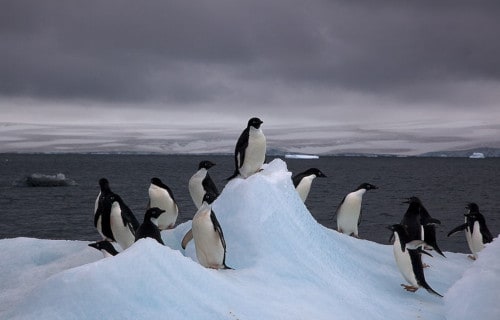
CCL: http://bit.ly/2xQPH8p
Adelie Penguin Distribution, Habitat, and Ecology
The fascinating Adelie Penguin evolved as native to a comparatively large swathe of the earths surface for a penguin. The location of that zone of habitation won’t surprise many of you, though, given its nature. That’s because the stunning animal developed as endemic to Antarctica.
Impressively, it holds a circumpolar distribution, thus being found around the entirety of the continent. The marvelous product of evolution’s also present on a multitude of the surrounding islands. These include the South Orkneys, South Shetlands, and Scott Island, among many others.
Within this territory, however, the amazing bird displays a surprising versatility regarding its choice of habitat. It’s thus found in various types of terrain, from rocky coastlines to ice-free islands. Yet, certain key requirements remain that each of these locations must have to meet its approval.
Though not completely ice-dependent like some other Antarctic species, they do rely on sea ice as a platform for their foraging, resting, and molting. The presence of this is therefore a necessity. While individuals spend much of their time on land, they also require easy access to open water.
Like all its relatives, the Adelie Penguin feeds entirely as a carnivore. It mainly consumes krill, fish, and squid. Its also an expert hunter, using its streamlined body and flipper-like wings to navigate underwater and catch prey. It also often forages in large groups, cooperatively herding prey.
This particular variety of penguin evolved a highly synchronized breeding cycle. It typically breeds in large colonies, where individuals form monogamous pairs and raise their chicks together. That’s why breeding colonies become established in areas with easy access to the ocean for foraging.
In turn, the beautiful animal sadly faces its own share of natural predators. From the air, these threats include such species as skuas and south polar skuas. Numerous aquatic predators, including powerful leopard seals and killer whales also pose serious theats to the enthralling animal.
5 Astounding Avians of Antarctica
We hope that each of you thoroughly enjoyed reading, and hopefully learning some things from, this article we’ve written about these 5 Astounding Avians of Tunisia. It’s also our hope that doing so has left you with either a new or renewed appreciation for such awesome wonders of Nature.
Unfortunately, however, many of the numerous species sharing their region now find themselves facing strong threats to their continued existence as a species. Many of those dangers, in fact, stem from the actions of mankind. We must do everything we can to protect and preserve them all.
Check out our other articles on 5 Incredible Italian Herbaceous Plants, Earth’s Many Stunning Waterfalls, 4 Fabulous New Zealand Flora, The Mighty Tornado, 5 Extremely Beautiful Epiphytes