


We sincerely hope that each of you, our readers, will greatly enjoy and appreciate this article we present about these 5 New Zealand Marine Mammals. It was certainly our great pleasure to compile the various information for you. May it provide you with both education and increased awareness.
Obviously, these few species listed herein represent only a small portion of the natural wonders found throughout the region, though. Yet, it’s our belief that they serve as excellent representations of the wonders found here. Check out some of our many other articles for similar marvels.
New Zealand Sea Lion
CCL: https://tinyurl.com/22y23f9m
New Zealand Sea Lion Facts
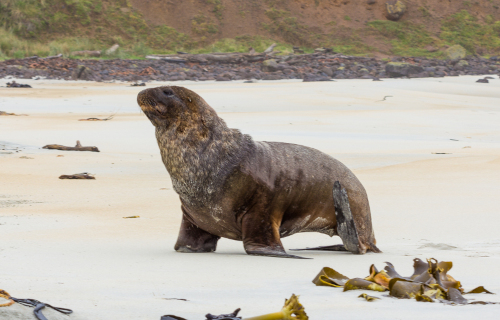
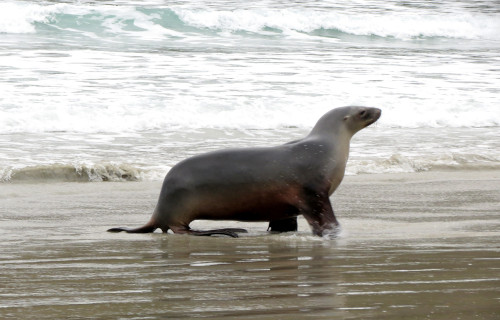
- Leading off this article about these 5 New Zealand Marine Mammals we give you the aptly-named wonder called the New Zealand Sea Lion.
- The highly informative term applied to it herein serves as the most frequently used common name for this remarkable product of Nature. Yet, the impressive animal does have other titles. These include the optional tags Hooker’s sea lion, Whakahao, and Southern sea lion.
- Inside of the scientific community, however, it’s perhaps better known by its technical designation. Like many such monikers, though, that one’s somewhat difficult for the layperson to pronounce. That’s because the pinniped holds the official appellation of Phocarctos hookeri.
- The marvelous creature received this technical epithet due to the efforts of John Edward Gray. The esteemed British zoologist recorded the first formal recognition of it as a separate and distinct species. He accomplished this scientifically noteworthy deed in the year 1844.
- The intriguing product of evolution currently holds several scientific distinctions. Sadly, the principal of these isn’t a positive one. That’s due to the lamentable fact that it presently ranks as one of the world’s rarest sea lion species. It also represents the sole member of its Genus.
- The estimated population of the New Zealand Sea Lion currently stands at approximately 12,000 individuals. Though its population continues to decline, protective measures put into place appear to have slowed this, at least. The IUCN now lists it as Endangered on its Red List.
- It faces multiple threats to its continued existence as a species. Some of these qualify as specific, such as subsistence hunting and commercial sealing. Yet, it also now faces the same global perils all forms of life on earth today do, such as habitat loss and climate change.
CCL: https://tinyurl.com/22y23f9m
New Zealand Sea Lion Physical Description
The New Zealand Sea Lion is a remarkable mammal that never fails to capture the attention of those fortunate enough to encounter one. The amazing animal does so for a variety of reasons, though. Its sheers size doubtless ranks high on any such list. It’s one of the largest in the entire world.
In terms of that aspect of its nature, however, it shares an attribute common in its relatives. That’s the fact that it displays a certain degree of the physiological characteristic of sexual dimorphism. In its case, this trait manifests itself with males being significantly larger than the females.
Mature males attain maximum body lengths measuring up to 10 ft (3.1 m). Most individuals do remain slightly smaller than this, though. In terms of mass, specimens of this gender average between 700 – 1,000 lb (320 – 450 kg). Exceptional examples sometimes exceed even this.
Females of the species, meanwhile, only reach lengths averaging between 5 – 6.5 ft (1.6 – 2 m). The difference in mass remains even greater. For them, this typically only ranges from between 200 – 360 lb (90 – 165 kg). Again, even the exceptional examples of the gender rarely exceed these greatly.
The overall body structure otherwise remains the same for both sexes. This remains robust, but obviously much more so among males. It’s also quite streamlined, thus being well-adapted for swimming. The animal also has two paddle-like flippers that aid in propulsion through the water.
The New Zealand Sea Lion also shows differences in coloring. Males display dark brown or black fur, often appearing darker with age. These also often have a thick, mane-like ruff of fur around the neck. Females and juveniles are lighter in color, with a pale yellowish-brown or greyish coat.
The head evolved as broad, with a blunt, short muzzle. The whiskers grow long and sensitive, helping the mammal detect movement in the water. It has large, dark eyes, well-adapted for underwater vision. It also has small, external ear flaps, which distinguish it from true seals.
- Kingdom: Animalia
- Phylum: Chordata
- Class: Mammalia
- Order: Carnivora
- Family: Otariidae
- Genus: Phocarctos
- Species: P. hookeri
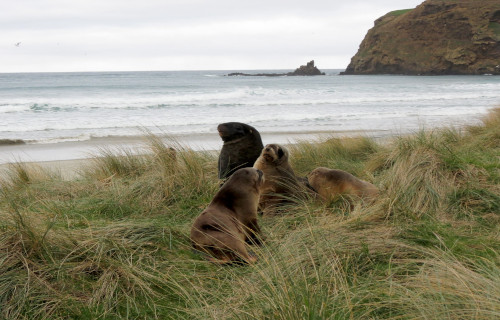
CCL: https://tinyurl.com/22y23f9m
New Zealand Sea Lion Distribution, Habitat, and Ecology
This impressive creature evolved as indigenous to a highly limited portion of the surface of the earth. The precise location of that zone of habitation won’t surprise anyone, however, given its very name. That’s because, as that title indicates, it’s mainly native to southern regions of New Zealand.
Even there, however, this marvel of Nature mainly appears in certain areas. These include such locations as several subantarctic islands. Those include the Auckland Islands and Campbell Island. Other regions with a presence include the South Island, the Otago Peninsula and Stewart Island.
Though its range unfortunately remains severely limited, the intrepid animal itself displays a surprising amount of flexibility regarding its choice of habitat. It’s therefore seen inhabiting a moderately wide variety of both coastal and marine environments across the entirety of that range.
The massive pinniped frequently appears on various sandy beaches where these are available in its territory. Yet, the animal also uses such other locations as rocky shores, dunes, and sometimes even grassy areas for resting, particularly on islands where there’s little human disturbance.
In some very rare cases, it’s also been known to rest and breed surprising distances inland, venturing into forested and scrub-covered areas. This qualifies as unusual behavior for pinnipeds and vividly highlights the extreme adaptability of the intriguing species to various types of terrain.
This wonder of evolution additionally stands out for another reason. It also ventures into deeper waters beyond the continental shelf. There, it dives tp depths of over 2,000 ft (600 m) in search of prey. In addition to its other unique attributes, this makes it one of the deepest-diving pinnipeds.
This extraordinary animal feeds as a pure carnivore. Indeed, it also represents an apex predator in its region. It principally feeds on a wide variety of fish species. These include such species as hoki and red cod, among others, which remain abundant in the waters around its breeding grounds.
Its dietary fare certainly doesn’t end there, though. Squid, particularly arrow squid, also form a large part of its diet. The carnivore also hunts octopus, particularly in deeper waters. It often dives to great depths to forage on bottom-dwelling species like skates, rays, and sometimes crustaceans.
The New Zealand Sea Lion breeds in large colonies, usually on sandy beaches on subantarctic islands like the Auckland and Campbell Islands. Males establish territories and compete for access to females during the breeding season. A dominant male sometimes mates with multiple females.
Females give birth to a single pup in December or January after a typical gestation period of 12 months. Mothers then nurse their pups for about a year, though weaning often begins after 6-8 months. During this time, the mother must balance caring for her pup on land and foraging at sea.
Given their great size, fully mature adults of the mammal have very few natural predators, though sharks and orcas occasionally prey on them. Pups and juveniles remain much more vulnerable to predation, however. That’s particularly true in the case of such threats as larger seabirds like skuas.
Humpback Whale

CCL: https://tinyurl.com/372utwy4
Humpback Whale Facts
- Next up in this compilation of 5 New Zealand Marine Mammals we give you the gentle giant bearing the name of the Humpback Whale.
- This attention-grabbing term currently serves as the best known common name for this true marvel of the marine regions of the world. The awesome marine wonder has other titles, of course, though these only represent the non-english language versions of the same.
- Some of these tags include Kohola in Hawaiian, in which culture they’re historically considered extremely sacred. Baleine à bosse, meanwhile, serves as the French term for the natural marvel. In Portuguese it’s called Jubarte, while the Spanish name is Yubarta, to name a few.
- Inside of the scientific community, however, it’s perhaps better known by its technical moniker. That appellation, though, like most such, remains quite difficult for the layperson to pronounce. That’s because it holds the official epithet of Megaptera novaeangliae.
- The magnificent mammal received that difficult designation due to the efforts of Georg Heinrich Borowski. That respected German zoologist wasn’t the first to identify it, but assigned it the name it holds now. He accomplished scientifically noteworthy deed in the year 1781.
- Lamentably, humans once hunted the majestic Humpback Whale nearly to the brink of extinction. In the 1960’s, its population fell to only around 5,000. Thankfully, officials put preservation efforts in place, and it now numbers around an estimated 135,000 individuals.
- Due to this marked improvement, the IUCN currently lists the creature as Least Concern on its published Red List. It nevertheless still faces numerous threats to its existence. Like most species today, these include the related perils of habitat loss and climate change.
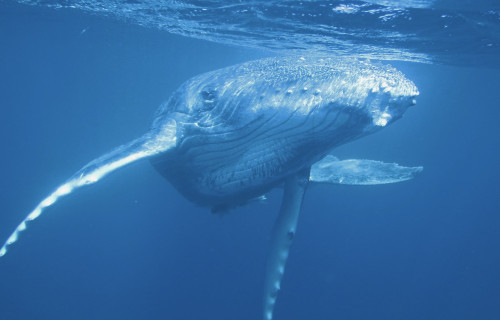
Humpback Whale Physical Description
The remarkable Humpback Whale truly distinguishes itself from most of its numerous kindred across the marine waters of the world. It does so, however, for more than just its sheer visual appeal. The creature also earns merit due to the fact that it ranks as one of the larger of its kind.
In that regard, the animal also follows an evolutionary pattern common among many mammals. That’s shown by the fact that it displays a certain amount of the physiological characteristic of sexual dimorphism. In its case, this trait manifest itself in terms of pure physical dimensions.
More specifically, males of the species attain greater average measurements than their female counterparts. Overall, though, the difference remains comparatively minor. Adult males typically range from 46 – 49 ft (14 – 15 m) in length. Females average about 3 – 5 ft (0.9 – 1.5 m) less.
The marvel of Nature also has a highly distinctive body shape characterized by a relatively large, robust body with a small dorsal fin located far back on its body. Its pectoral fins additionally develop as quite long and paddle-shaped, making up about one-third of its total body length.
In color, the impressive cetacean also presents a very distinctive visual pattern. This consists of mostly black or dark gray on its upper side, while its lower side usually shows lighter, often white. The animal also sometimes shows slightly irregular white patches on its flippers, belly, and throat.
For some viewers, however, the head of the Humpback Whale marks yet another feature that sets it apart from its kin. It displays a large, knobbly head with an elongated jaw covered in small, wart-like bumps called tubercles. These contain hair follicles believed to aid in sensory perception.
Yet another characteristic feature of this amazing mammal’s the presence of multiple pleats or throat grooves along its ventral side. These numerous grooves allow the animal’s throat to expand during feeding, enabling it to take in large volumes of water and prey during the process.
- Kingdom: Animalia
- Phylum: Chordata
- Class: Mammalia
- Order: Artiodactyla
- Family: Balaenopteridae
- Genus: Megaptera
- Species: M. novaeangliae
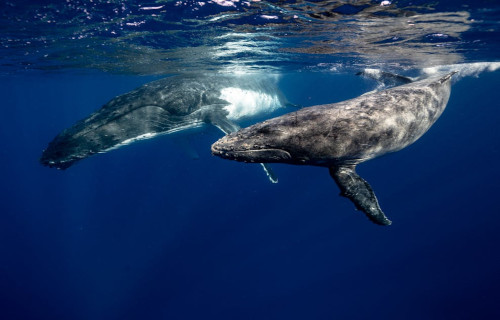
Humpback Whale Distribution, Habitat, and Ecology
Fortunately, the mighty Humpback Whale evolved naturally as endemic to an extraordinarily large expanse of the marine waters of the world. In fact, that natural zone of habitation consists of virtually all oceans and seas, with only a very few small, widely isolated exceptions.
Included among those comparatively rare places the mammal does not appear comes a handful of small enclosed seas. Somewhat understandably, however, it also does not live in the High Arctic areas. Intriguingly, though, it’s additionally absent from some regions situated near the equator.
Maintaining a pattern common to whales, this marvelous wonder of evolution displays decidedly strong flexibility regarding its choice of habitat. It’s therefore frequently found in an extremely wide variety of marine environments, including coastal waters, open ocean, fjords, and estuaries.
Yet, it’s also often observed near underwater features such as seamounts, submarine canyons, and continental shelves, where there’s increased prey abundance and more favorable oceanographic conditions. The animal further shows a strongly clear favoritism for much colder waters.
The amazing species feeds primarily as what’s known as a filter feeder. To that end, it uses baleen plates in its mouth to strain small prey such as krill, plankton, and small fish from the water. It also often feeds cooperatively, actually blowing bubbles, to trap the prey for easier feeding!
The Humpback Whale also undertakes amazingly long-distance migrations between its feeding and breeding grounds. These are driven by seasonal changes in temperature and prey availability. During migration, the whale travels thousands of miles, often following regular, predictable routes.
Breeding typically occurs in warmer waters during the winter months. Males engage in gently competitive behaviors such as singing and physical displays to attract the females. Mating itself typically produces a single calf, after an average gestation period lasting about 11-12 months.
Common Bottlenose Dolphin
Common Bottlenose Dolphin Facts
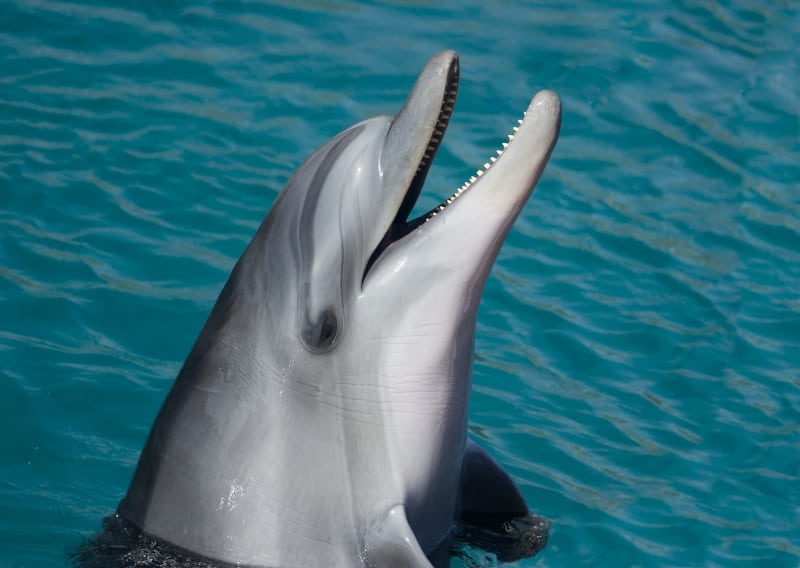
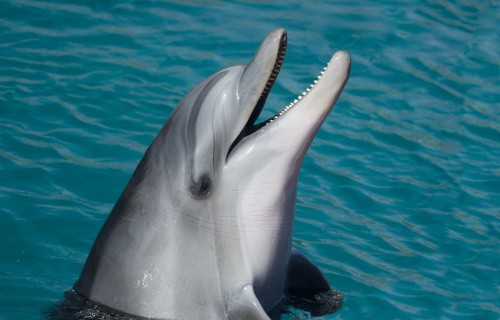
- Our next choice for inclusion in this gathering of these 5 New Zealand Marine Mammals is the fabulous animal known as the Common Bottlenose Dolphin.
- This magnificent ocean-dwelling creation of Nature and evolution generally goes by the intriguing name throughout its entire territorial range. It does have a very similar alternate general name, though. That’s the informative moniker of Atlantic bottlenose dolphin.
- Within scientific circles, however, it’s perhaps much better known by its purely technical title. Fortunately for the layperson, that’s the relatively easy to pronounce term of Tursiops truncatus. No matter which term one chooses, it remains a beautiful and impressive creature.
- It received that official designation due to the efforts of the highly respected English naturalist, George Mantagu. He accomplished the first recorded acknowledgement of it as a completely separate and distinct species. This scientifically noteworthy act occurred in the year 1821.
- The animal’s common name suits it perfectly, as it’s possibly the most numerous, widespread, and best-known of all its kin. It also has what may be the most extensive zone of habitation of its relatives. Sadly, the mammal’s also the most popular in marine parks and aquariums.
- Unlike a great many others of its kind, the Common Bottlenose Dolphin seems to be maintaing a sufficient population base. That further appears to hold true throughout the entirety of its known range. The IUCN therefore currently list it as Least Concern on its published Red List.
- The animal nevertheless does face potential threats to its existence, at least. In this, the same dangers exist as for other marine species. These include such factors as active hunting and accidental bycatch. Doubtless, though, its greatest threat continues to be climate change.
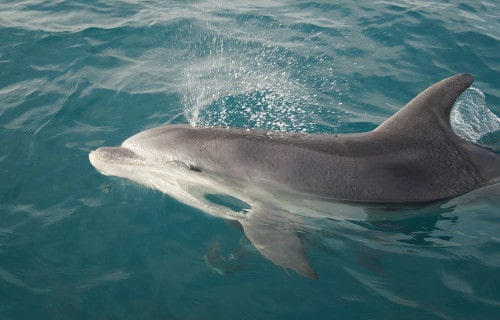
CCL: https://bit.ly/3n3PXy5
Common Bottlenose Dolphin Physical Description
One way in which the majestic Common Bottlenose Dolphin distinguishes itself from other dolphins around the world is sheer size. That’s due to the fact that this wonder of Nature ranks as the largest of all known beaked dolphins. That’s an extremely impressive claim to fame.
The marine marvel does follow the same pattern as other many other cetacea, though. That’s because the fabulous animal fully displays a moderate degree of the physiological trait of sexual dimorphism. In its specific case, this trait manifests itself in terms of simple physical size.
Males of the species generally attain a greater length and body mass than their female counterparts. In most instances, though, the difference isn’t greatly significant. Overall, both measurements vary significantly, often following different ranges. This tendency includes both genders, as well.
As a general rule of thumb, however, recorded individuals reach a length measuring somewhere between 6.6 – 13.1 ft (2 – 4 m). Weights also naturally vary accordingly. This ranges from 330 – 1,430 lb (150 – 650 kg). Exceptional specimens do occur, though, in both categories, regardless of gender.
In terms of coloring, the aptly-named Common Bottlenose Dolphin presents a nearly uniform gray shade. Slight variations on this theme occasionally present themselves in individuals, however. Upon close inspection, however, many present a slightly lighter shade on the underside of the body.
The amazing cetacea further possesses a comparatively short, well-defined nose. Often compared to a bottle, this serves as the source of the common name. Its neck evolved as more flexible than its cousins, too. That’s because five of their seven vertebrae aren’t fused, unlike other dolphins.
- Kingdom: Animalia
- Phylum: Chordata
- Class: Mammalia
- Order: Artiodactyla
- Family: Delphinidae
- Genus: Tursiops
- Species: T. truncatus
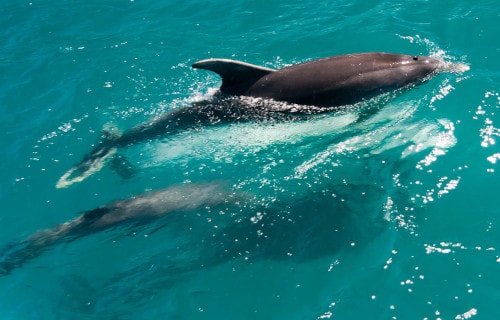
CCL: https://bit.ly/3FBbOU0
Common Bottlenose Dolphin Distribution, Habitat, and Ecology
Thankfully, the Common Bottlenose Dolphin evolved as native to a truly extensive natural range. In fact, thhis creature lives in marine waters across much of the globe. Incredibly, this mammal makes its home in every portion of the planet’s oceans, with the sole exception of the polar regions.
This means the water-based wonder remains equally at home in either tropical, subtropical, or temperate marine regions. Experts presently estimate its current global population to be roughly 600,000. It also migrates great distances, either individually or in groups of various size
Intriguingly, groups of the captivating cetacean live in collections both near the shore and further out to sea. In this repsect, the two differing concentrations display differing habitat preferences. Those diverse populations living further out tend to undertake the more significant migrations.
Those members of the species residing closer to shore typically migrate less often, and for shorter distances than the others. These same specimens also easily adapt to warm, shallower waters. This frequently includes such varied areas as lagoons, estuaries, bays, and even many harbors.
Again following the pattern established by its many kindred, the Common Bottlenose Dolphin lives as a very social species. Most known examples live in small groups called pods. These groups average 15 in number, but sometimes exceed 100 members. Lone individuals rarely occur.
Its diet typically consists of shrimp, squid, eels, and a wide range of fish species. The mammal hunts using echolocation, and does so effectively. The pods often hunt as a team, greatly increasing their effectiveness. It has few predators of its own. These threats mainly include orcas and sharks.
Leopard Seal
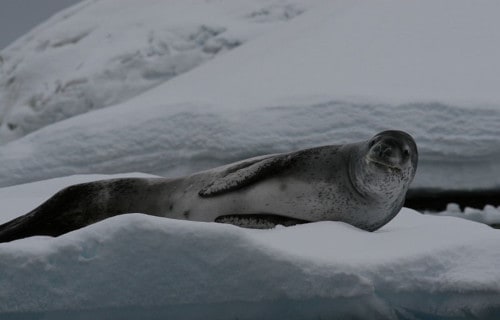
CCL: https://bit.ly/3Af0bNt
Leopard Seal Facts
- Now appearing in this compendium of 5 New Zealand Marine Mammals comes the surprising wonder best known as the Leopard Seal.
- This magnificent creation of evolution most typically goes by the descriptive common name w’re employing for understandable reasons. Yet, it does have a few alternate titles that it’s known by. These include the very similar terms of Sea Leopard and Water Leopard.
- Within the scientific community, however, it’s perhaps better known by its purely technical moniker. Like many such tags, though, that one remains somewhat difficult for the layperson to pronounce. That’s because it holds the official designation of Hydrurga leptonyx.
- The remarkable animal received that difficult name due to the efforts of Henri Marie Ducrotay de Blainville. That noted French zoologist recorded the first recognition of it as a separate and distinct species. He achieved this scientifically noteworthy deed in the year 1820.
- This astounding ocean-dwelling creature also stands out in the minds of many people for several reasons. Among those ranks the fact that it represents the second largest species of seal in the Antarctic. It’s also the second leading predator in its entire region of the earth.
- The species remains well known for its highly unpredictable mood swings. It’s shown itself able to switch from playfully curious behavior to dangerous aggression without warning. Though not generally threatening to humans, some individuals do sometimes attack divers.
- Thankfully, the amazing Leopard Seal appears to still be maintaining a population base that’s both stable and sufficient. That pleasant state additionally seems to extend across its entire range. The IUCN therefore currently lists the mammal as Least Concern on its Red List.
- This marvel nevertheless should be considered as facing at least several potential threats to its existence as a species, at least. Like all forms of life on earth today, most of these stem from the actions of man. These multiple perils include the danger posed by ongoing climate change.
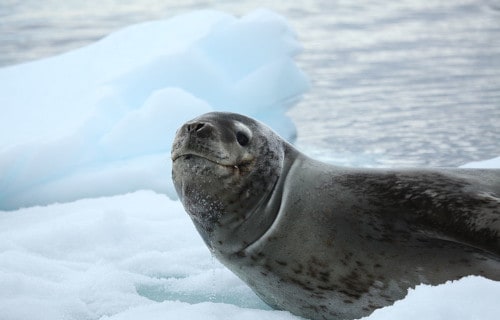
CCL: http://bit.ly/2xLZ0ap
Leopard Seal Physical Description
The fabulous Leopard Seal almost immediately grabs the attention of those individuals fortunate enough to view one of these magnificent creatures. Yet, this usually holds true for several reasons. That’s true since it’s not only a beautiful work of evolution, but also physically quite large.
In this regard, the species further follows a natural pattern common among mammals, including its numerous relatives. That’s in the fact that it demonstrates a degree of the physical characteristic of sexual dimorphism. In its particular case, though, the trait manifests in terms of sheer size.
More specifically, females of the awesome species attain a greater average body size than their male counterparts. This pattern extends to both length and weight. While both sexes have a similar general body shape, the larger size of the females clearly remains a distinguishing feature.
Mature females of this extraordinary pinniped species sometimes reach lengths measuring approximately 11.5 ft (3.5 m). The weights of these specimens also occasionally total as much as an equally impressive 880 – 1,320 lb (400 – 600 kg). Most, however, never reach these maximums.
Males of the species, meanwhile, do not usually grow quite so large. For this gender, a mean body length measures roughly 9.2 – 10.8 ft (2.8 – 3.3 m). Likewise typically remaining significantly less massive, their body weights generally range somewhere between 600 – 880 lb (270 – 400 kg).
Otherwise, the two genders present the same general outward appearance. The distinctive animal evolved a streamlined body well-adapted for swimming. That form’s also elongated, with a relatively small head compared to its body size. The pinniped also has a very strong, muscular neck.
The head of the creature clearly developed as somewhat flattened in terms of its design. Its mouth holds large, powerful jaws equipped with sharp, closely interlocking teeth. The eyes also developed as relatively large, and typically dark brown in color. These provide them with excellent vision.
It’s the skin and fur of the stunning Leopard Seal, though, that leads to the mainly used common name. That’s generally dark gray to silver on the back, with lighter, almost white, undersides. The coat’s covered with spots, usually more concentrated on the back and reducing near the belly.
The seal also boasts comparatively long, slender foreflippers, which it uses for its surprisingly powerful swimming. These flippers also develop as marked with spots. Its tail stays short, as remains typical of seals, and the hind flippers grow large, aiding in its propulsion through water.
- Kingdom: Animalia
- Phylum: Chordata
- Class: Mammalia
- Order: Carnivora
- Family: Phocidae
- Genus: Hydrurga
- Species: H. leptonyx
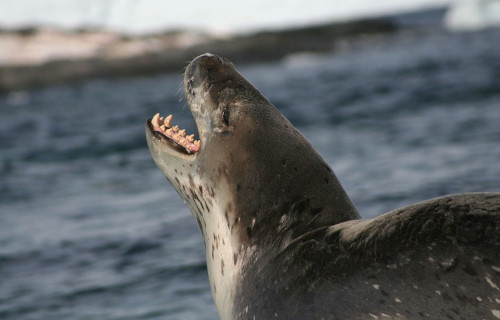
CCL: https://bit.ly/2VxKB0u
Leopard Seal Distribution, Habitat, and Ecology
The fully distinctive Leopard Seal evolved as indigenous to a surprisingly large, and yet still hard to define, region of the surface of the globe. That’s due to the fact the animal, like all species, has a primary range, yet also occasionally ventures outside of it, sometimes even a long distance.
This wonder of Nature developed as principally native to the area of the earth known as Antarctica. Yet, it also ventures out somewhat to numerous sub-Antarctic islands. Incredibly, a small percentage of individuals even journey as far north as South America, Australia, and New Zealand.
Within that unquestionably extensive range, the animal displays a decidedly high level of adaptability regarding its choice of habitat. It’s therefore found in a wide range of ecosystems. Most of these, of course, generally share one trait, that of being associated with cold, icy regions.
It’s most commonly found in and around the frigid pack ice surrounding Antarctica. This environment serves to provide it with ample hunting grounds and resting spots. The ice floes work as platforms from which it can hunt, and also haul itself out onto the ice to rest, molt, and give birth.
The wonder of Nature’s also often found within the many coastal waters immediately around the same area. Here, it’s able to hunt for its various prey as well. These alternate areas also provide rich feeding grounds, particularly during the austral summer when prey’s much more abundant.
Although primarily associated with ice, it’s also occasionally found in sections of relatively open water, particularly during periods of seasonal ice melt or when migrating. The mammal’s a strong swimmer, and is capable of covering significant distances in search of food or new territory.
The remarkable Leopard Seal isn’t simply another carnivore, it’s also an apex predator in the regions it inhabits. It evolved to thrive on a highly varied diet, including such prey as krill, fish, squid, and other marine animals. It’s especially known for preying on penguins and even other seals.
Except during the breeding season, this powerhouse remains a primarily solitary animal. Breeding occurs on the icepack. Females typically give birth to a single pup each year after an 11-month gestation period. Birth also takes place on the ice, with pups being weaned after about a month.
Southern Right Whale
Southern Right Whale Facts
- Closing out this article about these 5 New Zealand Marine Mammals we give you the other mammoth marvel on the list, the Southern Right Whale.
- This highly informative term perfectly serves as the most frequently used common name for this remarkable cetacean. Yet, the wonder of Nature does have a few other general titles by which it’s known. These other options include Southern Whale and the Black Whale.
- Within the annals of science, however, the animal’s perhaps much better known by its purely technical designation. As such monikers go, though, that one’s actually comparatively simple for the layperson to pronounce. That’s because it holds the formal tag Eubalaena australis.
- The amazing creature received that specific epithet due to the efforts of Antoine Desmoulins. The highly respected French anatomist accomplished the first official recognition of it as a separate and distinct species. He achieved that scientifically noteworthy deed in the year 1822.
- This creation of Nature and evolution holds a notable place of distinction in the halls of marine biology. Due to the nature of its range, it represents one of best-studied whale species. Of the three recognized species of Right Whale, it also boasts the largest remaining population.
- Thankfully, despite once being hunted nearly to extinction, the gorgeous Southern Right Whale now holds a respectable population base. That state holds true across the entirety of its range. In response to this pleasant trend, the IUCN now shows it as Least Concern on its Red List.
- The marvel nevertheless still faces numerous potential threats to its continued existence as a species. Like all forms of life on earth today, most of these stem from the actions of mankind. Those dangers include the closely related perils posed by habitat loss and climate change.
Southern Right Whale Physical Description
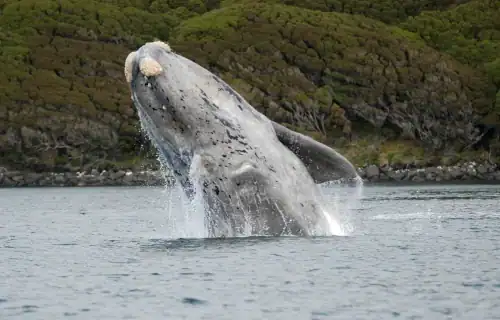
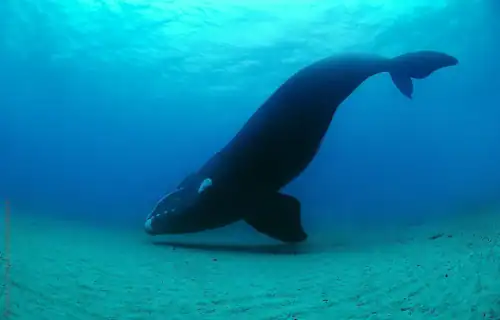
Like most whales, the Southern Right Whale almost never fails to capture the attention and awe of those individuals fortunate enough to encounter one. Unlike some other creatures around the world, however, it does so not just due to its amazing visual appeal, but also for its great size.
Regarding its appearance, though, it also follows an evolutionary pattern that, while uncommon among mammals in general, remains typical of its relatives. That’s the fact that the stunning mammoth of the seas displays a degree of the physiological characteristic of sexual dimorphism.
In its specific case, this natural trait manifests itself solely in terms of sheer physical dimensions. That’s true since females attain a greater overall size than their male counterparts. That extends to both length and mass. However, the gender-based differences remain relatively minor on average.
Adult females attain an average maximum length equaling between 55.8 – 59.1 ft (17 – 18 m). Males, though, only reach mean measurements of 45.9 – 52 ft (14 – 16 m). The females additionally achieve masses between 60 – 90 tons, unless pregnant, while the males merely average 40 – 80 tons.
Both sexes, however, present a general body shape best described as stocky and rotund, with a broad back. Its pectoral flippers, meanwhile, evolved as broad paddle-shaped. It also has a wide tail, with smooth trailing edges. Unlike most of its kindred, it remains conspicuously absent a dorsal fin.
Perhaps the most remarkable anatomical feature of the awesome Wouthern Right Whale is the head of the animal. This actually represents almost one-third of the total body length! This hosts two separate blow-holes on top, as well as roughened, raised patches of skin, known as callosites.
Its distinctive coloration also merits its fair share of mention. Among adults, this most typically consists of a primarily black or dark gray background. Many of these individuals additionally display white patches on the belly or chin. Calves usually begin life slightly lighter and darken as they age.
- Kingdom: Animalia
- Phylum: Chordata
- Class: Mammalia
- Order: Artiodactyla
- Family: Balaenidae
- Genus: Eubalaena
- Species: E. australis
Southern Right Whale Distribution, Habitat, and Ecology
The beautiful Southern Right Whale evolved as indigenous to a moderately broad swathe of the marine regions of the globe. As the name implies, though, this zone of habitation consists of several distinct areas situated within the Southern Hemisphere. Those areas likely won’t surprise anyone.
Part of that specific territorial range consists of the waters of the Southwestern Atlantic Ocean off the coast of South America. Within that particular section of its range, its breeding grounds mainly include those locations lying offshore of the nations of Argentina, Uruguay, and southern Brazil.
This wonder of Nature’s also present in the waters off of South Africa, in the Southeastern Atlantic Ocean. Inside of this smaller zone, its breeding grounds appear in the waters just off of the southern coast of the country of South Africa. That holds particularly true between Cape Town and Durban.
Yet, the magnficent creature’s also present in portions of the waters around both Australia and New Zealand. Those final locations lie within the Southern Indian and Pacific Oceans, respectively. There, its breeding grounds lie just off Southern Australia, Tasmania, and parts of New Zealand.
Like its many relatives across the globe, this marvel displays a high degree of flexibility regarding the regions it inhabits, at least in certain ways. That classification occurs due to the fact that the habitats of the species change seasonally as the whale migrates between breeding and feeding areas.
From Winter to Spring, it favors coastal, temperate waters. Here, it prefers certain ecosystems. These commonly include shallow bays and sheltered coastal areas, calm waters and gentle slopes, and waters warm enough to support newborn calves, since this forms the breeding and calving area.
During the period between Summer to Autumn, though, it inhabits its major feeding habitat. This typically consists of higher latitude, offshore locations hosting notably cooler waters. Prime features include nutrient-rich waters, and high concentrations of zooplankton, especially copepods and krill.
In keeping with its migratory habits, the ecology of the Southern Right Whale developed as highly complicated in nature. In fact, this aspect of its life cycle encompasses its many interactions with the local environment, individuals and group behavior, life history, and role in marine ecosystems.
It feeds as a filter feeder, consuming vast quantities of zooplankton, mainly composed of krill and copepods. To do this, it swims slowly with its mouth open, filtering prey through fringed baleen plates. Later, as a byproduct of this, its fecal plumes play an important role in nutrient recycling.
The awe-inspiring creature typically lives either solitary, or in small, loose-knit groups. After breeding, females give birth, usually to a single calf, roughly 12 months later. Subsequent to the birth, mothers nurse their calves for between 6 – 12 months, varying significantly between individuals.
Due to its great size, this wonder of evolution possesses very few natural predators. Nonetheless, a few denizens of the depths do prey on it on occasion, though usually on either calves, juveniles, or severely weakend adults. These enemies include Orcas, and larger sharks, such as the Great White.
CCL: https://bit.ly/3n3PXy5
5 New Zealand Marine Mammals
We legitimately hope that each of you fully enjoyed reading, and hopefully learning something from, this article we’ve written about these 5 New Zealand Marine Mammals. It’s also our fervent hope that doing so has left you with either a new or renewed appreciation for such wonders of Nature.
Unfortunately, however, many of their innumerable kindred around the world now find themselves facing strong threats to their continued existence as a species. Many of those dangers, in fact, stem from the actions of mankind. We must each do all we can to protect and preserve them all.
Check out our other articles on 5 Amazing African Herbaceous Plants, Earth’s Many Stunning Waterfalls, 4 Fabulous Geological Features of Texas, Earth’s 7 Mightiest Rivers