


CCL: http://bit.ly/2IjEG4n
We truly hope that each of you, our readers, will sincerely enjoy and appreciate this article we present to you about these 5 Remarkable Central American Reptiles. It was certainly our pleasure to gather the information for you. May it provide you with both education and increased awareness.
Certainly, these few magnificent species listed herein represent only a tiny portion of the similar species found throughout this region. It’s our belief, though, that they serve as excellent representations of the members of this Class. Check out our other articles for similar marvels.
Eyelash Viper
CCL: https://tinyurl.com/yswn2ycv
Eyelash Viper Facts
- Leading off this article about these 5 Remarkable Central American Reptiles we present you with the first snak on the list, the Eyelash Viper.
- This highly distinctive reptile most frequently goes by the somewhat unusual common name we’re applying to it in most parts of its range. It does have other general titles it’s sometimes known by, though. These include Eyelash Snake, and Schlegel’s Viper, among others.
- Inside of most scientific circles, however, it’s perhaps much better known by its entirely technical designation. Sadly, like many such epithets, that’s one that’s rather difficult for the layperson to pronounce. That’s because it holds the official term of Bothriechis schlegelii.
- The remarkable snake received that honorific due to the efforts of Arnold Adolph Berthold. The respected German zoologist accomplished the first formal recognition of it as a separate and distinct species. He achieved that scientifically noteworthy feat in the year 1846.
- This wonder of Nature stands out in the minds of scientists for several reasons. Among the many members of its Genus, it represents the one with the largest known population. Despite this fact, however, it has no known subpecies, unlike many species in the same situation.
- Thankfully, its population numbers do indeed seem to be both stable and sufficient for now. That pleasant state also appears to hold true throughout the entirety of its native range. The IUCN therefore presently shows it as Least Concern on its Red List of Threatened Species.
- The marvel of evolution nonetheless still faces many potential threats to its continued existence as a species, at least. Like all life existing on earth today, most of these stem from the actions of mankind. These include the related dangers of habitat loss and climate change.

CCL: https://tinyurl.com/4535ecxm
Eyelash Viper Physical Description
The amazing Eyelash Viper virtually always grabs the attention of anyone lucky enough to encounter one of these wonders of the reptilian world. This occurs mainly due to their appearance, though, not because of any size factor. That’s true since it’s actually a relatively small variety of pit viper.
The intriguing creature also follows a pattern common to many species, including serpents. That’s the fact that it displays a certain degree of the physiological characteristic of sexual dimorphism. In its specific case, the females of the species typically attain a larger average size than the males.
Collectively, though, the impressive reptile typically measures somewhere between 22 – 32 in (55 – 82 cm) in length. The females of the creature tend to be on the higher end of this range, while the males usually fall closer to the lower end of it. Exceptional examples nevertheless do occur.
Like most of its many relatives across the globe, the body developed as slender and agile. In its case, this seems especially so, given the nature of its habitat. It has keeled scales, giving the skin a rough texture. The tail also develops as prehensile, assisting in climbing and gripping branches.
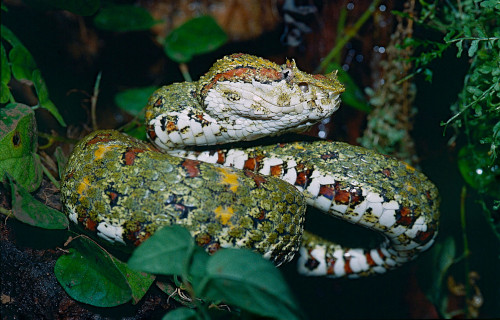
The head of this animal also evolved as relatively broad and triangular in design, clearly distinct from the neck. That’s further covered with small, irregular scales. It also displays strongly vertical elliptical pupils and relatively large eyes, which provide it with exceptional vision for a snake.
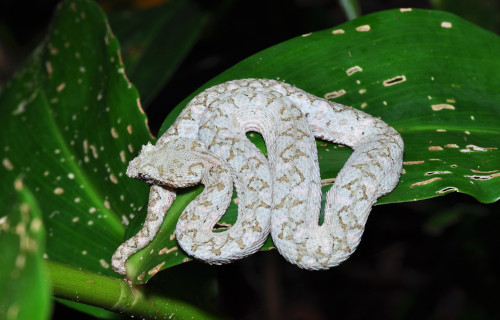
Yet, one of the most distinctive features of the highly evolved Eyelash Viper continues to be the presence of very unusual scales that protrude above the eyes like eyelashes. Most herpetologists believe that these developed to provide the animal some measure of camouflage among the foliage.
Like all known pit vipers, this marvel of evolution holds yet more wonders to discover. Those consist of very special, heat-sensing pits. Nature placed these between the eyes and the nostrils, situated on either side of the head. These pits allow the snake to ably detect warm-blooded prey.
The creature also exhibits an incredibly wide range of colors, including yellow, green, brown, and even red. Some examples even have patterns such as spots, stripes, or blotches, making them highly variable in appearance. People frequently refer to yellow specimens as golden eyelash vipers.
- Kingdom: Animalia
- Phylum: Chordata
- Class: Reptilia
- Order: Squamata
- Family: Viperidae
- Genus: Bothriechis
- Species: B. schleglii
CCL: https://tinyurl.com/ysjddhbz
Eyelash Viper Distribution, Habitat, and Ecology
The tantalizing Eyelash Viper actually evolved as indigenous to a moderately broad portion of the surface of the earth. The exact location of that zone of habitation, however, might surprise some of our readers. That’s because it’s native to portions of North America, central, and South America.
In the North American region, the remarkable animal’s presently only known to appear in the extreme southern portions of the country of Mexico. Even there, it’s found solely in smaller concentrations in certain sections of the state of Chiapas. It’s never been seen any further north.
In Central America, though, the amazing vertebrate’s known to be present in a large number of different countries. It also lives in respectable numbers there, as well. It’s proven present in the nations of Belize, Guatemala, Honduras, El Salvador, Nicaragua, Costa Rica, and Panama.
In the South American part of its range, however, its known native territory only reaches the most northerly parts of the continent. This amazing reptile’s only confirmed present in three countries, at least for the moment. Those consist of the nations of Colombia, Ecuador, and Venezuela.
Nature also blessed this marvel of evolution with a truly powerful evolutionary advantage. That’s formed of a high degree of flexibility regarding its choice of habitat. It’s therefore found in a wide variety of environments in its distribution range. Yet, it does favor lush, humid, settings.
Dense, tropical rainforests traditionally serve as its primary habitat. These settings provide ample foliage and tree cover, ideal for its arboreal lifestyle. It’s also often found in the understory layer, which offers a humid and shaded environment with plenty of prey and camouflage opportunities.
Montane forests form yet another popular location for the extraordinary species of snake, with high humidity and frequent cloud cover, providing a cool and moist environment. These have a rich diversity of plant life, including mosses, ferns, and orchids, which offer excellent hiding spots.
This unexcelled product of Nature also inhabits areas composed of moist lowland forests, which generally remain characterized by heavy rainfall and dense vegetation. These areas provide a wide variety of microhabitats, such as fallen logs, leaf litter, and relatively dense underbrush.
It’s also often found near various water sources like rivers and streams within these modified habitats. It’s even flexible in terms of elevation. The snake’s usually found between sea level and 2,640 ft (800 m) above that, though most observed specimens tend to stay at the lower altitudes.
Like others of its kin, the mesmerizing Eyelash Viper feeds as a carnivore, typically doing so as an ambush predator. It relies on its camouflage to conceal it until its prey comes close. The snake eats such prey as small birds, frogs and other amphibians, lizards, and small mammals, like rodents.
It lives a principally arboreal life, spending the vast majority of its time in various trees, shrubs, and other vegetation. The prehensile tail aids it in both climbing and anchoring itself to branches. In fact, the snake rarely descends to the ground at all, except to mate, unless forced to for some reason.
Breeding occurs throughout the course of the year, but seasonal peaks nevertheless exist, depending on the region. Females typically give birth to a litter of 6 to 12 neonates. The young are entirely independent from birth and come equipped with venom and camouflage very similar to the adults.
Green Iguana
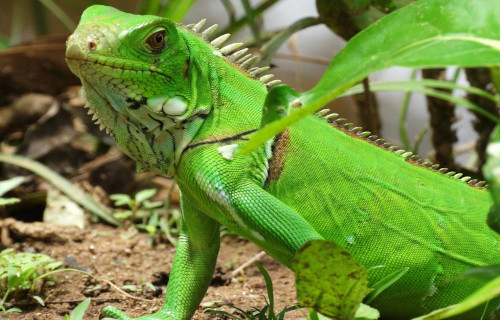
Green Iguana Facts
- Now appearing in this compilation of 5 Remarkable Central American Reptiles comes the dazzling creature named the Green Iguana.
- This undeniably descriptive term serves well as the most frequently used common name for this remarkable product of evolution. The intriguing reptile does have a few other general titles, though. Those include such terms as the common green iguana and American iguana.
- Scientific professionals, however, perhaps know the amazing creature better by its purely technical epithet. Amazingly, that’s an extremely simple term for the layperson to pronounce. It’s even somewhat ironic, as well. That’s because it holds the formal tag Iguana iguana.
- The impressive creature received that simple appellation due to the efforts of Carl Linnaeus. The highly esteemed Swedish zoologist accomplished the first recognition of it as a separate and distinct species. He managed that scientifically noteworthy deed in the year 1758.
- Researchers previously believed that a large number of subspecies of the fascinating animal also existed. Subsequent studies eventually disproved this erroneous belief, however. Herpetologists eventually reclassified these as simply regional variants of the same species.
- Fortunately, the Green Iguana appears to be maintaining a large and thriving population base in the wild. That pleasant state further seems to hold true across its entire native range. The IUCN therefore presently lists it as Least Concern on its Red List of Threatened Species.
- The fauna nevertheless still faces several potential threats to its continued existence as a species, at least. Most of these dangers stem from the actions of mankind. They include the related perils of habitat degradation, loss, and the ongoing effects of climate change.
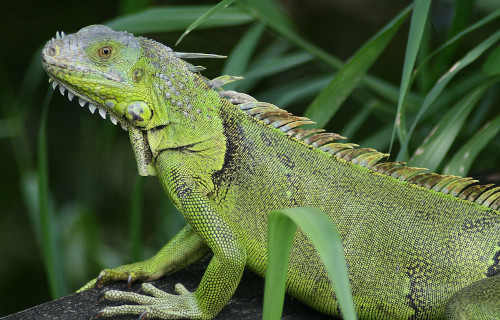
CCL: https://tinyurl.com/33psz7af
Green Iguana Physical Description
The beautiful Green Iguana almost immediately captures the attention of those individuals fortunate enough to encounter it. But the wonder doesn’t simply do so due to its visual appeal, great though that is. This holds true since it also grows to fully respectable dimensions when fully mature.
The lizard also follows the same pattern in this regard that the majority of its numerous kindred around the world display. That’s because it presents a degree of the physiological characteristic of sexual dimorphism. In its specific case, however, this trait manifests itself purely in terms of size.
More specifically, males of the species attain a greater average size than their female counterparts. This trend extends to both length and mass. Overall, though, the species reaches an average total length equaling approximately 3.9 – 5.6 ft (1.2 – 1.7 m). Yet, the tail accounts for most of this.
Despite the great total length, the body itself only averages somewhere between 12 – 17 in (30 – 42 cm). Males achieve a mean weight of about 8.8 lb (4 kg). Females, however, vary much more significantly in this respect. A typical mass for them ranges from about 2.6 – 6.6 lb (1.2 – 3 kg).
Exceptional individuals do occur, though, among both sexes. Some of the larger males reach or even exceed 18 lb (8.2 kg) in mass. On extremely rare occasions, a few mammoth examples even weigh as much as 20 lb (9.1 kg). These extreme examples occasionally reach lengths of up to 6.6 ft (2 m).
Otherwise, the genders of the mesmerizing Green Iguana present the same general outward appearance to the casual observer. Incredibly, this includes a row of thin, vertical spines extending from the tail across the back. The reptile’s tail also develops as highly elongated and quite thin.
But it’s the astonishingly vibrant colors of the creature that draw the most interest. Regardless of its common name, green only forms one of the many hues the animal presents. These vary, especially between locations. But, they include bluish, lavender, red, black, brown, and even orange.
- Kingdom: Animalia
- Phylum: Chordata
- Class: Reptilia
- Order: Squamata
- Family: Iguanidae
- Genus: Iguana
- Species: I. iguana
Green Iguana Distribution, Habitat, and Ecology
The deceptively-named Green Iguana evolved as endemic to a surprisingly large swathe of the earth’s surface. The full extent of that native zone of habitation might come as a shock to some people, though. That’s because it mainly lives in all of Central America and part of South America.
Though commonly present throughout Central America, southward, the distinctive animal only appears in the roughly northern half of South America. That reaches as far as northern Paraguay. To the far north, however, it does live in extreme southern Mexico, in North America.
This breathtaking creation of Nature displays decidedly strong preferences regarding its choice of habitat type. It primarily prefers to inhabit regions consisting of humid, tropical rainforests. The creature also manifests favoritism for areas situated in close proximity to abundant water sources.
Just like many other iguanas around the globe, this wonder of countless ages of evolution also developed as primarily arboreal in nature. Descending to the ground therefore occurs infrequently. It thus spends the vast majority of its time in the dense canopy of the ecosystems it inhabits.
The marvelous Green Iguana additionally developed as diurnal in terms of its behavior. For its dietary preferences, it feeds principally as a herbivore. The majority of that fare consists of various local fruit, flowers, and leaves. The occasional small invertebrate augments this, though.
Following mating, the female usually lays anywhere between 20 – 71 eggs in a burrow. Amazingly, she generally ignores the eggs completely once she has completed the process. Incubation typically requires 10 – 15 weeks. Hatchlings tend to stay together in a group for about an entire year.
American Crocodile
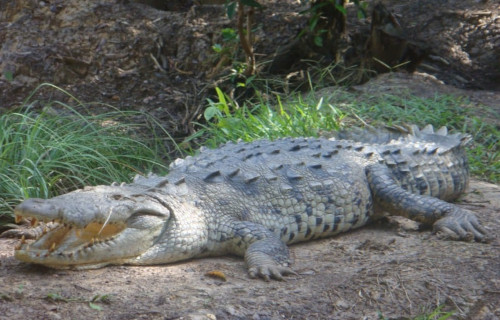
CCL: http://bit.ly/2xQPH8p
American Crocodile Facts
- Our next selection for this gathering of these 5 Remarkable Central American Reptiles is the astounding animal known as the American Crocodile.
- Perhaps most notably, this informative term serves as the descriptive common name for a particular species of crocodilian found in the Neotropics. Yet, the marvel also has other general titles. These include Acutus crocodile, Central American crocodile, and Neotropical crocodile.
- Inside of the scientific community, however, it’s most likely better known by its purely technical designation. Unlike most such tags, that’s comparatively simple for the layperson to pronounce. That’s because this wonder of Nature holds the formal epithet Crocodylus acutus.
- This amazing reptile received that relatively simple moniker due to the efforts of Jean Léopold Nicolas Frédéric, baron Cuvier. He accomplished the first formal recognition of it as a separate and distinct species. He achieved that scientifically noteworthy deed in the year 1807.
- The remarkable creature additionally holds yet annother distinction. That’s due to the impressive fact that it appears to be the most widespread of the four extant species of crocodile from the Americas. That status easily distinguishes it from its many relatives.
- This situation nevertheless has its unique aspects, however. Within the boundaries of its greatest area of concentration, the distribution of the American Crocodile remains extremely limited. This smaller range includes only Puerto Rico and the southern half of Florida.
- This animal remains extremely powerful and highly dangerous if provoked. Currently though, this product of evolution only has an estimated population of 2,000 individuals. For the moment, therefore the IUCN lists it as Vulnerable on its Red List of Threatened Species.
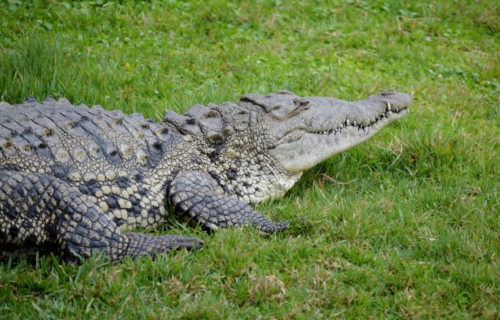
CCL: http://bit.ly/2IjEG4n
American Crocodile Physical Description
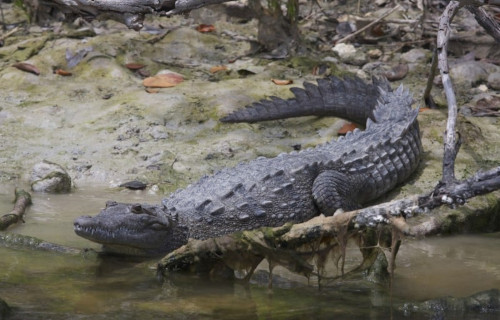
Like all known extant crocodilians, the fascinating American Crocodile developed as a quadruped, possessing four short, splayed legs, and a long, powerful tail. This majestic work of Nature also evolved an extremely thick, scaly hide with rows of ossified scutes running down its back and tail.
The snout of the impressive reptile also grows highly elongated, following the pattern of its brethren. This feature also includes a remarkably strong pair of jaws. The eyes develop as covered by nictitating membranes for their protection, along with lachrymal glands, which produce tears.
The nostrils, eyes, and ears develop situated entirely on the top of its head, so the rest of the body can be concealed underwater for surprise attacks. As a larger variety of crocodile, some males of the species reach lengths of as much as 20 ft (6.1 m) and weigh in excess of 2,000 lbs (907 kg).
On average, though, these individuals of the American Crocodile remain smaller than this. A more typical size’s in the range of 13 ft (4.1 m) in length, and a weight of about 880 lbs (400 kg). Like many animals, sexual dimorphism exists. Females develop smaller, rarely exceeding 12 ft (3.8 m).
- Kingdom: Animalia
- Phylum: Chordata
- Class: Reptilia
- Order: Crocodilia
- Family: Crocodylidae
- Genus: Crocodylus
- Species: C. acutus
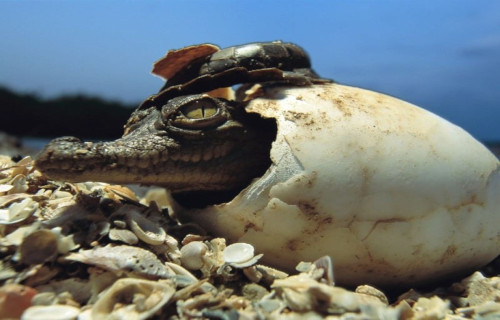
American Crocodile Habitat
As recently as 1970, the majority of experts determined that the population of the American Crocodile appeared to be highly threatened. Estimates at that time placed its population at no more than 200 individuals. The habitat of the powerful crocodile consists largely of coastal areas.
Specimens of this marvel of biology most frequently make their home in river systems. They do, however, have a tendency to prefer a certain level of salinity in the water itself. This usually results in the species congregating in brackish lakes, coastal swamps, lagoons, even cays, and small islands.
Some other crocodiles also have this natural tolerance for salt water. That’s because they have salt glands Nature provided them underneath the tongue. The American Crocodile, though, remains the only known species other than the Saltwater Crocodile to commonly live and thrive in saltwater.
Like any other large species of crocodilian, given its nature, this captivating animal continues to be potentially dangerous to humans. The reptile does not, though, appear to be a very aggressive species, relatively speaking. That holds true due to the fact that attacks on humans rarely occur.
CCL: http://bit.ly/2xLZ0ap
American Crocodile Distribution and Ecology
Populations of the fascinating American Crocodile occur across a realtively wide swathe of its region of the surface of the earth. Populations mainly exist along the Atlantic and Pacific coasts of southern Mexico. Some, however, appear to live as far as Peru and Venezuela, in South America.
This amazing species continues to remain the most prevalent in the United States, in North America, however. Yet, the powerful reptile also occasionally occurs on many of the Caribbean islands. But it presently remains unclear if this forms part of its natural range, or an aberration.
The well-known creature also constitutes one of the largest of all known crocodile species. This variety also has a noticeably more V-shaped snout compared to other large crocodiles. The great majority of these usually have a slightly wider snout. The evolutionary reason for this is unknown.
Somewhat surprisingly, despite its large size itself, this incredible crocodilain does not commonly prey upon large animals. In this, it differs from the majority of its relatives. Fish, reptiles, birds and small mammals appear make up the majority of the diet of most individual specimens.
Exceptions to this tendency do nevertheless occur, as is often the case. That’s due to the fact that on occasion larger mammals, such as deer and domestic animals do get taken. The dietary habits of the American Crocodile in coastal regions remain poorly studied, at least for the time being.
Plumed Basilisk
CCL: https://bit.ly/3akgcVe
Plumed Basilisk Facts
- Next up in this compendium of 5 Remarkable Central American Reptiles we give you the astonishing marvel known as the Plumed Basilisk.
- This mesmerizing creation of Nature and evolution most frequently goes by the appropriate and descriptive name that we’re using here. It does, however, also have other general titles it’s known by. These include crested basilisk and green basilisk, and even Jesus Christ Lizard.
- Within the scientific community, though, it’s perhaps better known by its technical tag. Like so many other such epithets, however, that one’s rather difficult for the layperson to pronounce. That’s because this remarkable reptile bears the designation of Basiliscus plumifrons.
- This remarkable creature received that epithet due to the efforts of Carl Linnaeus himself. That highly esteemed Swedish zoologist recorded the first formal recognition of the iguana as a separate and distinct species. He achieved that scientifically noteworthy deed in the year 1759.
- The moniker Jesus Christ Lizard derives from an astounding ability the animal has. It has the ability to run across the water! When threatened, special sections of skin on its toes expand. This increases surface area and allows it to skim across the water for up to 15 ft (4.6 m).
- Thankfully, the astonishing Plumed Basilisk appears to be maintaining a population base that’s both stable and sufficient. That pleasant state also seems to hold true throughout the entirety of its range. The IUCN therefore presently shows it as Least Concern on its published Red List.
- It nevertheless still faces numerous potential threats to its continued existence as a species. Like all forms of life on earth today, most of these stem from the actions of mankind. Chief among them, however, stands the related dangers of habitat loss and ongoing climate change.
CCL: https://bit.ly/3asIrB9
Plumed Basilisk Physical Description
The stunning Plumed Basilisk never fails to capture the attention and imagination of those individuals fortunate enough to meet one. Indeed, it does so for a variety of reasons. That’s true since it’s not only a beautiful variety of lizard, but also boasts some respectable measurements.
The wonder also follows a pattern of development quite common among many species, including its kindred. That’s the fact that it displays a degree of the physiological characteristic of sexual dimorphism. In its specifc instance, however, this trait actually manifests itself in several manners.
Males of this spectacular creature achieve an average length equaling 3 ft (0.91 m). Yet, despite their surprising length, these products of ages of evolution remain comparatively light in weight. Mature specimens of this particualr gender typically only mass somewhere around 7 oz (200 gms).
Females, meanwhile, virtually never achieve anywhere near this length. These examples, in fact, rarely exceed 2 ft (0.61 m) in this dimension. In their case, masses also remain notably less than their male counterparts. This sex most commonly only reaches approximately 5.3 oz (150 gms).
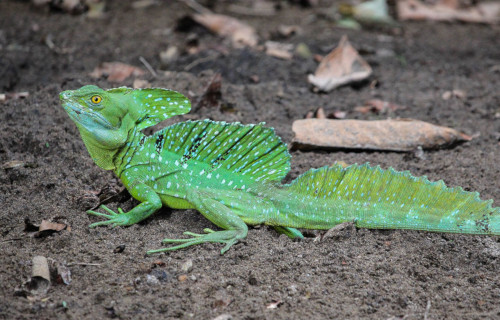
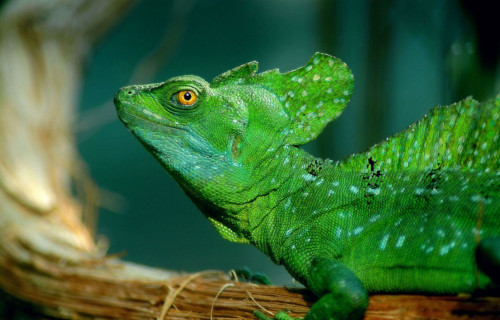
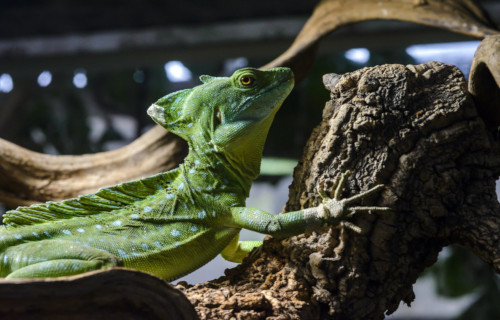
Another characteristic also exists which distinguishes the genders. Males possess three distinct crests. These appear on the head, back, and tails, and many believe they resemble plumes, thus the name. Female bodies, however, either lack these entirely or else display notably smaller one’s.
Otherwise, the two sexes of the Plumed Basilisk present virtually the same outward appearance, with only two more small variations. Color patterns generally consist of bright green with blue, turquoise, or yellowish markings. Some individuals, especially the males, display more turquoise.
The tail is long and laterally compressed, aiding in swimming and balance. It has strong, well-developed limbs. That’s particularly true of the hind legs. As previously mentioned, it also evolved long toes with fringes of skin that help increase surface area when the wonder sprints across water.
Nature isn’t finished with it yet, as still more features deserve notice. The eyes develop as relatively large and round in shape. These usually show a golden to orange color. Males have a prominent helmet-like crest on the top of the head, which separates them from females in yet another way.
- Kingdom: Animalia
- Phylum: Chordata
- Class: Reptilia
- Order: Squamata
- Family: Corytophanidae
- Genus: Basilicus
- Species: B. plumifrons
CCL: https://bit.ly/2TngB3X
Plumed Basilisk Distribution, Habitat, and Ecology
Sadly, the otherworldly Plumed basilisk evolved as indigenous to a moderately restricted portion of the surface of the earth. Exactly where that zone of habitation lies probably won’t surprise too many people, though. That’s because it developed as native to a specific part of Central America.
But, even there the animal only appears in a handful of countries. To date, it’s only known to be present within the national borders of the nations of Honduras, Nicaragua, Costa Rica, and Panama. For the moment, no credible evidence exists to indicate that it ever possessed a wider range.
Like many of its many kindred around the world, this species displays decidedly clear and specific preferences regarding its choice of habitat. Broadly speaking, this consists of regions comprised of tropical rainforests. Even here, however, the awesome reptile presents very specific favoritism.
It’s found almost exclusively in lowland sections of rainforest, typically having dense vegetation. In this manner, the animal manifests extremely certain preferences for a range of altitudes. Virtually all observed examples appeared at heights ranging from approximately sea level to 3,900 ft (1,200 m).
The intrepid lizard further displays uniquely precise microhabitat tendencies. The perpetually hot, humid, and wet conditions of these setting serve it well in this regard, of course. Yet, goes even further, and generally stays in trees situated in the immediate vicinity of either rivers or streams.
The Plumed Basilisk plays a dynamic role its tropical rainforest ecosystem, both as a predator and prey. It evolved as omnivorous, though it’s principally carnivorous. Its main prey includes insects, spiders, and small invertebrates. It does, however, occasionally eats fruits, flowers, or leaves.
In turn, it has its own share of predators, of course. These mainly include birds of prey, such as hawks, snakes, and various mammals. Coatis and raccoons stand high on the latter list. It uses its incredible ability to run across the water as a means of escaping from the aforementioned threats.
It evolved as pplygynous in nature, meaning males mate with multiple partners. Females lay clutches of 5–15 eggs, several times a year. She buries these in moist soil and hatching occurs in about 8–10 weeks. Hatchlings are highly independent and thus vulnerable to numerous predators.
Yellow-bellied sea snake
CCL: https://bit.ly/3qCT7YQ
Yellow-bellied sea snake Facts
- Closing out this article about these 5 Remarkable Central American Reptiles comes the only marine entry, the Yellow-bellied sea snake.
- The unusual, but descriptive, term that we’ve chosen to apply serves as the most often used common name for this remarkable species of marine reptile. The wonder also goes by yet another name, though. That’s the equally informative name of Pelagic Sea Snake.
- Scientific professionals, however, such as researchers, typically use its official scientific name to refer to the creature. That’s actually a relatively simple term, though, at least compared to many others. That’s because it bears the formal epithet of the Hydrophis platurus.
- It also holds a notable distinction, which it shares with a great multitude of other species. That’s due to the origin of that technical name. The eminent zoologist, Carl Linnaeus made the first formal acknowledgement of it as a separate and distinct species in the year 1776.
- For the moment, the fabulous marine reptile also holds still another rare distinction. It represents one of the minority of known species across the globe that appears to presently be holding its own in the face of the ecological upheavals the world’s now experiencing.
- As a result, its population numbers seem to be maintaining a level that’s both stable and sufficient. That further appears to hold true throughout the entirety of its natural range. The IUCN, therefore, presently lists it as Least Concern on its Red List of Threatened Species.
- The amazing product of Nature and evolution nevertheless does face some potential threats to its continued existence as a species. Commerical fishing practices pose a danger, in the form of accidental bycatch. Its greatest threat, though, most likely consists of climate change.
CCL: https://bit.ly/33vRJhY
Yellow-Bellied Sea Snake Physical Description
The stunning Yellow-Bellied Sea Snake manages to fully impress those individuals fortunate enough to encounter it safely, wholly regardless of sheer physical size. That’s because it actually ranks as smaller than average among its peers. Most related species, in fact, attain much larger sizes.
Nature, however, gives little regard to such things. The magnificent product of evolution also displays a moderate degree of the physiological characteristic known as sexual dimorphism. In its specific case, though, this biological trait manifests itself in terms of simple length of body.
More precisely, the males of this intriguing species grow to about 80% of the length of their female counterparts. Males of the animal reach an average body length equaling roughly 28 in (72 cm). The females, meanwhile, typically attain mature lengths averaging approximately 35 in (88 cm).
Otherwise, though, the two genders develop as virtually indistinguishable in appearance, at least to the naked eye. The body of the reptile develops a compressed, tapered shape. This thins to less than half the diameter of the neck. The head, however, remains narrow, with an elongated snout.
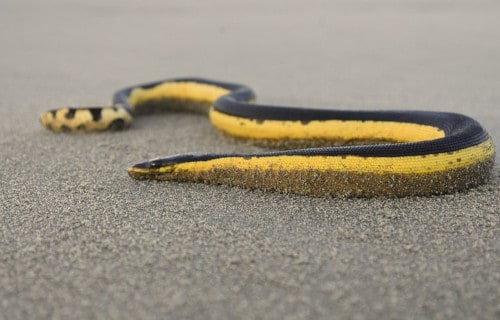
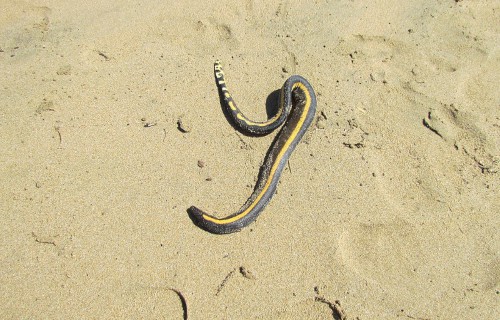
Yet, it’s doubtless the color scheme of the amazing Yellow-Bellied Sea Snake that generally catches the eye of the viewer. That pattern of coloring also obviously serves as the source of the common name. The belly of the snake usually presents a bright yellow, though rarely brown appears.
Colors of the upper body vary significantly, however. Most frequently, though, these consist of varying shades of either black or very dark brown. Infrequently, a series of small black dots also appears on the lighter background. A set of black bars even makes the occasional appearance.
- Kingdom: Animalia
- Phylum: Chordata
- Class: Reptilia
- Order: Squamata
- Family: Elapidae
- Genus: Hydrophis
- Species: H. platurus
CC License: https://bit.ly/33vRJhY
Yellow-Bellied Sea Snake Distribution, Habitat, and Ecology
Luckily, both for the Yellow-Bellied Sea Snake itself, and for those of us who appreciate Nature, it holds one the widest ranges of distribution of any snake on earth. The only warm ocean in which the remarkable marine animal does not appear to live in natively is the Atlantic Ocean.
Even there, though, the snake’s occasionally seen, due to human activities carrying individuals outside of their normal range. It principally naturally inhabits the warmer ocean regions throughout the world, except the Atlantic. It’s also the only sea snake to reach the Hawaiian Islands.
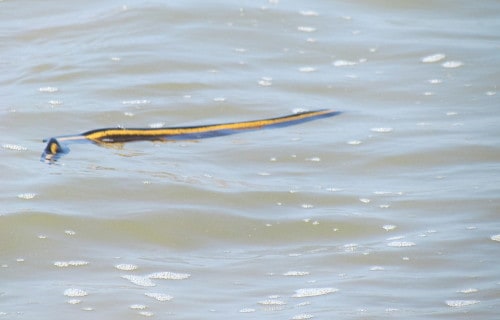
The intrepid reptile additionally greatly expands its territorial options due to its own distinct nature. That’s because it evolved as an entirely pelagic creature. It therefore inhabits the vast open regions of the ocean, typically, though not entirely exclusively, far from any shore in the general area.
This marvel of Nature further shows a clearly marked preference for regions of free-floating kelp. The reptile’s perhaps most frequently seen off the coast of Australia. In all areas in which it appears, however, the wonder of the seas prefers the same type of environment in which to make its home.
The reason the Yellow-Bellied Sea Snake so often prefers to inhabit regions of kelp pertains to two specific facets of its biology. These regions serve it well for purposes of both hunting and reproduction. Many of its favorite prey frequent such regions, and it generally seeks its mate there.
As opposed to ancient beliefs, the animal does require at least some fresh water for survival. Amazingly, however, it gathers most of this by drinking freshwater precipitation that gathers on the surface of the ocean. It also breeds in warm waters, bearing live young, usually in tidal pools.
CCL: http://bit.ly/2xLZ0ap
5 Remarkable Central American Reptiles
We hope that each of you enjoyed reading, and hopefully learning from, this article we’ve written for you about these 5 Remarkable Central American Reptiles. It’s also our fervent hope that doing so has left you with either a new or fully renewed appreciation for such remarkble wonders of Nature.
Unfortunately, however, many of their numerous kindred around the world now find themselves facing strong threats to their continued existence as a species. Many of those dangers, in fact, stem from the actions of mankind. We must do all that we can to protect and preserve them all.
Check out our other articles on 5 Thrilling Animals of Thailand, Spectacular Dolphins Throughout Our World, 7 Captivating United States Lakes, Earth’s Amazingly Abundant Avians