


We sincerely hope that each of you, our readers, will thoroughly enjoy and appreciate this article we present about these 5 Remarkable Romanian Herbaceous Plants. It was our pleasure to gather the information for you. May it provide you with both education and increased awareness.
Certainly, these few species listed within this presentation represent only a portion of the similar marvels in this region of the world. It’s our belief, though, that they serve as excellent representations of the wonders that exist. Check out some of our other articles for similar marvels.
Calypso Orchid

CCL: https://tinyurl.com/44ka7ja6
Calypso Orchid Facts
- Starting off this article about these 5 Remarkable Romanian Herbaceous Plants we give you the gorgeous flora named the Calypso Orchid.
- This mesmerizing creation of Nature and botanical evolution most frequently goes by the distinctive common name applied to it herein. The delicate wonder does have a few other titles by which it’s known, though. Those include the tags fairy slipper and Venus’s slipper.
- Within the scientific community, however, it’s perhaps much better known by its technical designation. Thankfully, that’s an extremely simple one for the layperson to pronounce. That’s because the incredible flora holds the extremely similar formal tag of Calypso bulbosa.
- The esteemed Carl Linnaeus himself accomplished the first official recognition of it as a separate and distinct species. At that time, though, the respected Swedish biologist assigned it a different moniker. He originally labeled it as Cypripedium bulbosa. He did this in 1753.
- This astounding beauty stands out in the annals of science for one reason in particular. That’s true since it represents the sole member of its entire Genus. Though not unknown, that’s nonetheless somewhat uncommon. Science presently recognizes several extant subspecies.
- Fortunately, the stunning Calypso Orchid appears to be maintaining a population base that’s both stable and sufficient. This pleasant state also seems to hold true througout the entirety of its established range. Accordingly, the IUCN does not yet show it on the famous Red List.
- The plant nevertheless should still be considered as facing multiple potential threats to its continued existence as a species. In this respect, it faces the same dangers as all forms of life on earth today. Most of those stem from the actions of mankind, and include climate change.
Public Domain Image
Calypso Orchid Physical Description
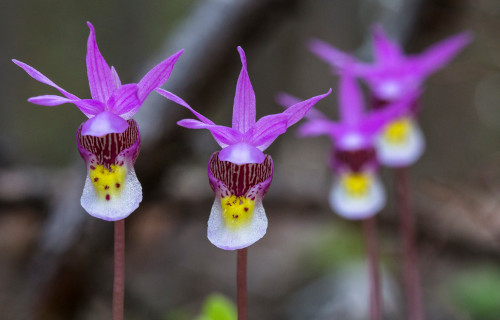
Just like most of its relatives, the mesmerizing Calypso Orchid rarely fails to capture the attention and interest of those individuals who spot one. Unlike some of those kindred, however, it typically does so due to its beauty alone. That’s true because it remains a comparatively small plant.
Each of these beauties evolved to produce a slender stalk, called a stem. In terms of color, this aspect of the flora usually appears either reddish or purplish. As stated, though, this never attains a great height. Average vertical reach for this portion of the amazing flora equals 4 – 6 in (10 – 14 cm).
This itself grows from a small, underground corm-like bulb anchors the plant. Distinctively, each stem also produces a single leaf only, situated relatively close to the ground. This solo foliage usually develops as somewhat oval in shape, and presents as dark green, shiny, and slightly pleated in form.
Yet, it’s doubtless the flowers of the breathtaking Calypso Orchid that generally garner the most attention form viewers. Each individual plant generally produces a single bloom. Nonetheless, exceptions occur. Even in these rare instances, however, it produces a maximum of two blossoms.
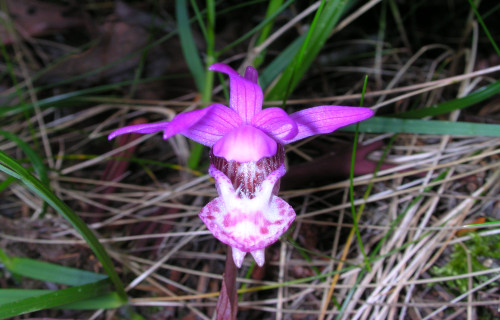
The stunning colors that this wonder of Nature and evolution most frequently displays run from very light pink to dark purple. Occasionally, though, these manifest with magenta tones. Meanwhile, the petals and sepals of the marvel both evolved as narrow in shape, spreading outward like wings.
The labellum, known colloquially as the lip of the flower, presents as white to pink, slipper-shaped, with yellow to reddish spots and hairs inside, giving it an appearance like a slipper or pouch. This same lip also often develops as notably ridged and hairy, typically creating a slightly textured look.
- Kingdom: Plantae
- Phylum: Tracheophyta
- Class: Liliopsida
- Order: Asparaglaes
- Family: Orchidaceae
- Genus: Calypso
- Species: C. bulbosa
CCL: https://tinyurl.com/44ka7ja6
Calypso Orchid Distribution, Habitat, and Ecology
The magical Calypso Orchid evolved as indigenous to a comparatively large portion of the surface of the earth. Yet, that natural zone of habitation qualifies as rather unusual. Nature created it as native to what science calls a circumboreal distribution. Explaining that therefore takes some doing.
The flora appears naturally across an area broad in expanse, but precise in location. It only grows natively around the northern regions of the globe. In doing so, it develops in the wild on a total of three separate continents. Those are the scattered locations of Europe, Asia, and North America.
In Europe, the Angiosperm mainly resides within Sweden, Norway, and Finland. It’s also present in the Baltic region, and parts of Russia. In its range inside Asia, though, the biological masterpiece makes itself known across Siberia, the Russian Far East, northern China, Korea, and even Japan.
In North America, it appears across all of Canada, except Nunavut. Its territory also extends further north, to Alaska. Southward, it extends that into the northern and western United States, including the Pacific Northwest, and northern Rockies, Great Lakes region, and parts of New England.
The remarkable Angiosperm displays habitat preferences that qualify as decidedly clear, specific, and delicate. This orchid variety principally appears in regions composed of cool, moist, shaded forests. It’s especially common in coniferous forests containing fir, spruce, hemlock, cedar, pine.
It does have some adaptability to differing elevations, however. Observers spot it from lowland forests to montane zones, depending on latitude. It favors humus-rich, well-drained soils with lots of decaying organic matter, often living on mossy forest floors or near decaying logs and stumps.
The fabulous Calypso Orchid achieves its pollination via a unique form of deceptive pollination strategy. Its bright colors, slipper-shaped lip, and yellow/reddish hairs mimic nectar-rich flowers, but it actually produces no nectar. This appearance tricks bumblebees into visiting, expecting a reward.
In its early stages, the flora depends on a symbiotic relationship with certain soil fungi. Even as an adult, it continues to rely on these to obtain nutrients, since its root system is very reduced. That dependence also makes it extremely sensitive to changes in soil conditions or forest composition.
Despite its size, though, it plays an important role in the eocsystems in which it appears. There, it acts as an indicator species of healthy, undisturbed old-growth forests, since it requires intact fungal networks and stable microclimates. The flower also provides seasonal forage for many insects.
Snake’s Head Fritillary
CCL: https://shorturl.at/chnq6
Snake’s Head Fritillary Facts
- Now appearing in this compendium of 5 Remarkable Romanian Herbaceous Plants comes the wonder named the Snake’s Head Fritillary.
- The attention-grabbing term somewhat surprisingly serves as the most frequently used common name for this remarkable plant. It has numerous other titles that it’s known by, however. These include the terms chess flower, leper lily, and Lazarus bell, just to name a few.
- Among scientific professionals, though, it’s typically referred to by its purely official title. But, as very often holds true, that’s a somewhat difficult term for the layperson to pronounce. That’s because the natural marvel holds the complex technical title of Fritillaria meleagris.
- The beautiful Angiosperm received that moniker due to the efforts of Carl Linnaeus. The highly esteemed Swedish botanist accomplished the first official recognition of it as a separate and distinct species. He managed that scientifically noteworthy deed in the year 1753.
- Several of its general names also stem from cultural references, some of them ancient. Snake’s Head, for example, derives from the supposed snake-like appearance of its bulbs. The term leper lily stems from the belief that its shape looks like the bell once carried by many lepers.
- The gorgeous Snake’s Head Fritillary appears to still be present across most of its range. Sadly, though, it’s become uncommon in the wild, though commonly planted in gardens. For the moment, the IUCN has no listing for its on the organization’s Red List of Threatened Species.
- Like many related flora, it faces multiple potential threats to its continued existence as a species. Many of these perils stem directly from the actions of mankind. They include such dangers as habitat loss due to human expansion, and the danger of ongoing climate change.

CCL: https://shorturl.at/ftvNS
Snake’s Head Fritillary Physical Description
The mesmerizing Snake’s Head Fritillary certainly qualifies as a creation of Nature that fully earns the appreciation it typically receives from those who encounter it. Yet it does so without the benefit of physical size. That’s true since, in that respect, it’s a small member of its particular Order.
Each example of this true botanical beauty typically produces only a single, though strongly upright stem. These features also generally develop as relatively slender. Exceptional specimens attain heights of up to 15 in (38.1 cm). Most of them, however, remain somewhat shorter than this.
These stems also possess several highly distinctly-shaped shaped leaves. This amazing foliage develops as highly elongated, and each generally curls in upon itself along its length. Both these and the stems from which they spring also usually present as a very light shade of green in color.
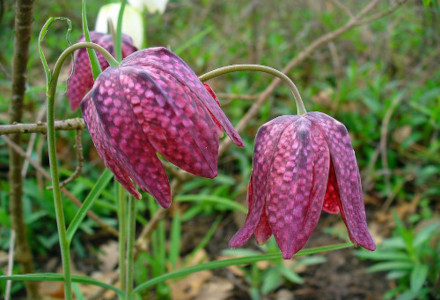
Yet it’s undoubtedly the flowers of the Snake’s Head Fritillary that capture the attention of the viewer. Most often these appear singly atop the stem. Nevertheless, as many as 2-3 develop on occasion. This bloom tends to droop from the tip of the structure, and averages 2 in (5 cm) long.
The vast majority of specimens of this wonder display a strongly checkered pattern of various shades of purple. Sometimes white also develops mixed in with the purple. In rare examples, it sometimes even shows pure white. Many thin, reddish-brown veins augment its distinctiveness.
- Kingdom: Plantae
- Phylum: Tracheophytes
- Class: Monocots
- Order: Liliales
- Family: Liliaceae
- Genus: Fritillaria
- Species: F. meleagris

Snake’s Head Fritillary Distribution, Habitat, and Ecology
The stunning Snake’s Head Fritillary evolved as native to a relatively broad swathe of the surface of our globe. The setting for that greater range probably won’t surprise many people, though. This wonder of evolution developed as endemic to most of both Europe and western Asia.
Sadly, though, even within that overall zone of habitation, however, it appears in the wild in only highly scattered concentrations. In fact, in many areas it’s presently considered endangered. Countries in which the stunning plant grows natively include Croatia and Sweden, among others.
Like many of its related species found around the world, the amazing flora displays moderately precise requirements regarding its choice of habitats. The remarkable variety of Angiosperm most frequently grows in the wild in regions of either meadows or openings in or near woodlands.
Yet, it nonetheless does sometimes grow in areas of open meadows. In all instances though, it needs the presence of relatively damp soil. Rivers or lakes often lay nearby. The flora also displays a preference for lower altitudes. It’s not known to develop above 2,625 ft (800 m) above sea level.
In the various regions in which the Snake’s Head Fritillary does live naturally, the Tracheophyte fortunately usually develops in moderately large numbers. Pollination occurs due to the actions of multiple locally numerous insects. Its most common pollinator, of course, consists of native bees.
Its beauty does conceal a dangerous secret, however, as so very frequently occurs in evolution. The lovely bulb contains modest amounts of extremely dangerous alkaloids. Due to their presence, few animal species feed on this lovely perennial plant. Nature itself tends to take care of its own!
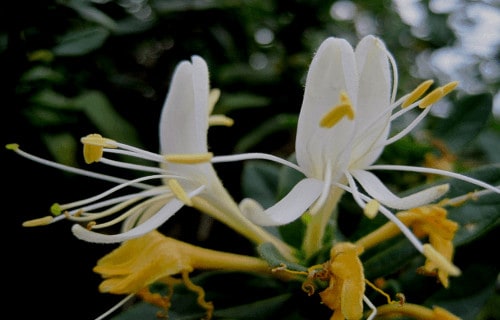
Honeysuckle
Honeysuckle Facts
- Our next choice for inclusion in this gathering of these 5 Remarkable Romanian Herbaceous Plants is the always delightful plant known as the Honeysuckle.
- Perhaps surprisingly to some, the very short term actually names an entire Family of stunningly beautiful plants placed in the Caprifoliaceae family. Due to this nature, each of these beautiful and remarkable species develops as either arching shrubs or highly twining vines.
- A remarkable total of roughly 180 recognized species of the Angiosperm exist at this time. Numerous other plants, however, remain under consideration for inclusion in the tantalizing group at this time. Consideration of that status remains ongoing by multiple researchers.
- All of the presently acknowledged members of this truly impressive Family of plants additionally share yet another characteristic. This particular one, however, has nothing to do with its amazing biology. That’s due to the fact, in this instance, it’s a matter of geography.
- That’s because all known varieties of this sweet-smelling and brilliantly colored plant evolved as native to various portions of the Northern Hemisphere. This geographical restriction also applies to those species presently being considered for inclusion in the very select group.
- As of now, approximately 100 of the recognized Honeysuckle forms evolved as endemic to the country of China, in Asia. The continents of Europe and North America, along with the large country of India, each further serves as home to a total of 20 of the member species.
- The relatively few remaining members of this marvelous botanical Family appear scattered throughout various locations in the continents of Australia and Africa. Members of its group therefore benefit from one of the widest ranges of distribution currently known to science.
Honeysuckle Physical Description
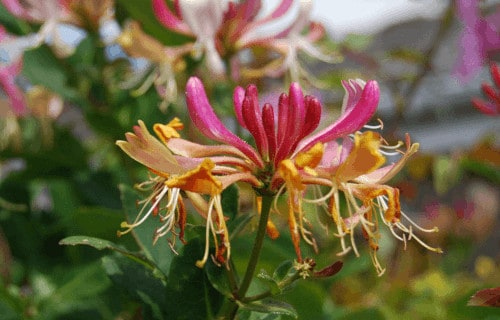
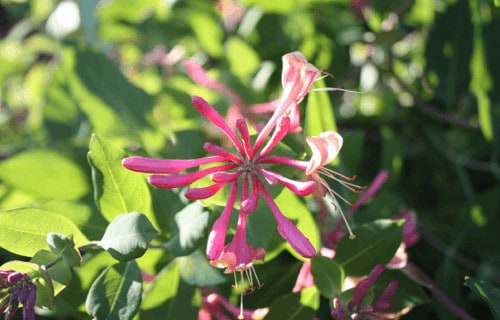
Impressively, the majority of the known types of Honeysuckle evolved as comparatively strong twining climbers in nature. On all of these many varieties, the leaves grow opposite, and develop as very simple ovals. This visually appealing foliage also averages about 4.5 in (10 cm) in length.
Although most of these marvels evolved as deciduous, some actually develop as evergreens. Many of the individual species also produce strongly sweetly-scented flowers. These blooms also produce small quantities of sweet, edible nectar. Most of the delicate flowers develop in clusters of two.
Both shrubby and vining sorts possess strongly fibrous stems which remain suitable for both binding and textiles. Like many beautiful plants, however, Honeysuckle conceals a somewhat darker secret. That’s because the fruit of the Angiosperm possesses a low level of poisonous compounds.
In appearance, these fruits vary, displaying either a spherical or somewhat elongated shape. Yet, the most commonly seen colors of the small fruit include red, blue, and black. Nonetheless, on very rare occasions, some specimens produce this aspect of the plant in an even wider range of such hues.
- Kingdom: Plantae
- Phylum: Angiosperms
- Class: Eudicots
- Order: Dipsacales
- Family: Caprifoliaceae
- Genus: Lonicera
Honeysuckle Invasiveness
Amazingly, while the fruit of many varieties of Honeysuckle evolved to be comparatively toxic, this trait does have its share of uses. That holds true due to the fact that, in a very few cases, the fruit of the Angiosperm, while extremely small, can be consumed and even used for types of commerce.
This part of the stunning plants also has other natural uses, though. This remains true because the berries of most forms of the natural beauty also remain extremely attractive to numerous forms of local wildlife. For example, an enormous variety of butterflies and hummingbirds adore them.
Most unfortunately, however, several species within this truly remarkable Family have now become considered as invasive. This occurred when human activities introduced them outside their native range. This sad situation holds particularly true in both New Zealand and the United States.

Honeysuckle Popularity
Due to its many fine qualities, the Honeysuckle has now become extraordinarily popular in many regions of the world. This most commonly manifests itself in using it as a garden decoration. Many people now use it both because it smells beautiful, and covers unsightly walls and outbuildings.
This gorgeous and colorful flora has also become quite popular for its sheer pleasure to the different human senses of perception. In fact, a great number of people find it pleasant to employ for the numerous blooms it produces in the summer. These form as quite beautiful and highly aromatic.
The hardy climbing types of this botanical wonder do have certain specific needs, of course. That’s because most forms need the roots located in shade, but the tops prefer sunlight or very light shade. The varieties one uses also need to be chosen with great care because most grow quite prolifically.
Cypripedium calceolus

Public Domain Image
Cypripedium calceolus Facts
- Placing here in this compilation of 5 Remarkable Romanian Herbaceous Plants we present you with the startling beauty named the Cypripedium calceolus.
- The tongue-twisting term found herein currently serves as the official scientific name of a truly stunning variety of plant. Unfortunately for most of its fans, the magnificent product of evolution, an orchid species, currently has no generally accepted common name.
- The first recorded scientific description of this beautiful botanical wonder of Nature took place in Germany, in the year 1753. Much later, the highly renowned Swedish botanist Carl Linnaeus himself became the first person to officially place it within a scientific classification.
- In fact, that official placement puts this gorgeous Angiosperm in the Family collectively known as the Lady’s Slipper Orchid. Its particular appearance, however, often leads to its being confused with other, visibly similar species, at least by non-professional observers.
- Quite thankfully for those who appreciate its beauty, the Cypripedium calceolus currently appears to be maintaining a sufficient and stable population base across its range. The IUCN, therefore, lists the natural beauty as Least Concern on its Red List of Threatened Species.
- The gorgeous plant must, however, nevertheless be considered to be facing at least some risks to its continued existence as a species. Though still abundant, human encroachment on its habitat could pose a threat in the future. Plus, it now faces the threat posed by climate change.

CCL: https://bit.ly/2YmDXb6
Cypripedium calceolus Physical Description
Regardless of its nearly impossible to pronounce name, the magnificent Cypripedium calceolus easily dazzles the eye. Yet it does not do so just because of its appearance, though that’s certainly lovely enough. It also represents one of the largest of the known orchid varieties in its range.
The captivating flora develops from a rhizome, and develops fine, fibrous roots. From these, it produces erect, vertical stems. Younger specimens generally have only one of these, with more developing as it ages. Fully mature examples sometimes possess as many as ten of these features.
In terms of height, these vary significantly between individuals, even on the same plant. Exceptional individuals sometimes reach as much as 23.6 in (60 cm) in height. Most, however, remain somewhat less tall than this. The stalks themselves usually present as a very delicate, light green in color.
At various locations along the length of each stem, a typical total of 3 – 4 leaves appear. These develop as broad, and ovate to lance-shaped in form. Averaging 8 in (20 cm) in length, this foliage alternates along the stem, and has a covering of small hairs. Each also manifests a bright green hue.
Each separate stem generally produces 1 – 2 of these stunning blooms. These also serve to distinguish the orchid from many of its relatives. That’s true because they evolved as moderately larger than most of those kin. These amazing flowers attain an average width equaling 3.5 in (9 cm).
It’s unquestionably the color scheme of the Cypripedium calceolus that garner the most attention from viewers, though. The general shape of the blooms follows the same pattern of its relations. Each separate part of the structure also presents an entirely different shade, augmenting the effect.
The most prominent feature is the inflated lip, or labellum, shaped like a slipper or shoe. This usually shows a bright yellow, often with reddish speckles inside. Its long, frequently slightly twisted sepals and petals typically vary from deep maroon to purplish-brown, but occasionally show green!
- Kingdom: Plantae
- Phylum: Angiosperms
- Class: Monocots
- Order: Asparagales
- Family: Orchiaceae
- Genus: Cypripedium
- Species: C. calceolus

CCL: https://bit.ly/3f9FB6v
Cypripedium calceolus Distribution, Habitat, and Ecology
Thankfully, the breathtaking Cypripedium calceolus possesses a remarkably wide distribution. In point of fact, the botanical wonder inhabits a relatively broad swathe of the world. This extensive range includes nearly every country in Europe, and also many of those in Asia, as well.
Quite sadly, however, its numbers have now become severely diminished in the European part of its range, especially in recent decades. In all parts of its range, though, it displays decided preferences for its habitat. The great majority of its numbers appear in temperate forests and shrubland.
Nonetheless, in that part of its territory, the breathtaking plant managed to adapt to another type of environment. This consists of areas of humus, over a limestone base, and within partially shaded woodlands. In all parts of its range, it lives at altitudes of no more than 6,890 ft (2,100 m).
The ecology of the Cypripedium calceolus remains extremely complex and tightly linked to specific environmental conditions and symbiotic relationships. For reasons that still confound researchers, a large precentage of its known population appears in or in close proximity to stands of hazel trees.
Like many of its related species, this wonder of Nature achieves its pollination via the action of a wide range of locally prevalent insects. The majority of these, though, seem to be formed of various species of bees. Meanwhile, the flower itself seems to be a popular food for slugs and snails.
Like many orchids, this marvel of Nature and evolution reproduces in two ways. This process principally occurs due to division of its rhizome, which forms clumps over time. Seed production does occur, though natural seedling establishment’s rare due to highly specific environmental needs.
Lotus corniculatus
Public Domain Image
Lotus corniculatus Facts
- Finishing off this article about these 5 Remarkable Romanian Herbaceous Plants comes the marvel best known as the Lotus corniculatus.
- This complex term currently serves as the scientific name of a stunning and extremely unusual, small flowering plant. It also goes by several common names, though. These include such unusual titles as the birdsfoot deervetch, and even the comical eggs and bacon.
- But, regardless of the name one uses for it, the gorgeous plant remains a true marvel of Nature and evolution. This actually holds true for many reasons other than just its beauty, however. Believe it or not, the stunning species actually constitutes a member of the pea family.
- You do not want to eat th plant, though, regardless of its remarkable visual appeal. That’s due to one very astonishing fact. That’s the truly startling knowledge that this botanical beauty actually contains naturally occurring trace amounts of the deadly chemical cyanide.
- In extremely small amounts, however, this beautiful and remarkable species actually does have some specific medicinal uses. To the great surprise of many people, though, the beautiful plant also often actually gets widely used as a source of forage for many types of livestock.
- Fortunately for them, the majority of animal varieties kept as livestock have a very specific advantage over human beings. That’s true since many of these creatures have the ability eat the beautiful, yet quite dangerous, Lotus Corniculatus without incurring harmful effects.
- As a rule, most animals have a much greater natural tolerance for small concentrations of cyanide than homo sapiens. Fortunately, the flora also has a comparatively wide range of natural distribution. The IUCN therefore currently has no listing for it on the Red List.
CCL: http://bit.ly/2P4R3Ic
Lotus Corniculatus Physical Description
Astonishingly, though seemingly extremely delicate, the magnificent Lotus Corniculatus surprises most individuals for multiple reasons. That’s due to the fact that this particular variety of Angiosperm conceals a great many marvels. Among those is the fact that it’s actually quite hardy.
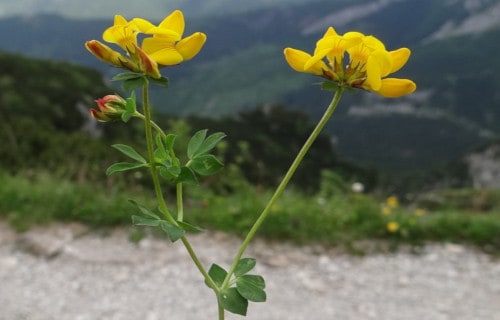
Nonetheless, sheer physical size does not rank as one of the astounding characteristics of the beautiful Angiosperm. That remains true since this beautiful herbaceous plant only achieves a maximum known height of approximately 8 in (20 cm) unless supported by other plants.
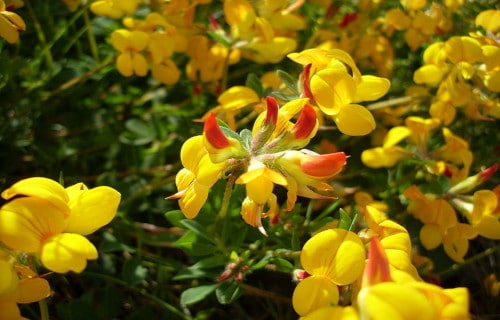
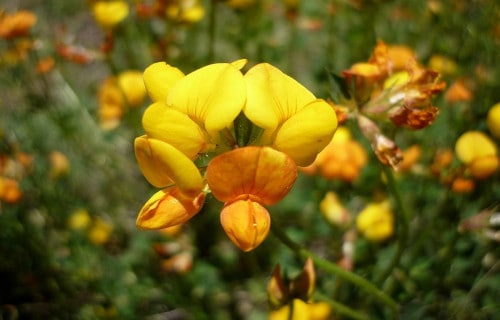
This truly stunning flora also most commonly grows in a highly sprawling manner along the ground. Yet, it very rarely does so over great distances, however. The small flowers of the gorgeous product of Nature additionally display multiple combinations of bright orange and yellow colors.
These stunning blooms also appear in clusters, typically ranging from 2-7 in number. Each flower displays the typical legume structure with a banner, wings, and keel. Each of its stunning blooms remains separately small, though. These structures average 0.4 – 0.8 in (1 – 2 cm) in length.
The leaves of the Lotus Corniculatus also merit a certain degree of interest. These develop as compound, with three main leaflets, and two more the base. In shape, they appear oblong to elliptical, usually with a blunt tip. These develop as green, sometimes with a slight bluish tint.
The leaves of the remarkable plant also most commonly grow in groups of five. Typically, three of these form a natural trefoil pattern over the other two. Not surprisingly, since it constitutes a member of the pea family, the seeds of this wonder develop in small, highly elongated pods.
- Kingdom: Plantae
- Phylum: Angiosperms
- Class: Eudicots
- Order: Fabales
- Family: Fabaceae
- Genus: Lotus
- Species: L. corniculatus
CCL: http://bit.ly/2GGxvUT
Lotus Corniculatus Distribution, Habitat, and Ecology
Surprisingly, the visually breathtaking, as well as scientifically fascinating, Lotus Corniculatus evolved as endemic to a remarkably large section of the globe. In point of fact, the intriguing plant inhabits an impressively wide swathe of the continents of Europe, Asia, and Northern Africa.
Due to its comparative hardiness, farmers often actually use this botanical beauty in cultivation, especially in certain parts of Europe. As a result of this surprising practice, this wonder of Nature has become considered an invasive species in some portions of Australia and North America.
Despite its seeming fragility, the visually captivating wonder of evolution displays an impressive degree of flexibility regarding its choice of habitat. It’s therefore found in a surprisingly broad range of ecosystems within its native range. This provides it with an evolutionary advantage.
It mainly appears in grasslands and meadows. These regions include both natural and semi-natural areas, sometimes including pastures. It also prefers well-drained soils and areas with moderate fertility. Yet, it’s also seen along roadsides, railway embankments, and other disturbed sites.
The remarkably intrepid plant’s additionally frequently spotted at the edges of woodlands, and in clearings within many forests. It generally prefers bright sun, but tolerates shade. Though less common, heathlands and moorlands also serve as another area it sometimes inhabits.
The Lotus Corniculatus achieves its pollination via the actions of a variety of locally prevalent pollinators, including bees, butterflies, and other insects. These creatures also remain crucial for the reproductive success of many plants and contribute to the biodiversity of the ecosystem.
It serves vital purposes where it appears. It provides both habitat and food for many insect species, supporting highly complex food webs. Its seeds and foliage also serve as food for birds and small mammals. Numerous grazing animals, such as rabbits and deer, also feed on the lovely plant.
5 Remarkable Romanian Herbaceous Plants
We greatly hope that each of you thoroughly enjoyed reading, and hopefully learning from, this article we’ve written about these 5 Remarkable Romanian African Herbaceous Plants. It’s also our hope that doing so has left you with either a new or renewed appreciation for such wonders.
Unfortunately, however, many of their kindred around the world now find themselves facing strong threats to their continued existence as a species. Many of those dangers, in fact, stem from the ongoing actions of mankind. We must do everything we can to protect and preserve them all.
Check out our other articles on 5 Amazing African Herbaceous Plants, Earth’s Many Stunning Waterfalls, Spectacular Dolphins Throughout Our World, 5 Magical Mammals of Ohio
