

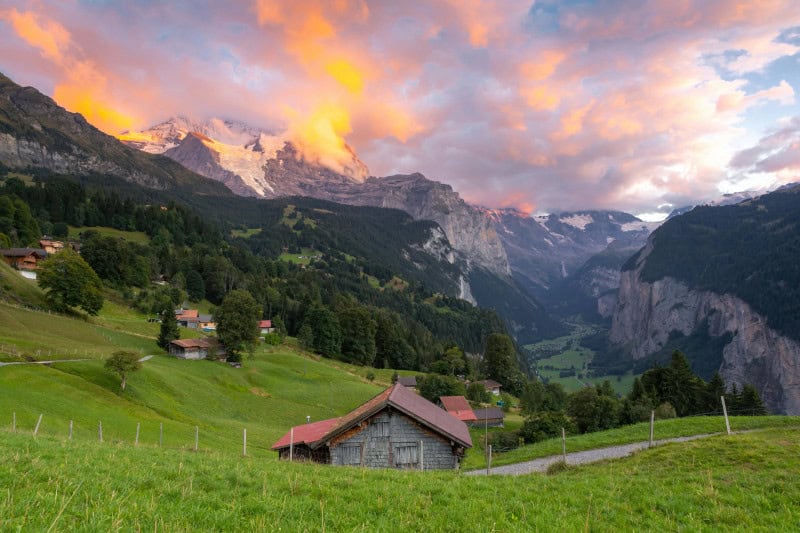
Alps Facts
- The deceptively short term of Alps represents the most frequently used name for this breathtaking creation of time and natural forces. Yet, it also has several other, if less often employed titles by which it’s known. Those consist of the similar tags Alpen, Alpi, and Alpe.
- Ancient, prehistoric humans knew of the existence of this geological masterpiece long before our modern era. Indeed, archaeological evidence indicates that prehistoric peoples knew of it as far back as 10,000 – 5,000 BCE. By aroud 500 BCE, Celtic tribes inhabited the region.
- Many notable events in the history of the continent in modern times took place within their confines. Hannibal notably crossed the range with a herd of elephants, and the Romans even had settlements in the region. Napolean also crossed one of the passes with a large army.
- Fortunately, the stunning Alps now enjoys a certain degree of protection from the depredations of man. That comes in the form of a mix of national parks, nature reserves, and international agreements. Several UNESCO Biosphere Reserves also appear in multiple parts of the range.
- Nevertheless, the impressive collection of mountains faces a variety of environmental, human, and climate-related threats. Habitat loss and biodiversity decline now occur, due to a variety of human-related factors. Climate change also threatens it, including the retreat of glaciers.
Related Articles
Alps Physical Description
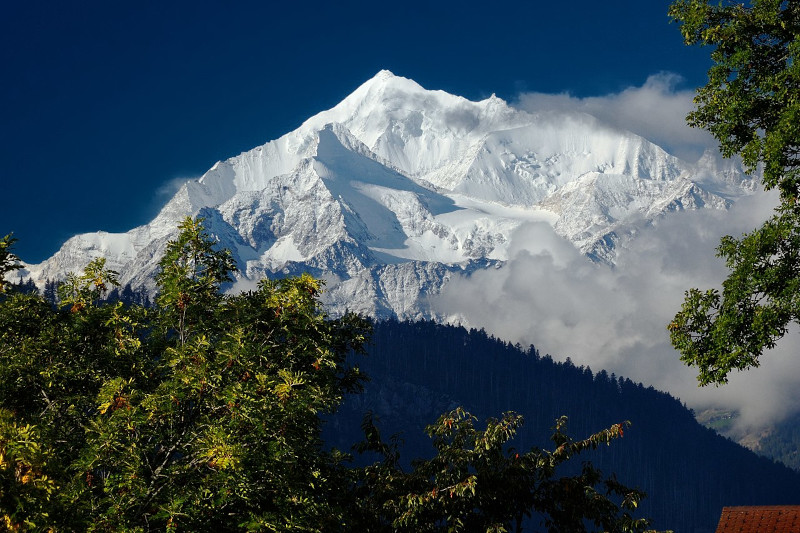
The remarkable Alps never fail to immediately capture the attention and interest of those individuals fortunate enough to encounter them Unlike similar features around the world, however, they do not do so due to their grandeur alone. That’s because they also boast impressive stature.
Stretching roughly from west to east, the collective range extends for a total distance of about 750 mi (1,200 km). It also has an extremely distinctive width, ranging from approximately 75 – 155 mi (120 – 250 km). Taken together, these give it an amazing total area of 77,000 sq mi (200,000 sq km).
As a general principle, most experts divide the greater range into three separate main sections. The aptly-named Central Alps remains the shortest of the component parts of the larger grouping. In total, this subsection of this awesome wonder of Nature stretches for 185 – 250 mi (300 – 400 km).
Meanwhile, the equally properly-named section known as the Western Alps ranks as the second-longest of these three parts of this true wonder of geological formation. Being moderately greater in length than the central region, this subdivision extends for about 280 -310 mi (450 – 500 km).
The final subsection of the Alps holds the appellation Eastern Alps. This portion, the lengthiest, sprawls for a total of 435 mi (700 km). Intriguingly, it’s also divided into three smaller groupings. These hold the tags Northern Limestone Alps, Central Eastern Alps, and Southern Limestone Alps.
Individual spectacular features also appear within the confines of these mountains. Several of the highest peaks in its part of the continent formed here. Numerous glaciers reside at the higher altitudes. Deep U-shaped valleys, and countless steep, rugged ridges also dominate the entire range.
Alps Location, Formation, and Ecology
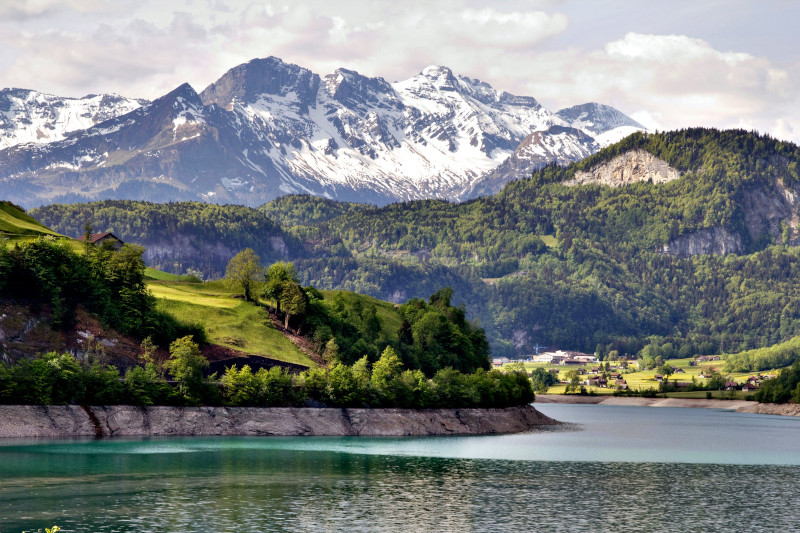
Nature formed the mesmerizing Alps in a region of the surface of the earth already well known for its grat abundance of similar natural marvels. Exactly where it lies, therefore, likely won’t surprise a great many people. That’s true since geological activities created this true wonder as part of Europe.
Forming a crescent-shaped arc, they extend from the Mediterranean Sea near Nice, France, and run all the way to the nation of Slovenia. Along that route, they wend through a total of eight countries. Those are France, Monaco, Italy, Switzerland, Liechtenstein, Germany, Austria, and Slovenia.
About 300 million years ago, the surrounding region comprised a flat area with an ancient mountain chain, which later slowly eroded. Over a vast span of time, a comparatively shallow sea, known to science as the Tethys Ocean, covered the entire area, depositing numerous layers of sediments.
Then plate tectonics also came into play, aiding its creation. Around 65 million years ago, the African Plate began moving northward and collided with the Eurasian Plate. This caused the closure of the ocean and pushed up the sedimentary rocks, folding and faulting them into huge mountain chains.
The collision caused intense compression, folding rocks into complex structures, named nappe formations and thrust faults. Metamorphic rocks, such as various types of gneiss, schist, and marble uplifted from deep in the Earth. Large granite intrusions also eventually formed in some regions.
Subsequently, during the Ice Age, which lasted from approximately 2.5 million to 11,700 years ago, enormous glaciers carved the landscape, creating the multiple distinctive U-shaped valleys, sharp peaks, and cirques. Many present-day lakes also originated via the erosion of these many glaciers.
Experts divide the Alps into five altitudinal zones in regards to vegetation. The Colline zone reaches up to 2,600 ft (800 m), with deciduous forests, vineyards, orchards, and agriculture in valleys. The Montane zone, at 2,600 – 4,900 ft (800 – 1,500 m) holds mixed forests with beech, fir, and spruce.
At 4,900 – 6,600 ft (1,500 – 2,000 m) sits the Subalpine Zone, with coniferous forests of larch, pine, and spruce. The Alpine zone lies at 6,600 – 9,800 ft (2,000 – 3,000 m), with meadows, grasses, and hardy flowers. The Nival zone, above 9,800 ft (3,000 m) is mostly bare, with mosses and lichens.
Wildlife also abounds at the lower altitudes. That includes large mammals, like Chamois and red deer. Small mammals like marmots, alpine hare, and stoats thrive here too. Birds appear in quantity, along with a few reptiles and amphibians. A high diversity of butterflies and beetles appears too.

Features Sharing Its Region
Check out our other articles on 5 Amazing African Herbaceous Plants, Mountain Hare, McMurdo Dry Valleys, Rila Primrose, Emperor Penguin, Aphrodite Fritillary, Keeled slug-eating Snake