

Appalachian Brown Butterfly Facts
- This beautiful Lepidoptera most frequently goes by the partially informative common name of the Appalachian Brown Butterfly. Yet, this remarkable invertebrate does have at least one other general title by which it’s known. That’s the notably similar term of woods eyed brown.
- Inside of the scientific community, however, it’s perhaps much better known by its purely technical designation. Thankfully, that moniker’s one that’s comparatively simple for the layperson to pronounce. That’s true since it bears the official appellation Satyrodes appalachia.
- The wonder of Nature received that epithet due to the efforts of Ralph Lucien Chermock. That highly respected American entomologist accomplished the first formal recognition of it as a separate and distinct species. He achieved that scinetifically noteworthy deed in the year 1947.
- Fortunately, the captivating Appalachian Brown Butterfly appears to be maintaining a thriving and sufficient population base. This pleasant state also seems to hold true throughout the entirety of its range. The IUCN thus does not currently display it on the published Red List.
- Nonetheless, it should still be considered as facing multiple potential threats to its continued existence as a species. In this respect, it faces the same dangers as all forms of life on earth today. Most of these derive from the actions of man, including ongoing climate change.
Related Articles
Appalachian Brown Butterfly Physical Description
The gorgeous Appalachian Brown Butterfly generally enthralls and intrigues those individuals fortunate enough to encounter one. Yet, it does not do so due to especially impressive dimensions, however. That’s true since this marvelous insects ranks as an approximately average-sized butterfly.
In regards to its description, though, it follows an evolutionary pattern common among its many relatives around the world. That’s the fact that it displays only a small degree of the physiological trait of sexual dimorphism. In its case, this natural characteristic manifests solely in terms of size.
Overall, examples of this marvel of Nature and evolution attain an average wingspan of somewhere between 1.5 – 2 in (3.8 – 5.1 cm). Females of the amazing species reach a greater mean measurement in this respect than their male counterparts, though only to an extremely slight degree.
The body itself develops along the same general lines as most butterflies, being notably slender in nature. This feature does, however, also display an intriguing physical attribute. That’s the presence of a covering of fine, brownish scales which belnd quite well into the wings of the insect themselves.
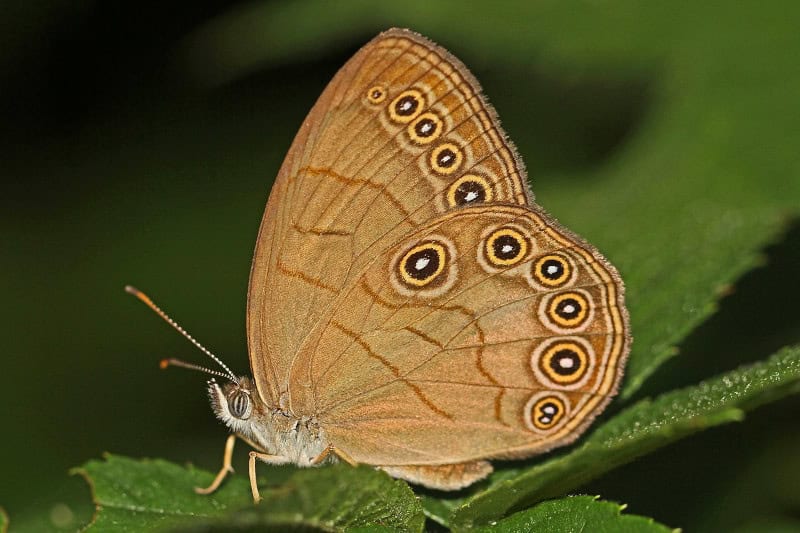
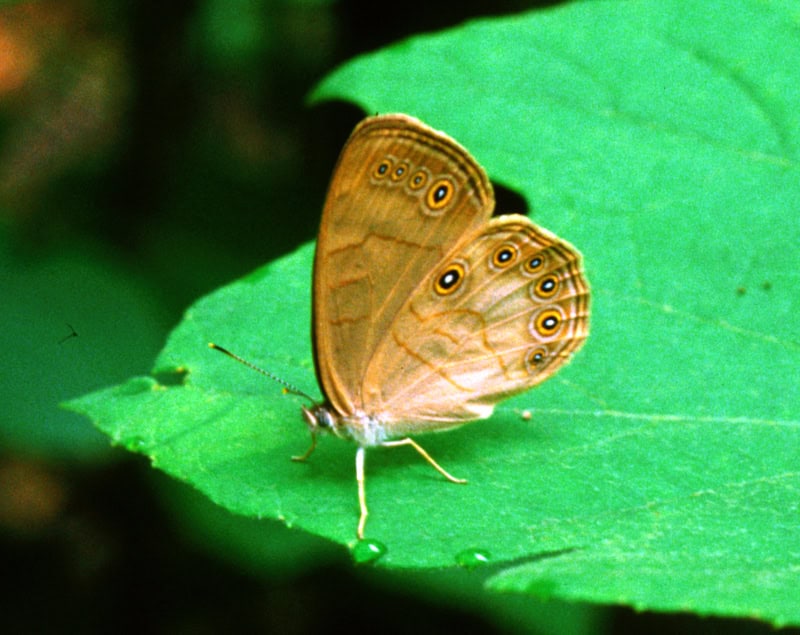
Without doubt, though, it’s the pattern of coloring among examples of the aptly-named Appalachian Brown Butterfly that typically garners the most attention from observers. As a general principle, this consists of a background of a dull brown shade, with a very slightly darker outer margin.
Breaking it down separately, however, the upperside of the delicate wings present as light brown with two black eyespots appearing on each forewing, along with several smaller eyespots on the hindwing. These distinctive features usually develop as encircled with a faint yellow colored ring.
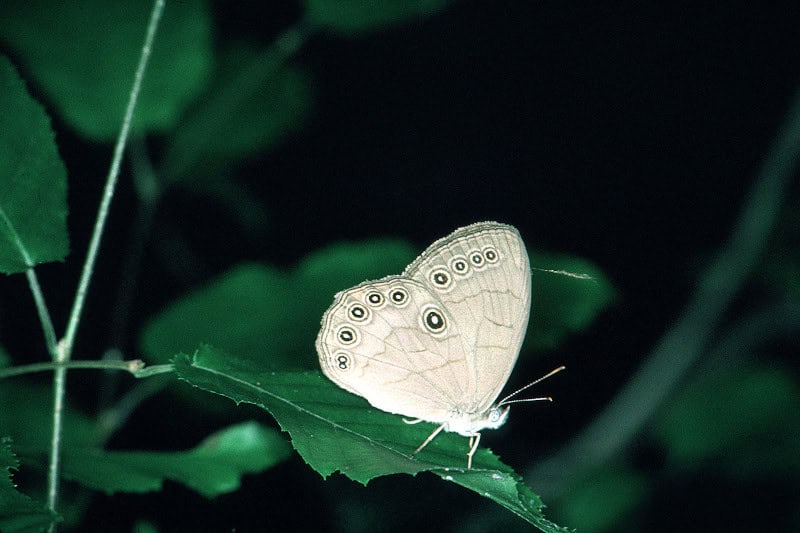
Meanwhile, the underside of these appendages show a moderately different patterning to the eye. This most frequently appears composed of a pale brown to tan. That’s also often complemented by a series of six eyespots on the hindwing, more distinct than those showing on the upperside.
- Kingdom: Animalia
- Phylum: Arthropoda
- Class: Insecta
- Order: Lepidoptera
- Family: Nymphalidae
- Genus: Satyrodes
- Species: S. appalachia
Appalachian Brown Butterfly Distribution, Habitat, and Ecology
The beautiful Appalachian Brown Butterfly evolved as indigenous to a moderately broad swathe of the surface of our world. Precisely where that zone of habitation lies, however, probably won’t surprise anyone. That’s true since its very name provides a clear indication of the general area.
This amazing Arthropod developed as native to a limited portion of the continent of North America. Part of its territory extends as far north as southern Canada, reaching into southern Quebec. The vast majority of its population, though, resides within the national borders of the United States.
There, it ranges from eastern Minnesota and east to New England. It also appears south through the Appalachian Mountains, Piedmont, and Coastal Plain regions, down to Mississippi and Alabama. However, a few isolated populations of this wonder of Nature also live in north peninsular Florida.
Much like many of its numerous kindred across the globe, this intriguing Lepidoptera displays decidedly clear and strong preferences ragarding its choice of habitat. The wonder of the insect world remains extremely closely tied to notably moist habitats, most especially those rich in sedges.
It primarily appears in one of several closely related environments. The creature mainly lives in wooded swamps, marsh edges, bogs, and wet forested floodplains. It’s also quite commonly observed living around such features as very slow-moving streams, oxbows, and even beaver ponds.
The diminutive beauty also manifests other preferences, all of which unfortunately limit its options. The wonder prefers areas with dense herbaceous vegetation situated beneath partial canopy cover. It more frequently appears in either shaded or semi-shaded wetlands, not in open sunny marshes.
The delicate beauty known as the Appalachian Brown Butterfly evolved a natural pattern that lamentably restricts it to only certain very specific environmental conditions. That’s because this remarkable winged wonder possesses a specialized ecology that closely ties it to wetland systems.
Those living in the northern part of its range reproduce only once per season, between the months of June and July. Those populations residing in the more southern section of its native territory, though, typically produce two separate broods, approximately between late spring and late summer.
Females lay their eggs on the blades of host plants, generally sedges. Larva feed mainly at night on sedge leaves; they overwinter as half-grown caterpillars. The adult members of the species, however, most commonly stay close to their breeding habitats, flying low and erratically in shaded areas.
Sadly, these lovely insects face predation from a wide range of other creatures. Numerous species of birds, spiders, frogs, and dragonflies prey on adults. The tiny larvae, meanwhile, are frequently eaten in large numbers by various amphibians, small mammals, and often even other insect predators.
Species Sharing Its Range
Check out our other articles on 5 Astounding Asian Wild Cats, New Zealand Sea Lion, Lake Maracaibo, Sandbox Tree, Spotted Seahorse, Blue Baboon Tarantula, Keeled slug-eating Snake