

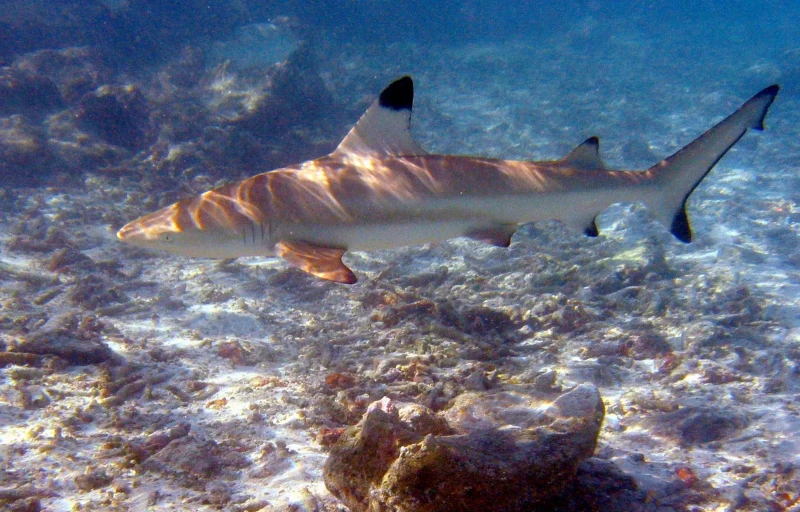
Blacktip reef shark Facts
- Though highly descriptive, the term Blacktip reef shark only serves as the most frequently used common name for the amazing fish. It does have several other general titles. These include the tags Blackfin reef shark, Blacktip shark, Blacktip whaler, and Indo-Pacific blacktip shark.
- Within the halls of science, however, it’s probably much better known by its technical designation, though. Unfortunately for the layperson, that’s an extremely difficult appellation to pronounce. That’s because the animal holds the formal epithet Carcharhinus melanopterus.
- It received that tongue-twisting moniker due to the efforts of a duo of French researchers. Jean René Constant Quoy and Joseph Paul Gaimard accomplished the first official recognition of it as a separate and distinct species. They achieved that scientifically noteworthy feat in 1824.
- This stunning creature distinguishes itself from many of its kindred in terms of its behavioral patterns. Unlike many of those kin, it’s generally shy and not aggressive toward humans. It’s also known for its extremely cautious nature, often observed darting away if approached.
- Unfortunately, for a combination of reasons, the beautiful Blacktip reef shark now finds itself with a dwindling population. That sad situation also appears to hold true across its range. The IUCN therefore presently shows it as Vulnerable on its Red List of Threatened Species.
- Though not directly targeted by commerical fishing, it often perishes due to accidental bycatch. It also faces other dangers to its continued existence, most of these stemming from the actions of man. Those many perils primarily include habitat loss and ongoing climate change.
- Though not universally so, it does at least now enjoy a certain amount of protection in some portions of its range. In some areas, parts of its population dwell within marine parks. In some other local regions, measures range from partial conservation to a full ban on local fishing.
Related Articles
Blacktip reef shark Physical Description
It’s easily comprehended that the mesmerizing Blacktip reef shark rarely fails to captivate those who encounter it, especially in the wild. The amazing fish generally does so, however, due more to its appearance than sheer size. That’s true since it’s a comparatively small shark species.
In this respect, it also follows a pattern common among animals, including fish. That’s the fact that it displays a certain degree of the physiological characteristic of sexual dimorphism. In the case of this particular creature, though, that trait only manifests in relatively subtle manners.
More precisely, females of this fascinating fish attain greater average measurements than their male counterparts. This evolutionary tendency extends to both length and mass. That’s extremely common among sharks, though, likely due to the natural demands of its reproduction.
The females generally reach a mean total length equaling roughly 5.2 ft (1.6 m). Examples of this same sex also typically range in body mass from 25 – 40 lb (11 – 18 kg). Though it’s extraordinarily rare, exceptional examples of this sex occasionally reach weight measuring roughly 55 lb (25 kg).
Males, meanwhile, attain lesser weights and lengths. As mentioned previously, the difference on average remains relatively slight. Though, once again, uncommon individuals do occur, these rarely grow beyond 4.6 ft (1.4 m). Mean masses also usually range from between 20 – 30 lb (9 – 14 kg).
Other sex-based differences exists, as well. Males of this marvel have features named claspers. These represent specialized reproductive organs used during the mating process, and are located on the underside near the pelvic fins. Females, though, understandably do not develop these.
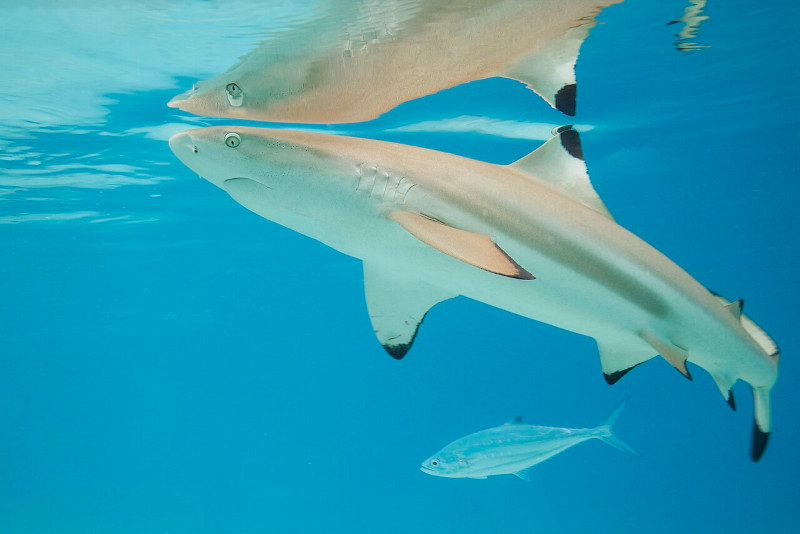
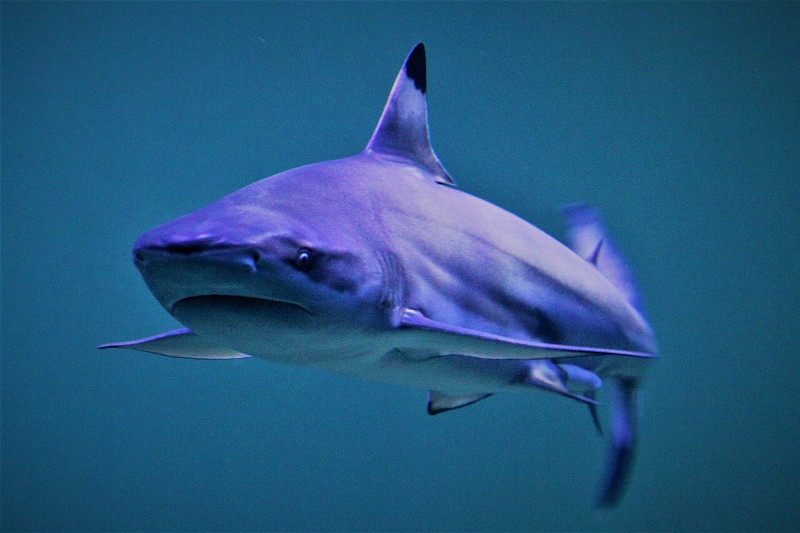
Otherwise, both sexes of the Blacktip reef shark present the same appearance. The body evolved a slender, torpedo-shaped form, obviously designed for speed. The head of the highly developed animal also displays a comparatively short, rounded snout with large nostrils for detecting prey.
In coloring, the animal displays a light brown to grayish top or dorsal side. The underside, however, presents a white or pale gray shading. The most distinctive feature, clearly is the presence of distinct black tips on its fins. Yet, it also manifests a conspicuous white stripe that runs along its sides.
The first dorsal fin grows large and triangular, positioned far forward on the body. The second’s much smaller but still has a black tip. Its pectoral fins develop as broad and slightly curved, aiding it in maneuverability. The upper lobe of its tail also evolved as longer than the lower one.
- Kingdom: Animalia
- Phylum: Chordata
- Class: Chondrichthyes
- Order: Carcharhiniformes
- Family: Carcharhinidae
- Genus: Carcharhinus
- Species: C. melanopterus
Blacktip reef shark Distribution, Habitat, and Ecology
The captivating Blacktip reef shark apparently evolved as indigenous to a moderately broad expanse of the marine regions of the globe. In its fullest expanse, though, the extent of this zone of habitation might surprise many individuals. The nature of the region, however, probably will not.
The wonder of Nature most often appears within the confines of the Indo-Pacific Ocean. This remarkable fish also resides in the waters of both the Red Sea and the western Indian Ocean. It also inhabits the waters off the coast of East Africa, and from there to Hawaii and the Central Pacific.
But Nature didn’t stop there. The fish lives near Northern Australia, Indonesia, and the Philippines, too. It’s present in the marine areas off Southeast Asia, including India, Thailand, and Malaysia. It’s even present around French Polynesia, the Maldives, and many other Pacific islands.
Like many of its relatives globally, it displays decidedly clear preferences regarding its choice of habitat. This favoritism does, however, allow for some leeway in the exact nature of the ecosystems it inhabits. It’s therefore found inside a number of differing areas with similar conditions.
Each of these lies inside regions of warm, shallow tropical waters, especially coral reef ecosystems. It manifests its clearest preference for shallow coastal waters, typically measuring less than 100 ft (30 m) deep. That often consists of coral reefs, especially reef flats, lagoons, and reef edges.
Scattered groupings nevertheless also appear in other regions with similar environmental settings. These include magrove forests, which frequently serve as nurseries for juveniles. Other locations include locations such as seagrass beds and sandy flats, often used for the purpose of hunting.
Following the typical pattern of its kind, the Blacktip reef shark developed as a pure carnivore. In the ecosystems it appears in, it fill the role of mid-level predator, known as a mesopredator. Its presence in these regions plays a pivotal role in maintaining and regulating local fish populations.
Its diet principally consists of a wide variety of local small, bony fish, such as mullet and sardines. The shark also preys on crustaceans, like crabs and shrimp. Other fare includes small cephalopods, like squid, cuttlefish, and octopi. Rays and smaller sharks sometimes make the list, too.
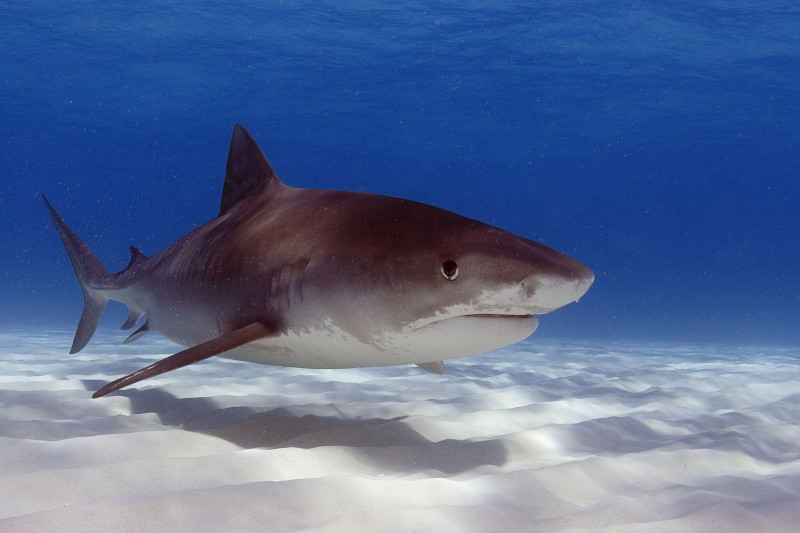
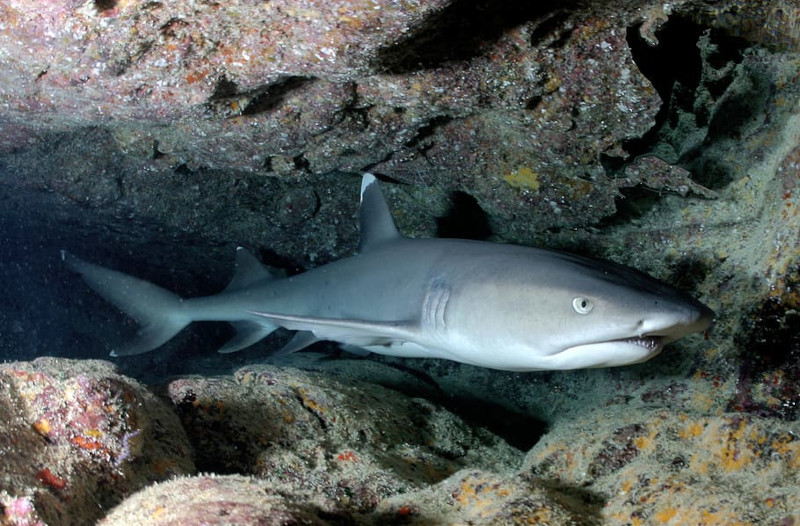
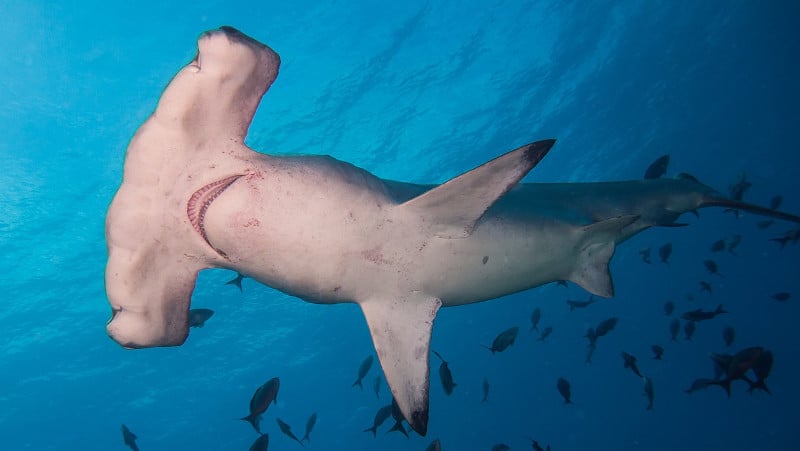
Like most creatures on eath, it has its own share of predators, too, especially given its relatively small size. These primarily consist of larger sharks, such as Tiger sharks and Grey reef sharks. In certain portions of its territory, though, it also sometimes falls prey to Saltwater crocodiles.

Species Sharing Its Range
Check out our other articles on 5 Thrilling Animals of Thailand, Red-legged Pademelon, Phillip Island, Western Juneberry, Hellbender Salamander, Black and scarlet Cicada, Black Caiman