

Bubble Coral Facts
- The charming, and clearly appropriate, term of Bubble Coral represents the most frequently used common name for this remarkable Cnidaria. Yet, it does have a few other general titles by which it’s known. These include the options of Pearl Coral, Grape Coral, and Bladder Coral.
- Within the scientific community, however, it’s perhaps better known by its purely technical designation. Like many such tags, though, that one’s somewhat difficult for the layperson to pronounce. That’s because this wonder holds the official moniker Plerogyra sinuosa.
- This captivating creation of Nature and evolution received that epithet due to the efforts of James Dwight Dana. The American zoologist recorded the first formal recognition of it as a separate and distinct species. He achieved that scientifically noteworthy deed in the year 1846.
- Sadly, the beautiful Bubble Coral now finds itself in dire straits. Its estimated population currently stands at a greatly reduced number, compared to what it once held. Accordingly, the IUCN now categorizes the creature as Near Threatened on its Red List of Threatened Species.
- The natural marvel’s now facing multiple threats to its continued existence as a species. Like most forms of life on earth today, most of these dangers stem from the actions of mankind. They include the closely related perils posed by habitat loss and ongoing climate change.
Related Articles
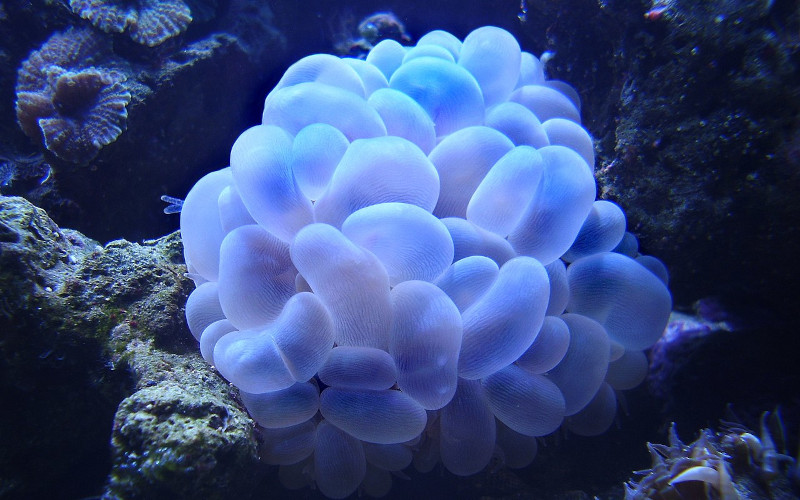
Bubble Coral Physical Description
The visually mesmereizing Bubble Coral typically fascinates and appeals to those individuals fortunate enough to encounter one. They generally do so for a wide variety of reasons, of course. However, impressive physical dimensions isn’t among them, because it’s moderately small.
This remarkable product of evolution follows a pattern of development prevalent among its many relatives around the world. That’s the fact that, while it does possess two separate genders, it does not exhibit the physiological characteristic of sexual dimorphism in the classical sense.
Like many corals, it’s a gonochoric species, meaning individual colonies are either male or female, but there’s no visible difference in morphology. Reproductive organs develop internally and only appear distinguishable through microscopic or histological examination during spawning season.
Again, like those relations, it develops as a colonial creature. While final size varies, many specimens achieve a measurement of around 12 in (30 cm) across. Eventual maximums depend greatly on age and environmental conditions. Larger examples do exist, of course, but these remain rare.
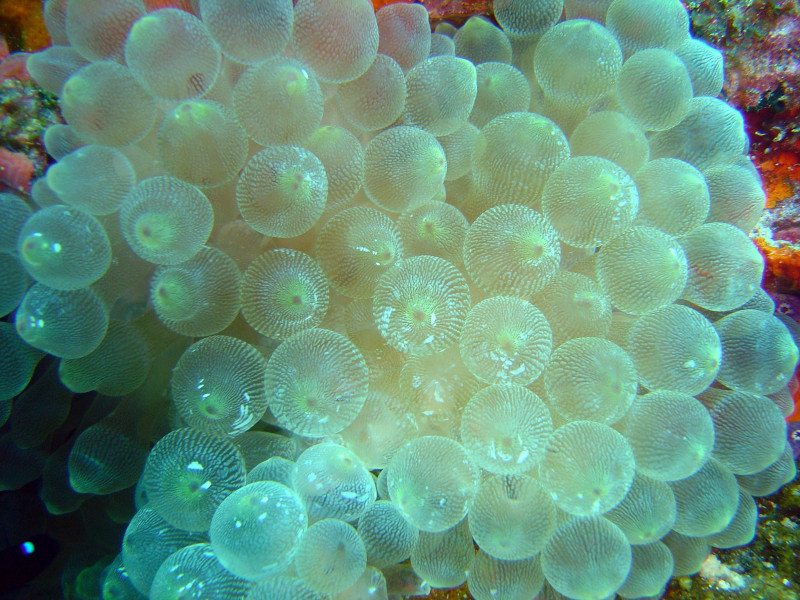
It manifests as what science classifies as a variety of large-polyp stony coral. These colonies typically develop as dome-shaped in form, with meandering, fleshy vesicles. The external skeletons, meanwhile, evolved as aragonite-based, with winding, ridge-like septa that support the polyps.
Each of the inflated, bubble-like vesicles of the Bubble Coral constitutes tentacles that resemble grapes or pearls. In mature specimens, these structures attain an average diameter equaling 0.8 – 1.2 in (2 – 3 cm). These notable features also boast yet another highly impressive physical trait.
During the daytime, these parts of the animal actually inflate. They also remain soft, and smooth, giving a fleshy, cushiony look. At night, however, the skeletal structure becomes more visible as the bubbles retract and tentacles extend, including long, transparent feeding tentacles with stingers.
Probably its most visually appealing characteristic, however, is that of its color patterns. This varies between individuals, but most examples present bright shades of whatever hue they manifest. These most frequently consist of white, cream, green, bluish, sometimes even with fluorescence.
- Kingdom: Animalia
- Phylum: Cnidaria
- Class: Hexacorallia
- Order: Scleractinia
- Family: Plerogyridae
- Genus: Plerogyra
- Species: P. sinuosa
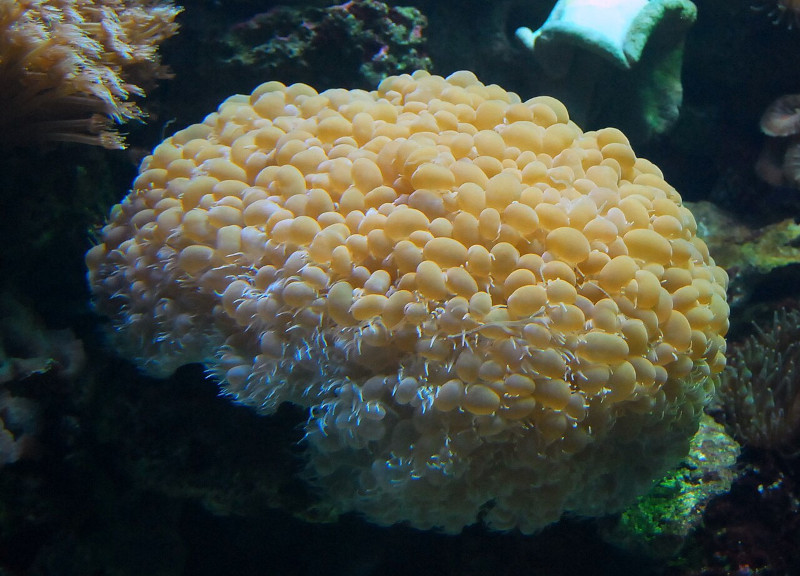
Bubble Coral Distribution, Habitat, and Ecology
Evidence currently indicates that the truly gorgeous Bubble Coral evolved as indigenous to a comparatively broad expanse of the marine regions of the globe. Exactly what portion of the earth’s overall surface that native zone of habitation occurs in just might surprise some of our readers.
The majority of that area consists of the Indo-Pacific region. Within the Indian Ocean, this wonder of Nature’s numbers most greatly appear in four general areas. These consist of off the east coast of Africa, and the waters around the island nations of Madagascar, the Maldives, and Sri Lanka.
Other groupings also reside in portions of the Red Sea and the western and central Pacific Ocean. These areas include the Great Barrier Reef, in Australia, Indonesia, the Philippines, the Solomon Islands, Micronesia, and Fiji. It’s also present in the South China Sea, near Taiwan and China.
Continuing its trait of following the same patterns as most of its kindred, this amazing Cnidaria presents extremely precise requirements and preferences regarding its choice of habitat. Although it dwells in multiple types of environments, each of these share certain basic necessary conditions.
It principally inhabits specific reef environments that support its unique structure and biological needs. These regions primarily consist of four different choices. They include sheltered reef slopes, lagoonal reefs, reef flats and channels, and either under overhangs or in locally available crevices.
Other factors also play important roles in its selection. Depth remains vital to its survival, with the vast majority of specimens appearing in water ranging from 1.1 – 115 ft (3 – 35 m) deep. Even within this overall range, most observed individuals resided approximately in the middle of this zone.
The invertebrate also prefers low to moderate levels of light where it lives. Water patterns play an additional role. The marvelous animal favors gentle to moderate movement. In these areas, it usually settles on hard rock, or in crevices or depressions where its base enjoys some protection.
Despite its relatively small size, the Bubble Coral plays a unique role in the numerous coral reef ecosystems in which it appears beneath the waves. Its unique and specific ecological characteristics continue to be shaped by both its biology and interactions with many other reef organisms.
It actually hosts symbiotic algae within its tissues. These symbionts perform photosynthesis, providing energy to the coral and aiding in calcium carbonate skeleton formation. In return, the coral provides shelter and nutrients, mainly in the form of nitrogen and carbon dioxide, to the algae.
Yet, the remarkable animal also feeds actively, as well. At night, its comparatively long sweeper tentacles extend to both catch food and defend space. Its food source mainly consists of plankton and free-falling organic matter, in the form of detritus. This feeding process usually occurs at night.
This astounding lifeform, despite its appearance, does reproduce sexually. The vesicles of each individual develop as either male or female in nature. It reproduces via what’s known as broadcast spawning. This includes releasing eggs and sperm into the water column for external fertilization.

Species Sharing Its Range
Check out our other articles on 3 Bewildering Birds of Australia, Red-legged Pademelon, Lobster Claw Heliconia, Emperor Penguin, Aphrodite Fritillary, Goldentail moray, Eyelash Viper