

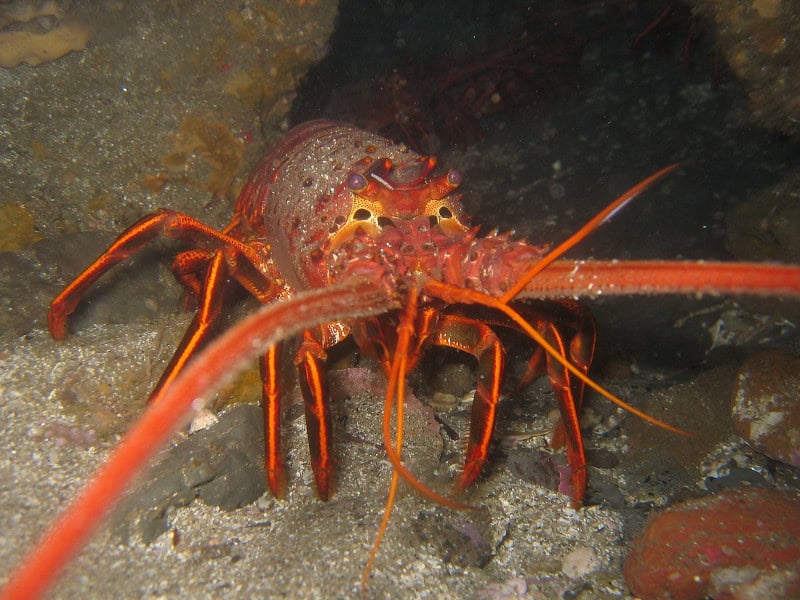
California Spiny Lobster Facts
- This amazing denizen of the depths most often goes by the equally informative and descriptive common name of the California Spiny Lobster. Yet, it also holds several other titles by which it’s sometimes known. These include Spiny lobster, Red spiny lobster, and Rock Lobster.
- Those terms, however, only represent its various honorifics in the english language. Obviously, the animal has others in different tongues as well. In Spanish, this marvel of evolution and Nature’s also known by the monikers of the Langosta and Langosta roja del Pacífico.
- Inside the scientific community, though, it’s perhaps much better known by its purely technical designation. Luckily, as such appellations go, that’s a relatively simple one for the layperson to pronounce. That’s because the creature holds the formal tag of Panulirus interruptus.
- These Arthropods hold the interest of researchers for an intriguing evolutionary behavioral pattern that they display. They migrate in groups, sometimes literally forming lobster trains, walking single file along the seafloor, especially during storms or changes in water conditions.
- Thankfully, the captivating California Spiny Lobster appears to be maintaining a population base that’s both stable and sufficient. This pleasant state also seems to hold true throughout the entirety of its range. The IUCN thus presently shows it as Least Concern on its Red List.
- This marine wonder nevertheless still faces numerous potential threats to its continued existence as a species. In this respect, it must deal with the same dangers as all forms of life on earth today. Most of these stem from the actions of mankind, and include climate change.
Related Articles
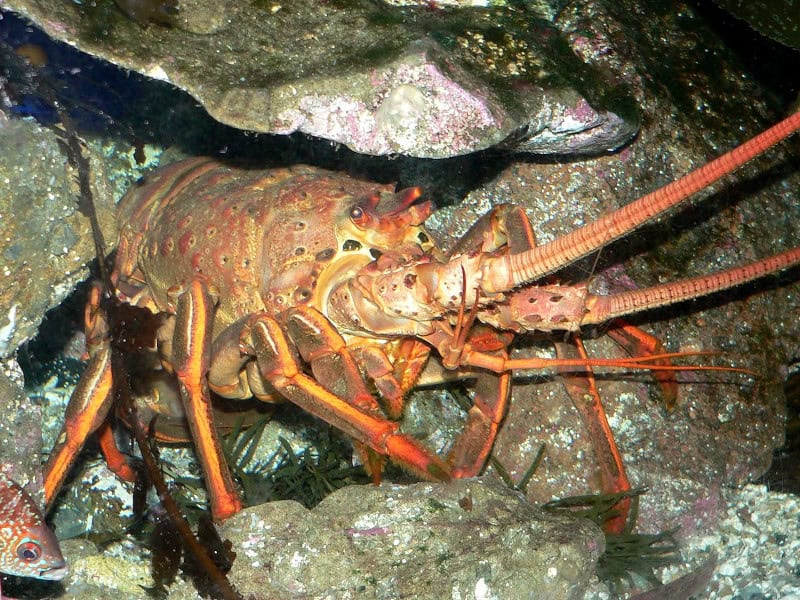
California Spiny Lobster Physical Description
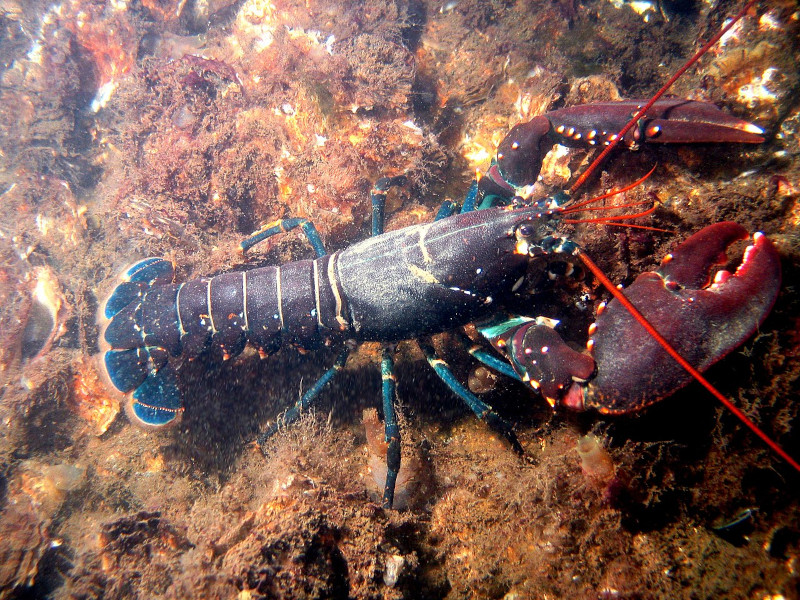
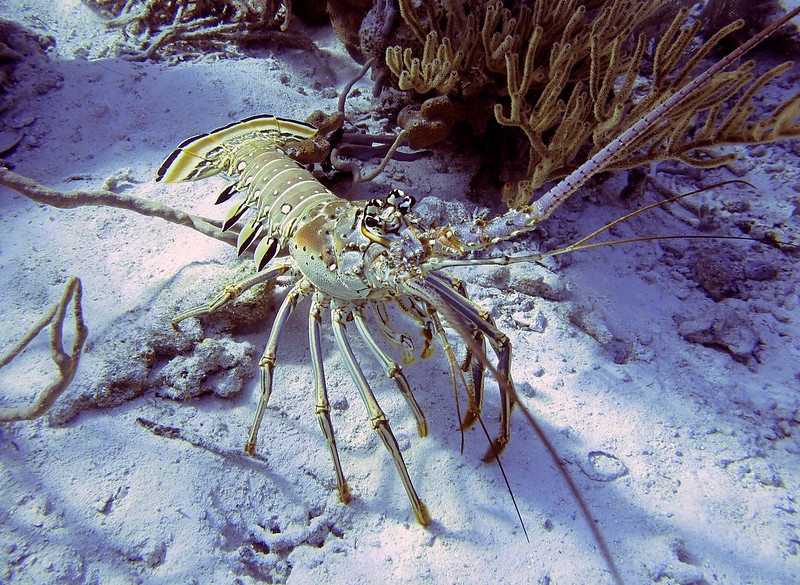
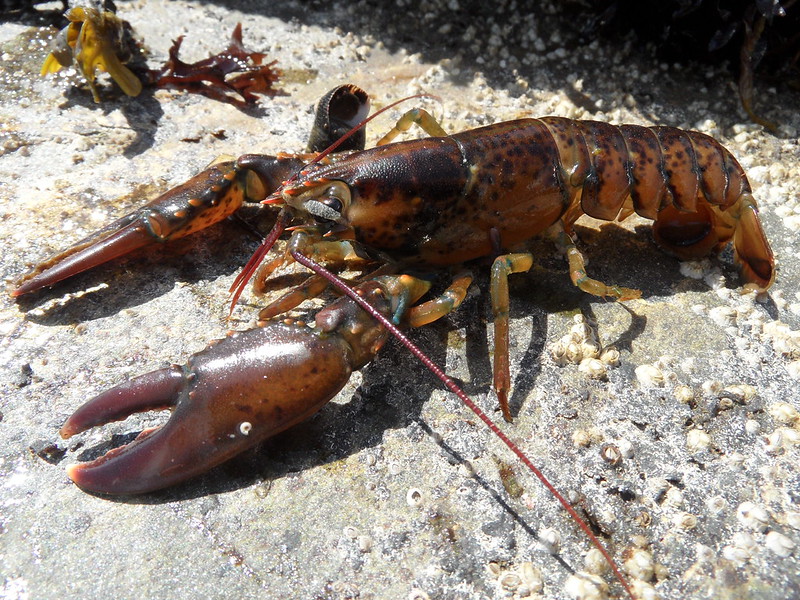
The gorgeous California Spiny Lobster generally enthralls those individuals fortunate enough to encouner one of them in the wild. The Decapod does not typically do so, however, due to especially impressive physical dimensions. That’s true since it’s an average-sized member of its Order.
In that regard, it also follows a pattern of development shared by many fauna around the world. That’s the fact that it displays a certain degree of the physiological characteristic of sexual dimorphism. The amazing animal manifests this natural trait primarily in terms of simply body size.
Overall, adults of this wonder attain an average body length ranging from 12 – 16 in (30 – 40 cm). Exceptional individuals sometimes reach 24 in (60 cm). Weights usually vary from 1 – 7 lbs (0.45 – 3.2 kg), though a few reach 10 lbs (4.5 kg). In general, males remain on the upper end of these.
Its antennae evolved as comparatively long, thick, and spiny, thus the common name. The awesome creation of Nature and evolution also displays a rigid, spiny shell covering the head and thorax, with forward-pointing spines above the eyes. The eyes develop as compound, and on long stalks.
Appearing in the abdomen of the animal, the tail also merits attention. This particular feature evolved as strongly muscled with a fan-shaped tail fin. The intriguing Arthropod possesses a total of ten legs, arranged in five pairs. Distinctively, the first pair lacks large claws, unlike true lobsters.
The pattern of coloring of the beautiful California Spiny Lobster also earns a certain measure of respect from its observers. That generally consists of reddish-brown to orange on the body. The legs of this fascinating invertebrate also often display several yellow to light orange shaded bands.
Yet, the rest of the body of the marine creature differs from this, augmenting its visual appeal. That’s because the underside of its structure tends to be slightly paler, sometimes yellowish. In addition to the aforementioned sharp spine, the antennae present an extremely impressive reddish hue.
- Kingdom: Animalia
- Phylum: Arthropoda
- Class: Malacostraca
- Order: Decapoda
- Family: Palinuridae
- Genus: Panulirus
- Species: P. interruptus
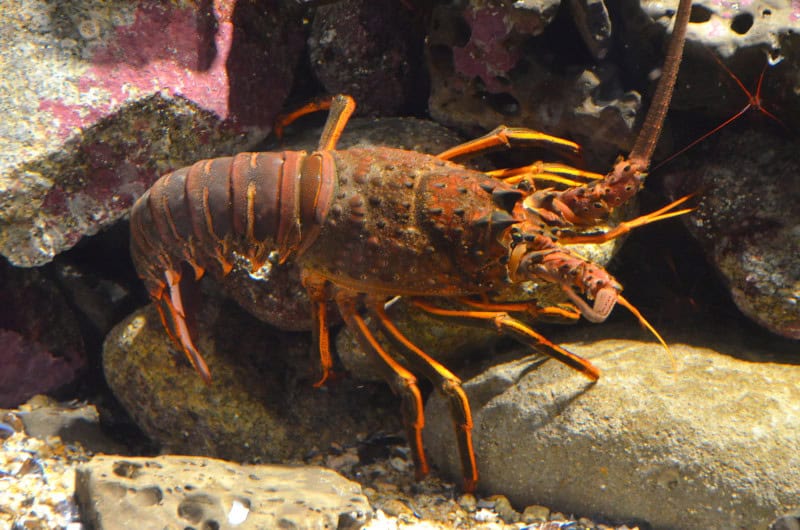
California Spiny Lobster Distribution, Habitat, and Ecology
The mesmerizing California Spiny Lobster evolved as endemic to a relatively limited portion of the marine regions of the globe. Exactly where that native zone of habitation lies, though, likely won’t surprise any of our readers. That’s because its very name provides a clear indication of this setting.
It appears only in a small section of the eastern Pacific Ocean, running along the west coast of North America. To the north, that extends as far as Monterey Bay, California, in the United States. From there, it reaches southward, through the Channel Islands, as far as Baja California, in Mexico.
It also displays decidedly strong and clear preferences regarding its choice of habitat. In general, it favors warmer waters, rarely being seen north of Point Conception, California. Generally it lives in waters no more than about 3 ft (1 m) deep, but occasionally appears as deep as 213 ft 65 m).
The intrepid product of eons of natural development also manifests preferences for terrain. It likes rocky reefs containing numerous crevices and overhangs. Kelp forests form another popular residence for the animal. Adults and juvelines alike also frequently hide under ledges and boulders.
Like its many other relatives around the world, the California Spiny Lobster evolved as carnivorous in nature. Its diet principally consists of a wide variety of benthic small benthic species. These primarily include different types of sea snails, clams, mussels, crabs, and sometimes sea urchins.
In turn, it faces its own share of predators, just as most animals. Some fish eat the invertebrate, such as the California Sheephead. Other natural threats include various octopuses and even sea otters. Unfortunately, however, the remarkable lobster also falls prey to human consumption.
During breeding activities, males of this nocturnal wonder transfer spermatophore to females. These then fertilize eggs and carry them under their tails. Eggs hatch into planktonic larvae that drift in the open ocean for several months before settling. A typical lifespan equals roughly 50 years.

Species Sharing Its Range
Check out our other articles on 5 Amazing African Herbaceous Plants, New Zealand Sea Lion, Cepkeliai Marsh, Basket Stinkhorn, European Honey Buzzard, Chinese Alligator