

CCL: https://tinyurl.com/yd548wbv
Canadian Violet Facts
- This seemingly delicate beauty most frequently goes by the somewhat deceptive common name of the Canadian Violet across its range. It also holds other general titles by which it’s known. Those options include Canadian white violet, tall white violet, and the white violet.
- Within the scientific community, however, it’s possibly much better known by its purely technical designation. Fortunately, that’s a comparatively simple one for the layperson to pronounce. That’s because the Angiosperm holds the formal moniker of Viola canadensis.
- The beautiful flora received that easy to utter epithet due to the efforts of Carl Linnaeus himself. That highly esteemed Swedish biologist accomplished the first official recognition of it as a separate and distinct species. He achieved that scientifically noteworthy deed in 1753.
- Despite its relatively unassuming appearance, this marvel of Nature and evolution holds a certain amount of note in the halls of science. This holds true due to the fact that the species also boasts several subspecies and varieties. To date, botanists recognize a total of four.
- Thankfully, the stunning Canadian Violet appears to be maintaining both a stable and sufficient population base. That state also seems to hold true throughout the entirety of its known range. Therefore, the IUCN does not currently show it on their Red List of Threatened Species.
- Nevertheless, this remarkable plant should still be considered as facing numerous potential threats to its continued existence as a species, at least. Most of those perils stem from the actions of mankind. They include the related dangers of habitat loss and climate change.
Related Articles
Canadian Violet Physical Description
The mesmerizing Canadian Violet typically captivates and intrigues those individuals fortunate enough to encounter it. The flora does not generally do so, however, due to impressive physical dimensions. That’s true since, while quite lovely, it’s not an overly large example of its kind of plant.
The Angiosperm develops as a herbaceous perennial that grows from short, creeping rhizomes. Each diminutive stem grows as erect in nature, smooth or slightly hairy, and green to purplish in color. These features vary in height, usually reaching upward roughly between 8 – 18 in (20 – 45 cm).
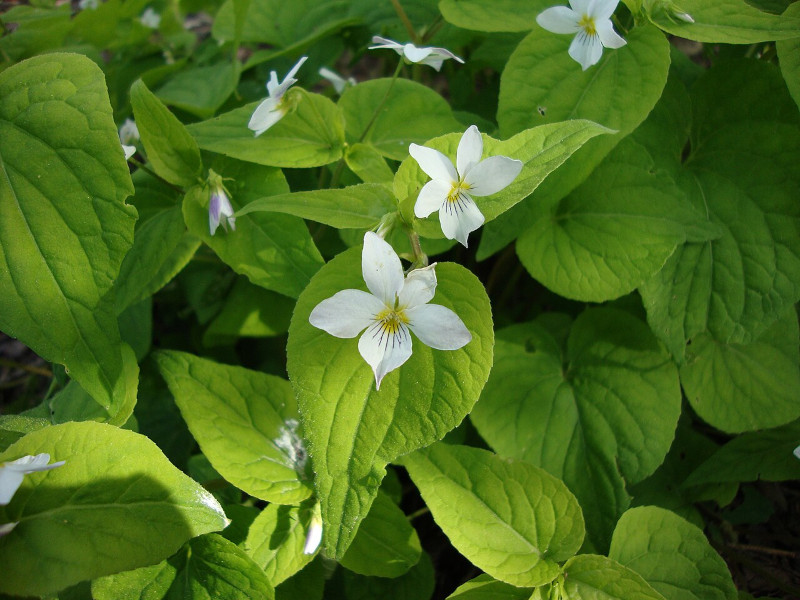
The stems also support multiple, distinctively-shaped leaves. The majority appear near the base of the stem, though some do grow higher up as well. Averaging 1.6 – 3.9 in (4 – 10 cm) long, these develop as heart-shaped, with serrated edges. The texture is smooth to slightly hairy beneath.
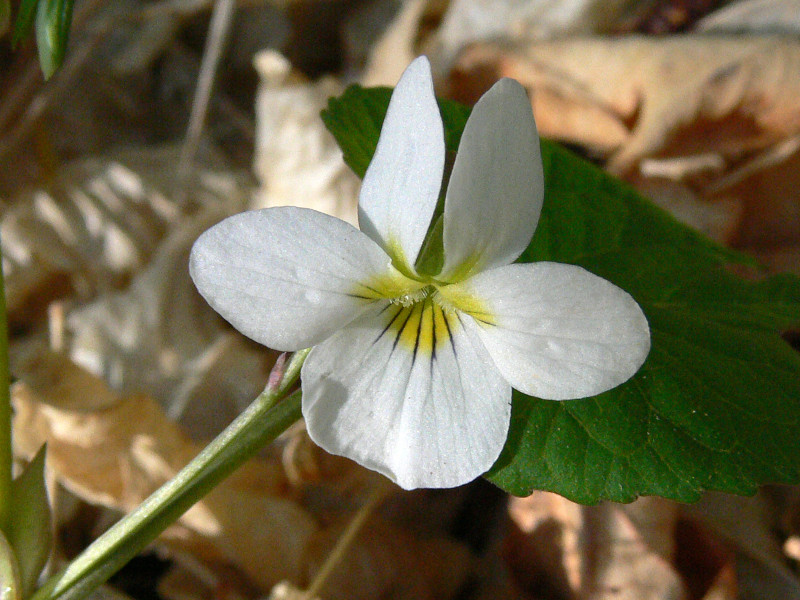
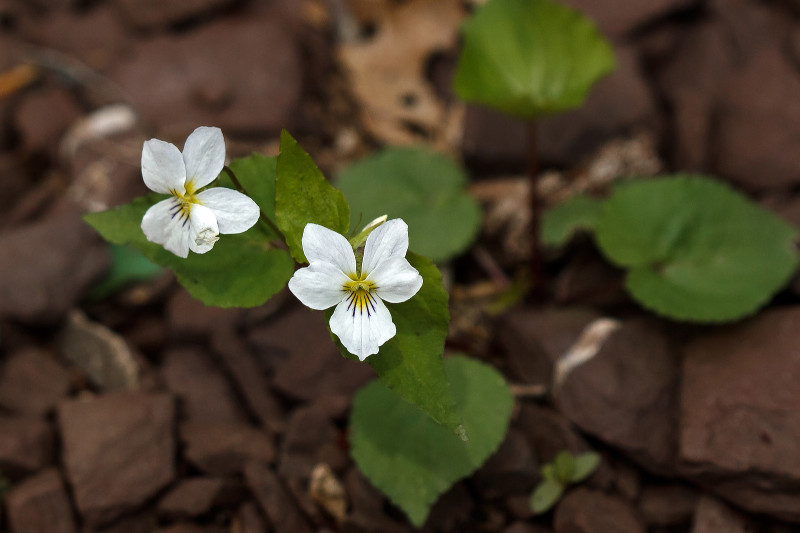
It’s understandably the flowers, though, of this botanical wonder that typically garner the most interest from observers. These manifest at the top of the stalks, above the foliage. Each has five petals, with the lower one being broader and veined, while the side petals appear slightly bearded.
Yet, it’s the appearance of the blooms of the beautiful Canadian Violet represent its most appealing aspect. These average about 0.75 – 1 in (2 – 2.5 cm) across. Each also shows white with a yellow throat and purple veins on the lower petals. The backs of the petals often also show a light purple.
The fruit of this remarkable flora, meanwhile, remains comparatively inconspicuous, at least when compared to the rest of this marvel of Nature. This evolved to be a small, three-part capsule in form. The interior of this structure contains a relatively large number of very tiny light brown seeds.
- Kingdom: Plantae
- Phylum: Tracheophyta
- Class: Magnoliopsida
- Order: Malpighiales
- Family: Violoaceae
- Genus: Viola
- Species: V. canadensis
Canadian Violet Distribution, Habitat, and Ecology
The fabulous Canadian Violet evolved as indigenous to a moderately broad portion of the surface of the earth. Precisely where that native zone of habitation lies, though, likely won’t surprise anyone. That’s true given the fact that the name provides an indication of at least part of that territory.
It developed as endemic to a portion of North America. The southerly extent of the reach of this flora extends into the United States. There, it appears in the northern and central regions. This includes the Great Lakes area, New England, the Pacific northwest, and the Appalachian Mountains.
Northward, however, as the name implies, the majority of its population thrives in Canada. In that country, the species occurs in every province except Newfoundland and Labrador. Despite its generally widespread presence, though, the typical abundance of this botanical masterpiece varies.
Like many of its kindred, this beauty displays a surprising amount of flexibility regarding its choice of habitat. It therefore appears in a fairly wide variety of local ecosystems. Nevertheless, each of these different settings does share certain basic environmental conditions which it requires.
One of these always remains a matter of elevation. It thrives in lowlands to mid-elevation regions. At these heights, it prefers both partial to full-shade, along with rich, loamy, and well-drained soil types. The plant also needs this to be moist, but not waterlogged, and only slightly acidic in nature.
It most commonly makes its home in areas of either moist deciduous or mixed forests. Other favored regions include woodland edges and clearings, as well as shaded stream banks. This marvel of evolution also regularly frequents moist meadows, cool ravines, and upland slopes in its range.
The appealing Canadian Violet thrives best in the environments mentioned above. In these settings, it also plays a surprisingly important role in temperate forest ecosystems of both Canada and the northern U.S., where it contributes to understory diversity and early-season pollinator support.
It achieves its pollination via the activities of local species of bees, butterflies, and flies. Intriguingly, it mainly manages seed dispersal through the actions of ants. The seeds have small, fatty appendages that attract these insects, who eat the attachments, then discard the seeds in rich soil.
Its leaves also serve as food for various fritillary butterfly caterpillars, further enhancing its ecological importance. The nectar it provides supports native pollinator populations, especially early in the season. It also provides low ground cover for small invertebrates and mammals.

Species Sharing Its Range
Check out our other articles on 7 Endemic Socotran Species, Northern Raccoon, Cradle Mountain, Cucumber Tree, Goldentail moray, Baltimore Checkerspot, Keleed slug-eating Snake