


Dog Rose Facts
- This delightful botanical beauty most frequently goes by the sadly uninspiring common name of the Dog Rose, which doesn’t do it justice. It does have many other titles by which it’s known, though. Those include Wild rose, Briar rose, Dog briar, Hedge rose, and hip rose, among others.
- Inside of the scientific community, however, it’s perhaps much better known by its entirely technical designation. Thankfully, that’s a rather simple one for the layperson to pronounce, at least as such tags go. That’s because the lovely plant holds the formal moniker Rosa canina.
- The marvel received that short epithet due to the efforts of Carl Linnaeus himself. That highly esteemed Swedish biologist accomplished the first official acknowledgement of it as a separate and distinct species. He achieved that scientifically noteworthy deed in the year 1753.
- It also holds a distinctive place among botanists. That’s due to the fact that it represents a very variable and complex species, with taxonomists recognizing several subspecies, and sometimes local forms or hybrids. To date, a total of six mainly recognized subspecies remain known.
- Fortunately, the amazing Dog Rose appears to be maintaining a population base that’s both stable and sufficient. That pleasant state also seems to hold true throughout the entirety of its native range. Accordingly, the IUCN does not show it on the Red List of Threatened Species.
- The flora should nevertheless still be considered as facing numerous potential threats to its continued existence as a species. Like all forms of life on earth today, most of these stem from the actions of man. They include the related perils of habitat loss and climate change.
Related Articles
Dog Rose Physical Description
The lovely Dog Rose generally quickly captures the attention and interest of those individuals fortunate enough to encounter it. Unlike some of its relatives around the world, though, it does so for more reasons than just its beauty. That’s because it also boasts respectable measurements.
This deciduous, scrambling shrub evolved as a collection of arching, woody stems with a bushy and sprawling growth habit in form. Most specimens attain a height ranging from somewhere between 3.3 – 9.8 ft (1 – 3 m). Some exceptions however, occasionally reach as much as 16 ft (5 m) tall.
The flora also produces innumerable short stems covered in thorns. In color, the stems develop as green to reddish-brown, smooth when young, becoming woody with age. Its thorns, meanwhile, appear as clearly curved and strong, flattened at the base, and typically pointing slightly downward.
The leaves also merit note. These develop in a compound pattern, with between 5 – 7 leaflets each. Those have an oval shape, with finely-toothed margins, and average 0.8 – 1.6 in (2 – 4 cm) in length. Their coloring also receives attention, being bright to dark green on top, yet paler underneath.
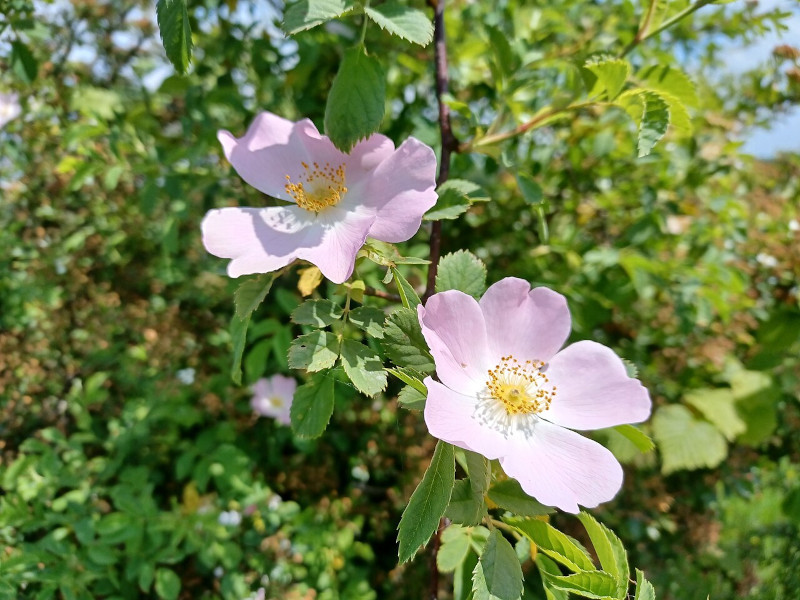
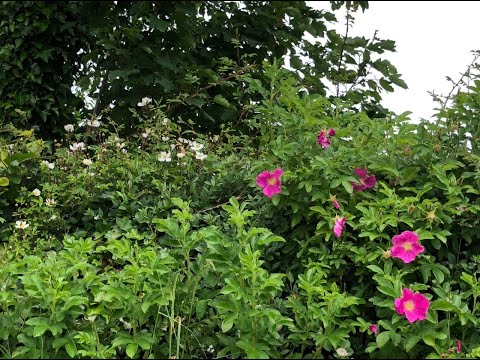
It’s unquestionably the flowers of the gorgeous Dog Rose that garner the most attention, however. These blossoms average between 1.5 – 2.5 in (4 – 6 cm) across. Each of these amazing creations of Nature and evolution usually five rounded and slightly overlapping petals to appeal to the observer.
The overall pattern of coloring of these marvelous blooms, though, varies between individual plants. Most frequently, though, these range from various shades of pale pink or white, yet sometimes with a deeper pink. Prominent yellow stamens also appear within the center, accenting this perfectly.
The fruits of this wonder of the botanical world also earn a measure of appreciation. This aspect of the flora develops as an ovoid berry-like structure. Each averages about 0.6 – 0.8 in (1.5 – 2 cm) long. The color appears as orange-red when ripe, and possessing a notably smooth, glossy texture.
- Kingdom: Plantae
- Phylum: Tracheophyta
- Class: Magnoliopsida
- Order: Rosales
- Family: Rosaceae
- Genus: Rosa
- Species: R. canina
Dog Rose Distribution, Habitat, and Ecology
The enchanting Dog Rose evolved as indigenous to a comparatively extensive section of the surface of the world. How much of an area that native zone of habitation covers just might surprise many people, though. That’s because it appears in parts of Europe, northwest Africa, and western Asia.
In northern Europe, that endemic territory includes both Scandinavia and the British Isles. In southern Europe, however, it consists of Spain, Italy, and Greece. Meanwhile, in the eastern regions of this area of the world, the floral marvel inhabits a range that reaches into the beautiful Caucasus.
Stretching outward from there, though, it spreads its presence into several nations in western Asia. Those include the countries of Turkey and Iran. Not content to stop there, it also makes appearances in countries such as Morocco, Algeria, and Tunisia, within the confines of north Africa.
Nature blessed this remarkable Angiosperm with an extraordinary degree of adaptability regarding its choice of habitat type. This hardy, flexible shrub thus appears in a broad range of environments and ecosystems. Most of these, however, consist of open, sunny to partially shaded environments.
It’s often found in rural areas, comprising part of hedgerows and field margins. It also favors such areas as transitional zones between forest and open land, like clearings and woodland edges. The wonder of evolution additionally often occurs in quantity among areas of scrublands and thickets.
In sections of land where grazing by livestock remains light, it also thrives in many grasslands and pastures. Given that it tolerates disturbances and poor, dry soils, it does well along roadsides and on embankments. It even lives coastal slopes and hillsides in open areas with adequate drainage.
Like most of its kindred located across the globe, the gorgeous Dog Rose achieves its pollination via the activities of numerous species of locally prevalent insects. These efficient pollinators primarily include various species of bees, hoverflies, beetles, and multiple other nectar-feeding invertebrates.
The dispersal of its many small seeds, however, principally occurs through the actions of different animals. As a principle, most of these helpers consist of avians, such as the thrushes, blackbirds, and fieldfares. These, and some small mammals, eat the hips and disperse seeds via their droppings.
Despite its seemingly delicate nature, this impressive flora plays a role of importance in the areas in which it appears. Not only does it serve as a source of nectar and pollen for the aforementioned insects, but it also often serves as an important host plant for the larvae of several species of moth.
It provides a reliable source of nourishment and security for many animal species, as well. Large numbers of birds feed on the hips and use its branches for nesting and protection. Countless small mammals also eat its fruit and employ the dense nature of the shrub for protection from predators.
Species Sharing Its Range
Check out our other articles on 5 Amazing African Herbaceous Plants, Ethiopian Wolf, Čepkeliai Marsh, Hairy Shadow Witch, Blue Baboon Tarantula, Spotted Eagle Ray, Earless Monitor Lizard