

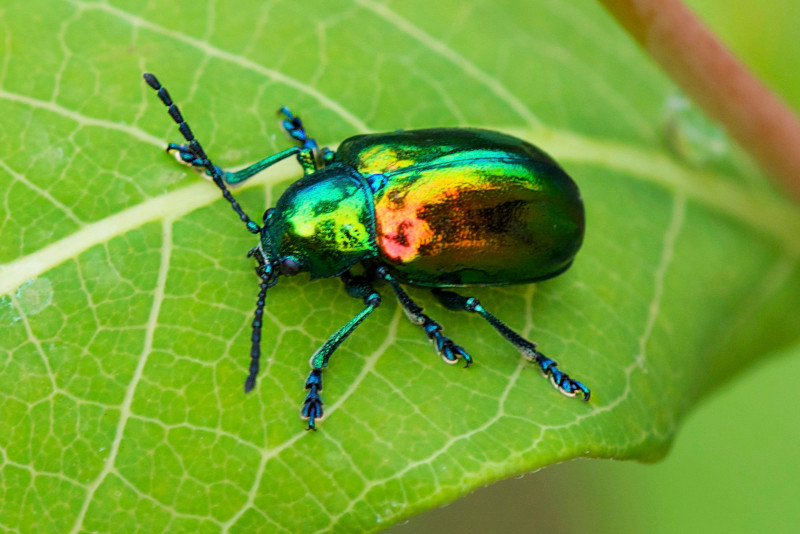
Dogbane Beetle Facts
- This eye-catching invertebrate most frequently goes by the intriguing common name of Dogbane Beetle across its native range. The marvel does have a few alternate titles that it’s known by, though. These include the terms Metallic Tortoise Beetle and Iridescent Leaf Beetle.
- Inside the halls of science, however, it’s possibly much better known by its purely technical tag. That one, though, like many such, is somewhat hard for the layperson to pronounce. That’s because this amazing product of Nature and evolution bears the moniker Chrysochus auratus.
- The stunning insect received that epithet due to the efforts of Johann Christian Fabricius, a student of Carl Linnaeus. This researcher accomplished the first official recognition of it as a separate and distinct species. He achieved that scientifically noteworthy deed in the year 1775.
- This fascinating Arthropod’s quite well-known among entomologists for a variety of reasons. High on this list stands its unusual reproductive behavior. The insect lives a highly polygamous lifestyle. The mating process itself lasts for many hours, sometimes more than a day!
- Fortunately, the gorgeous Dogbane Beetle appears to be thriving, and maintaining a population that’s both stable and sufficient. That most pleasant state also seems to hold true throughout its entire range. The IUCN therefore does not presently have a place for it on the Red List.
- Nonetheless, this natural marvel still faces many potential threats to its continued existence as a species, at least. In this regard, it faces the same dangers as all forms of life on earth today. Most of these derive from the acts of man, including habitat loss and climate change.
Related Articles
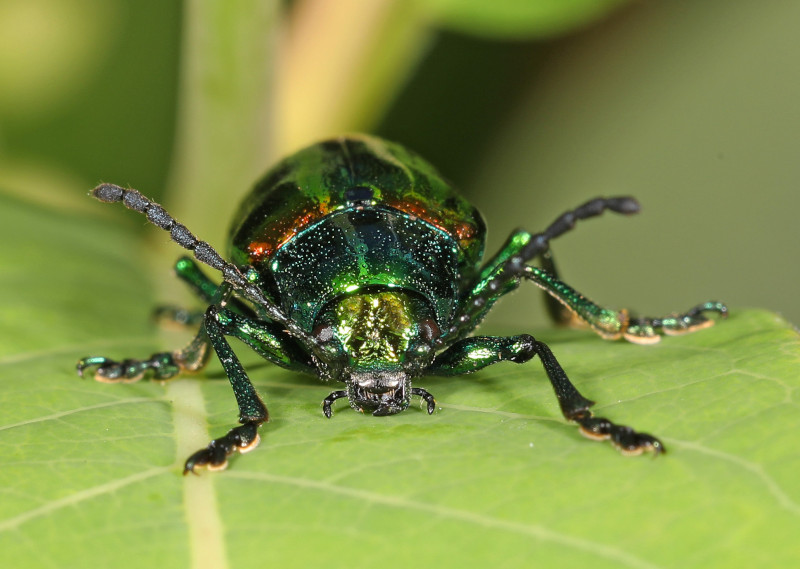
Dogbane Beetle Physical Description
The magnificent Dogbane Beetle rarely if ever fails to mesmerize those individuals fortunate enough to notice it in its native environment. That principally occurs, however, due more to its obvious visual appeal than any factor of size. In that respect, it’s a small-to-medium member of its Order.
It does differ from many other creatures around the world, including many of its kindred, in one respect, though. That’s the fact that it displays only the tiniest degree of the physiological characteristic known as sexual dimorphism. This makes distinguishing the genders visibly difficult.
Females do attain a greater average size than their male counterparts, it’s true. Yet, that difference remains so small as to be undetectable with the naked eye. They’re also very slightly more robust in shape. Obviously the genitalia are different, but remain wholly invisible without magnification.
Otherwise the two genders present the same outward appearance to the casual observer. The body reaches a mean length equaling roughly 0.3 – 0.4 in (8 – 11 mm). In width, it also averages about 0.16 – 0.24 in (4 – 6 mm). This makes the wonder roughly the size of a standard pencil eraser.
The shape of the body develops as dome-like and compact, possessing a smooth, rounded back. Like most of its countless relatives, it also evolved wing cases. These develop as shiny and hard, covering the hindwings and abdomen. They display no clear markings, just a shimmering surface.
Other physical features of the breathtaking Dogbane Beetle also catch the eye. It has medium-length, thread-like antennae, often dark or black in color. Its legs, mwawhile, appear thin and dark-colored, sometimes with a slight metallic sheen. The surface’s consistently smooth and glossy.
Yet, it’s unquestionably the dazzling array of colors that most stands out about this species. This consists of brilliant, metallic green or blue, often with gold, copper, or red highlights depending on the angle of the light. This iridescence occurs due to its structural coloration, not pigment.
- Kingdom: Animalia
- Phylum: Arthropoda
- Class: Insecta
- Order: Coleoptera
- Family: Chrysomelidae
- Genus: Chrysochus
- Species: C. auratus
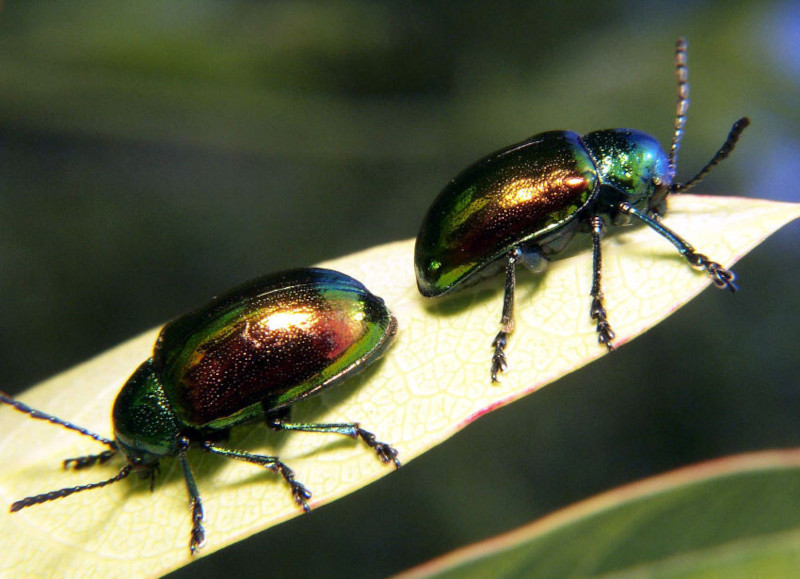
Dogbane Beetle Distribution, Habitat, and Ecology
The beautiful Dogbane Beetle evolved as indigenous to a moderately broad expanse of the surface of the globe. Precisely where that expansive zone of habitation lies probably won’t surprise a great multitude of people. That’s because the remarkable beetle developed as native to North America.
Within the boundaries of that continent, the intrepid insect appears to be native solely to the general eastern and central portions of the landmass. Part of that range includes sections of the nation of Canada. There, it’s only known to occur in southern Ontario, Quebec, and Manitoba.
The majority of its native territory resides within the confines of the United States. There, in the east, its range extends as far north as Maine, and as far south as Florida. Spreading westward, the insect inhabits sections of the Great Plains, including states like Texas, Nebraska, and Minnesota.
Nature provided this enthralling beetle with a distinct evolutionary advantage over many other competing creatures. That’s the developement of an impressive degree of flexibility regarding its choice of habitat. The beautiful invertebrate’s therefore found in a wide variety of ecosystems.
Man of its numbers populate areas of meadows and open fields. Forest edges and clearings also serve as a common home to the insect. Prairies and old fields represent another location where it’s often seen. Displaying its versatility, it also commonly frequents roadsides and ditches of all sizes.
The ecology of this delightful Arthropod remains closely tied to its host plant, its chemical defenses, and its role in the food web. This serves as one of the limiting factors of its habitation range. Due to its dependency on a specific food source, it only lives where it finds this in sufficient quantity.
The animal feeds almost exclusively on varieties of dogbane plants, hence the name. These plants contain toxic compounds which the beetles ingest and sequester as a defense mechanism. The larvae feed on the roots, while adults of the species feed on the leaves and stems, both voraciously.
This dietary preference serves a pivotal role in its survival. After consuming these, it becomes not only unpalatable, but potentially lethal to would-be predators. Its bright, metallic iridescence also sends notice to those, since, in Nature such colors commonly represent a warning signal of toxicity.
The female of the Dogbane Beetle lays large numbers of eggs. These she typically places on or near the host plant. Larvae feed on roots underground, pupate in the soil, and emerge as adults in mid to late summer. Adults live for several weeks, during which they feed, mate, and lay their eggs.
This natural wonder plays an important role in the native plant-insect ecosystems it inhabits. Among other factors, its feeding habits help to regulate dogbane populations. Though only a few specialized predators feed on it, the insect nonetheless plays a role in the food chain in that regard.

Species Sharing Its Range

Check out our other articles on 7 Stunning Atlantic Ocean Sharks, Mountain Hare, Kangaroo Island, Scarlet Elf Cup, Spotted Eagle Ray, Fulvous Skimmer, Emperor Penguin, Mugger Crocodile