

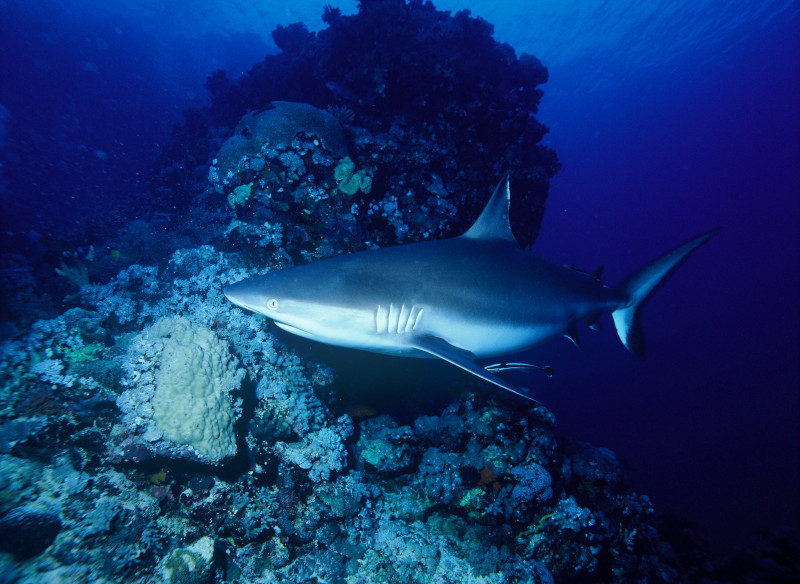
Gray Reef Shark Facts
- The fully descriptive title of Gray Reef Shark serves perfectly as the most frequently employed common name for this marine marvel. This amazing creature does, however, hold several others. These include the terms Blacktail Reef Shark, Shorttail Shark, and Bronze Whaler.
- Inside the halls of science, though, it’s perhaps much better known by its purely technical tag. Unfortunately, that’s one that’s virtually unpronounceable by the typical layperson. That’s because this wonder of Nature bears the formal moniker Carcharhinus amblyrhynchos.
- This impressive fish received that truly tongue-twisting designation due to the efforts of Pieter Bleeker. That highly respected Dutch ichthyologist accomplished the first official recognition of it as a separate and distinct species. He achieved that scientifically noteworthy deed in 1856.
- The shark stands out to many researchers due to an uncommon behavior. It represents one of the few shark species known to perform a threat display when feeling cornered or threatened. This fish arches its back, lowers its pectoral fins, and swims in an exaggerated, jerky motion.
- Sadly, the stunning Gray Reef Shark now finds itself in a lamentable situation. Its known population continues to decline steadily. Though that unfortunate trend remains less in some regions, overall it continues. Accordingly, the IUCN now lists it as Endangered on its Red List.
- This marvel of evolution faces numerous threats to its continued existence as a species. Like most forms of life on earth today, the majority of these stem from the actions of mankind. In its case, these include being actively fished, habitat loss, and ongoing climate change.
Related Articles
Gray Reef Shark Physical Description
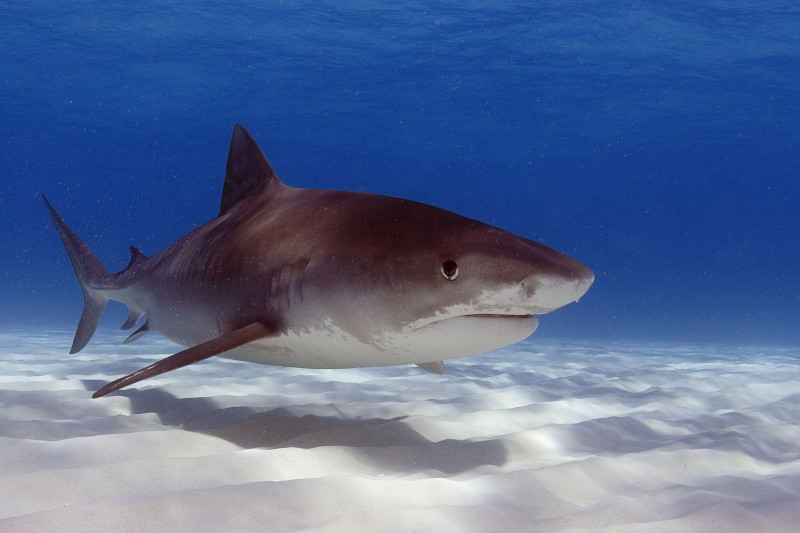
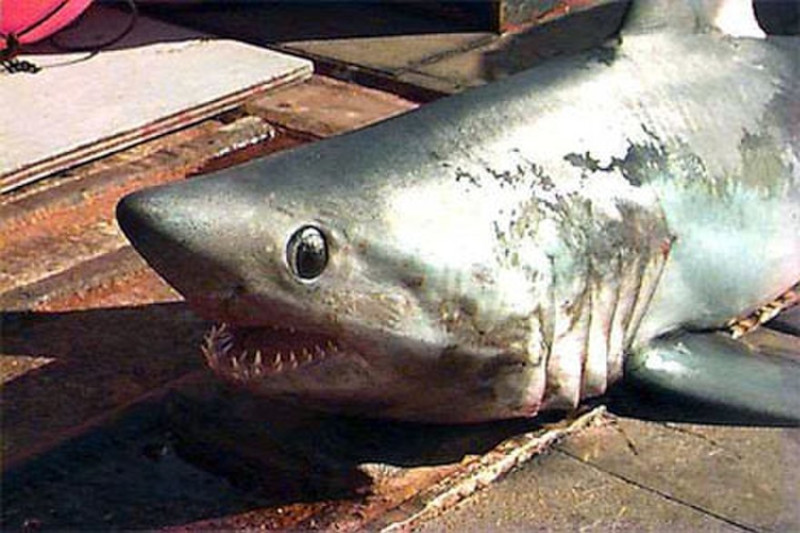
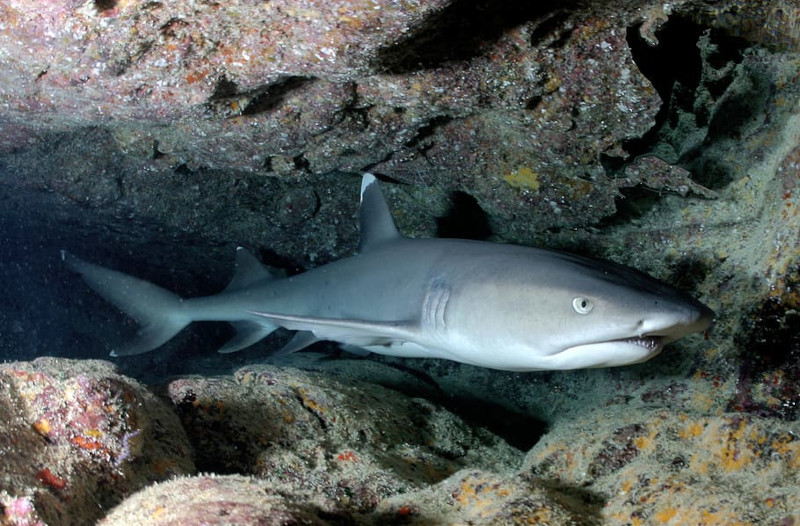
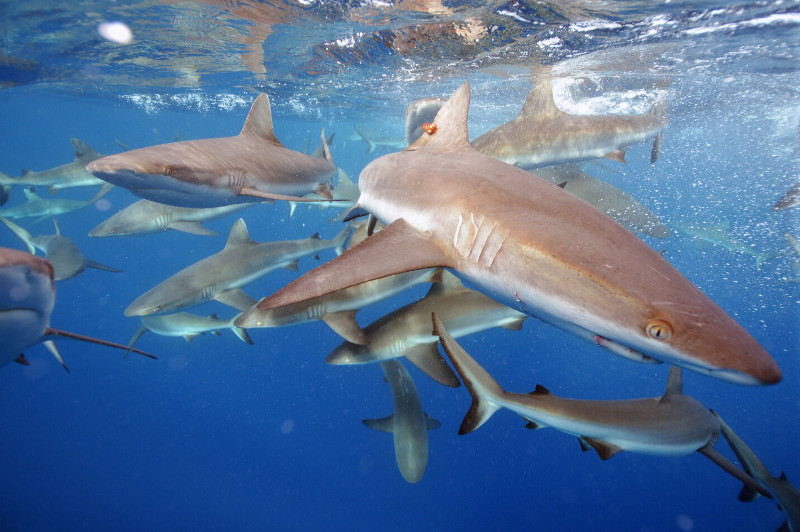
The remarkable Gray Reef Shark rarely fails to captivate and amaze those individuals fortunate enough to view one of these marvels. It does not typically do so due to impressive physical statistics, however. That’s because, while eye-catching in other ways, it’s not especially large.
In terms of its physical nature, it diverges from many creatures on earth today in an uncommon manner. That’s the fact that it displays only a very minor amount of the physiological characteristic of sexual dimorphism. It’s therefore difficult for the layperson to distinguish the genders.
Nonetheless, while relatively small, sex-based differences do exist. One of those, as is quite often the case, remains sheer size. As a general rule, females achieve slightly greater measurements than their male counterparts. This variation in the species pertains to both weight and length.
The aforementioned females generally reach maximum lengths equaling up to 8.2 ft (2.5 m). A more typical average, though, totals between 5 – 6.5 ft (1.5 – 2 m). As previously mentioned, males usually remain marginally smaller, generally appearing at the lower end of this specific size range.
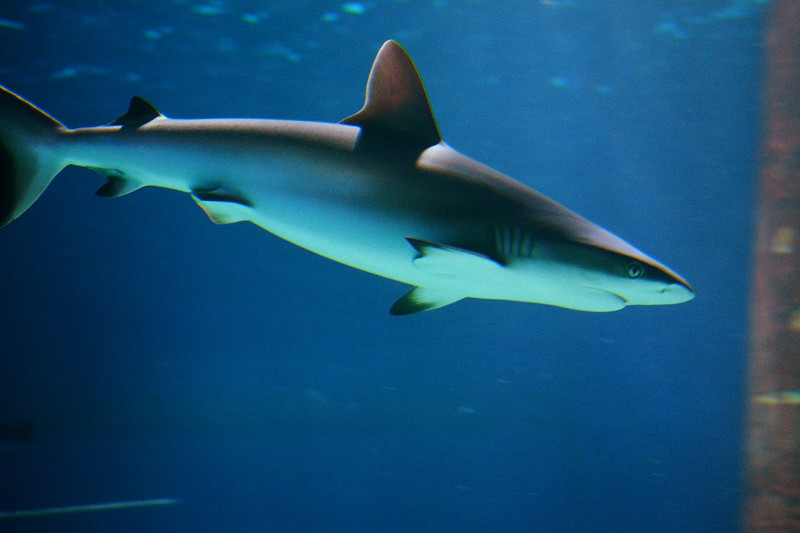
The overall shape of the body, however, appears the same for members of both sexes. That consists of the rounded snout and slim, torpedo-shaped structure common among its close relatives. Body masses typically range from between 77 – 88 lb (35 – 40 kg), with males being on the lighter end.
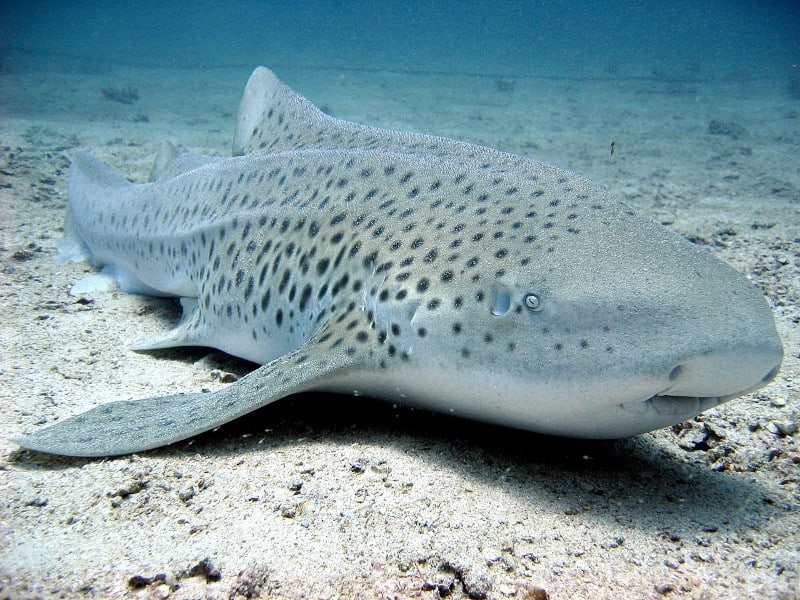
The very name of the Gray Reef Shark provides a clue to its basic coloring, which holds true for both genders. Its upper side presents shades of gray that run from dark to bronze-gray. Yet the underside shows white. Various parts of the streamlined body also display highly distinctive markings.
The tail fin, known as the caudal fin, shows prominent black or dark tips. These also occasionally appear on the second dorsal fin. Some individuals also manifest a white tip on the first dorsal fin. Highlighting all these, however, a faint white stripe runs along the flank from the gills toward the tail.
- Kingdom: Animalia
- Phylum: Chordata
- Class: Chondrichthyes
- Order: Carcharhiniformes
- Family: Carcharhinidae
- Genus: Carcharhinus
- Species: C. amblyrhynchos
Gray Reef Shark Distribution, Habitat, and Ecology
The beautiful Gray Reef Shark evolved as indigenous to a comparatively broad expanse of the earth’s marine regions. Precisely where that zone of habitation lies won’t surprise very many people. That’s true since this wonder of Nature developed as native to most of the Indo-Pacific region.
Within the Indian Ocean, this intrepid marvel lives in the waters around East Africa, including Madagascar and the Seychelles. From there, it extends that territory to western Australia. It’s further found around island chains like the Maldives, Chagos Archipelago, and even parts of the Red Sea.
Meanwhile, in the Pacific Ocean, the intriguing creation of evolution resides in the waters of Southeast Asia. This includes near Indonesia, Philippines, and Papua New Guinea. Around Australia, it frequents the Great Barrier Reef, as well as areas along both the northern and western coasts.
It also appears near Micronesia, Melanesia, and Polynesia, namely the Marshall Islands, French Polynesia, and Samoa. Not surprisingly, it’s common around the Northwestern Hawaiian Islands. From there, it’s even been seen, though on rare occasions, as far south as Northern New Zealand.
The expansive nature of this range remains deceptive, though. The animal displays decidedly strong and selective preferences regarding its choice of habitat. These, in fact, severely restrict where the fish usually makes it’s home. Again, its name gives one a clear concept of the nature of this.
It principally inhabits areas of coral reefs. There, it mainly prefers the outer reef slopes, lagoons, and reef passes. The shark also usually favors shallower waters, with depths of no more than 920 ft (280 m). Most commonly, it spends most of its time at depths equaling less than 197 ft (60 m).
The ecology of the stunning Gray Reef Shark centers around its role as a top reef predator, influencing the structure and behavior of reef fish communities. There, depending on the ecosystem it appears in at any particular time, it plays the role of either an apex predator or mesopredator.
Understandably, it feeds opportunistically as a pure carnivore. Given its own relatively diminutive size, its prey primarily consists of locally available small species. That mainly consists of bony fish, such as wrasses, groupers, and jacks. Smaller cephalopods and crustaceans also make the list.
Although active at all times of day or night, it’s primarily diurnal in nature. It sometimes forms loose groupings during the day, especially among females, but hunts alone at night. It’s not strongly territorial, yet displays home range behaviors. It even uses a threat display, unique among sharks.

Species Sharing Its Range
Check out our other articles on 7 Captivating United States Lakes, Humpback Whale, Salton Sea, Douglas Iris, Koa Butterfly, Hellbender Salamander, Emperor Penguin, Mugger Crocodile