

CCL: https://tinyurl.com/5954phb3
Himalayas Facts
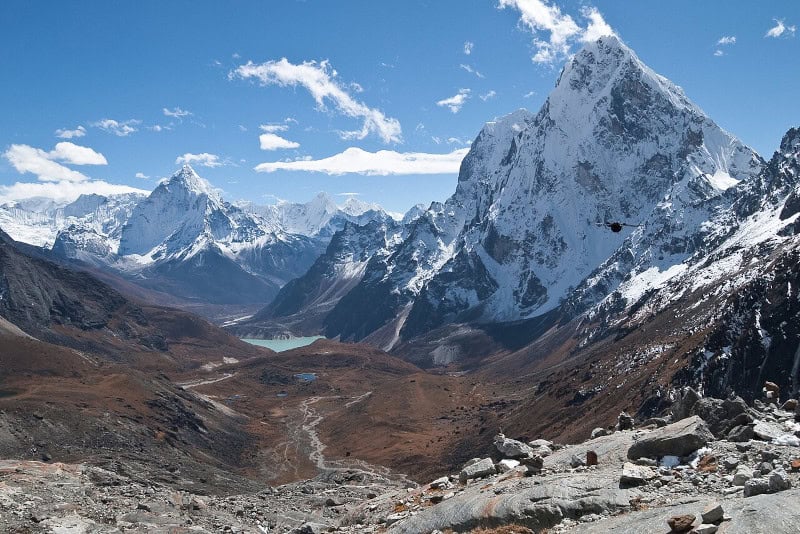
- This magnificent creation of Nature and geological processes remains best known to the majority of the world by the appellation of the Himalayas. It does have a few more general titles by which it’s known, though. Those include Great Himalayas and Snowy Mountains.
- These few choices, however, represent only differing english language versions of their designation. The marvelous feature naturally also holds still more monikers in other languages. Those include Himavan, Parvata Raja, Himal, Gang Rinpoche, and Qomolangma Feng.
- This mountain range was never discovered in the traditional sense. That’s true since ancient man inhabited the region long before the rise of actual civilizations. In fact, archaeological evidence indicates a human presence in the region stretching back tens of thousands of years.
- In more modern times, though, after the rise of formal cultures, European explorers eventually became the first outsiders to view this breathtaking formation during the colonial period. British surveyors became the first in the early 1800s to begin detailed cartographic work.
- Fortunately, the various governments of the nations within whose borders the Himalayas lie recognize their significance. Due to this cognizance, the range of mountains now enjoys at least partial protection. Their sheer size and scope renders complete protection impossible.
- What does exist, however, comes in the form of national parks, wildlife sanctuaries, and conservation initiatives spread across those same countries. Many of these qualify as UNESCO World Heritage Sites, in addition to numerous local biosphere reserves and Nature Reserves.
Related Articles
Himalayas Physical Description
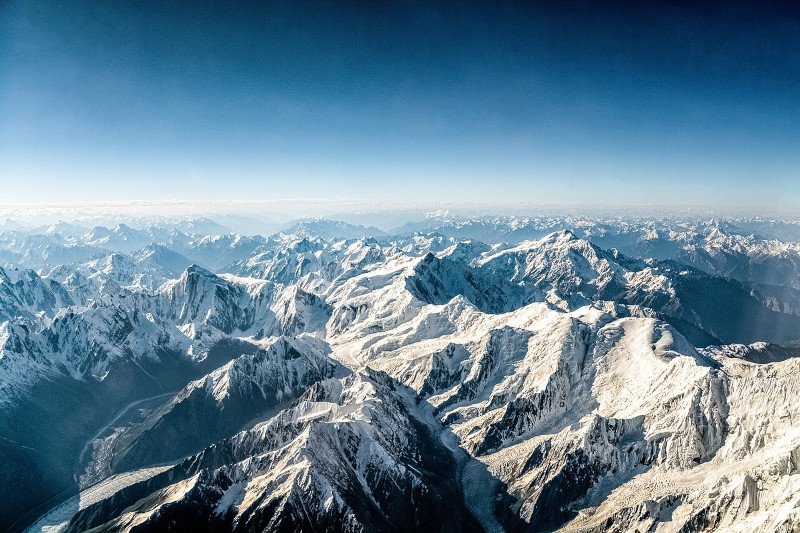
The Himalayas never fail to leave those who encounter them breathless with wonder. In their entirety, their span befuddles many with its scope. In length, they extend 1,500 mi (2,400 km). Their width ranges from 124 – 248 mi (200 – 400 km), with an area of 230,000 sq mi (595,000 sq km).
However, they’re also composed of four clearly distinct main ranges. The so-named Outer Himalayas remains the lowest of these in terms of height. Their vertical reach ranges from around 1,969 – 3,937 ft (600 – 1,200 m). It’s also primarily composed of soft sandstone, clay, and boulders.
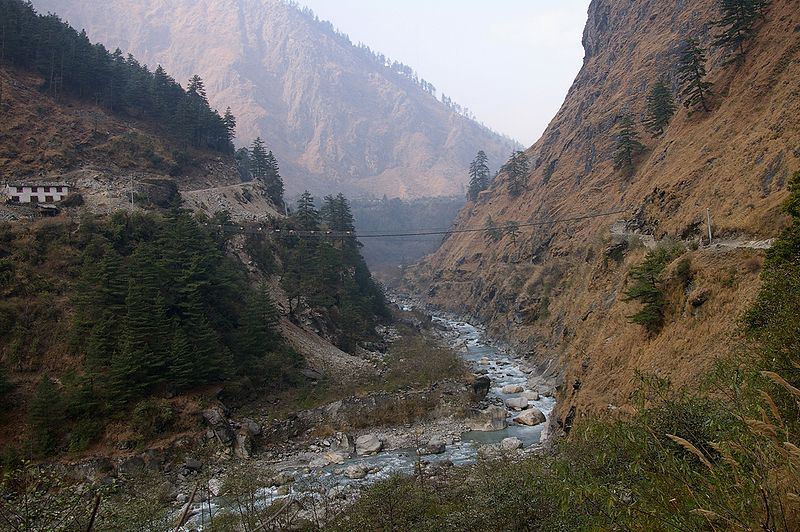
Next comes that portion of the marvel of geology called the Lesser Himalayas. In terms of altitude, these peaks extend upward to points that range from roughly 11,483 – 14,764 ft (3,500 – 4,500 m). This section of the greater area also features a unique blending of rugged terrain with fertile valleys.
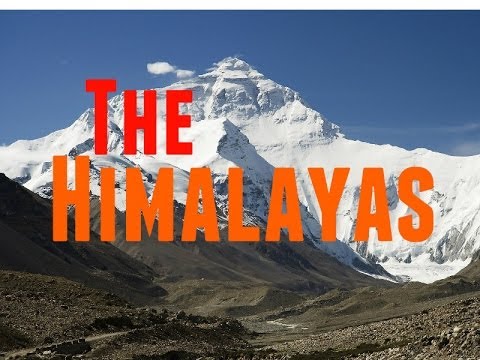
The next composite section of this range bears the apt title of the Greater Himalayas. It forms both the tallest and most continuous part of the marvel. Here, the tops of the individual peaks averages an incredible 19, 685 ft (6,000 m). The earth’s tallest land peak lies here, at 29,032 ft (8,849 m).
The fourth and final primary component of the Himalayas bears the slightly different honorific of the Trans-Himalayas. This itself also contains three smaller ranges, named Karakoram, Ladakh, and Zaskar. These each principally contain notably barren, cold desert regions with very high passes.
Not to be outdone, however, Nature also blessed this extraordinary wonder with still more separat natural wonders. Here, a mind-numbing total of over 15,000 glaciers appear! Between them many of these collectively form the sources of the Ganga, Indus, Brahmaputra, Yamuna, and Mekong rivers.
Himalayas Location, Formation, and Ecology
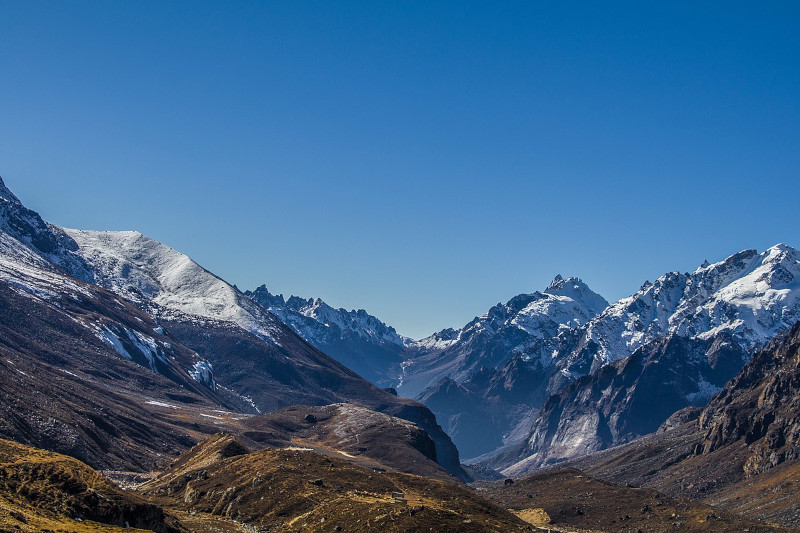
The beautiful Himalayas formed in a region of the world already well known for its extreme abundance of natural wonders. That location therefore comes as no surprise to most people who learn of it. That’s true since natural processes created it as part of the stunning continent of Asia.
These peaks form a huge mountain system along the northern boundary of the Indian subcontinent, acting as a natural barrier between South Asia and the Tibetan Plateau. Their reach also extends through the span of the five separate countries of India, Nepal, Bhutan, China, and Pakistan.
The formation of this majestic beauty remains one of the most dramatic events in Earth’s geological history. Around 200 million years ago, a vast ocean called the Tethys Sea lay between two giant landmasses. Science now gives those the names of the Indian Plate and the European Plate.
About 120 million years ago, the Indian Plate broke off from Gondwana and began moving north at a relatively rapid rate. Around 50–55 million years ago, the Indian Plate collided with the Eurasian Plate. The ocean floor between compressed, folded, and uplifted, forming the first ranges.
Yet, Nature continues this process even today. The Indian Plate continues to push into Eurasia at the rate of roughly 2 in (5 cm) per year. Due to this motion, the range continues to rise at a rate of about 0.4 in (1 cm) yearly. It also causes frequent earthquakes in the region, due to tectonic stresses.
Despite the picture people have of the Himalayas, though, the local ecology represents one of the richest on the entire planet. That’s understandably been inexorably shaped over vast spans of time by its unique combination of extreme altitudes, widely varying climates, and differing landscapes.
As the elevation increases, the native environment changes dramatically. In the foothills, which extend up to a height of roughly 4,921 ft (1,500 m), subtropical broadleaf forests appear, including sal, teak, and bamboo. In many local valleys, rich areas of human agriculture frequently abounds.
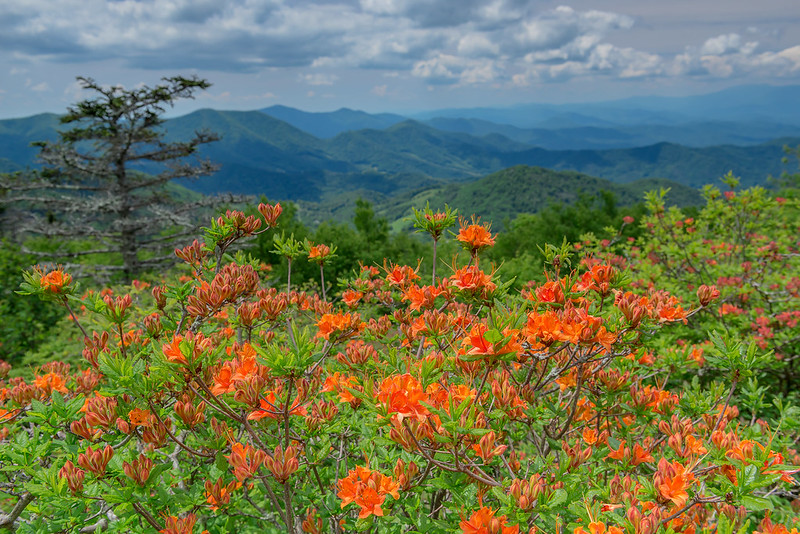
Meanwhile, from 4,921 – 9,843 ft (1,500 – 3,000 m) temperate forest of oak, rhododendron, pine, cedar, and chestnut thrive. From 9,843 – 14,764 ft (3,000 – 4,500 m) coniferous forests and alpine meadows abound. Between this and 19,685 ft (6,000 m) alpine shrubs, mosses, and lichens live.
A large number of fauna of various types also thrive in locations up to the higher reaches. These include a number of flagship species, such as the Snow Leopard and Red Panda. Along with these, other creatures like the Himalayan tahr, yak, musk deer, and the Himalayan monal also live.
Features Sharing Its Region
Check out our other articles on 5 Amazing African Herbaceous Plants, New Zealand Sea Lion, Cepkeliai Marsh, Southern Darwin’s Frog, Silky Afgekia, Baltimore Checkerspot, Chinese Alligator