

Mauve Stinger Facts
- This breathtaking creation of Nature and eons of evolution most frequently goes by the fully descriptive common name of the Mauve Stinger. Yet, this remarkable Cnidaria actually holds not merely one, but a wide variety of other general titles by which it’s occasionally known.
- The terms purple-striped jelly and purple stinger mimic its primary one. Other options consist of purple jellyfish, luminous jellyfish, and night-light jellyfish. Humorously, in close association with a comedic older song, it’s also sometimes referred to as the purple people eater.
- Within the scientific community, however, it’s perhaps much better known by its technical designation. Fortunately, that’s a comparatively simple one for the layperson to pronounce. That’s because this wonder of the seas bears the formal moniker of Pelagia noctiluca.
- It received that shorter epithet due to the efforts of Peter Forsskål. That well-respected Swedish naturalist accomplished the first official acknowledgement of it as a separate and fully distinct species. The researcher achieved that scientifically noteworthy deed in the year 1775.
- Thankfully, the dazzling Mauve Stinger appears to be maintaining a population base that’s both stable and sufficient. That pleasant state also seems to hold true throughout the entirety of its range. Accordingly, the IUCN does not presently show it on the organization’s Red List.
- Nevertheless, the captivating creature should still be considered as facing multiple potential threats to its continued existence as a species. In this, it faces the same dangers as all forms of life on earth today. Most of these derive from the actions of mankind, including climate change.
Related Articles
Mauve Stinger Physical Description
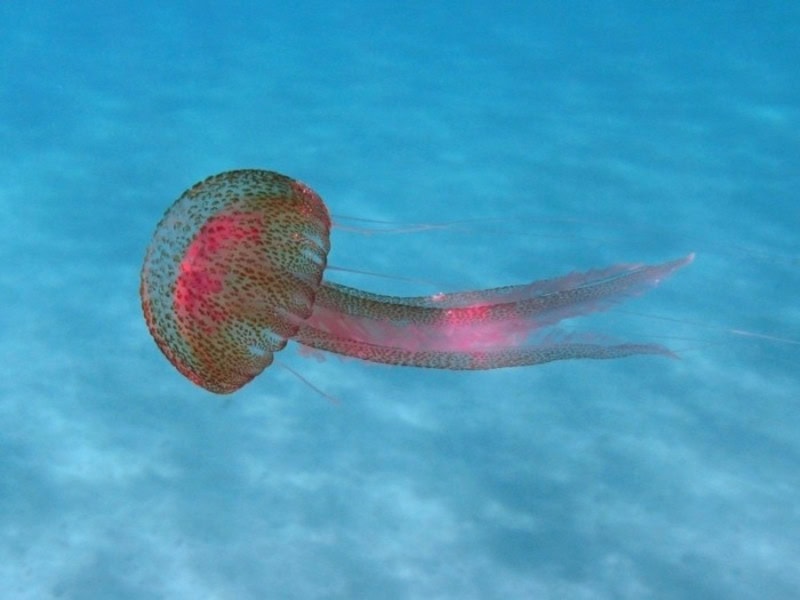
The attention-grabbing Mauve Stinger almost instantly captivates those individuals fortunate enough to view one of these marvels. Unlike some of its numerous kindred across the globe, though, this remarkable marine wonder does not do so due to any particularly impressive physical size.
When it comes to its appearance, it also follows a pattern of development common among its relatives. That’s the fact that it displays no outwardly visible sign of the physiological characteristic of sexual dimorphism. Distinguishing the sexes purely visually therefore becomes quite difficult.
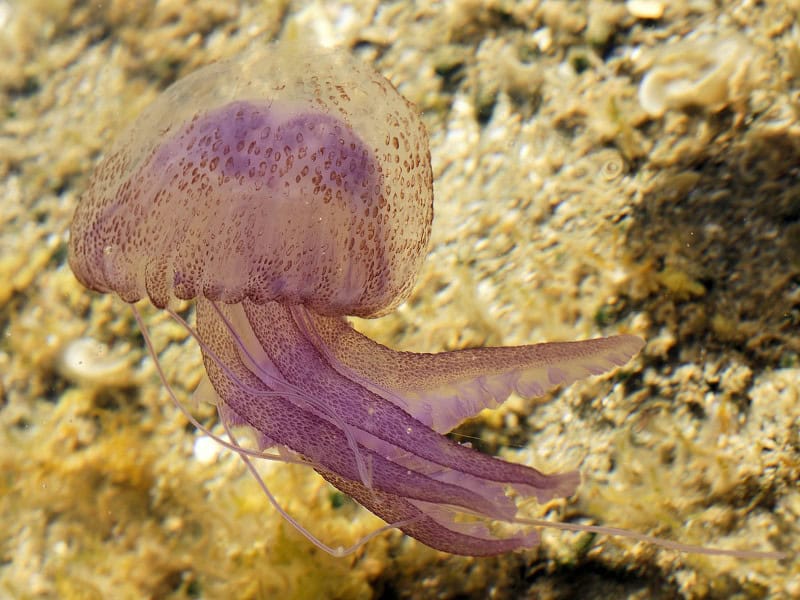
Again, mirroring those aforementioned relations, the creature evolved to possess a central bell. In its case, however, this varies in exact shape between individuals. This appears as either hemispherical, saucer-shaped, or slightly flattened. It also averages between 1.2 – 4.7 in (3 – 12 cm) in diameter.
The jellyfish additionally has eight long marginal tentacles, extending from the bell margin. Those tentacles develop as thin, contractile, and often trail several times the diameter of the bell. Each also comes equipped with stinging cells, called nematocysts, capable of extremely painful stings.
In addition to these, the incredible animal also boasts the presence of four long, frilled, and ribbon-like oral arms arising from the central mouth. These appendages also contain nematocysts, like the tentacles. All 12 of these present the same color scheme as the rest of the stunning marine marvel.
Yet, it’s doubtless that color scheme that ranks as the most memorable quality of the Cnidaria for most observers. The majority of its structure appears from transparent to pink, mauve, or light violet in color. Much of its also frequently appears heavily covered with small reddish or brownish spots.
- Kingdom: Animalia
- Phylum: Cnidaria
- Class: Scyphozoa
- Order: Semaeostomeae
- Family: Pelagiidae
- Genus: Pelagia
- Species: P. noctiluca
Mauve Stinger Distribution, Habitat, and Ecology
The gorgeous Mauve Stinger evolved as indigenous to a comparatively broad expanse of the marine regions of the globe. Within that native zone of habitation, however, its distribution remains uneven. Explaining precisely where the animal appears therefore becomes somewhat complicated.
It’s found in warm and temperate waters of the world’s oceans. The species developed as common in the Atlantic Ocean, Mediterranean Sea, and North Sea, although only rarely in the latter. There, it mostly lives in British and Irish waters. It also resides in specific parts of the Pacific Ocean, as well.
Within the confines of the Mediterranean Sea, it represents one of the most abundant and well-known jellyfish species there. It’s well known to occur year-round, but surface swarms are more frequent in summer. Populations regularly show boom-and-bust cycles, with periodic outbreaks.
Meanwhile, in the waters of the Eastern Atlantic Ocean, it appears along the coastline of Europe. The Cnidaria often shows up off the coasts of Portugal, Spain, France, and the British Isles. It also appears off northwest Africa and around oceanic islands, like the Canaries, Azores, and Madeira.
This fascinating product of ages of development typically displays a moderately flexible nature pertaining to its choice of specific habitat. In addition to thriving best in warm and tropical areas, it also migrates up closer to the surface at night, and moves downward to deeper layers during the day.
Though not tied to the seafloor, it nonetheless predominantly favors greater depths. Sightings place the species at depths as great as approximately 3,300 ft (1,000 m). As part of its vertical migrations, however, the amazing animal also occasionally appears as high as the surface of the water itself.
Within its chosen habitat, the diminutive yet nevertheless eye-catching Mauve Stinger evolved as purely carnivorous in nature, and forms a mid-level predator there. It principally feeds on a wide variety of very small crustaceans, plankton, fish eggs, and sometimes also other, smaller jellyfish.
Like nearly all forms of animal life on the planet though, it also possesses its own share of predators, especially given its size. These natural threats primarily consist of several species of sea turtle, mainly the enormous leatherback sea turtle, the Mola Mola, certain seabirds, and some large fish.
For reproductive activities, the males and females release their eggs and sperm into the water column. Fertilization therefore typically takes place externally. Fertilized eggs develop into free-swimming organisms. Unlike in other jellyfish, these does not settle on the seafloor to form a polyp.
Those that survive develop into a juvenile jellyfish, known as an ephyra. This stage, in turn, later develops into the fully adult form. Given the fact that, unlike most jellyfish, it does not have a polyp stage, it’s able to reproduce continuously in areas of open water, often causing mass swarms.

Species Sharing Its Range
Check out our other articles on 7 Endemic Socotran Species, New Zealand Sea Lion, Alexander Island, Sandbox Tree, Sooty Gull, Southern Darwin’s Frog, Empress Cicada, Chinese Alligator