

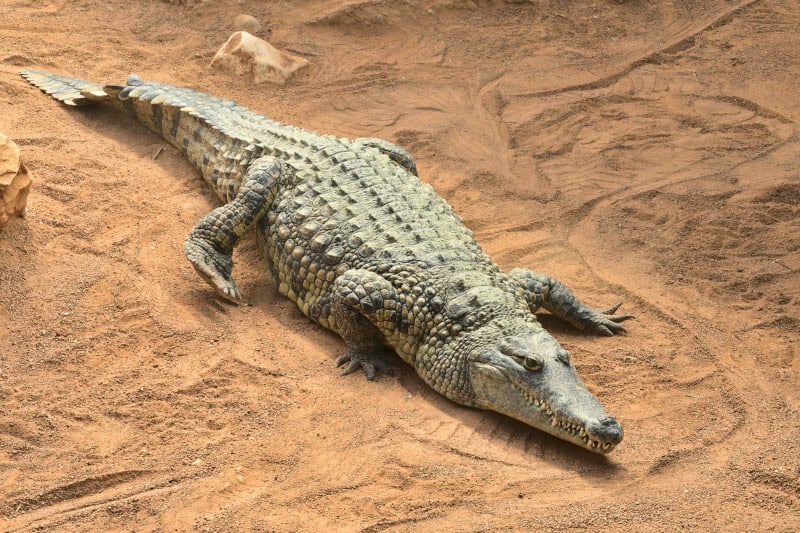
Nile Crocodile Facts
- This magnificent reptile most frequently goes by the equally descriptive and informative common name of the Nile Crocodile. The remarkable creature does, however, have several other titles by which it’s known. These options include Cocodrilo del Nilo and Nylkrokodil.
- Within the hallowed halls of science, though, it’s perhaps much better known by its entirely technical designation. That appelation’s actually a comparatively simple term for the layperson to pronounce. The amazing animal currently holds the official moniker of Crocodylus niloticus.
- The marvel received that epithet due to the efforts of Josephus Nicolaus Laurenti. That highly respected Austrian zoologist accomplished the first formal acknowledgement of it as a fully separate and distinct species. He achieved that scientifically noteworthy deed in the year 1768.
- This awe-inspiring creature stands out among its relatives for a truly impressive reason. It not only ranks as the largest predator in its part of the world, but it also constitutes the second-largest extant species of crocodile on the planet. Only the Saltwater Crocodile exceeds it.
- Thankfully, the amazing Nile Crocodile appears to be maintaining a population base that’s both stable and sufficient. This pleasant state also seems to hold true throughout its entire range. The IUCN accordingly presently shows it as Least Concern on its published Red List.
- The marvelous fauna should nevertheless still be considered as facing multiple potential threats to its continued existence as a species. Like most forms of life on earth today, most of these dangers stem from the actions of man. Those include the perils posed by climate change.
Related Articles

Nile Crocodile Physical Description
The magnificent Nile Crocodile never fails to capture the immediate attention and respect of those individuals who encounter one. The wonder does not do so, however, due to its formidable appearance alone. That’s because it also boasts some highly respectable physical attributes.
Regarding its description, it also follows a pattern of development common among animals around the world. That’s the fact that it displays a certain degree of the physiological characteristic known as sexual dimorphism. In its specific case, this trait primarily manifests itself in terms of sheer size.
Males of this marvel of evolution attain a significantly greater average size than the females of the species. Examples of this gender typically measure somewhere between 13 – 16 ft (4 – 5 m) in length. Exceptional specimens, though, occasionally actually grow to a truly incredible 20 ft (6 m).
These also most commonly achieve a substantially greater mass than their female counterparts. Larger individuals frequently surpass 1,500 lb (680 kg). Although quite rare, exceptional specimens do occasionally occur, with these male giants sometimes exceeding 2,200 lb (1,000 kg).
Females, however, as previously noted, remain markedly smaller in their dimensions. This particular sex generally reaches a body length only roughly between 8 – 11 ft (2.5 – 3.5 m). These individuals generally attain a mean body mass ranging from approximately 260 – 550 lb (120 – 250 kg).
Like the males, exceptional examples naturally occur, though even these do not approach the massive size of the males. Larger females reach around 13 ft (4 m), and weigh 660 – 880 lb (300 – 400 kg). Truly giant females, though, on rare occasions achieve a weight equaling 1,000 lb (450 kg).
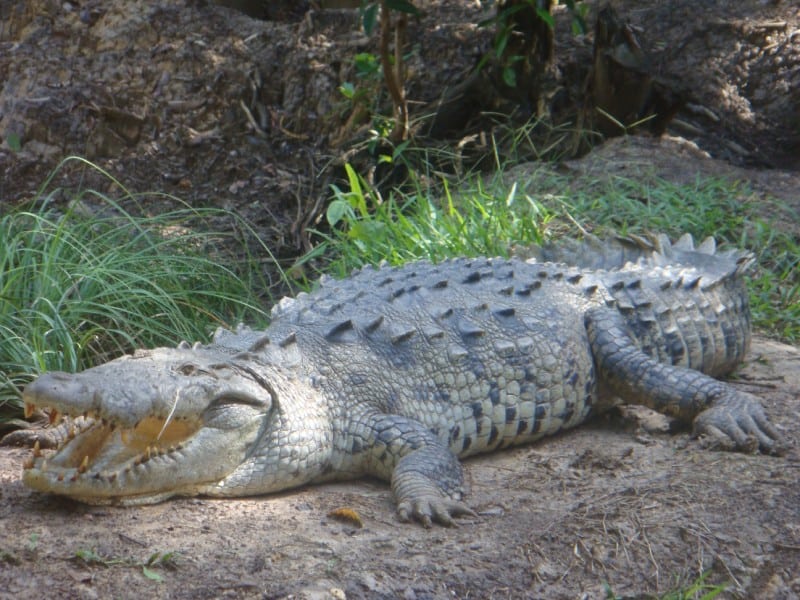
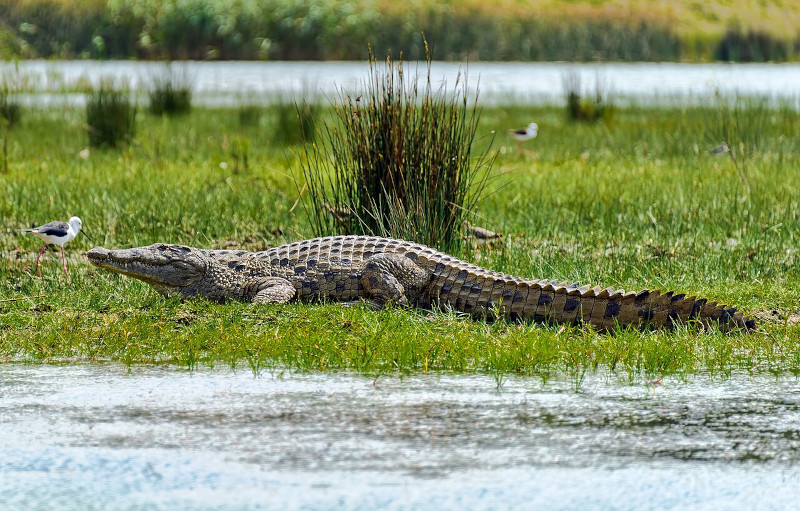
Males also tend to develop broader heads and thicker bodies than the females. Otherwise, the two genders present the same general outward appearance to the observer. Individuals possess a long, muscular body, and a powerful, laterally compressed tail that’s mainly used for swimming.
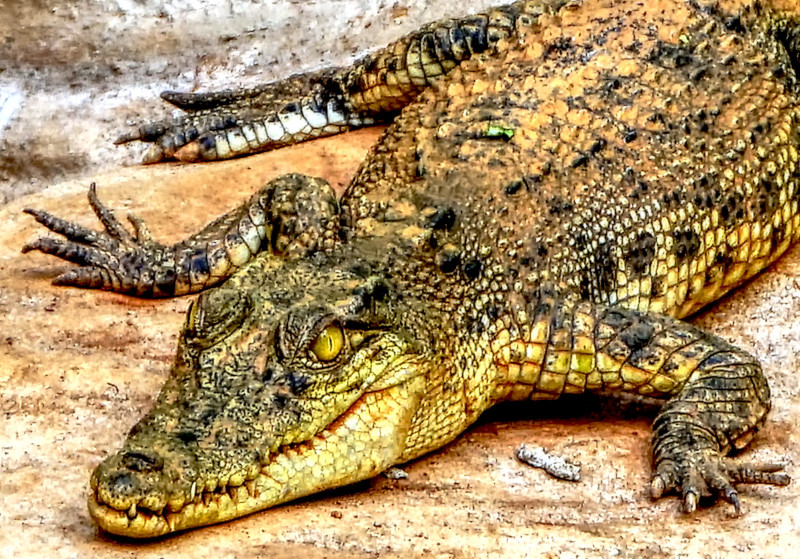
The back and flanks of the amazing Nile Crocodile develop as armored, with tough, scaly skin and rows of bony plates called osteoderms. Its color generally manifests as a very dark olive to brown, with darker cross-bands on the body and tail. The underside’s lighter, often yellowish or cream.
Meanwhile, the eyes, ears, and nostrils of this masterpiece of Nature all appear on the top of the head. The eyes have vertical slit pupils and nictitating membranes. Its limbs also evolved as short but strong. Its front feet have five toes, while the hind feet develop as webbed with four toes.
- Kingdom: Animlia
- Phylum: Chordata
- Class: Reptilia
- Order: Crocodilia
- Family: Crocodylidae
- Genus: Crocodylus
- Species: C. niloticus
Nile Crocodile Distribution, Habitat, and Ecology
The stunning Nile Crocodile evolved as indigenous to a comparatively broad swathe of the surface of the earth. Precisely where that zone of habitation lies, however, surprises no one. That’s due to the fact that this wonder of Nature evolved as endemic to a portion of the continent of Africa.
It primarily inhabits the sub-Saharan sections of the landmass, including East, Central, and Southern Africa. Historically, though, the remarkable reptile was present along the Nile River, Today, however, the intrepid creature remains mostly restricted to parts of only southern Egypt and Sudan.
The crocodilian also lives in West Africa, where it occurs in some countries, though populations remain fragmented. In Madagascar, meanwhile, it’s still reasonably common. Today, it’s now absent from most of the Sahara, although highly scattered populations do still exist in very isolated oases.
Fortunately, this amazing animal displays a decidedly impressive degree of flexibility regarding its choice of habitat. In fact, this specific species evolved to possess one of the widest habitat ranges of any crocodilian. It therefore appears in an extremely wide variety of greatly different ecosystems.
The reptile frequently lives in rivers and lakes. These settings include major freshwater systems such as the Nile, Zambezi, Okavango, and Lake Victoria. Regions of wetlands and marshes represent an additional common location. Those environments include swamps, floodplains, and seasonal pans.
Yet, it’s also demonstrated its adaptability by making its presence felt in artifical bodies of water, like dams, irrigation canals, and reservoirs. It also tolerates brackish waters well. As a result of this, the intriguing animal often resides in estuaries, deltas, mangrove swamps, and the motuhs of rivers.
Like its relatives, the Nile Crocodile evolved as a carnivorous species. In this regard, it represents an apex predator in every region it inhabits. It feeds as an ambush hunter, lying motionless at the edge of the water. Except for humans and other large crocodiles, it possesses no natural enemies.
Interestingly, it’s diet itself also changes over time, as the individual ages. Juveniles consume insects, small fish, and amphibians. Sub-adults, however, prey on large fish, waterbirds, and small mammals. Adults, though, feed on large mammals, such as antelope, zebra, and buffalo, and even carrion.
Mating activities typically take place during the dry season, when the water level drops. Females dig holes in sandy banks to lay 25–80 eggs. Mothers guard their nests, help hatchlings reach water, and sometimes carry them in their mouths. Most hatchlings fall prey to birds, fish, and other predators.

Species Sharing Its Range
Check out our other articles on 7 Endemic Socotran Species, Mountain Hare, Millaa Millaa Falls, Hairy Shadow Witch, Goldentail moray, Blue Baboon Tarantula, Keeled slug-eating Snake