

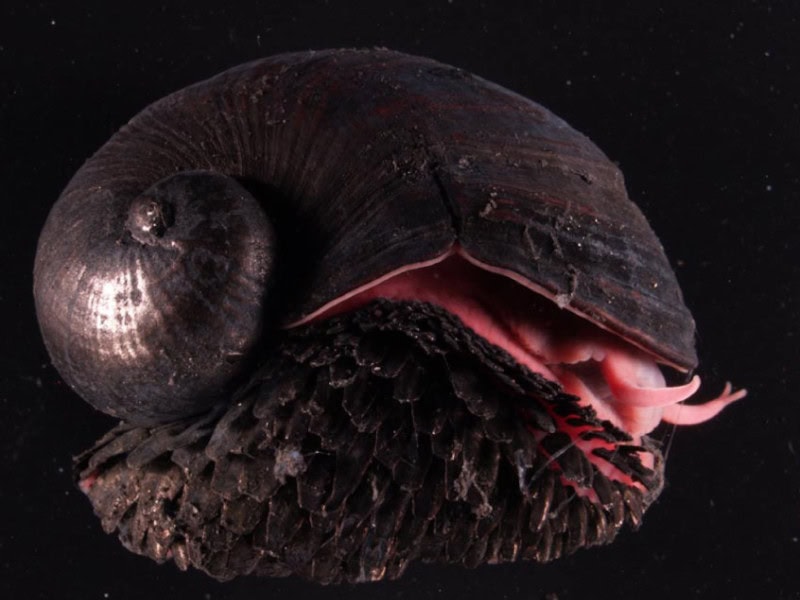
Volcano Snail Facts
- This remarkable creation of Nature and evolution most frequently goes by the distinctive yet informative common name of Volcano Snail. Yet, it also has a few other general titles by which it’s known. Those include sea pangolin and scaly-foot gastropod, among others.
- Within the scientific community, however, it’s perhaps much better known by its entirely technical designation. Unfortunately, that one’s very difficult for the layperson to pronounce. That’s because the wonder holds the official moniker of Chrysomallon squamiferum.
- It received that tongue-twisting epithet due to the combined efforts of a four-person team of researchers. These respected individuals accomplished the first official recognition of it as a separate and distinct species. The group achieved that scientifically noteworthy deed in 2001.
- Sadly, due to the specific nature and known locations of the habitat that the remarkable Volcano Snail possesses, presently finds itself in a highly vulnerable state. Accordingly, the IUCN currently ranks the wonder as Vulnerable on its own Red List of Threatened Species.
- It faces numerous threats to its continued existence as a species, both active and potential. For the moment, deep-sea mining activities pose its most immediate problem. Nevertheless, it also must deal with the problem of climate change, like all forms of life on the earth today.
Related Articles
Volcano Snail Physical Description
The astonishing Volcano Snail never fails to astound and amaze those few individuals fortunate observe to encounter this marvel. It does so due its extraordinary nature, though, not because of any impressive physical dimensions. That’s true since it represents a fairly small variety of mollusc.
It also follows a pattern of natural development that differs from the majority of fauna around the world, but’s common among its kindred. That’s the fact that it displays no externally visible signs of the physiological characteristic of sexual dimorphism. Outwardly, the sexes appear the same.
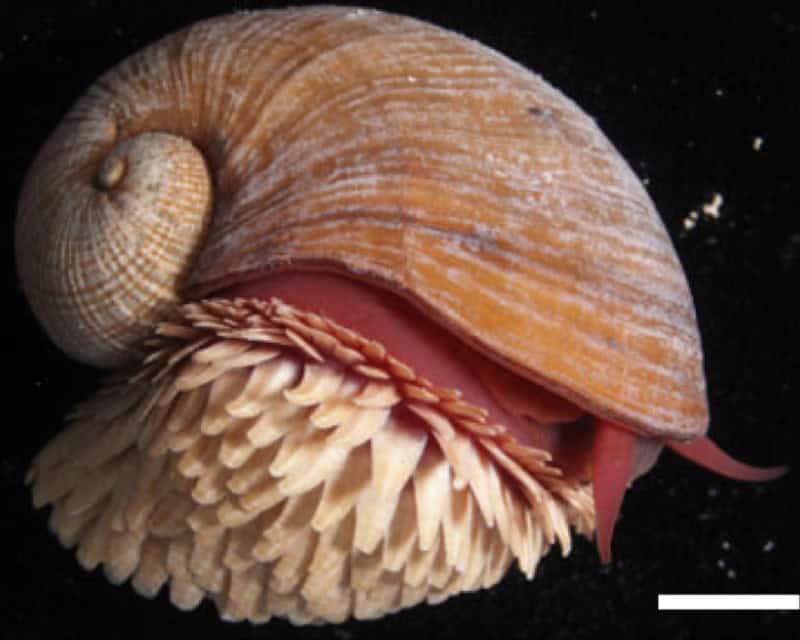
Mature adults of this wonder of evolution attain an average shell length equaling approximately 1.2 – 1.6 in (3 – 4 cm). That amazing structure further manifests as globular and relatively thick, and possesses 3 – 4 whirls. In color, this usually presents as either an extremely dark brown or black.
It’s unquestionably this shell that garners the most attention, though. It actually forms in three distinct layers. The shell has an inner aragonite layer, like most molluscs. A middle, organic layer follows this. Astonishingly, the unique outer layer’s actually composed of several iron sulfides!
The other aspects of the body of the Volcano Snail remain more in keeping with its relatives. Its head boasts reduced eyes and no eyelids. The mouth has radula, for scraping food. It also has an enlarged heart that ranks as one of the largest in the animal kingdom relative to body size.
Nature didn’t simply stop there, however. That’s true since with it, also like many of its numerous kin, the ventral foot supports hundreds of tightly overlapping scales. These individual structures themselves also evolved as mineralized with iron sulfides, giving a black, armored appearance.
- Kingdom: Animalia
- Phylum: Mollusca
- Class: Gastropoda
- Order: Neomphalida
- Family: Peltospiridae
- Genus: Chrysomallon
- Species: C. Squamiferum
Volcano Snail Distribution, Habitat, and Ecology
Lamentably, the fabulous Volcano Snail evolved as indigenous to an extremely small portion of the marine regions of the globe. In fact, it represents one of the most restricted distributions of any marine snail known. Exactly where that zone of habitation lies might surprise some people.
To date, it remains known in only three isolated locations within the confines of the Indian Ocean. Two lie in the Central Indian Ridge, named the Kairei vent field and the Edmond vent field. The third one, however, named the Longqi Dragon’s Breath vent field, sits in the Southwest Indian Ridge.
Remarkably, this creature displays extraordinarily strong, clear, and restrictive preferences regarding its choice of habitat type. These regions remain unlike the choices of virtually any other known animal. For the moment, it’s only known to reside around these few deep-sea hydrothermal vents.
These extremely harsh settings consist of sight located either directly on or in close proximity to active chimneys, known as black smokers, where superheated, mineral-rich fluids spew from the seafloor. These locations appear at depths that range from roughly 7,874 – 9,514 ft (2,400 – 2,900 m).
Given where it reside, the amazing Volcano Snail also evolved a fascinating ecology understandably shaped by its environment. Unlike most snails, it does not graze or hunt for food. The remarkable product of evolution entirely relies on endosymbiotic bacteria in an enlarged oesophageal gland.
These bacteria use a biological process known to science as chemosynthesis. They actually manage to oxidize hydrogen sulfide from vent fluids to fix carbon, thereby providing the snail with nutrients. This natural process makes the fantastic animal functionally quite similar to vent tubeworms.
Again due to the harsh nature of its environment, few details pertaining to its reproductive activities exist. It does possess two sexes. Researchers believe its eggs and larvae to likely be dispersed in vent plumes, helping colonize new vent fields. Limited dispersal likely explains its restricted range.

Species Sharing Its Range
Check out our other articles on 4 Fabulous Geological Features of Texas, New Zealand Sea Lion, Khone Phapheng Falls, Rila Primrose, Indian Vulture, Blue Baboon Tarantula, Chinese Alligator