

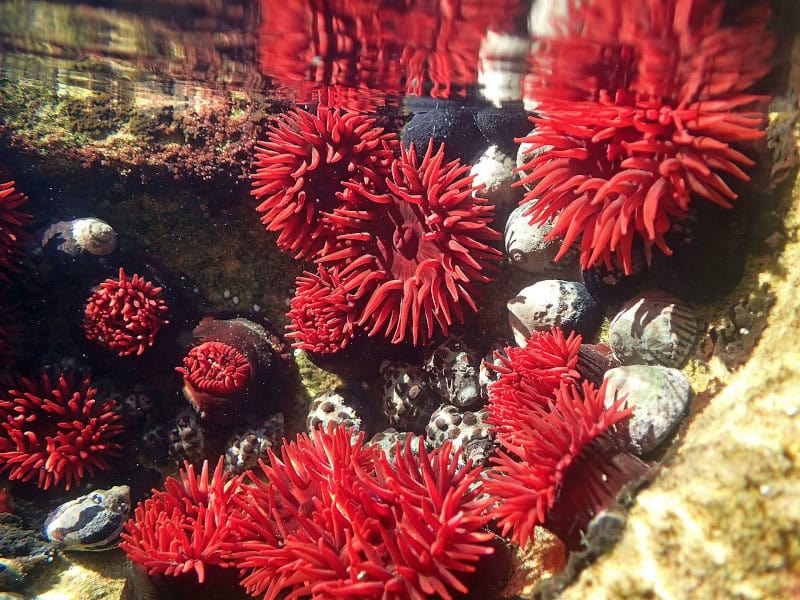
Waratah Anemone Facts
- The intriguing term of Waratah Anemone serves as the most frequently used common name for this remarkable marine creature. Yet, the amazing animal also holds a few other titles by which it’s known. These include the optkions Red anemone, Sea anemone, and Rock anemone.
- Within the scientific community, however, it’s perhaps much better known by its entirely technical designation. Thankfully, that’s a terms that’s comparatively simple for the layperson to pronounce. That’s because the impressive marvel holds the formal tag of Actinia tenebrosa.
- It received that easy to utter epithet due to the efforts of Dr. William Elford Leach. The respected English zoologist accomplished the first official acknowledgement of the animal as a separate and distinct species. He achieved that scientifically noteworthy deed in the year 1816.
- This colorful wonder of Nature and evolution also holds a moderate place of distinction within the hallowed halls of science. That’s true due to the fact that it actually represents the most common variety of sea anemone in the entire area of the marine world in which it appears.
- The remarkable Waratah Anemone clearly shows itself to be maintaing a population base that’s both stable and sufficient. That pleasant state also holds true across the entirety of its range. Accordingly, the IUCN does not presently have a listing for it on the organization’s Red List.
- It should nevertheless still be considered as facing multiple potential threats to its continued existence as a species. In this regard, it’s endangered by the same perils as all forms of life on earth today. Most of these threats stem from the actions of man, including climate change.
Related Articles
Waratah Anemone Physical Description
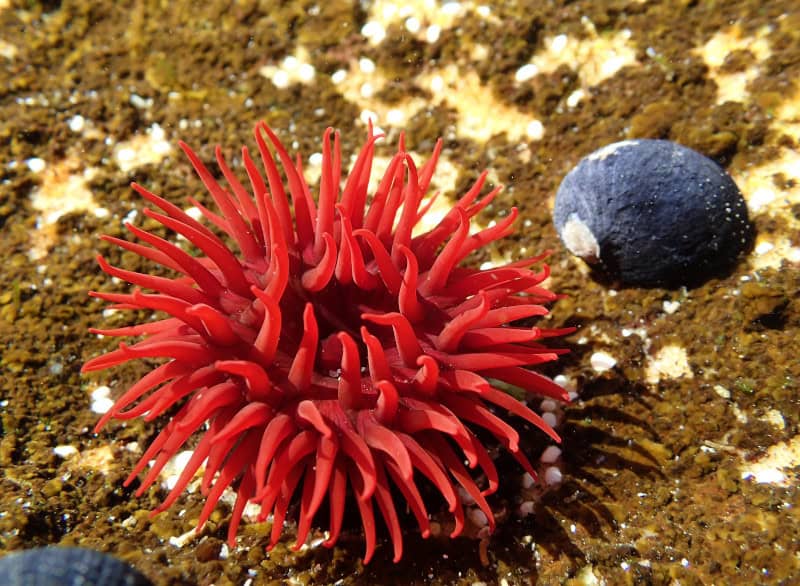
The gorgeous Waratah Anemone rarely if ever fails to capture the immediate attention and interest of those idividuals who encounter them. This wonder of the marive regions does not, however, usually do so due to sheer physical dimensions. In that regard, it remains a fairly small creature.
In terms of its appearance, this marvel of evolution follows a pattern of natural development common among its relatives. That’s the fact that it displays no outward sign of the physiological characteristic of sexual dimorphism. Distinguishing the sexes visually is therefore often difficult.
The animal evolved to possess a base, called a pedal disc, with which it attaches itself to surfaces. In diameter, individuals achieve an average size equaling only 2 – 3.1 in (5- 8 cm) across, yet even then just when expanded. Though exception specimens do occur, they rarely surpass this by much.
Like its numerous kindred located across the globe, it also develops an oral disc. This particular aspect of its anatomy forms a roughly flat, central surface surrounded by concentric rings of tentacles. Evolution placed this vital part of its biology at the top of the animal’s cylindrical body.
Yet, it’s undoubtedly the pattern of coloring among examples of the stunning Waratah Anemone that generally garner the most attention from observers. The body wall, named the column, typically presents a deep red to dark crimson color, sometimes even appearing almost black when retracted.
Not to be outdone, though, it also has up to 192 short tentacles, arranged in several rows. These evolved to also display a red shade, though often appearing slightly paler than the column. The tentacles also evolved to be completely retractile, and form a compact mass when the animal closes.
- Kingdom: Animalia
- Phylum: Cnidaria
- Class: Hexacorallia
- Order: Actiniaria
- Family: Actiniidae
- Genus: Actinia
- Species: A. tenebrosa
Waratah Anemone Distribution, Habitat, and Ecology
The eye-catching Waratah Anemone evolved as indigenous to only a moderately small portion of the marine regions of the globe. Precisely where that native zone of habitation lies, however, likely won’t surprise many people. Its territory’s well known for its abundance of natural wonders.
This remarkable creation of evolution developed as native to a small section of both the South Pacific Ocean and the Tasman Sea. It mainly lives along the southern and southeastern coasts of Australia, in New South Wales, Victoria, Tasmania, South Australia, and in parts of New Zealand.
It exhibits tendencies that mimic many of its numerous relatives found throughout the oceans and seas of the world. The intrepid animal displays decidedly clear and strong preferences regarding its choice of specific habitat. It thus resides in only a few closely related types of local ecosystems.
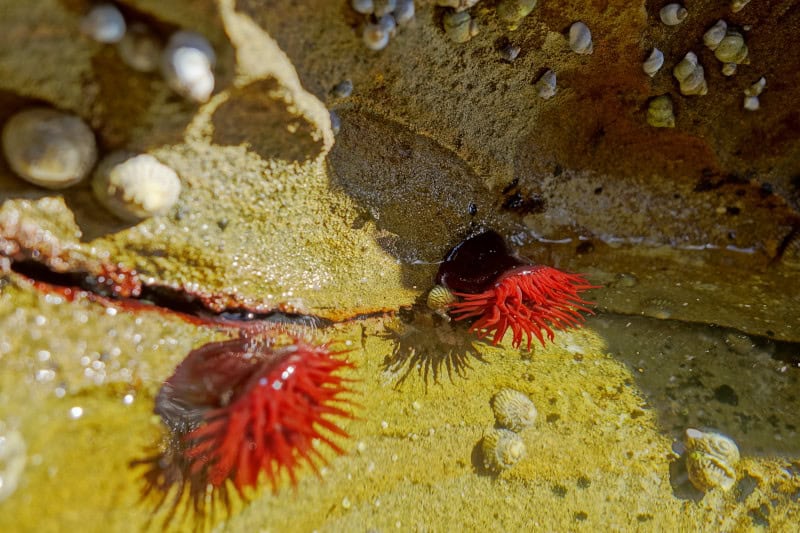
The brilliantly colored Cnidaria developed as principally an intertidal species. On occasion, though, some individuals make their homes in very shallow sub-tidal zones. As such, it rarely appears at depths measuring greater than (10 m). In fact, the majority live in waters much shallower than this.
At whatever depth it decides to live, though, the anemone manifests extreme favoritism for the nature of its local environment. It prefers areas of rocky shores, generally having rock crevices, ledges, and pools. In these settings, it’s even able to tolerate brief exposure during low tides.
The beautiful Waratah Anemone evolved as a purely carnivorous species in nature. It also feeds opportunistically. To manage this, the creature uses its large number of tentacles, fully equipped with nematocysts, to capture various types of small prey brought close to it by water currents.
The vast majority of its dietary fare consists of locally prevalent small crustaceans, worms, and sometimes shrimp. Occasionally, though, it also manages to capture and digest organisms from the intertidal zone, and on rare occasions, even capture insects that fall or wash into its vicinity.
It reproduces both sexually and asexually. Using sexual reproduction, it has planktonic larvae that disperse farther away. However, dispersal often remains limited by local adaptation and competition from established clones. It also achieves asexual reproduction via the forming of clonal clusters.

Species Sharing Its Range
Check out our other articles on 5 Lively North American Lizards, Mountain Hare, Amazon River, Basket Stinkhorn, East African Lowland Honey Bee, Emperor Penguin, Keeled slug-eating Snake