

Wiliwili Facts
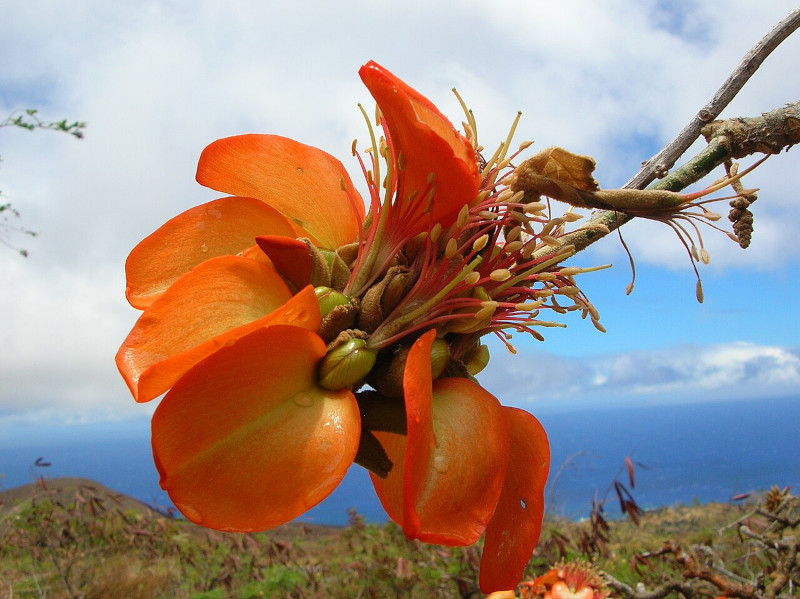
- This distinctive creation of Nature and evolution most frequently goes by the deceptively simple common name of Wiliwili. The plant does have alternate titles, though. Those include the informative Wiliwili Coral Tree, Hawaiian Coral Tree, and Hawaiian Erythrina.
- Inside the halls of science, however, the marvel’s perhaps better known by its technical designation. Unfortunately, like so many such appellations, that’s a rather difficult term for the layperson to pronounce. That’s because it holds the official tag of Erythrina sandwicensis.
- Officially, the respected American botanist Otto Degener typically receives credit for the recognition of this floral beauty. That occurs since he documented and studied the wonder as part of his studies of all the botanical wonders within its region, in the mid-20th century.
- In actuality, though, the remarkable species received its official epithet due to the efforts of Asa Gray. That American botanist recorded the first formal acknowledgment of the plant as a separate and distinct species. He achieved that scientifically noteworthy deed in the year 1854.
- This amazing plant surprises many people, due to several facts. Despite its great size and physical appearance, it in fact represents a member of a Genus placed in the pea Family! Impressively, of the roughly 130 species within that group, it’s the only one present in its region.
- Sadly, the stunning Wiliwili now finds itself with a declining population base. That lamentable state holds true throughout the entirety of its native range. Accordingly, the IUCN currently shows the intriguing Angiosperm as Vulnerable on its Red List of Threatened Species.
- It faces numerous threats to its continued existence as a species. Specifically, it’s endanged by competition from non-native species, both flora and fauna. Yet, it’s also imperiled by the same dangers facing all forms of life on earth today, namely habitat loss and climate change.
Related Articles
Wiliwili Physical Description
The captivating Wiliwili rarely fails to capture the attention of those individuals fortunate enough to enocunter one in the wild. Unlike many of its relatives throughout the world, however, it does so due to a variety of reasons. Its distinctive beauty and physical dimensions certainly both qualify.
Uncommonly, mature specimens of this particularly interesting flora vary significantly in terms of overall size. That variation occurs due to combinations of various random factors. These include such elements as local meteorological conditions, soil quality, and the presence of human activities.
Fully developed examples of the Angiosperm therefore typically range in height from roughly 20 – 50 ft (6 – 15 m). Under ideal conditions, though, exceptional individuals sometimes exceed this by a respectable amount. Some of these occasionally attain heights of as much as 60 ft (18 m).
The trunk develops as gnarled and twisted in shape, regardless of its vertical reach. This portion of the flora averages between 1 – 3 ft (0.3 – 0.9 m) in diameter. Its branches display the same pattern of growth. The bark presents as smooth, slightly fissured, and covered in gray or black spines.
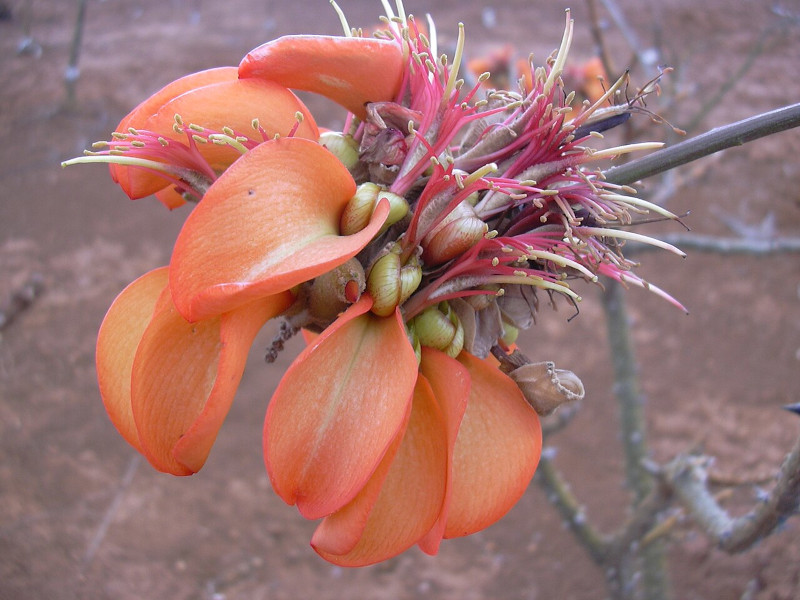
It’s undoubtedly the flowers of the Wiliwili that garner the most attention, however. These appear on horizontal or nearly so racemes, averaging 3 – 6 in (7.5 – 15 cm) in length. Developing as slightly coral-shaped, the blooms present in varied shades of orange, yellow, red, or greenish-white.
One mustn’t neglect the appreciation of its leaves, either. That foliage develops as tri-lobed, with each being broad, rounded, and somewhat heart-shaped or oval. In length, these average 2 – 4 in (5 – 10 cm). When young, each shows a bright green hue, and possesses a smooth, slightly waxy surface.
- Kingdom: Plantae
- Phylum: Tracheophyta
- Class: Magnoliopsida
- Order: Fabales
- Family: Fabaceae
- Genus: Erythrina
- Species: E. sandwicensis

Wiliwili Distribution, Habitat, and Ecology
The mesmerizing Wiliwili evolved as indigenous to a uniquely restricted portion of the surface of that earth. Exactly where that zone of habitation lies probably won’t surprise anyone, though. That’s true given the fact that several of its alternate general titles provide clear clues to that location.
This creation of Nature developed as native to the Hawaiian Archipelago. In fact, it’s present on all the main Hawaiian Islands, including Hawai’i, known as the Big Island, Maui, O’ahu, Kaua’i, Moloka’i, and Lanai. No evidence exists of it ever appearing anywhere outside that natural range.
Within that limited area, the product of botanical evolution displays a high degree of versatility regarding its choice of habitat. All of these share certain environmental conditions, however. Each resides in either dry or coastal ecosystems. It’s also well adapted to harsh, lowland conditions.
It’s thus often found in regions consisting of both lowland forests and coastal areas. The tree’s also highly adaptable to different altitudes. Concentrations of its population appear at heights ranging from sea level to 1,500 ft (450 m) above that. That remains especially true in relatively dry zones.
Intriguing, it additionally manifests a strong preference for poor, dry soils, often the rockier or sandier the better. It also tolerates alkaline soils and evolved the useful ability to thrive in areas with low moisture availability. The unusual plant also frequently favors both arid and semi-arid climates.
To the added delight of fans of the species, the visually enthralling Wiliwili even plays an important ecological role within the dry forest ecosystems of the Hawaiian Islands. Its unique adaptations and interactions with other species serve to make it a key component of these many habitats.
It achieves its pollination via the actions of a multitude of locally prevalent insects. The majority of those pollinators include various insects and hummingbirds. Its twisting seed pods, meanwhile, are spread by the wind, which helps distribute seeds across wide areas of the dry forest ecosystem.

Species Sharing Its Range
Check out our other articles on 5 Stunning Pacific Ocean Sharks, Humpback Whale, Mount Etna, Fall Phlox, American Giant Millipede, Spotted Seahorse, Hellbender Salamander, Mugger Crocodile