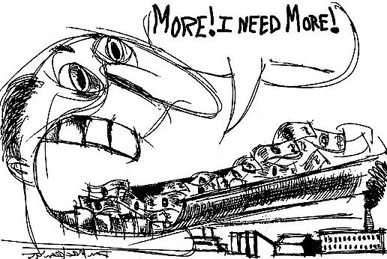
I love Consumerism. The idea of “I SHOP, therefore I AM” is a fantastic ego boost, so what’s not to like?
Wikipedia explains Consumerism as “a social and economic order that is based on the systematic creation and fostering of a desire to purchase goods and services in ever greater amounts”. Great, we all deserve a decent standard of living where we can afford the things that would make us happy.
Yet, beyond a minimum threshold of poverty, money doesn’t buy happiness. Possessions may seem like a solution to your problems, but often they simply replace the ones they solve. As paychecks increase, lifestyle usually match those increases. This results in the same financial concerns, just with more stuff.
Possessions may seem like a solution to your problems, but often they just replace the ones they solve. #consumerismClick To TweetAn obsession with owning things is a meager attempt to fill a vacuum. Buying that new computer or fancy car might momentarily shrink the hole. Yet, you quickly adapt to the new upgrades and the hole grows, enslaving you to earn higher and higher paychecks with no way out.
Ehrlich Impact and Consumerism
Let us get a bit more technical.
As Ray C. Anderson writes in his article “More Happiness, Less Stuff”, within the environmental community, there is widespread acceptance of the Ehrlich equation that establishes the relationship among four factors:
- population (P),
- affluence (A),
- technology (T),
- and environmental impact (I).
The relationships are expressed in the famous Ehrlich impact equation: I=PxAxT (published in The Population Bomb by Paul and Anne Ehrlich).
Many consider this equation immutable, and believe there is no way to break its iron grip on humanity. As any of the three independent variables grows, environmental impact increases.
So, how do we break the grip of this equation on the future of humankind? How do we rewrite the equation for a sustainable future?
Unfortunately, one huge challenge to the global business setup is to move the T (call it T1) from the numerator to the denominator (now call it T2). Renewable, recyclable materials fit the category, as does renewable energy. As technologies transition from T1 that belong in the numerator to T2 in the denominator, the equation changes to:
I = (P x A x T1)/T2
and impacts (I) are reduced. As T2 displaces T1, the future looks very different.
But, what about the capital “A” for affluence?
It suggests that affluence is an end in itself, satisfying unlimited “wants,” rather than “needs”. What if we converted “A” to “a”, signifying affluence to be a means to an end, and not the end in itself? Then the equation would read: I = . And what if societal changes and priorities allowed happiness to increase without more and more affluence? Then the equation, over time, could evolve to:
(P x a x T1)T2
More happiness with less stuff, all made sustainably. Now we have the equation correctly. People love the idea of more happiness, less stuff. So why do we find ourselves in the consumerism mess than we’re in, environmentally and socially speaking? How will we find our way out of it?
Industrialism – the industrial system of which we are each a part – developed in a different world from the one we live in today: fewer people, more plentiful natural resources, simpler lifestyles: less stuff. It made perfect sense to exploit nature to increase human productivity – 300 years ago.
These days, with people overly abundant and nature scarce and diminishing, industry moves, mines, extracts, shovels, burns, wastes, pumps and disposes of four million pounds of material to provide one average, middle-class American family their needs for a year. With the whole world aspiring to the American living standard, that cannot go on and on and on in a finite Earth. And it is finite, you can see it from space; that’s all there is and there isn’t any more.
With the whole world aspiring to the American living standard, that cannot go on and on and on in a finite Earth.Click To TweetThe rate of material throughput – the metabolism of the industrial structure – is now endangering prosperity, as much as enhancing it, and the toxicity of some of that stuff is really endangering the biosphere, thus everyone’s health, ours and that of the 30 million other species that share the biosphere with us. It is manifestly the wrong thing to do.
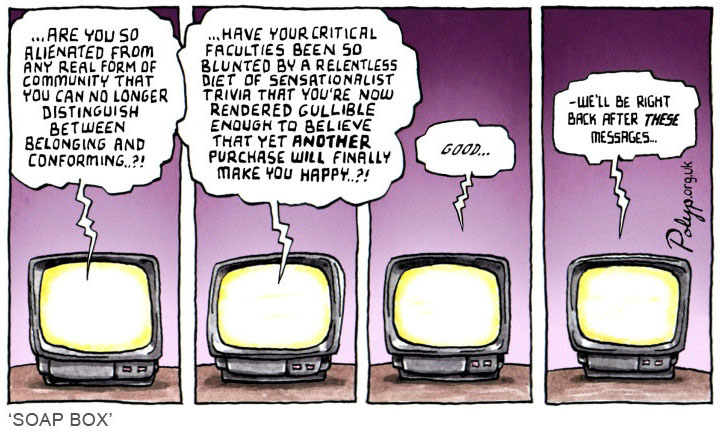
When we talk about consumerism and environmental destruction as the “wrong thing to do,” we’re talking about what I see as a shifting mind-set, a growing sense of ethics.
This mindset might be the push we need to find our way out of the mess that we’re in. In the final analysis, the ethical thing—in fact, the right thing to do—is driven by enlightened self-interest.
The study of ecology tells us we are part of nature, not above or outside it; it also tells us that what we do to the web of life we do to ourselves.
Industrial ecology shows us the industrial system, as it operates today, simply cannot go on and on and on, taking, making, wasting, abusing. Realistically, the system takes too much, extracting and frittering away Earth’s natural capital on wants, not needs. It wastes too much, abuses too much, and takes stuff and makes stuff that very quickly ends up in landfills or incinerators.
Indeed, more waste, more abuse, more pollution.
I’ve heard that less than 3% of the throughput of the entire industrial set-up has any value six months afterward. We industrialists operate a waste-making machine. And all of us are part of the problem, either as producers, specifiers, users, or consumers.
So what about this sacred shrine of growth and affluence, the one that fuels the extractive, abusive and linear technologies upon which we have become so dependent? How do we make the shift? How do we decide, if we are moving toward a sustainable society, what should grow? What should not grow?
Here are some thoughts to stimulate our thinking: The lowest impact technologies, those that are beneficial, (belong in the denominator), ought to increase. In fact, the abusive “numerator technologies” should shrink and eventually disappear.
The sale of services have to increase. The sale of products should shrink. Applied brainpower should grow. Applied brute force should diminish. Market shares for the sustainable companies ought to go up. For the unsustainable companies, market shares should shrink – to zero.
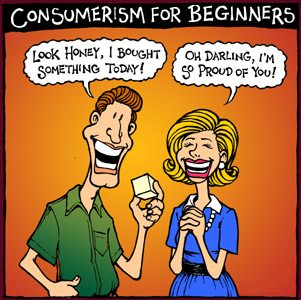
Each of us has a role to play because each of us has power.
The power to vote, with ours dollar and our ballots.
The power to shape commerce, with what we buy and what we don’t buy.
We have power as individuals and collectively, as a community of people.
We each make choices, large and small, every day, that translate into power. Power to change the consumerism paradigm. To get where we need to be requires a vast mind-shift that leads to a cumulative and collective mandate: Less stuff, more happiness. Then the revised formula equation can take center stage.
We each make choices, large or small, every day, that translate into power. Power to change the #consumerism paradigm.Click To TweetIn fact, I strongly believe that the general solution to the consumerism abyss is building a stable inner world. Spirituality, relationships, philosophy, learning, ethics are all facets of this bigger idea. This inside of us isn’t entirely detached from the material one, instead it’s a new lens for viewing what happens in it.
In fact, a person with a solid inner world won’t obsess over buying things or forsake the objects she owns. Instead, she can view it as a person playing a game would look at the tokens on the board. Seeing past the ownership illusion, she can put all her effort into experiencing the game.
How do you build this inside of us? Throughout time people have come up with many different answers to this question. I think that the answer is so difficult to arrive upon not because it is too hard or complicated. But because of it’s simplicity and intangibility, it is tricky to communicate.
Simply, the answer is learning. Not just the sub-branch of activities that has to do with education, but actually improving your understanding. This comes from a combination of experience, education and thought.
Indeed, experience builds this mental world most directly by showing you reality upfront and unaltered.
#Education constructs the inside being by expanding the capacity of your thoughts.Click To TweetFinally, thinking sculpts the basic forms presented in experience and education.
This sculpted internal world is difficult to describe. Many great philosophical thinkers have touched upon it but only from a passing glance rather than direct contact. I don’t believe I’ve managed to describe it directly either, but the idea remains the same. Actually, the way to break the bonds of consumerism and see past the mirage of ownership is in building a mind capable of doing this.
First, “It is preoccupation with possessions, more than anything else that prevents us from living freely and nobly.” – Henry David Thoreau
Second, “Much of our activity these days is nothing more than a cheap anaesthetic to deaden the pain of an empty life.” – Unknown
Third, “The things you own end up owning you.” – Tyler Durden in Fight Club
Credit: Excerpts from Ray C. Anderson’s article, and Lifehack’s “How to Avoid Being Enslaved by Consumerism”
Check out our article on Antarctica Expedition










Great post!
I also love Kate Raworth’s idea that we need a new economic model that considers the environmental sustainability and human growth/thriving aspects of an economy instead of GDP growth as the benchmark for the success of an economy.
What do you call standard of living? we work our ass off, only to get sick at 40, there is no creativity, no time to think, only greed and stupid people following other stupid people.
I am 23 and I already feel so tired..there is so much running, run through college – no time to gain knowledge, just getting grades is enough, then job, again running to earn some money, then get sick, running still, then I die, having to realize, that I have wasted such an opportunity to be alive. 🙁 🙁
Poor people, we are no naive and so ignorant..
I live in America, the land of rampant consumerism. I know exactly what you mean. For the vast majority of people here, “status” is everything. And that status is based upon, in most cases, possessions. I personally know people who, with their children, live in squalor, because they are making payments on that fancy car that they “must” have to be perceived as having status among their peers. “Keeping up with the Jones’s” has become an expression that means: If they have something…I must have it too. At some point, the “Jones’s” family became more important than our own family! The pursuit of having evermore “stuff” , as opposed to pursuing family tranquility is one of the leading causes of such things as crime, social apathy, and the destruction of the family unit in America today.
So sad condition. If The Earth can think, I wonder, what is she thinking now, seeing all this stupidity..
Yes, consumerism must come to an end and we must work toward encouraging the growth of certain economic sectors and degrowth (and total phase out) of others. The challenge, of course, is that those unsustainable sectors have a lot of resources to prop up the current system. Thus, to succeed, we’ll need to work proactively to transform cultures so that living sustainably becomes as natural as living as a consumer feels today–which is the key message of Worldwatch Institute’s State of the World 2010. To do this, we’ll have to do more than just change our own consumption choices but use our talents to shift cultures. If you have business talent: work for a social enterprise; a blogger: blog on green topics (thanks Zornitza=), a student: work on reforming your school’s curriculum and sustainability codes, and so on. Only by utilizing our skills for this broader cultural shift, will we have any chance combating the vast momentum that the consumerist/growth culture now has.
Dear Erik,
Thank you for your comment. I have been following Nourishing the Planet and Worldwatch for a long time now. I do blog on green topics but I also work in the industry – check out my latest post on E-waste that was featured on CleanTechnica, http://cleantechnica.com/2011/07/05/tackling-e-waste-by-an-environmentalist-and-a-professional-in-the-industry/.
You are absolutely right – we need to help big groups of people shift behaviors. It is nice to see that notable people and celebrities embrace the green lifestyle and pioneer its new image of being cool and in fashion. That is the way to go. The old hippie ways are gone.
I thought I’d share this with you – in just a couple of days a new film will come out, http://www.youtube.com/watch?v=zavTd31qxho&feature=player_embedded, let’s watch it and discuss it afterwards. Looking forward!
Greetings from Dubai!
PS. If you would like to submit posts to OBP, let me know. We could link the two websites as well, I’d love to have you guys as a “Friend” or the like.
I thank you humbly for sharing your wisdom