


CCL: https://tinyurl.com/2s4apsss
It’s our sincere hope that each of you, our readers, will truly enjoy and appreciate this article we present about these 3 Magnificent Marvels of Maine. It was certainly our great pleasure to gather the various information for you. May it provide you with both education and increased awareness.
Certainly, these few sites listed herein, while incredible, nonetheless represent only a small portion of the wonders found throughout this amazing region. It’s our belief, though, that they serve as excellent representations of the marvels found here. Check out some of our other articles, as well.
Gulf Hagas
CCL: https://bit.ly/3xfSrua
Gulf Hagas Facts
- Leading off this article about these 3 Magnficent Marvels of Maine we present you with the stunning setting known as Gulf Hagas.
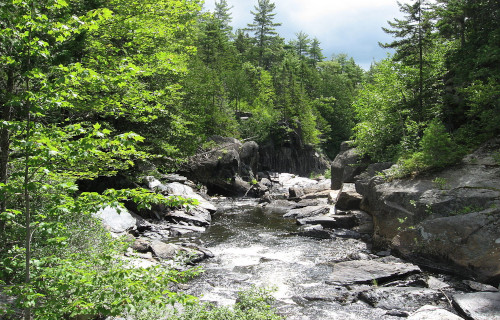
- This remote, ruggedly beautiful, yet little-known, marvel of geological processes bears the somewhat deceptive name given herein. It’s quite obviously not a gulf, but is in fact a magnificent gorge cut through the surrounding terrain over a vast span of time.
- It’s not known when the first European settler in the region discovered this amazing site. The local Native American tribes, however, long knew of this wonder’s existence. That’s true because archaeological evidence of their presence dates back as much as 7,500 years.
- In modern times, though, the location presently constitutes one of 14 National Natural Landmarks in the region in which it formed. It thus represents an extremely popular, if quite difficult to access, tourist area. It’s open to the public, for a fee, during the regular season.
- It also forms part of the indescribably majestic Appalachian Trail, which extends a total of 2,200 mi (3,500 km). In fact, the section in which it lies itself forms the last 100 mi (160 km) of the magnificent trail. It’s also considered by many to be the most highly remote portion.
- The opportunities for hiking therefore quite obviously form a primary appeal to visitors to the captivating Gulf Hagas. Its pure scenic beauty, however, also attracts many viewers. Other popular attractions to the site include kayaking its waters, though only for experts, and fishing.
CCL: https://bit.ly/3CO5rIG
Gulf Hagas Physical Description
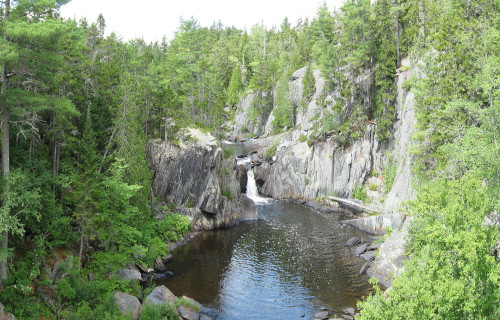
The stunning Gulf Hagas quickly earns the appreciation of those individuals fortunate enough to visit its remote setting. That holds true due to numerous attributes, of course. Though it’s by no means the largest such feature on earth, it nonetheless boasts some respectable dimensions.
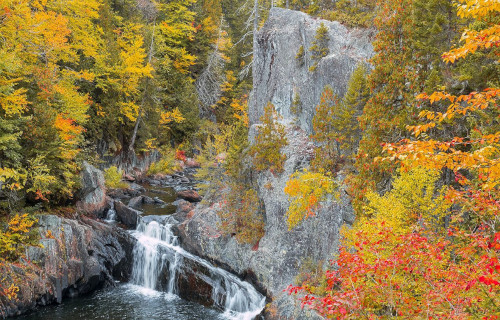
The beautiful gorge possesses a total length measuring approximately 3 mi (4.8 km). Much of that length, though, holds a strongly twisting, winding nature. While its walls naturally vary greatly in height across its length, these features reach a maximum height of 130 ft (40 m) in some locations.
A branch of the charmingly-named Pleasant River also flows through its length. Between it sheer vertical walls, the course of the river flows over an extraordinarily rocky bed. Numerous regions of rapids also appear along its length. Numerous small but lovely waterfalls also dot its course.
Along its expanse, though, the gorgeous flow also drops relatively significantly. More precisely, its total elevation drops a total of 370 ft (110 m). Due to this comparatively steep decline, the flow becomes quite strong in some regions, creating the powerful rapids for which its often known.
Not to be outdone, the width of the remarkable Gulf Hagas also, quite naturally, varies along its entire stretch. This variation becomes notably extreme in some places. In some sections, it attains a width of as much as 150 ft (45.7 m). In others, however, it narrows to as little as 26 ft (7.9 m).
CCL: https://bit.ly/3nH4vBK
Gulf Hagas Location, Formation, and Ecology
The astonishing beauty of Gulf Hagas formed in a region of the globe already very well known for its marked abundance of various geological marvels. That’s because this visually tantalizing creation of Nature formed within the greater region that now constitutes the continent of North America.
More precisely, though, the breathtaking gorge formed in the region that now comprises the lovely state of Maine, in the United States. There, the marvel of geology purely by chance lies in the approximate middle of the state. It’s also situated about 90 mi (140 km) from the city of Bangor.
The section of the Appalachian Trail in which this wonder lies also happens to bear the alternate name of the Hundred-Mile Wilderness. That formed 400 million years ago. That occurred due to the convergence of tectonic plates. It’s part of what geologists call the Carrabassett formation.
At that time, vast mud deposits slowly crystallized into the mineral slate. This now comprises the majority of the bedrock in its region. That mineral created sharp, angular edges when fractured, but wind erosion later smoothed these out. This further shows in the nature of the canyon walls.
Flora and fauna both abound within the stunning confines of Gulf Hagas. In fact, its course wends its way through one of the last remaining virgin old growth forests in the entire region. Enormous eastern white pines line its banks in numbers, some reaching as much as 150 ft (46 m) in height.
Many animal and insect species also currently make their homes within these forests, among the accompanying spruce and fir trees. Along with the usual small animals native to the region, such as the snowshoe hare, larger mammals, including various deer and elk, also call the area home.
Appalachian Mountains
CCL: https://tinyurl.com/2s4apsss
Appalachian Mountains Facts
- Our next choice for inclusion in this compilation of 3 Magnficent Marvels of Maine is the breathtaking range known as the Appalachain Mountains.
- Today, this truly breathtaking mountain range almost always goes by this lengthy term due to ages of tradition. Up until the late 19th century, however, a competing title existed. That’s because many at that time referred to the marvel as the Allegheny Mountains.
- Understandably, the local Indigenous Peoples held different appellations for the range in their various native tongues, though. Among the Cherokee, for example, a select portion of the feature bore the moniker of Shaconage. Other tribes held still other names for it.
- Native Americans long knew of the existence of this natural wonder, of course. Yet, it’s believed the first sighting of it by a non-native occurred somewhere between the years 1539 – 1540. That occurred due to the actions of the Spanish explorer Álvar Núñez Cabeza de Vaca.
- During an earlier expedition, in 1528, somewhat to the south of the range, he encountered a native village. His group translated the name of the tribe as Apalachee. Over time, however, that specific term became synonymous with both the group and the immediate region.
- Fortunately, the undeniably majestic beauty of the entire Appalachian Mountains enjoys a measure of protection from the depredations of man. That’s partly due to the existence of an enormous number of federally protected regions. These exist along its entire length.
- Amazingly, an astonishing total of six National Parks appear along the expanse of this geological marvel. An additional eight national forests also dot its length, along with two national wildlife refuges. Great care is taken to maintain the natural state of these areas.
- Yet, it’s also known for one more astounding feature. Because of the extraordinary length of the range, and its extreme natural beauty, an astounding walking path was created. Known as the Appalachian Trail, this stunning feature stretches for an astounding 2,175 mi (3,500 km).
Appalachian Mountains Physical Description
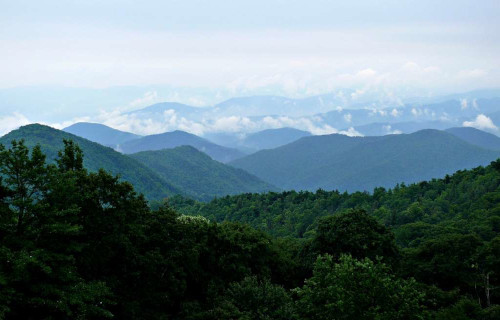
This mind-boggling formation almost immediately captivates those individuals fortunate enough to encounter it for the first time. Yet it does so for a wide combination of reasons. That holds true since it’s not only possessed of great beauty, the site also boasts truly incredible dimensions.
Most experts divide the magnificent mountain range into three clear subdivisions. Each of these sections holds both features similar to the others, as well as some distinct to itself. This allows for at least some context when discussing its qualities, given the vast scale of its massive size.
The most northern section roughly begins in the province of Newfoundland and Labrador, in Canada. From there, though, it extends itself to the Hudson River. Within this greater extent, however, numerous individual features clearly stand out in terms of their impressive stature.
Withn the Canadian portion of this particular section, multiple peaks exceed 4,000 ft (1,219 m) in height. Many others also reach at least 2,700 ft (823 m). In its southern parts, however, several reach or even exceed elevations of 5,000 ft (1,524 m). One attains a height of 6,288 ft (1,917 m).
Meanwhile, the central section of the captivating range roughly reaches from the Hudson River to the state of West Virginia. This stretch contains its own wonders. These include the stunning New River. Yet ot also obasts other marvels to delight the eye of the fortunate visitor or resident.
Subsections of the greater range also exist in this area, including the Allegheny Plateau and the Taconic Mountains. The impressive Great Appalachian Valley, itself a true wonder of Nature, also appears here. The stunning Blue Ridge Mountains, another amazing subset, also begin there.
The southern section of the Appalachian Mountains completes its expansive length. This portion reaches from the deceptively-named New River in Pennsylvania, to northern Alabama. Along its course, though, yet more marvels await, including other mountains of 2,700 ft (823 m) or more.
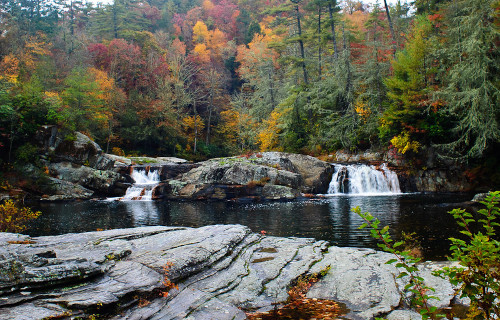
This portion also holds some of the greatest natural wonders. The magnificent Mt. Mitchell lies within this region of the range. Being the highest point east of the Mississippi, it reaches 6,684 ft (2,037 m). Others include such features as Linville Falls and Sliding Rock, both in North Carolina.
CCL: https://tinyurl.com/22y23f9m
Appalachian Mountains Location, Formation, and Ecology
The unquestionably awe-inspiring Appalachian Mountains formed in a region of the globe already renowned for its abundance of geological wonders. The location of that area won’t surprise many, though. That’s because it formed in a lovely portion of the continent of North America.
Though one end of the range lies inside Canada, the majority of its expanse runs through the United States. It further resides in the approximate eastern section of the continent. Within the United States, it extends from Maine in the north, to the northern part of the state of Alabama.
The origins of this marvelous work of geological forces actually lie far back in the earth’s distant past. That’s true since this irresitible mountain range began its formation over 1 billion years ago. That makes this amazing natural formation one of the oldest known such in the entire world.
Its birth originally, and primarily, occurred due to the inexorable collision of tectonic plates. Volcanic activity subsequently followed, though much later. The majority of that process occurred around 200 million years ago. Evidence places the last eruption at over 50 million years ago.
The mind-blowing beauty of the Appalachian Mountains further boast a strongly thriving ecology. In fact, the range is considered by most, experts and enthusiasts alike to stand as one of the most biodiverse regions on the entire continent. Species of all kinds thus abound within its confines.
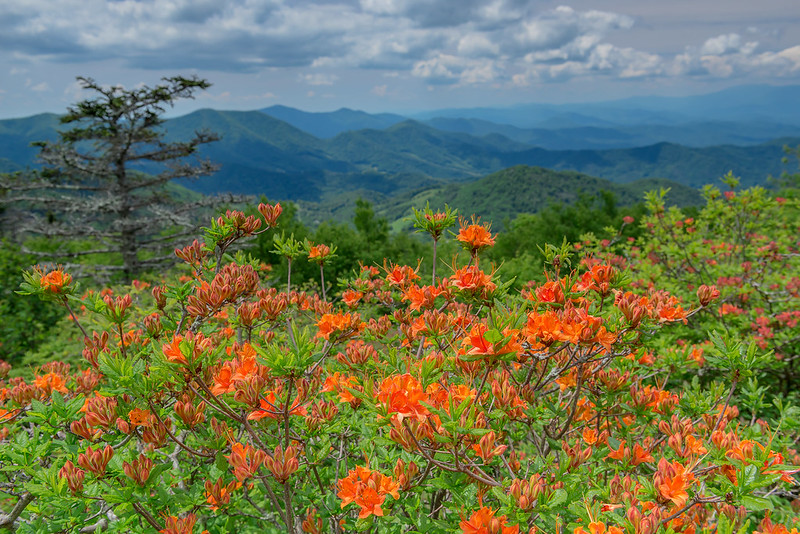
Much of its extent still holds an extensive cover of beautiful forested regions. These woodlands contain a variety of tree types, of course. Deciduous and evergreen species alike proliferate in abundance. Many other plants also appear, including the Flame Azalea, which lives nowhere else.
Innumerable species of both animals and insects also appear here. Mammals of all sizes, from squirrels to deer and black bear thrive in the region. Birds of all kinds additionally spend their lives here. The reptiles present include the large and dangerous Eastern Diamondback Rattlesnake.
Maine Desert
Public Domain Image
Maine Desert Facts
- Closing out this listing of these 3 Magnficent Marvels of Maine comes the astonishing feature appropriately known as the Maine Desert.
- The remarkable geological formation sometimes known by this title for obvious reasons remains an unexpected feature within its region. This astonishing marvel of the work of various processes also goes by the similarly descriptive common name of the Desert of Maine.
- Regardless of the name one chooses to use to refer to it, however, one indisputable fact about this site clearly stands out. That’s the fact that this location actually forms a surprising geological phenomenon. Thus, it shows that names can sometimes be quite deceptive.
- That holds true due to the fact that, in the minds and opinions of some individuals, this site does not actually qualify as a true desert. That particularly surprising perspective occurs because the surrounding climate remains much too wet and cold to meet some definitions.
- The formation of this truly astounding feature, furthermore, did not come about naturally. In point of fact, this quite dry, arid region, whether it constitutes an actual desert or not, actually owes its existence to human activity. That alone sets it apart from other similar settings.
- Nonetheless, the surprising knowledge of its origins does nothing to detract from the fascinating nature of this remarkable location. Quite understandably, the very uniqueness of the Maine Desert serves to garner the formation with a more than modest claim to fame.
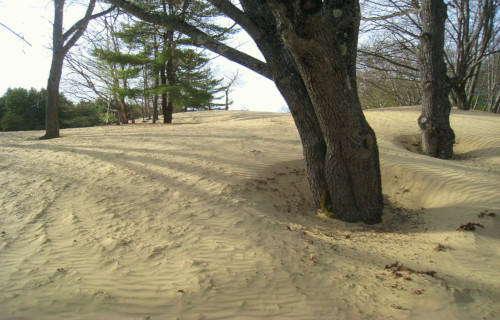
- This surprising statement holds true due to yet another fascinating statistic. That’s the fact that this mind-boggling formation has been preserved as a natural oddity. That’s additionally been the case since 1925. A small museum and gift shop also presently exist on the property.
Public Domain Image
Maine Desert Physical Description
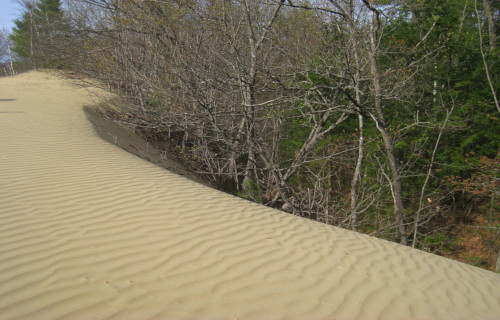
For all the controversy around the Maine Desert, several key facts stand out when one considers it. Among these, regardless of its origins, stands the fact that it covers a tiny area. However, a debate over whether or not it’s actually a desert remains ongoing among concerned scientists.
As a result of this continuing situation, the amazing formation does not presently officially hold the title of the smallest confirmed desert on earth. In fact, for the present moment, at least, the slightly larger Carcoss Desert, located within Canada, also finds itself in the very same predicament.
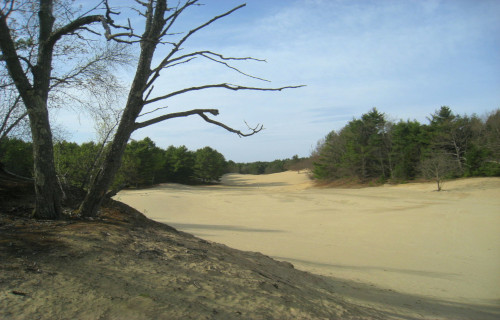
But, regardless of any official status, the atention-grabbing feature still constitutes an interesting phenomenon. In terms of sheer size, though, the Maine Desert only covers approximately 40 acres (16.2 ha). In this, it aptly demonstrates the fact that size has no bearing on impressiveness.
No matter its official situation, the remarkable feature definitely qualifies as extremely unique, at the very least. That status occurs due not only to its questionaable origins, but also to its very nature. This occurs because it does not, in fact, consist of sand. It’s actually composed of glacial silt.
Public Domain Image
Maine Desert History and Formation
While this wondeer formed only recently, the beginnings of the story of the Maine Desert reaches back roughly 10,000 years ago. At the end of the last ice age, the enormous glaciers retreated. As they did so, the foundations for the future formation of this fascinating site actually began.
The actual site of this origin story presently represents the state of Maine, situated within the United States, in North America. During the course of the slow but inexorable retreat of these gigantic glaciers, the withdrawing ice sheet slowly began its work of creating the unique masterpiece.
As a result of that movement, the prodigious quantities of ice ground rocks into a fine powder, known as glacial silt. Over the passage of millennia, copious quantities of topsoil became deposited over this. This finished condition remained comparatively stable for many thousands of years.
Then, much later, eventually came huge numbers of European settlers. Eventually, a local family established a farm on this site. This occurred in 1797. Yet the people failed to manage the land properly. Poor farming practices also combined with overgrazing to erode the topsoil.
One day, a small patch of the underlying sand appeared to observers. To the surprise of those viewers, this formation quickly spread, eventually taking over the entire farm. Subsequent to this development, the Maine Desert came into existence. To date, it’s depth has never been measured.
Eventually, bowing to the inevitable, the family abandoned the farm in the year 1919. A man named Henry Goldrup later purchased the property in 1925. Recognizing its uniqueness, he opened the site as a tourist attraction. Today, Nature does appear to be slowly reclaiming the distinctive area.

3 Magnificent Marvels of Maine
We hope that each of you thoroughly enjoyed reading, and hopefully learning something from, this article we’ve written about these 3 Magnificent Marvels of Maine. It’s also our hope that doing so has left you with either a new or renewed appreciation for such amazing wonders of Nature.
Unfortunately, many other such features located around the world now find themselves facing severe threats to their continued existence in an undamaged state. Many of those dangers, in fact, stem from the actions of mankind. We must do all we can to protect and preserve them all.
Check out our other articles on 5 Magnificent Mountains of Eurrope, Earth’s Many Stunning Waterfalls, 3 Bewildering Birds of Australia, The Mighty Tornado, 5 Fantastic Fauna of Tunisia