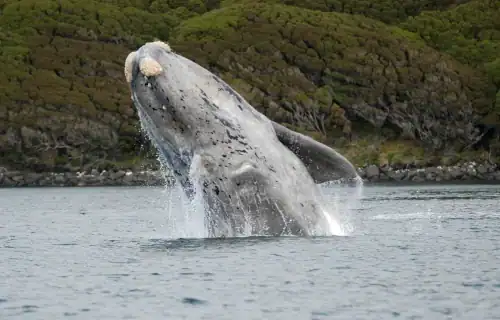
Photo: Oregon State University
CCL: https://tinyurl.com/bd3jn23y
We truly hope that each of you, our readers, will greatly enjoy and appreciate this article we present about these 3 Remarkable Right Whales. It was certainly our great pleasure to compile the various information for you. May it provide you with both education and increased awareness.
Obviously, very select species listed herein represent only a small portion of the natural wonders found throughout the world, though. Yet, it’s our belief that they serve as excellent representations of the wonders found here. Check out some of our many other articles for similar marvels.
North Atlantic Right Whale
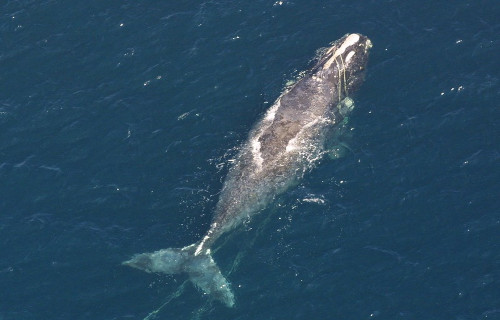
North Atlantic Right Whale Facts
- Leading off this article about these 3 Remarkable Right Whales comes the first of the marvels to make the list, the North Atlantic Right Whale.
- This majestic marine mammal is most typically referred to by this informative common name due to its native range. Yet, this majestic beauty does have several other general titles. These include such terms as black right whale, bone whale, and Biscay whale, among others.
- Scientific professionals, however, perhaps know it better by its purely technical designation. Unfortunately, though, as often occurs, that’s a somewhat difficult tag for the layperson to pronounce. That’s because it holds the complex formal epithet of Eubalaena glacialis.
- The magnificent creature received that appellation due to the efforts of Otto Friedrich Müller. That highly respected Danish naturalist accomplished the first recognition of it as a separate and distinct species. He managed that scientifically noteoworthy deed in the year 1776.
- The massive animal currently represents one of only three recognized species placed within its entire genus. Previously, however, scientists classified all three of these as a single species. This marvel of Nature is now a protected species across much of their native habitat range.
- Sadly, though, the amazing North Atlantic Right Whale currently finds itself in a most precarious position. Though it’s now protected by legal decrees, humans once hunted it nearly to the point of extinction. It still has a very small population, and recovery proceeds slowly.
- Due to these severe factors, the IUCN currently lists the creature as Critically Endangered. The whale faces multiple threats to its continued existence as a species. Most of these perils stem from the actions of mankind. They include the dangers of habitat loss and climate change.
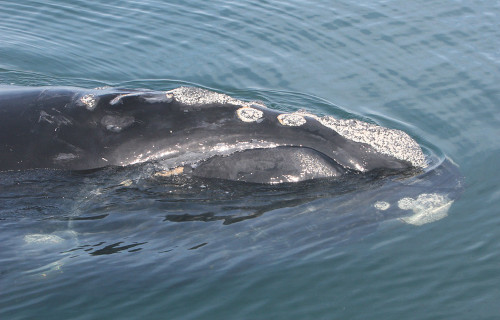
North Atlantic Right Whale Physical Description
The beautiful North Atlantic Right Whale certainly captures the attention of those individuals fortunate enough to encounter it. Like its cousins, it also does so for a variety of reasons. That’s due to the fact that, as with many cetaceans, it possess both great beauty and impressive dimensions.
It also follows another evolutionary pattern typical to its many relatives around the world. That’s the fact that it displays a certain amount of the physiological characteristic of sexual dimorphism. In this species, that trait manifests itself purely in terms of size. Females are slightly larger than males.
The gender-based difference remains comparatively minor, though. Overall, mature individuals reach an average length measuring approximately 43 – 52 ft (13 – 16 m). Weights among examples frequently vary significantly, however, usually ranging from 88,185 – 154,324 lb (40,000 – 70,000 kg).
Exceptional specimens nevertheless do sometimes occur, wholly regardless of their gender. The most physically impressive examples ever reliably confirmed attained lengths equaling 61 ft (18.6 m), and amazingly weighed roughly 234,000 lb (106,000 kg). Such examples remain rare, though.
Other than size, both sexes of the North Atlantic Right Whale present the same general outward appearance. Its most distinguishing attribute, setting it apart from other cetaceans, is its lack of a dorsal fin on its back. It also has a large head that accounts for a large part of its total length.
Exact patterns of coloring additionally vary markedly between individuals, though nonetheless within certain ranges. These primarily consist of various shades or black or gray. A few individuals, however, also display random patches of an off-white, usually on their throats and stomachs.
- Kingdom: Animalia
- Phylum: Chordata
- Class: Mammalia
- Order: Artiodactyla
- Family: Balaenidae
- Genus: Eubalaena
- Species: E. glacialis
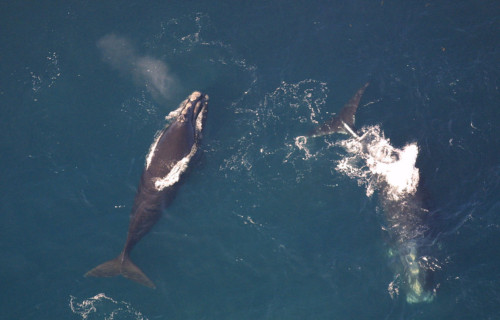
CCL: https://tinyurl.com/22y23f9m
North Atlantic Right Whale Distribution, Habitat, and Ecology
The gorgeous North Atlantic Right Whale evolved as native to only a moderate expanse of the marine regions of the surface of the earth. Its very name provides the location of that zone of habitation. It developed as endemic to the most northern areas of the Atlantic Ocean.
To the north, that territory extends as far as the Labrador Sea, located near Greenland, as well as other regions at the same longitude. To the south that only reaches to Florida, in the United States, in the southeast. That range also extends to around the northwest coast of South America.
The remarkable cetacean also evolved decidedly clear preferences regarding its choice of habitat. Yet, the nature of this favoritism serves to drastically limits its available range. This marvel of evolution primarily, but not solely, chooses to reside in waters along the continental shelf.
Individuals and groups nevertheless do occasionally venture much farther out to sea, roaming into areas of very deep water. The species also migrates seasonally within this greater territory, generally between feeding grounds. This migratory action occurs both as individuals and in groups.
The amazing North Atlantic Right Whale, just like its many kindred located around the world, evolved as fully carnivorous in nature. Its diet consists primarily of copious quantities of relatively small crustaceans and other invertebrates. These include pteropods, krill, and similar creatures.
Following mating activities, females carry the young for about 1 year. The mother typically nurses the offspring for 1 – 2 years. Even after that, though, calves often stay with or near the mother until around the age of 10. Minus human interaction, an averae lifespan equals about 100 years.
Southern Right Whale
Southern Right Whale Facts
- Next up in this compendium of 3 Remarkable Right Whales we give you the next mammoth of the marine regions, the Southern Right Whale.
- The informative term that we’re using perfectly serves as the most frequently used common name for this remarkable cetacean. Yet, the wonder does have a few other general titles by which it’s known. These other options include Southern Whale and the Black Whale.
- Within the annals of science, however, the animal’s perhaps much better known by its purely technical designation. As such monikers go, though, that one’s actually comparatively simple for the layperson to pronounce. That’s because it holds the formal tag Eubalaena australis.
- The amazing creature received that specific epithet due to the efforts of Antoine Desmoulins. The highly respected French anatomist accomplished the first official recognition of it as a separate and distinct species. He achieved that scientifically noteworthy deed in the year 1822.
- This creation of Nature and evolution holds a notable place of distinction in the halls of marine biology. Due to the nature of its range, it represents one of best-studied whale species. Of the three recognized species of Right Whale, it also boasts the largest remaining population.
- Thankfully, despite once being hunted nearly to extinction, the gorgeous Southern Right Whale now holds a respectable population base. That state holds true across the entirety of its range. In response to this pleasant trend, the IUCN now shows it as Least Concern on its Red List.
- The marvel nevertheless still faces numerous potential threats to its continued existence as a species. Like all forms of life on earth today, most of these stem from the actions of mankind. Those dangers include the closely related perils posed by habitat loss and climate change.
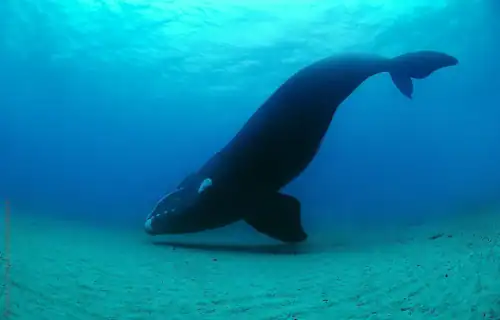
Southern Right Whale Physical Description
Like most whales, the Southern Right Whale almost never fails to capture the attention and awe of those individuals fortunate enough to encounter one. Unlike some other creatures around the world, however, it does so not just due to its amazing visual appeal, but also for its great size.
Regarding its appearance, though, it also follows an evolutionary pattern that, while uncommon among mammals in general, remains typical of its relatives. That’s the fact that the stunning mammoth of the seas displays a degree of the physiological characteristic of sexual dimorphism.
In its specific case, this natural trait manifests itself solely in terms of sheer physical dimensions. That’s true since females attain a greater overall size than their male counterparts. That extends to both length and mass. However, the gender-based differences remain relatively minor on average.
Adult females attain an average maximum length equaling between 55.8 – 59.1 ft (17 – 18 m). Males, though, only reach mean measurements of 45.9 – 52 ft (14 – 16 m). The females additionally achieve masses between 60 – 90 tons, unless pregnant, while the males merely average 40 – 80 tons.
Both sexes, however, present a general body shape best described as stocky and rotund, with a broad back. Its pectoral flippers, meanwhile, evolved as broad paddle-shaped. It also has a wide tail, with smooth trailing edges. Unlike most of its kindred, it remains conspicuously absent a dorsal fin.
Perhaps the most remarkable anatomical feature of the awesome Wouthern Right Whale is the head of the animal. This actually represents almost one-third of the total body length! This hosts two separate blow-holes on top, as well as roughened, raised patches of skin, known as callosites.
Its distinctive coloration also merits its fair share of mention. Among adults, this most typically consists of a primarily black or dark gray background. Many of these individuals additionally display white patches on the belly or chin. Calves usually begin life slightly lighter and darken as they age.
- Kingdom: Animalia
- Phylum: Chordata
- Class: Mammalia
- Order: Artiodactyla
- Family: Balaenidae
- Genus: Eubalaena
- Species: E. australis
Photo: Oregon State University
CCL: https://tinyurl.com/bd3jn23y
Southern Right Whale Distribution, Habitat, and Ecology
The beautiful Southern Right Whale evolved as indigenous to a moderately broad swathe of the marine regions of the globe. As the name implies, though, this zone of habitation consists of several distinct areas situated within the Southern Hemisphere. Those areas likely won’t surprise anyone.
Part of that specific territorial range consists of the waters of the Southwestern Atlantic Ocean off the coast of South America. Within that particular section of its range, its breeding grounds mainly include those locations lying offshore of the nations of Argentina, Uruguay, and southern Brazil.
This wonder of Nature’s also present in the waters off of South Africa, in the Southeastern Atlantic Ocean. Inside of this smaller zone, its breeding grounds appear in the waters just off of the southern coast of the country of South Africa. That holds particularly true between Cape Town and Durban.
Yet, the magnficent creature’s also present in portions of the waters around both Australia and New Zealand. Those final locations lie within the Southern Indian and Pacific Oceans, respectively. There, its breeding grounds lie just off Southern Australia, Tasmania, and parts of New Zealand.
Like its many relatives across the globe, this marvel displays a high degree of flexibility regarding the regions it inhabits, at least in certain ways. That classification occurs due to the fact that the habitats of the species change seasonally as the whale migrates between breeding and feeding areas.
From Winter to Spring, it favors coastal, temperate waters. Here, it prefers certain ecosystems. These commonly include shallow bays and sheltered coastal areas, calm waters and gentle slopes, and waters warm enough to support newborn calves, since this forms the breeding and calving area.
During the period between Summer to Autumn, though, it inhabits its major feeding habitat. This typically consists of higher latitude, offshore locations hosting notably cooler waters. Prime features include nutrient-rich waters, and high concentrations of zooplankton, especially copepods and krill.
In keeping with its migratory habits, the ecology of the Southern Right Whale developed as highly complicated in nature. In fact, this aspect of its life cycle encompasses its many interactions with the local environment, individuals and group behavior, life history, and role in marine ecosystems.
It feeds as a filter feeder, consuming vast quantities of zooplankton, mainly composed of krill and copepods. To do this, it swims slowly with its mouth open, filtering prey through fringed baleen plates. Later, as a byproduct of this, its fecal plumes play an important role in nutrient recycling.
The awe-inspiring creature typically lives either solitary, or in small, loose-knit groups. After breeding, females give birth, usually to a single calf, roughly 12 months later. Subsequent to the birth, mothers nurse their calves for between 6 – 12 months, varying significantly between individuals.
Due to its great size, this wonder of evolution possesses very few natural predators. Nonetheless, a few denizens of the depths do prey on it on occasion, though usually on either calves, juveniles, or severely weakend adults. These enemies include Orcas, and larger sharks, such as the Great White.
North Pacific Right Whale
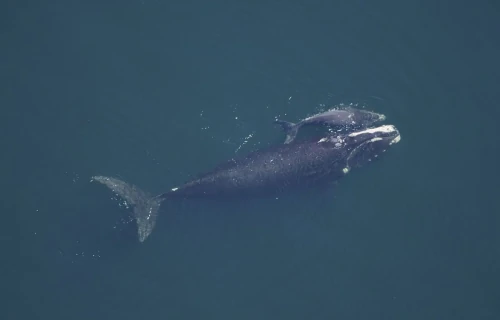
North Pacific Right Whale Facts
- Closing out this listing of these 3 Remarkable Right Whales comes the incredible work of Nature best known as the North Pacific Right Whale.
- Though somewhat lengthy, this title serves as the most frequently used common name for this true marine marvel. Yet, it does have a few other general titles by which it’s known. These include the terms Japanese right whale and Pacific right whale, among others.
- Within the scientific community, however, it’s possibly much better known by its purely technical designation. Fortunately, that’s a comparatively simple one for the layperson to pronounce. That’s because this wonder of Nature holds the formal tag Eubalaena japonica.
- The remarkable cetacean received that epithet due to the efforts of Bernard Germain de Lacépède. That rrespected French naturalist accomplished the first official recognition of it as a separate and distinct species. He achieved that scientifically noteworthy deed in the year 1818.
- Interestingly, the amazing product of Nature and evolution possesses two distinctly separate population groups. Evidence indicates that the smallest of these consists of fewer than 50 individuals. While somewhat larger, the second group nonetheless remains quite small.
- Taken together, the stunning North Pacific Right Whale finds facing an extremely dire situation. Its total numbers, already minimal, continue to decline. This lamentable state appears to hold true in both groupings. Accordingly, the IUCN now lists it as Endangered on its Red List.
- Although this fabulous mammal enjoys protected status, it nevertheless still faces multiple threats to its continued existence as a species. Like all forms of life on earth, the majority of these perils stem from the actions of man. They include habitat loss and climate change.
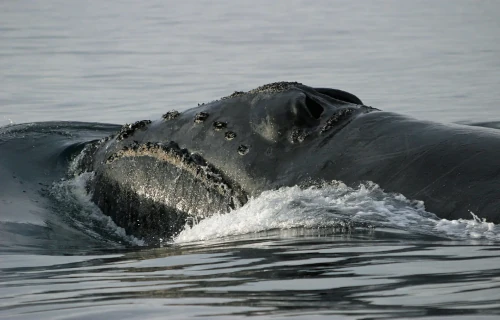
Public Domain Image
North Pacific Right Whale Physical Description
The aptly-named North Pacific Right Whale never fails to enthrall and fascinate those individuals fortunate enough to encounter one. Unlike some creatures, though, it does so for several reasons. It’s both a truly majestic species of fauna, and one possessed of impressive dimensions.
It also follows an evolutionary pattern common among mammals across the world. That’s the fact that it displays a certain amount of the physiological characteristic of sexual dimorphism. In its specific case, this natural trait manifests itself in terms of size, though the difference is minimal.
Overall, individuals of both genders develop a body shape best described as rotund and thicker than most whales. It has no dorsal fin or grooves under the throat, unlike rorquals like blue or humpback whales. The mammal also has broad, paddle-shaped flippers and a wide, notched tail fluke.
The powerful cetacean further evolved a covering of numerous baleen plates on each side of its body. Measuring up to 9 ft (2.8 m) in length each, every animal develops between 200 – 300 of these per side. In its coloring, this feature typically presents various dark shades unique to each specimen.
The rest of the body of the North Pacific Right Whale displays as mostly a dark gray to black in coloring. Some individuals have white patches on the belly or chin, but these are rare. The skin of this whale often appears rough or mottled due to the presence of callosities, scars, and parasites.
Yet, several features undoubtedly draw the most attention. One consists of an enormous, arched head, making up about one-third of the whale’s body length. The upper jaw, technically known as the rostrum, evolved as sharply arched, and holds many hundreds of its own long baleen plates.
Meanwhile, the previously mentioned callosites represent another distinctive feature that separates this creatue from its many relatives. These represent extremely roughened patches of skin, unique to each whale. They’re also often colonized by whale lice, which gives them a whitish appearance.
- Kingdom: Animalia
- Phylum: Chordata
- Class: Mammalia
- Order: Artiodactyla
- Family: Balaenidae
- Genus: Eubalaena
- Species: E. japonica

CCL: https://tinyurl.com/2p72bfpk
North Pacific Right Whale Distribution, Habitat, and Ecology
Historically, the North Pacific Right Whale held a territorial range that included a significant portion of the marine regions of the globe. The impressive cetacean once appeared throughout nearly the entire North Pacific Ocean, from the Sea of Japan, Okhotsk Sea, and Bering Sea in the west.
From there, though, that previous zone of habitation extended across to the Gulf of Alaska, Aleutian Islands, and down to Baja California in the east. It also frequently migrated between high-latitude feeding areas and lower-latitude breeding grounds within each of these separate regions.
Due to the near extinction of this wonder from 19th and 20th century whaling, its range has contracted greatly. The Western North Pacific population holds three confirmed areas of habitation. These zones consist of the Sea of Okhotsk, Eastern Russian waters, and offshore of Japan.
The smaller Eastern North pacific grouping, meanwhile, lives in just a few known small marine sections of the world. It’s present in the Bering Sea, particularly near Bristol Bay, the Gulf of Alaska, including Kodiak Island and south of the Aleutians, and along the west coast of the United States.
This breathtaking creation of eons of evolution displays a very specific set of preference regarding its choide of habitat types. That’s true since the whale inhabits marine environments that vary seasonally, reflecting its migratory behavior between feeding and potential breeding grounds.
During the summer and autumn, it primarily resides in its feeding habitat, mainly in high-latitude, cold, nutrient-rich waters with highly abundant zooplankton. Features common to this area typically include continental shelf and slope regions, cold water currents, and oceanographic fronts.
Inside of this section of the globe, certain geographical locations appear to be more favored than others, some mentioned earlier. These include the Bering Sea, especially the southeastern shelf, and Sea of Okhotsk. It’s also around the Aleutian Islands and the Northwestern Pacific, near Hokkaido.
Yet, in the winter, it migrates to its breeding habitat. That’s poorly known, but presumed to be in lower-latitude, warmer offshore waters. It’s known to favor shallow to mid-depth waters, reaching down no further than 4,921 ft (1,500 m). It also often appears over sandy or muddy bottoms.
The ecology of the fantastic North Pacific Right Whale centers on its specifc role within its region. There, it represents a large, slow moving baleen whale that feeds on zooplankton in cold, productive waters. It additionally serves as a key indicator species for ecosystem health in the North Pacific.
Though carnivorous in nature, it feeds entirely as what science calls a secondary consumer. Its prey principlly consists of extremely small copepods and krill. The massive mammal consumes these in vast quantities, utilizing skim feeding, filtering zooplankton through its many baleen plates.
It’s most commonly found either singly, or in small groups numbering no more than 3 individuals. Females generally give birth in warmer waters, and usually to a single calf. An estimated lifespan equals approximately 70 years, with sexual maturity occurring at roughly 10 years of age.
3 Remarkable Right Whales
We legitimately hope that each of you fully enjoyed reading, and hopefully learning something from, this article we’ve written about these 3 Remarkable Right Whales. It’s also our fervent hope that doing so has left you with either a new or renewed appreciation for such wonders of Nature.
Unfortunately, however, many of their innumerable kindred around the world now find themselves facing strong threats to their continued existence as a species. Many of those dangers, in fact, stem from the actions of mankind. We must each do all we can to protect and preserve them all.
Check out our other articles on 5 Magical Mammals of Ohio, Africa’s Many Geological Masterpieces, 3 Remarkable South American Reptiles, Wonderful Wild Cats of the World

Leave a Reply