CCL: https://bit.ly/3w4gRF6
We truly hope that each of you, our readers, will sincerely enjoy and appreciate this article we present to you about these 5 Beautiful Insects of Borneo. It was certainly our pleasure to gather the information for you. May it provide you with both education and increased awareness.
Certainly, these few magnificent species listed herein represent only a tiny portion of the similar species found throughout this region. It’s our belief, though, that they serve as excellent representations of the members of this Class. Check out our other articles for similar marvels.
Empress Cicada

Photo: Bernard DUPONT
CCL: https://tinyurl.com/ysjddhbz
Empress Cicada Facts
- Leading off this article about these 5 Beautiful Insects of Borneo we present you with the royal member of the group, the Empress Cicada.
- This startling creation of Nature and evolution remains best known by the majestic common name used here Empress Cicada across its range. Yet, the invertebrate does have a few other general titles. These include the terms Imperial Cicada, Giant Cicada, and Emperor Cicada.
- Within the scientific community, however, it’s perhaps better known by its technical designation. Sadly, though, like many such epithets, that’s quite difficult for the layperson to pronounce. That’s because it holds the formal name of Megapomponia imperatoria.
- This biological marvel received that tongue-twisting moniker due to the efforts of John Obadiah Westwood. The respected British entomologist recorded the first recognition of it as a separate and distinct species. He achieved that scientifically noteworthy deed in the year 1842.
- The amazing creature stands out in the annals of science for one very specific reason. To date, it represents the largest known species of cicada. The Arthropod also produces one of the loudest calls among its kind. That generated by males nearly equals the noise of a jet engine.
- Fortunately, the regal Empress Cicada appears to be maintaining a population base that’s both sufficient and stable. This pleasant state also seems to hold true throughout the entirety of its native range. The IUCN therefore does not currently place it on its published Red List.
- The wonder nevertheless still faces numerous potential threats to its continued existence as a species, at least. Like all forms of life on earth today, most of these stem from the actions of man. They include the closely related perils of habitat loss and ongoing climate change.
CCL: https://tinyurl.com/2dcehfvs
Empress Cicada Physical Description
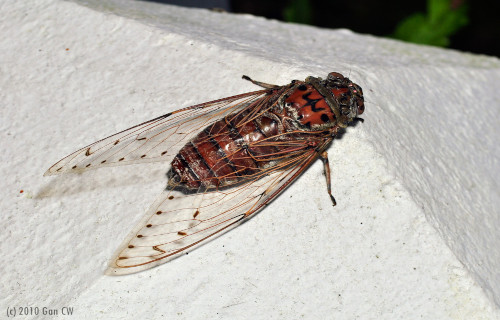
The remarkable Empress Cicada certainly captures the attention of those who encounter it for the first time. This incredible product of evolution typically does so, however, for a wide variety of reasons. That’s true since the creature possesses a broad range of highly distinctive physical traits.
It does share one in common with the majority of life around the world, though. That’s the fact that it displays a certain degree of the physiological characteristic of sexual dimorphism. In this particular species, that manifests in several manners, though not usually visually prominently.
Males tend to have a more slender and elongated abdomen than their female counterparts. That’s partially because it houses the tymbal organs and is adapted for sound production. The females, meanwhile, typically develop a somewhat broader and much more rounded abdomen.
Otherwise, the two genders present the same overall appearance to the observer. An average body length equals an astound 3 – 3.5 in (7 – 8 cm). But the wingpan’s even more impressive. This measures a mean width of roughly 8 in (20 cm)! Exceptions do occur, but rarely exceed this greatly.
Those wings develop as transparent and membranous, with a network of veins that give them a slightly rigid structure. The larger of the two pairs, the forewings are long and slender, extending well beyond the body when at rest. Its hindwings have a similar pattern, but remain slightly shorter.
The legs also deserve notice. These evolved as relatively long and spiny, especially the front pair. These serve as an aid in gripping tree bark while it’s feeding or calling. The ends of the legs further developed as equipped with small yet sharp claws that help the cicada cling to plants and trees.
Males have specialized structures on their abdomen called tymbals. These ribbed membranes vibrate to produce its distinctive, loud calls. Nature placed these just below the wings on either side of the abdomen. That of the male’s hollow and amplifies the sound produced by the tymbals.
Yet, it’s the head of the startling Empress Cicada that generally garners the most interest. This holds prominent compound eyes, positioned on the sides of the head, giving it a wide field of vision. The eyes typically show brown or reddish. It also has short, fine antennae, and piercing mouthparts.
The stout, elongated body typically develops as somewhat flattened in shape. This usually shows brown or green in color. Variations in shading also appear. Dark or mottled patterns also show along the body, adding to its camouflage. The thorax occasionally displays intricate patterns or ridges.
- Kingdom: Animalia
- Phylum: Arthropoda
- Class: Insecta
- Order: Hemiptera
- Family: Cicadidae
- Genus: Megapomponia
- Species: M. imperatoria
Photo: Bernard DUPONT
CCL: https://tinyurl.com/ysjddhbz
Empress Cicada Distribution, Habitat, and Ecology
The captivating Empress Cicada evolved as indigenous to a moderately broad expanse of the earth’s surface. That zone of habitation’s exact location likely won’t surprise anyone, though. That’s because this marvel of Nature developed as native to what’s now known as the continent of Asia.
Within that greater region, though,the Arthropod’s principally present within the area considered to form Southeast Asia. There, it’s mainly found in several clearly distinct sections. Together, peninsular Malaysia and the Borneo island region comprise one of the primary portions of this zone.
It’s also found in southern Thailand and Indonesia, particularly Sumatra. Unconfirmed reports further place its presence in sections of several other countries. These include southern Vietnam, Laos, Cambodia, and Myanmar, though its presence here isn’t very well documented.
It displays decidedly clear preferences regarding its choice of habitat. The insect primarily lives in tropical and subtropical forests. These climates possess the dense vegetation, high biodiversity, and year-round warmth and humidity, which remain essential for the survival of cicadas.
It’s also commonly found in areas of lowland rainforests. These offer the invertebrate a stable environment with plenty of trees for both adults and nymphs. The dense canopy and plant diversity provide protection from predators and ideal conditions for feeding and reproduction.
Yet it thrive in secondary forests, too. These regions comprise forests that eventually regenerated after severe dame, such as by logging or agricultural use. These forests frequently have younger and more diverse vegetation, which still provides a suitable habitat for the intrepid species.
It’s needs don’t stop there, however, The Empress Cicada also requires a humid, warm climate with consistent temperatures throughout the year. It thrives in areas where the average temperature stays warm, and free moisture abounds in the air, making tropical regions especially ideal.
It evolved as a sap-feeder. Nymphs feed on the sap from roots while underground, and their long developmental period, often several years, makes them a consistent part of the ecosystem. Adults feed on tree sap, using their mouthparts to extract nutrients from stems and branches.
After mating, the female lays her eggs. She makes multiple cuts in selected plant tissue and lays clusters of eggs within these slits. This provides the eggs with protection and keeps them hidden from predators until they hatch. She usually selects branches, twigs, or stems of trees and shrubs.
Gray’s Leaf Insect
Gray’s Leaf Insect Facts
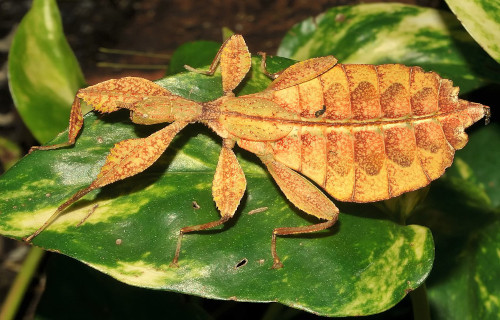
- Appearing next in this compilation of 5 Beautiful Insects of Borneo comes the incredibly adapted one known as the Gray’s Leaf Insect.
- This intriguing product of natural evolution most frequently goes by the somewhat informative common name due to its nature. This marvel of Nature also has another, less often used common title, though. That’s the equally informative term of the Java Leaf Insect.
- Professional entomologists, however, typically refer to the remarkable species by its formal scientific name. That, however, is the truly tongue-twisting term of Pulchriphyllium bioculatum. Regardless of the tag used to refer to it, the insect remains a highly fascinating one.
- The first formal recognition of the fantastic Arthropod as a separate and distinct species occurred back in the year 1832. This event took place as a result of the diligent work of George Robert Gray, the highly respected English zoologist, and part of the British Museum.
- This particularly small but nonetheless greatly impressive animal also represented a true personal milestone for the eminent researcher. That’s because the creature also constituted the first phasmid he ever discovered. He later went on to discover numerous others, however.
- For the moment, the IUCN has no listing for the incredible Gray’s Leaf Insect on its Red List of Threatened Species. That’s due to the fact that, for the moment, at least, it appears to be maintaining a population base that’s both sizeable and sufficient within its range.
- The amazing insect must nevertheless be considered to be facing at least some potential threats to its continued existence. Given the exact nature and location of its range, habitat loss poses a potential danger. Its greatest threat, however, likely consists of climate change.
Gray’s Leaf Insect Physical Description
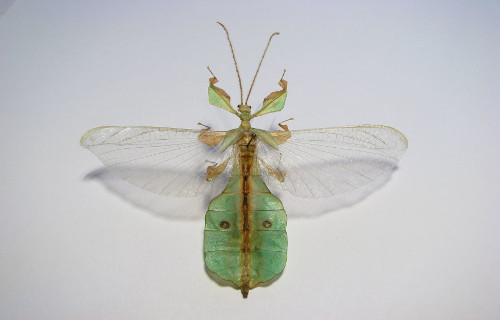
It’s worth noting that, while the Gray’s Leaf Insect does impress those individuals fortunate enough to encounter it, the creature does not do so due to sheer size. That’s due to the fact that it also ranks as a moderately-sized member of its Order. It’s nonetheless a fully respectable specimen.
Like many insects, this evolutionary wonder also displays a moderate degree of the physiological characteristic of sexual dimorphism. In its specific case, though, this trait mainfests itself in terms of simple physical size. Specifically, females attain a shorter length, though, thicker body.
More precisely, males of the intriguing species attain an average overall length of roughly 2.6 – 3.7 in (6.6 – 9.4 cm). The shorter females, though, only grow to an average length of 1.8 – 2.7 in (4.6 – 6.9 cm). Females of the species also develop an abdomen that remains narrower at the base.
Both sexes, however, typically manifest the same general pattern of coloring. Both the body and the legs display a primarily green background, though shades vary. Random markings consisting of such hues as bright orange and yellow also manifest, varying between individuals of either gender.
Females of the Gray’s Leaf Insect further distinguish themselves from their larger male counterparts in yet another manner. The masculine gender typically possesses significantly longer antennae than those of the females. Males, additonally possess fully functioning wings, while females do not.
- Kingdom: Animalia
- Phylum: Arthropoda
- Class: Insecta
- Order: Phasmatodea
- Family: Phylliidae
- Genus: Pulchriphyllium
- Species: P. bioculatum
CCL: https://bit.ly/3mNymZj
Gray’s Leaf Insect Distribution, Habitat, and Ecology
Fortunately, both for the Gray’s Leaf Insect, and those of us who appreciate Nature, the marvelous insect appears to inhabit a relatively large swathe of the surface of the globe. That’s due to the fact that its known habitat range covers an extremely respectable portion of southeastern Asia.
This mesmerizing invertebrate does, however, also appear in several other regions of the world. These consist of the Seychelles, Mauritius, and Madagascar. In its main area, though, it seems widespread throughout such countries as India, Sri Lanka, China, Borneo, Java, and Malaysia.
In whatever region one encounters it, though, the creature clearly displays a decidedly strong preference in terms of its choice of habitat. The vast majority of individuals live in tropical regions. There, the arthropod mostly makes its home in sections of the locally abundant tropical rainforests.
It also evolved as highly dependant on very specific environmental conditions. These include warmer temperatures, roughly between 75 – 82 F24 – 28 C). The species further requires moderately high humdity levels, not surprisingly, given the region of the earth in which the insect evolved.
Like most of its multitudinous relatives, the Gray’s Leaf Insect additionally evolved as a strict herbivore. Wherever it lives, the insect adapts to the locally prevalent vegetation. It does, however, display certain strong preferences in its diet. These include such sweet foods as guava and mango.
During breeding season, the females lays approximately 100 eggs. They lay these, however, scattered over a period usually lasting several days. She also lays eggs with or without fertilization, in a process called parthenogenesis. Those eggs laid without fertilization invariably only produce females.
Malaysian Dead Leaf Mantis
CCL: https://bit.ly/3w4gRF6
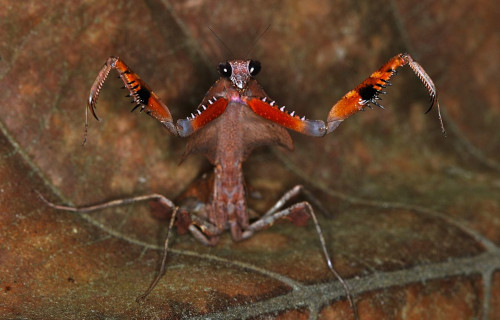
Malaysian Dead Leaf Mantis Facts
- Our next chohice for inclusion in this gathering of these 5 Beautiful Insects of Borneo is the astounding predator named the Malaysian Dead Leaf Mantis.
- The most frequently used common name for this marvel of Nature and evolution is this descriptive and informative term applied herein. This remarkable insect’s also, however, sometimes referred to by the somewhat misleading term of the giant dead leaf mantis.
- Professional researchers, though, typically refer to the marvel by its formal scientific name. That term, however, like many such technical names, remains somewhat hard to pronounce. That’s because professionals refer to the insect by the term Deroplatys desiccata.
- Regardless of what one chooses to call this natural wonder, it’s a fascinating and truly captivating creature. The alternate common name, though, is slightly misleading. That, however, isn’t at all unusual, as common names often give a false impression of the species.
- Though larger than some of its many kindred, it’s by no means a giant among its roughly 1,800 known related species, overall. Yet, it nevertheless does qualify as a giant, in a way, though. That’s because it attains a somewhat larger size than any other leaf mantis, specifically.
- The highly respected English entomologist, as well as archaeologist, John Obadiah Westwood, made the first recorded recognition of it as a separate and distinct species. That notable individual achieved this scientifically noteworthy achievement accomplished in the year 1839.
- Fortunately, its population base appears to be both sizeable and relatively stable. This pleasant situation further appears to hold true throughout the entirety of its known native range. Unfortunately, it’s also become quite popular among those who keep insects in captivity.
- Due to these facts, the IUCN presently has no listing for the Malaysian Dead Leaf Mantis on its Red List of Threatened Species. In the wild, it nevertheless faces several potential threats. Habitat loss poses an potential danger to it, along with the effects of climate change.
CCL: https://bit.ly/2Stss2x
Malaysian Dead Leaf Mantis Physical Description
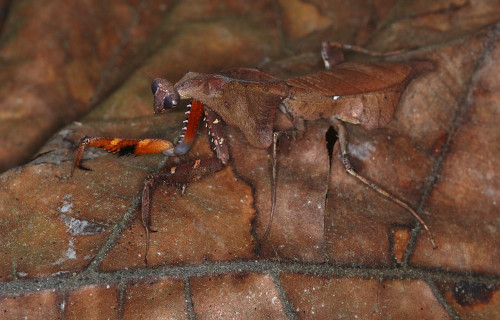
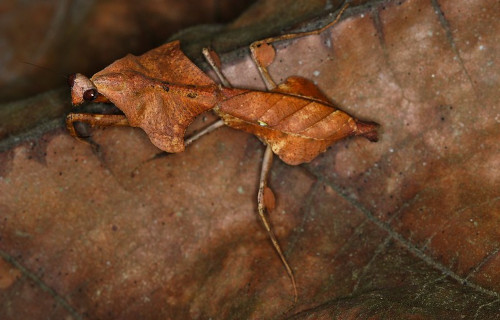
Like virtually all of its many relatives across the globe, the magnificent Malaysian Dead Leaf Mantis ranks as a literal master of camouflage. In its specific case, its own name gives an indication of its approach. That’s due to the fact that, when it wishes, it closely resembles a dead, dry leaf.
Like many insects of all kinds, this product of evolution also displays the physiological trait of sexual dimorphism. In its case, this trait merely manifests itself in terms of sheer physical size. The overall size difference between the two genders, however, remains comparatively minor.
More precisely, the females, again, like many of its innumerable relatives, attains a greater mean length than the male of the species. Mature females reach an average length of 3 – 3.1 in (7.5 – 8 cm). Males, meanwhile, grow to a body length that usually measures roughly 2.6 – 2.8 in (6.5 – 7 cm).
Otherwise, the two sexes display virtually identical patterns of coloring, with only extremely slight variations ocurring among individuals. Those patterns, though, include a very respectable range of colors. These run from nearly black, to various shades of brown, to an orange-brown hue.
The highly extended thorax of the Malaysian Dead Leaf Mantis possesses an extremely flattened shape. It also manifests intricate patterns, like the veins on a leaf, on the upper surface of its wings. The underside, however, has a mainly black background, with a large eye-like spot on each wing.
- Kingdom: Animalia
- Phylum: Arthropoda
- Class: Insecta
- Order: Mantodea
- Family: Deroplatyidae
- Genus: Deroplatys
- Species: D. dessicata
CCL: https://bit.ly/3hc1Uvf
Malaysian Dead Leaf Mantis Distribution, Habitat, and Ecology
The mesmerizing Malysian Dead Leaf Mantis inhabits a moderately expansive part of the surface of the world. This range consists of the region generally known as southeast Asia. More specifically, it’s known to live in the nations of Sumatra, the Philippines, Borneo, Indonesia, and Malaysia.
Within that greater range, though, it fortunately seems to be moderately adapable in terms of its habitat requirements. That’s due to the fact that observed specimens appear in regions consisting of both tropical forest and scrubland. For now, no evidence that it ever lived elsewhere exists.
This amazing Arthropod’s also supremely adapted for the environment in which it lives. Its coloring, as well as its body shape and design, all serve well to provide it with excellent natural camouflage. The insect even appears to sway in the breeze, mimicking the movements of a dried up leaf.
This learned behavioral pattern serves the amazing creature perfectly within its typical habitat range. That’s because it offers it a certain measure of protection from its own predators. Those hunters include the usual species, such as tree climbing lizards, snakes, and birds, among others.
Like its numerous relatives, the Malaysian Dead Leaf Mantis evolved as a purely carnivorous species. Also like them, it’s a master hunter, preferring to hunt as an ambush predator. The insect also feeds quite opportunistically, consuming virtually any prey of sufficient size, especially moths.
Giant Forest Ant
Giant Forest Ant Facts
- Now mking its presence known in this compendium of 5 Beautiful Insects of Borneos we give you the appropriately named Giant Forest Ant.
- This impressive and distinctive creation of Nature and evolution, quite understandably, most frequently goes by this uniquely inspiring common name. Unlike many species found around the world, for the moment the insect has no other broadly accepted common name.
- Professional researchers, meanwhile, generally refer to the remarkable creature by another term. That’s because those professionals usually apply its formal scientific name when speaking of it. That, however, is the less than easily pronounced term of Dinomyrmex gigas.
- The invertebrate received that official name at the hands of the renowned French zoologist, Pierre Andre Latreille. This respected researche made the first recorded acknowledgement of it as a separate and distinct species. That scientifically noteworthy action occurred in 1802.
- Regardless of which term one chooses to employ when referrring to it, though, it stands out from the majority of its many kindred. It also represents the only known member of its genus, further distinguishing it. At least one known subspecies does appear to exist, however.
- The Giant Forest Ant appears to be maintaining a population base that’s both stable and sizeable. That condition further seems to hold true throughout the entirety of its native range. The IUCN, therefore, currently has no listing for it on its Red List of Threatened Species.
- This majestic Arthropod nevertheless must be considered to be facing at least some potential threats, like most species. These naturally include the potential danger of habitat loss. Its greatest threat, however, most likely consists of the ongoing peril of climate change.
CCL: https://bit.ly/3yM3Guq
Giant Forest Ant Physical Description
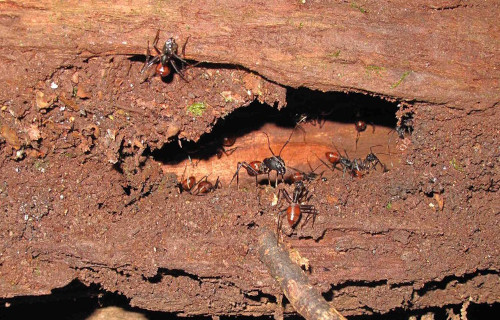
The amazing Giant Forest Ant impresses those people fortunate enough to encounter it for a variety of reasons, of course. Likely its most impressive feature, however, remains its sheer size. That’s due to the fact that this particular variety of ant ranks as one of the largest in the entire world.
The marvel of evolution further qualifies as the largest of all known ants in its entire region of the world. Sizes vary between individuals, of course, due to the very nature of ants. That’s because members of different castes have different attributes. That statistic extends to sheer size as well.
Normal workers within each colony attain an average overall length measuring a relatively impressive 0.82 in (20.9 mm). The significantly larger soldiers of each colony, however, reach even greater mean lengths. Members of that caste display an average length of roughly 1.11 in (28.1 mm).
The queens of this amazing species, meanwhile, grow to even greater sizes, as holds true for most known ants. Each queen of this remarkable invertebrate grows to approximately 1.22 in (31 mm) in overall length. These measurements truly drive home the incredible size of these invertebrates!
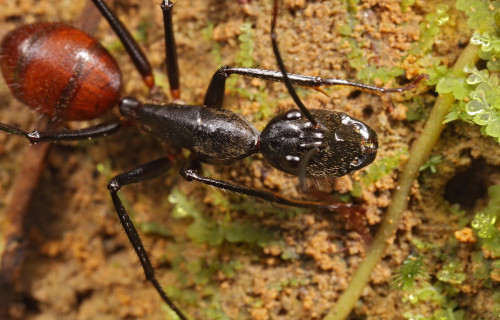
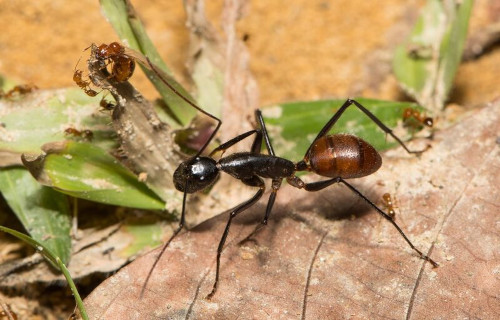
The general physical appearance of the Giant Forest Ant, apart from its uncommon size, strongly parallels that of other ants. It does manifest bright yellow fur on its legs, unlike others, though. The main body shows a dark brown shade, yet the posterior displays a much lighter, reddish-brown hue.
- Kingdom: Animalia
- Phylum: Arthropoda
- Class: Insecta
- Order: Hymenoptera
- Family: Formicidae
- Genus: Dinomyrmex
- Species: D. gigas
CCL: https://bit.ly/3CNAGVA
Giant Forest Ant Distribution, Habitat, and Ecology
The marvelous Giant Forest Ant appears to inhabit a moderately large swathe of the surface of the globe. More specifically, the Arthropod inhabits much of the southeastern portions of the continent of Asia. It still remains somewhat unclear, however, if the arthropod ever possessed a greater range.
The northern-most region of its known range includes both the countries of Thailand and the Philippines, though separated by a large expanse of ocean. From there, though, the intrepid insect extends its range through parts of Malaysia and Borneo, and into much of the country of Indonesia.
In all the numerous regions that it inhabits, however, the invertebrate displays very strong preferences in its choice of ecosystems to dwell in. Primarily, the insect makes its home, as the name implies, in the relatively dense regions of rainforest found throughout this region of the world.
Yet this intriguing product of millions of years of evolution also appears, though, in notably smaller concentrations, in a few other types of habitat. These varying ecosystems might surprise many, as they include such highly diverse areas as regions of mangrove forest, and peat swamps.
The extraordinary creature also chooses to llive at a surprisingly wide range of altitudes, unlike some related species. In point of fact, it makes appearances from near sea level up to about (1,500 m) above sea level. There, the animal sometimes makes its home in regions of montane forest.
The undeniably impressive Giant Forest Ant also differs from many of its relatives on earth today in its behavioral patterns. Most ants forage primarily by day, but not this one. These productive ants conduct the great majority of the their many activities at night, including, of course, foraging.
The vast majority of the diet of this distinctive ant, an impressive 90 percent, consists of honeydew. The remainder includes small insects, such as winged termites. The animal also consumes smaller quantities of other food options, such as nectar, sap, and even quantities of bird droppings.
Black and scarlet Cicada
CCL: https://tinyurl.com/462rnnjn
Black and scarlet Cicada Facts
- Closing out this article about these 5 Beautiful Insects of Borneo comes the distinctively colored beauty named the Black and scarlet Cicada.
- It’s immediately obvious to observer why this particular choice of terms serves as the most frequently used common name for this insect. The marvel of Nature does have other general titles, though. These include such highly shortened tags as simply the scarlet cicada.
- Within the scientific community, however, it’s likely significantly better known by its technical appellation. Fortunately for the layperson, though, that’s a comparatively easy one to pronounce, in this case. That’s because it holds the official epithet Huechys sanguinea.
- The remarkable invertebrate received that designation due to the efforts of Charles De Geer. The noted Swedish-Dutch entomoligist recorded the first official acknowledgement of it as a separate and distinct species. He achieved that scientifically noteworthy deed in 1773.
- This marvel of Nature and evolution earns note among scientists as well as those who appreciate its sheer visual splendor, though. This respect occurs due to an impressive statistic. Entomologists currently recognize four subspecies of this highly intriguing Arthropod.
- Thankfully, the amazing Black and scarlet Cicada appears to still be maintaining a population base that’s both sufficient and stable. That pleasant state further seems to hold true throughout its known range. The invertebrate thus does not presently appear on the IUCN Red List.
- It nevertheless still faces potential threats to its continued existence as a species. In this respect, it shares the same dangers as most creatures on earth today. It’s presently faced with the dual related perils posed by habitat loss and the ongoing effects of climate change.
CCL: https://tinyurl.com/2s4apsss
Black and scarlet Cicada Physical Description
The gorgeous Black and scarlet Cicada certainly grabs the attention of most people the moment they’re fortunate enough to encounter one. That typically occurs due to its admittedly striking appearance, however. That’s true since, in terms of size, it’s not an overly large variety of insect.
In this respect, it also follows a pattern of evolution shared by many species around the world. That’s the fact that the insect displays a certain degree of the physiological characteristic of sexual dimorphism. In this specific case, that presents itself with the females being larger.
Overall, however, the size difference between the genders remains compoaratively minor. Otherwise, the two sexes appear virtually indistinguishable. Variations also naturally occur between the four subspecies. Size varies between these, while color varies slightly between individuals.
Among the various forms of the creature, an average body length ranges from approximately 0.8 – 1.2 in (2 – 3 cm). Like that of a grasshopper, the shape of this tends to be elongated. It also tends to be quite robust in form, with well-developed legs designed for both perching and jumping.
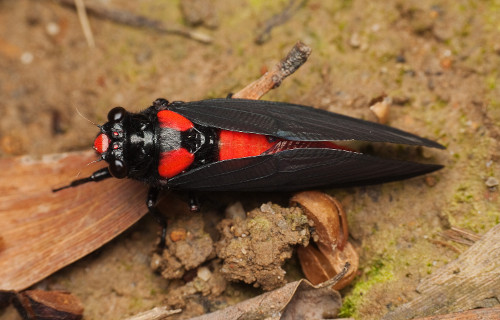
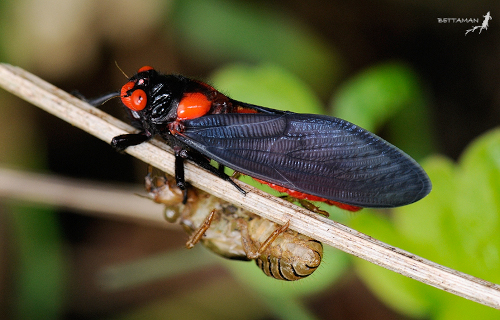
Yet, it’s undeniably the coloring of the fabulous Black and scarlet Cicada that garners the most appreciation. The very name for the impressive insect, in fact, describes this as a general principle. But, despite the name, the overall pattern isn’t quite as simple as the title itself implies.
As previously stated, the coloration of the versions of this product of evolution can vary, but it commonly has a combination of hues such as green, brown, yellow, orange, black, and even a speckled patterning. Additionally, its wings also sometimes display translucent areas.
The large head of the natural wonder, meanwhile, typically features extremely prominent compound eyes and short antennae. Its thorax and abdomen also develop as relatively large, containing muscles necessary for producing the buzzing sound that cicadas are known for.
- Kingdom: Animalia
- Phylum: Arthropoda
- Class: Insecta
- Order: Hemiptera
- Family: Cicadidae
- Genus: Huechys
- Species: H. sanguinea
CCL: https://tinyurl.com/462rnnjn
5 Beautiful Insects of Borneo
We truly hope that each of you enjoyed reading, and hopefully learning from, this article we’ve written for you about these 5 Beautiful Insects of Borneo. It’s also our fervent hope that doing so has left you with either a new or fully renewed appreciation for such remarkble wonders of Nature.
Unfortunately, however, many of their numerous kindred around the world now find themselves facing strong threats to their continued existence as a species. Many of those dangers, in fact, stem from the actions of mankind. We must do all that we can to protect and preserve them all.
Check out our other articles on 5 Sensational Salamanders, Earth’s Amazingly Abundant Avians, 5 Magnificent Reptiles of Mexico, Africa’s Many Geological Masterpieces

Leave a Reply