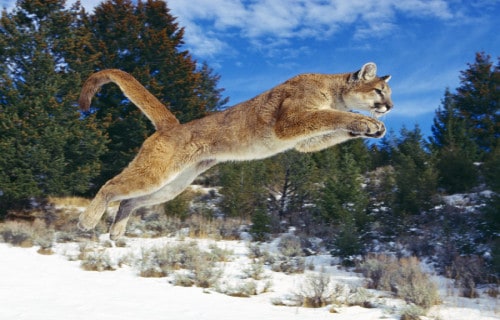
We hope that each of you, our readers, will greatly enjoy and fully appreciate this article we present about these 5 Captivating North American Wildcats. It was certainly our sincere pleasure to gather the various information for you. May it provide you with both education and increased awareness.
Certainly, these few creatures listed herein represent only a very small portion of the similar species found in this region. It’s our belief, though, that they collectively serve as excellent representations of the members of this Class. Check out some of our other articles for similar marvels.
Ocelot
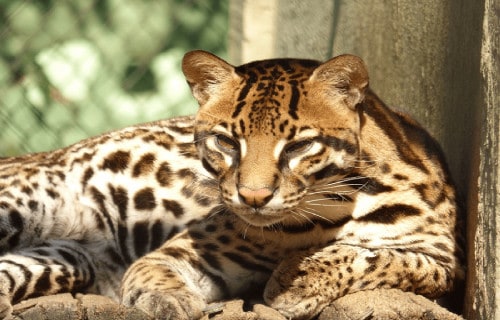
Ocelot Facts
- Starting off this article about these 5 Captivating North American Wildcats we present to you the beautiful creature known simply as the Ocelot.
- Perhaps most notably, the short term used here serves as the generally accepted common name of a truly stunning species of wildcat. The animal does have a few other general titles, though. These include Painted Leopard, Dwarf Leopard, McKenney’s Wildcat, and Tiger Cat.
- Within the scientific community, though, it’s perhaps better known by its technical designation. Unlike most such terms, however, it’s at least relatively simple for the layperson to pronounce. That’s because the amazing mammal holds the formal tag Leopardus pardalis.
- It received that comparatively simple official epithet due to the efforts of Carl Linaeus himself. The highly esteemed Swedish zoologist accomplished the first official recognition of it as a separate and distinct species. He achieved that scientifically noteworthy feat in the year 1758.
- Quite sadly, in the not so distant past, mankind widely hunted the magnificent animal for its pelt, which humans regarded as highly valuable. Thankfully, due to a more enlightened government, authorities banned this practice decades ago throughout its endemic territory.
- In an extremely pleasant twist of fate, while most wildcats see their numbers dwindling rapidly, the beautiful Ocelot stands somewhat apart. That’s because the creature holds the distinction of being one of the few wild felines that the IUCN currently lists as a Species of Least Concern.
- Previously, however, the stunning feline held the status of Endangered, until the year 1996. But, due to numerous concerted efforts at protecting the creature, its numbers managed to bounce back significantly. Now, though, it faces the potential threat posed by climate change.
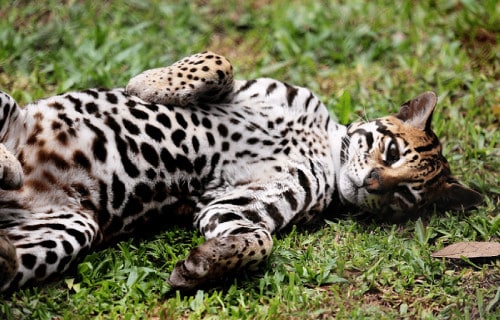
Ocelot Physical Description
The fabulous Ocelot rarely fails to capture the interest and attention of those individuals fortunate enough to encounter one, especially in the wild. The wonder typically does so, however, due more to its beauty than sheer size. In that respect, it’s only of relatively moderate dimensions.
Concerning its overall appearance, it also follows a pattern common among many mammals, including its kindred. That’s the fact that it displays a certain amount of the physiological characteristic of sexual dimorphism. In its case, though, this only manifests to a moderate degree.
Females of the species attain a smaller average size than males. These rarely weigh as much as 25 lb (11.3 kg). The males, meanwhile, reach a weight of up to 34 lb (15 .5 kg). Both sexes nonetheless attain approximately the same average overall body length of between 22 – 39 in (55 – 100 cm).
That makes the magnificent species significantly smaller in size than most, but not all, wildcats. Nature’s not done with it, however. That’s true since the moderately impressive tail adds an additional 10 – 16 in (25.5 – 41 cm) to the total length of the feline. It also serves to add to its beauty.
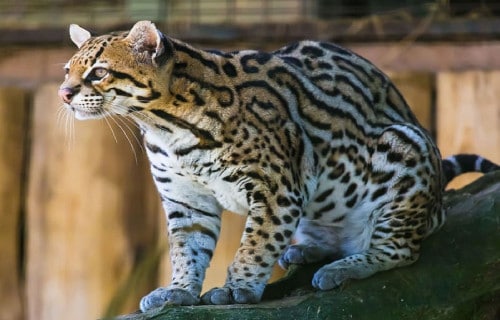
In color, the fur of the gorgeous Ocelot also garners attention. This displays predominantly a tawny yellow with numerous black markings. Not to be outdone, the neck and belly display a white coloring. Meanwhile, its fur usually remains short on the belly but slightly longer on the back.
Yet, its distinctiveness does not simply end there. Further adding to its visual appeal, the small ears usually remain rounded. These also display a prominent white spot, creating a rather dramatic effect. The eyes most commonly show a brown color that reflects patterns of gold in bright light.
- Kingdom: Animalia
- Phylum: Chordata
- Class: Mammalia
- Order: Carnivora
- Family: Felidae
- Genus: Leopardus
- Species: L. paradis
CCL: https://bit.ly/1ryPA8o
Ocelot Distribution, Habitat, and Ecology
The breathtaking Ocelot apparently evolved as indigenous to a surprisingly extensive portion of the surface of the earth. Given its nature, though, the location of this zone of habitation won’t surprise many people. It’s range includes portions of North America, Central America and South America.
The mesmerizing product of natural evolution doesn’t appear within every part of these regions, though. It’s not known to live in Canada. The animal’s territory extends from Texas, in the United States, through Central America, and to all but the most southerly parts of South America.
Regrettably, population densities for the creature also vary somewhat widely throughout the entirety of that range. However, the highest known density seems to occur in the nation of Panama. In all areas, though, this particular animal inhabits an impressively wide range of habitats.
This flexibility seemingly contributed to the rebounding of its numbers from just a few decades ago. Its favored habitat types include such regions as rainforests, scrublands, mangrove forests, and even coastal marshes. It also prefers lower elevations, but some occur as high as 9,843 ft (3,000 m).
Like all of its known kindred, the breathtaking Ocelot also evolved to have an entirely carnivorous diet. Given its specific habitat preferences, and its own size, its primary prey consists of smaller creatures. Thankfully, however, its native range continues to have an abundance of these.
Those include such highly varied species as rabbits, rodents, fish, birds, opossums, armadillos, and occasionally small reptiles and sometimes even insects. Hunting activities typically occur during the evening and at night, but do sometimes take place during the day when necessary.
Kodkod
CCL: https://bit.ly/3AqJ7UY
Kodkod Facts
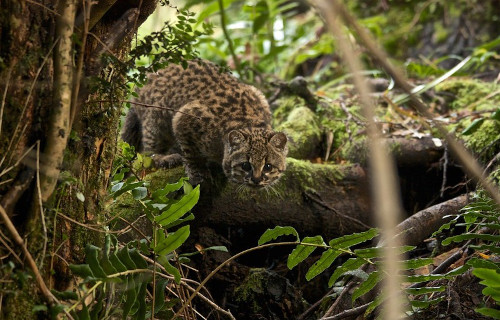
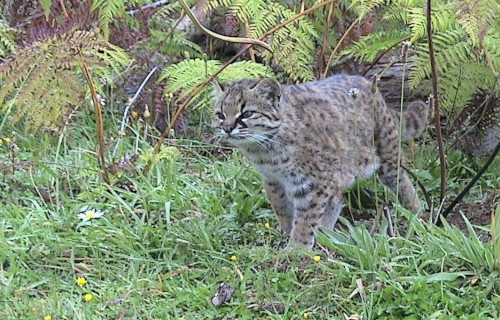
- Next up in this compilation of 5 Captivatin North American Wildcats comes another smaller, but no less beautiful example, the Kodkod.
- This intriguing creation of Nature and evolution most frequently goes by this surprisingly simple designation across its known native range. Yet, the remarkable feline’s also known by several others, including Guigna, Chilean cat, Little tiger cat, and Huemul cat.
- Within the scientific community, however, it’s generally better known by its technical title. Fortunately, that’s one that’s comparatively simple for the layperson to pronounce. That’s because the beautiful creature holds the formal epithet of Leopardus guigna.
- This small yet impressive animal received that appellation due to the efforts of Juan Ignacio Molina. The respected Spanish-Chilean naturalist recorded the first recognition of it as a separate and distinct species. He accomplished that noteworthy deed in the year 1782.
- Ensuing research additionally led to more fascinating discoveries related to the marvelous mammal. To date, a total of two recognized subspecies also exist. These even share the same general territory as the parent species. This frequently leads to confusion in identification.
- Sadly, the IUCN indicates that the animal’s population now numbers less than 10,000 known individuals. Combining this number with its unfortunately limited habitat range, it thus has the classification of Vulnerable on the organization’s Red List of Threatened Species.
- The stunning creation of Nature currently faces numerous threats to its continued existence as a species. Many stem from the actions of man, including climate change and habitat loss due to deforestation. It’s also often killed by local inhabitants for hunting their livestock.
CCL: https://bit.ly/3yynC41
Kodkod Physical Description
The captivating Kodkod rarely fails to do exactly that with those who encounter it, namely captivating them. The animal generally does so, though, due more to its appearance than sheer physical size. That’s true since, compared to most other wild cats, it’s actually quite diminutive.
Like many of its relatives, it also presents a certain degree of the physiological characteristic of sexual dimorphism. Continuing to follow the pattern established by its kindred, both wild and domesticated, this trait manifests itself in several ways. All of them, however, remain rather subtle.
Males of the species attain both a slightly greater average body mass and length than their female counterparts. This gender reaches a mean body weight of approximately 4.8 – 5.5 lbs (2.2 – 2.5 kg). Females, though, typically only range in mass from roughly 3.3 – 4.4 lbs (1.5 – 2.0 kg).
The sex-based differences also present themselves in regard to other aspects of the body. At the shoulder, both sexes average about 9.8 in (25 cm) in height. Overall, the head-and-body length averages 15 – 20 in (37 – 51 cm). The tail, meanwhile, extends between 7.9 – 9.8 in (20 – 25 cm).
While short, the tail of this mesmerizing small wildcat nevertheless grows comparatively thick in size. Somewhat distinctively, the lovely feline additionally evolved a relatively small head. Contrasting this, though, its feet rank as comparatively large in proportion to the rest of the body.
The beautiful Kodkod possesses a distinctive coat coloration that helps it blend into its forest habitat. This, at least, remains the same for both genders. The primary color of the coat ranges from dark yellow to grayish brown. Some individuals nonetheless present a more reddish hue.
It’s also covered in small, dark black spots, which evolution often arranges in rows along the body. The underside usually shows lighter in color, often pale or whitish. The tail’s ringed with multiple dark bands and ends in a black tip. On its face, dark streaks run from the eyes down the face.
- Kingdom: Animalia
- Phylum: Chordata
- Class: Mammalia
- Order: Carnivora
- Family: Felidae
- Genus: Leopardus
- Species: L. guigna
CCL: https://bit.ly/3AqJ7UY
Kodkod Distribution, Habitat, and Ecology
The fabulous Kodkod, sadly, evolved as indigenous to a somewhat limited portion of the surface of the earth. Where that native range lies, however, likely won’t surprise many of our readers. That’s because it developed as native to a restricted section of the continent of South America.
There, the distinctive product of natural selection’s only known to be present in areas lying within the boundaries of two nations. These locales consist of the countries of Chile and Argentina. Yet even within this greater range, the feline only appears in certain portions of the larger region.
In Chile, it’s found from the central sections down to southern Patagonia. That range includes the magnificent Andes Mountains and coastal forests. In Argentina, it’s only known to exist in the Andean foothills in the west, primarily in the provinces of Neuquén, Río Negro, and Chubut.
Thankfully, evolution provided it with a reasonable degree of flexibilty regarding its choice of habitat. Nevertheless, the mammal still demonstrates certain preferences. Accordingly, the majority of its known population resides within regions consisting of dense temperate rainforests.
That holds especially true of both the Valdivian and Patagonian forests. Yet, smaller but still stable population concentrations also appear in other types of habitat. These include scrublands and secondary forests. It’s even on occasion found in close proximity to small human settlements.
That adaptability doesn’t simply end there, however. That’s due to the observed fact that various concentrations of the animal reside at a wide range of altitudes, as well. It’s present in varying numbers from sea level up to roughly 8,200 ft (2,500 m), though less commonly at that height.
The Kodkod represents an elusive wild cat that plays a surprisingly crucial role in the various ecosystems it inhabits. Like its relatives, it’s carnivorous in nature. It’s also primarily opportunistic in its feeding habits. As a rule, it mainly hunts at night and twilight, being nocturnal and crepuscular.
Given its own size, it typically hunts smaller prey. These include such dietary sources as numerous species of rodents, marsupials, small birds, lizards, and invertebrates. The highly evolved hunter’s also an extremely skilled tree climber, often ambushing prey from above or using trees for escape.
It lives a principally solitary existence, again following a pattern common among its many relations. The animal’s also territorial, with males usually having larger territories than females. It faces its own share of natural predators, including large birds of prey, such as eagles and owls, and cougars.
Cougar
Cougar Facts
- Now appearing in this gathering of these 5 Captivating North American Wildcats comes the stunningly elegant animal called the Cougar.
- This simple term easily serves as the most frequently used common name when referring to this magnificent wild feline. It does have numerous others, though. These include mountain lion, puma, painter, panther, and catamount. The variety of names occur due to its wide range.
- Inside of scientific circles, however, it’s better known by its technical appellation. Thankfully, that’s one that’s actually surprisingly simple for the layperson to pronounce. That’s true given the fact that the marvel of Nature and evolution holds the formal tag of Puma concolor.
- It received that moniker due to the efforts of the esteemed Swedish zoologist, Carl Linnaeus. That renowned researcher accomplished the first acknowledged recognition of it as a separate and distinct species. He achieved that feat in 1771. The name he chose later changed.
- Regardless of which of these one chooses to employ, it stands out in the minds of many scientists for several reasons. Though not technically one of the so-called big cats, it’s the fourth largest of all known wild felines. It’s also the most widespread of any in its Hemisphere.
- Though its population numbers don’t compare to where they stood in the past, the Cougar nonetheless appears to be maintaining a measure of stability. That pleasant fact also seems to hold true across its range. The IUCN therefore currently lists it as Least Concern.
- It nevertheless still faces numerous potential threats to its continued existence as a species. Like most forms of life remaining on earth today, most of these perils stem from the actions of mankind. They include the related dangers of habitat loss and ongoing climate change.
Cougar Physical Description
The breathtaking Cougar immediately grabs the attention of virtually everyone who encounters the impressive creature. Unlike some animals, though, this occurs due to a variety of reasons. That’s because it typically mesmerizes viewers with both its sheer beauty and surprising measurements.
In both regards, it follows the pattern common among many mammals, including felines. That’s due to the fact that it displays a certain degree of the physiological characteristic of sexual dimorphism. Where this wildcat’s concerned, however, that trait manifests itself in terms of sheer size.
Again mimicking its many relatives, males of the species attain slightly greater statistics. That holds true in all categories. It must nevertheless be pointed out that, even within the same gender, mature adults vary significantly in each of these, due to a combination of factors, such as environment.
In general, however, it’s in the length that the gender-based difference appears the most readily apparent. Males reach a mean nose-to-tail length equaling approximately 7.9 ft (2.4 m). Females of the creature, however, generally reach an overall length only equaling about 6.7 ft (2.05 m).
Like all cats, it also possesses a long, slender tail. This appendages comprises an average 25 – 37 in (63 -95 cm) of the total length of the animal. It also forms another minor sex-based difference. The tail of males tend to measure on the higher end of this range, compared to the females.
A final example of sexually dismorphic traits appears in the body mass of the feline. The males generally attain a much greater weight than their female counterparts. For him, this usually ranges between 115 – 220 lb (53 – 100 kg). Females, though, typically weigh from 64 – 141 lb (29 – 64 kg).
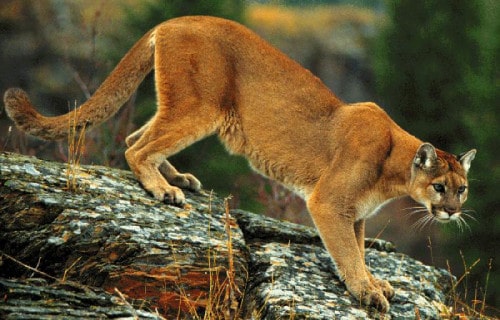
The Cougar also boasts other impressive statistics, shared equally. Its rounded head displays erect ears. The feline has a jaw and forequarters powerful enough to grasp large prey. It also has five retractable claws on the forepaws, and proportionately the largest hindlegs in the cat family.
Its coloring also merits notice. The fur develops as short and sleek in nature. In coloring, the upper body presents as tan or light brown to reddish-brown. The stomach, though, shows shades of cream or white. Black markings also appear on the tips of the tail and ears, and on the muzzle.
- Kingdom: Animalia
- Phylum: Chordata
- Class: Mammalia
- Order: Carnivora
- Family: Felidae
- Genus: Puma
- Species: P. concolor
Cougar Distribution, Habitat, and Ecology
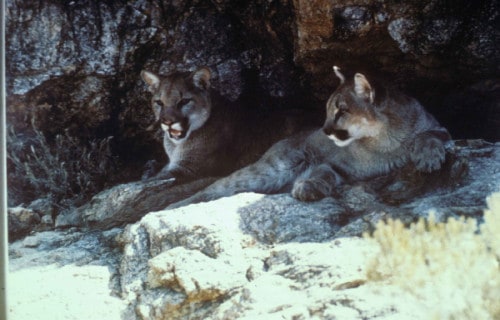
The fascinating Cougar evolved as endemic to an impressively broad swathe of the earth’s surface. The full extent of that range rarely fails to surprise most who learn of it. That impressively large native zone of habitation actually extends from parts of Canada to the Andes in South America.
The greatest concentration of its population, though, falls within the boundaries of North America. The smaller section of that territory consists of the northwestern part of Canada. Most of its numbers in North America reside in the western third of the United States, with a few exceptions.
Aiding in its continued existence as a species comes the fact that it evolved as a highly adaptable creature. This flexibility allows it to inhabit a wide variety of habitat types within its native range. Most notably, though, these include forests, lowlands, mountains, and arid climates.
Its incredible physique also allows the impressive feline some of the greatest leaping and short-sprint ability of any extant animal. Individuals have the ability to jump as high as 18 ft (5.5 m) in one bound. These cats also evolved the capacity to leap as far as 40-45 ft (12-14 m) horizontally.
But Nature did not simply stop there. This daunting animal also boasts some extremely impressive speeds. The top measured running velocity of the animal ranges between 40-50 mph (64-80 kph). It remains, however, best capable of short, powerful sprints as opposed to long chases.
The remarkable Cougar feeds entirely as a carnivore, like its relations. As a supremely successful generalist predator, the mammal understandably feeds opportunistically. Specimens therefore eat any animal they can manage to catch, from insects to large ungulates in excess of 1,100 lbs (500 kg).
Investigations in Yellowstone National Park showed that elk, followed by mule deer, seem to represent the animal’s primary targets. The mammal even evolved as highly adept at climbing, allowing it to evade canine competitors. Although not strongly associated with water, it does swim.
CCL: https://bit.ly/1jxQJMa
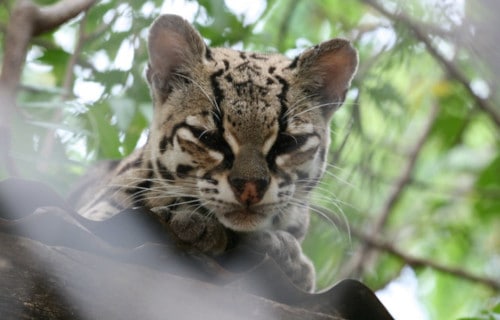
Margay Facts
- Our next choice to appear in this compendium of 5 Captivating North American Wildcats once again holds a deceptively short title, the Margay.
- That deceptively unprepossessing short term serves as the most frequently used common name for a truly stunning species of wildcat. The animal does hold other general titles, though. These include Tiger cat, Tigrillo in Spanish, Caucel, and the confusing Little ocelot.
- Inside of the scientific world, however, it’s probably more often known by its technical moniker. As such epithets go, though, it’s comparatively simple for the layperson to pronounce. That’s because the marvel of Nature and evolution bears the official name Leopardus wiedii.
- It received that appellation due to the efforts of Heinrich Rudolf Schinz. That highly respected Swiss naturalist accomplished the first formally recorded recognition of it as a separate and distinct species. He achieved that scientifically noteworthy deed in the year 1821.
- This highly evolved cat has distinctive attributes belied by its seemingly simple outward nature. For this reason, many researchers consider it a fascinating product of evolution. Among these factors lies the fact that scattered reports indicate it imitates the calls of prey to lure them in!
- The Margay now finds itself in a precarious position. Horrendously, some people in its native range still slaughter an average of 14,000 of them each year for their fur. Partly due to the population loss derived from this, the IUCN lists the marvelous Margay as Near Threatened.
- Yet, it also faces numerous other potential threats to its continued existence as a species. In this, it deals with the same dangers as all other forms of life on earth today. Most of those perils stem from the actions of man. They include the issues of habitat loss and climate change.
Margay Physical Description
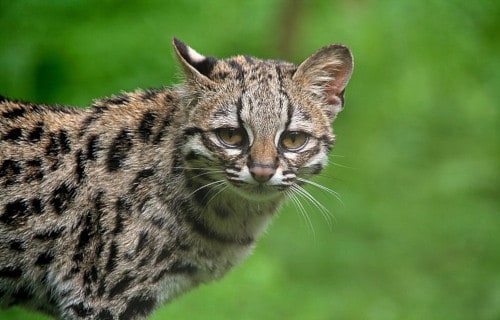
Like many of its relatives, the gorgeous Margay generally instantly captivates those individuals fortunate enough to encounter one. That’s especially true if that meeting takes place in the wild. Unlike some of those same kin, however, it rarely grabs one’s attention due to physical dimensions.
It’s actually smaller than many other wildcats. The stunning creature also displays a certain degree of the phsyiological characteristic of sexual dimorphism. In its spcific case, though, that trait manifests itself in terms of pure physical size. Even then, gender-based differences remain minor.
This principally appears in terms of body mass, and related shape. Males of the species typically attain marginally greater weights than their female counterparts. That sex averages 7.7 – 8.8 lb (3.5 – 4 kg). Females, meanwhile, usually range from somewhere between 5.7 – 7.7 lb (2.6 – 3.5 kg).
Specimens of both sexes develop the same approximate range of body length. This varies widely, ranging from 19 – 31 in (48 – 79 cm). Given the tendency to have the roughly the same length, but different masses, males typically present a moderately stockier build than that of the females.
One feature that quickly gains notice is the tail of the animal. The range in length of this remains the same for both genders, a surprising 13 – 20 in (33 – 51 cm). Astonishingly, that represents roughly 70% as long as the body of the creature itself! That’s far longer than average for wild felines.
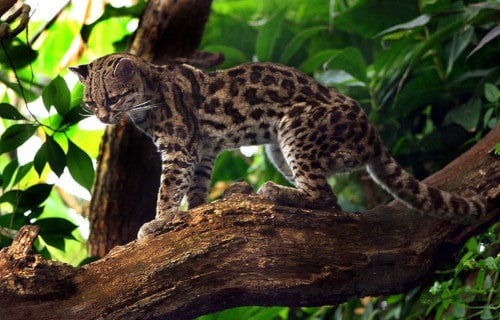
Its fur also displays a distinctive pattern. This usually displays as golden-brown to grayish, with a white underbelly. Dark rosettes and streaks appear on the body, with stripes on the tail and legs. Large eyes with dark rings around them and distinctive white markings also show above the eyes.
Yet, perhaps the most distinctive feature of the Margay remains the fact that it has a remarkable evolutionary adaptation in its ankles. These evolved to be so flexible that the cats actually has the ability to walk down a tree trunk headfirst. It’s one of only two known to possess this ability.
- Kingdom: Animalia
- Phylum: Chordata
- Class: Mammalia
- Order: Carnivora
- Family: Felidae
- Genus: Leopardus
- Species: L. wiedii
CCL: http://bit.ly/2IjEG4n
Margay Distribution, Habitat, and Ecology
The astounding Margay evolved as indigenous to a lamentably small section of the surface of the earth. Exactly where that zone of habitation lies might surprise a few people, though. It developed as native to a limited portion of sections of North America, Central America, and South America.
Sadly, however, it seems to now be extinct inside the United States. There, evidence indicates that it once ranged as far north as the states of Georgia and Florida. Today, the amazing mammal’s only known presence on that continent lies within the borders of the nation of Mexico.
In Central America, however, it’s spotted in Belize, Guatemala, Honduras, El Salvador, Nicaragua, Costa Rica, and Panama. In the southern portion of its territorial range, the wonder of Nature’s present in Colombia, Venezuela, Ecuador, Peru, Bolivia, Brazil, Paraguay, and Argentina, at least.
One factor which perhaps limited its expansion is the fact that it demonstrates a clear and somewhat restrictive preference regarding its choice of habitat. In the broadest terms, it only thrives within the confines of dense forests in the parts of its range in which it makes its home.
The wildcat primarily resides in either rainforests, cloud forests, or dry forests in all regions. It also prefers mature, undisturbed forests, but shows the ability to adapt to secondary forests. It’s flexible about altitude, however. The animal appears at ranges from sea level up to 9,800 ft (3,000 m).
Not only did the awesome Margay evolve as carnivorous in terms of its diet, it’s also primarily arboreal in nature. In fact, unlike most of its countless relatives across the globe, the great majority of individuals often spend their entire lives within the canopy, rarely ever descending to the ground.
This does, however, along with its size, further limit is options in terms of food. Understandably, it thus preys on animals that share its locale. This mainly includes rats, mice, and squirrels. It will, on occasion, though, manage to catch small monkeys. It augments these with small birds and eggs.
The marvel breeds throughout the year, but mating typically peaks during the rainy season, when the availability of food is usually greater. Gestation typically requires 70 – 80 days. The young generally become fully independent of their mother sometime between the ages of 9 – 12 months.
Florida Panther
Florida Panther Facts
- Closing out this article about these 5 Captivating North American Mammals we give you the rarely encountered Florida Panther.
- This majestic product of Nature and evolution most commonly goes by the highly informative common name we’ve used herein. It also has several other general names, though. These include such similar terms as Florida cougar, Florida Puma, and Coast Rican puma.
- Among scientific professionals, however, it’s probably much better known by its formal moniker. That’s the rather different term of Puma concolor cougar. Regardless of the title one chooses to use when referring to it, it represents a severely threatened subspecies of cougar.
- The marvel of Nature received that technical name due to the efforts of the American zoologist, Outram Bangs. This researcher accomplished the first known acknowledgement of it as a separate and distinct species. That scientifically noteworthy action occurred in the year 1899.
- The magnificent mammal also represents the only known subspecies of cougar in the portion of the country it lives in. To the knowledge of wildlife experts, though, it only occupies 5% of its former range. Current estimates place its total population at just over 200 individuals.
- Given this sad clearly lamentable situation, the IUCN now lists the animal as Critically Endangered. That status is reflected on the organization’s Red List of Threatened Species. Incredibly, before protections existed, its numbers once dwindled to only 20 specimens.
- Because of its scant numbers and restricted range, it understandably continues to face numerous threats to its continued existence. Habitat loss due to human expansion obviously qualifies. Like most species on earth, though, it also now faces the perils of climate change.
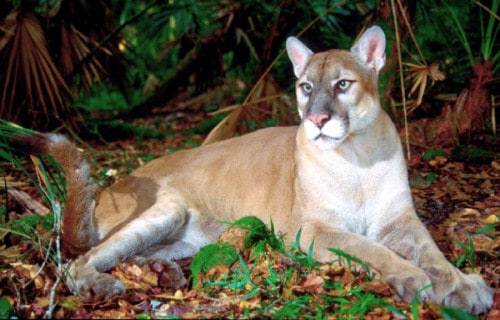
Public Domain Image
Florida Panther Physical Description
The magnificent Florida Panther immediately impresses anyone fortunate enough to view one, especially in the wild. Much like its close relatives, it does so due to a combination of factors. One’s its sheer size. Though certainly not quite as large as some wild felines, it’s nonetheless respectable.
Also following a pattern common to its many kin around the world, the animal shows a moderate degree of the physiological trait of sexual dimorphism. In its case, this natural trait manifests itself purely in terms of sheer size. In overall appearance, however, the genders appear the same.
Regarding those aforementioned physical dimensions, though, males most often attain larger growth than their female counterparts. These reach weights equaling up to a very respectable 159 lb (72 kg). The males also attain a known head-to-tail length that ranges from 5.9 – 7.2 ft (1.8 – 2.2 m).
Females of the species, meanwhile, generally reach moderately shorter lengths. This gendere also develops a somewhat more slender shape. This further reduces their mass in comparison with males. As a result, these usually reach a weight that ranges from between 64 – 100 lb (29 – 45.5 kg).
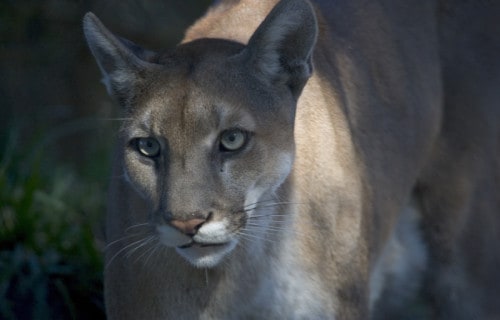
The sexes of the mesmerizing Florida Panther remain virtually indistinguishable based on patterns of color alone, however. Interestingly, at birth, both present a spotted pattern, and striking blue eyes. As these mature, though, the eyes change to a yellowish shade, while the spots disappear entirely.
Among mature adult specimens of the animal, the fur of the upper body takes on a very deep tan hue. The underbelly of the gorgeous mammal, though, usually manifests a creamy white shade in color. In contrast, extremely distinctive black markings manifest on the tips of the tail and ears.
- Kingdom: Animalia
- Phylum: Chordata
- Class: Mammalia
- Order: Carnivora
- Family: Felidae
- Genus: Puma
- Species: P. concolor
- Subspecies: P. c. couguar
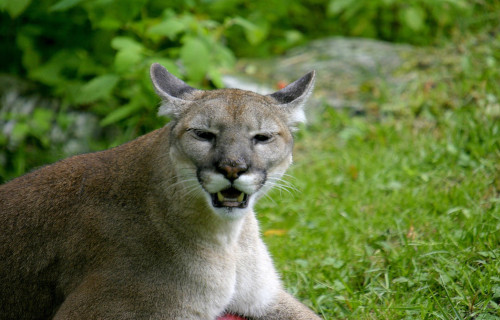
Photo: Everglades National Park
Public Domain Image
Florida Panther Distribution, Habitat, and Ecology
Sadly, the stunning Florida Panther evolved as indigenous to an extremely limited portion of the world. The exact location of that zone of habitation certainly won’t surprise anyone, though. That’s due to the simple fact that its very name provides a clear indication of where that range lies.
As indicated, it inhabits the area that now comprises the sate of Florida, in the United States, in North America. Yet even within this already severely restricted territory, it only inhabits a portion of its former range therein. That reduced region consists of the southeastern portion of the state.
Evidence does clearly indicate, however, that the wonder of the animal kingdom once possessed a respectably greater territorial range. It’s known to have once been present in at least 6 other states. Those consisted of Texas, Louisiana, Alabama, Mississippi, Georgia, and parts of South Carolina.
Like many wildcats, it displays decidedly strong and clear preferences pertaining to its choice of habitat. It’s also highly adapted to these. Today, its range consists almost exclusively of the swamps, forests, and grasslands of southern Florida, particularly the Everglades and Big Cypress Swamp.
Even in these areas it lives almost exclusively in only very specific ecosystems. These consist of regions of the rapidly vanishing tropical hardwood hammocks, pinelands, or mixed freshwater swamp forests. Luckily, much of the animal’s little remaining range now lies within protected areas.
Again following a pattern common to wild felines, each individual Florida Panther generally migrates through its territory. This movement mainly occurs during the day. Most specimens prefer to spend their days in wetlands, then move to grassland in the evening. It’s also mainly nocturnal.
Given its feline ancestry, it naturally evolved as purely carnivorous in nature. Its prey typically consists of a broad variety of smaller animals. It will, however, occasionally attack larger prey. These typically include such species as deer or wild boar. Alligators form its only known natural predator.
5 Captivating North American Wildcats
We hope that each of you thoroughly enjoyed reading, and hopefully learning from, this article we’ve written for you about these 5 Captivating North American Wildcats. It’s also our hope that doing so has left you with either a new or renewed appreciation for such wonders of Nature.
Unfortunately, however, many of their numerous kindred located around the world now find themselves facing strong threats to their continued existence as a species. Many of those dangers, in fact, stem from the actions of mankind. We must do all we can to protect and preserve them all.
Check out our other articles on 6 Stunning North American Bees, Earth’s Many Stunning Waterfalls, 3 Memorable Malaysian Herbaceous Plants, The Mighty Tornado, 5 Beautiful Birds of Venezuela

Leave a Reply