CCL: https://rb.gy/5ctin
We greatly hope that each of you, our readers, will fully enjoy and appreciate this article we present to you about these 5 Fabulous Insects of France. It was certainly our pleasure to compile the various information for you. May it serve to provide you with both education and increased awareness.
Of course, these few species listed herein represent only a tiny portion of the natural wonders found throughout the region, though. Yet, it’s our belief that they nevertheless serve as excellent representations of the wonders found here. Check out some of our other articles for similar marvels.
Lobster Moth
CCL: https://tinyurl.com/2t4n9kra
Lobster Moth Facts
- Starting off this article about these 5 Fabulous Insects of France we present you with the tanatalizing Lepidoptera known as the Lobster Moth.
- This rather surprising term represents the most frequently applied common name for this beautiful and intriguing Lepidoptera. Yet, the true marvel of Natue and evolution has a few alternate titles, too. Those include Lobster caterpillar, Fagi moth, and Lobster prominent.
- Inside of the halls of science, however, the creature’s perhaps much better known by its technical designation. Fortunately, that’s a comparatively simple one for the layperson to pronounce. That’s because the delicate wonder holds the short official moniker Stauropus fagi.
- The invertebrate received that specific epithet due to the efforts of Carl Linnaeus. The highly esteemed Swedish zoologist recorded the first formal acknowledgement of it as a separate and distinct species. He achieved that scientifically noteworthy deed in the year 1758.
- Thankfully, the appealing Lobster Moth appears to be maintaining a population base that’s both stable and sufficient. That pleasant state further seems to hold true throughout the entirety of its known range. The IUCN therefore does not currently show it on its Red List.
- This wondrous Arthropod nevertheless should be considered as facing at least several potential threats to its continued existence as a species. In this, the insect finds itself dealing with the same perils as all other forms of life on earth today. Most of those dangers are related.
- In fact, the vast majority of problems the species faces stem from the actions of mankind, either directly or indirectly. These include such problems as habitat loss and deforestation. Pollution, pesticide use, light pollution, and of course, the ongoing effects of climate change.

CCL: https://tinyurl.com/47nx44kt
Lobster Moth Physical Description
The captivating Lobster Moth typically fascinates those individuals fortunate enough to spot one of these wonders of Nature. Yet, the intriguing Lepidoptera does so for a combination of several reasons, unlike some others. Let us detail a few of the insect’s most remarkable natural attributes.
Regarding its physical appearance, it follows the pattern of development common among most of its many kindred around the world. That’s due to the fact that it displays a certain amount of the physiological characteristic of sexual dimorphism. Indeed, it does so in multiple ways.
Adults of the species attain wingspans averaging between 1.6 – 2.75 in (40 – 70 cm). The males of the species, however, generally remain on the lower end of this scale, while their female counterparts usually reach the greater spans. Exceptional specimens occur, but rarely exceed this greatly.
The overall body shape also catches one’s attention, given that it differs moderately between the genders. Most of the males generally remain both shorter and slimmer in nature. Females of the invertebrate, though, tend to be both longer and in possession of stockier, more robust bodies.
Nature didn’t simply stop there, however. The two sexes additionally distinguish themselves via the nature of their respective antennae. Those of males evolved to be fluffier, significantly thicker, and somewhat longer than the female’s. In that gender, these appendages remain thin and thread-like.
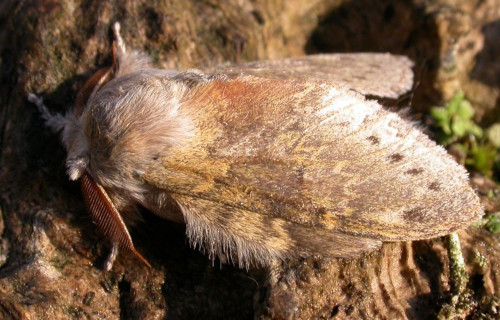
Yet, it’s the wings of the Lobster Moth that typically receive the most attention. The base color of the forewings consists of a mix of gray, brown, and sometimes reddish or ocher tones. These appear mottled and wavy, resembling tree bark. Dark streaks and subtle crosslines manifest, as well.
Meanwhile, its hindwings present a much lighter combination than the forewings. These often have a pale brown or grayish shade. Patterning appears significantly less, too. Nevertheless, markings similar to those on the other wings occasionally develop, though these usually remain fainter.
It’s the larval stage, however, that serves as the source of the most often used common name. This stage of the moth bears a striking resemblance to a lobster in the minds of many people. It has a wide body, legs that appear clawed, and even displays a pattern of color similar to the crustacean.
- Kingdom: Animalia
- Phylum: Arthropoda
- Class: Insecta
- Order: Lepidoptera
- Family: Notodontidae
- Genus: Stauropus
- Species: S. fagi
CCL: https://tinyurl.com/2t4n9kra
Lobster Moth Distribution, Habitat, and Ecology
The remarkable Lobster Moth evolved as indigenous to a unique portion of the surface of the earth. That true since its distribution simultaneously qualifies as both widespread yet specific. That slightly unusual zone of habitation covers a large section of Europe, and extends into parts of Asia.
Within the European part of its range, the stunning creature resides throughout much of Central and Western Europe. That habitation area mainly includes the nations of the UK, France, Germany, Spain, Italy, and Scandinavia. Smaller concentrations also live in other countries there, too.
Its numbers and groupings in Asia, though present, remains fewer, and more scattered. To date, the invertebrate’s known to be present in four countries. These include Russia, China, Japan, and Korea. It’s not currently known if this marvel of evolution lives in any other parts of the region.
Like many of its relatives, this species demonstrates a moderate degree of flexibility regarding its choice of habitat. It’s therefore found in a variety of different ecosystems. Each of these varying location nonetheless share certain basic environmental conditions that meet its specific needs.
The moth primarily prefers areas composed of deciduous woodlands. It’s most commonly found in beech woodlands but’s also occasionally spotted in forests with oak, birch, and other broadleaf trees. This intrepid Arthropod further thrives in similar forests, parks, and lightly wooded areas.
Since its larvae feed on the leaves of beech trees and other broadleaved trees, any type of forest where these exist in decent numbers suffices. Yet, it’s also frequently found in settings consisting of hedgerows and shrubby areas near forests, provided these are situated near its host plants.
Despite its relatively diminutive size, the fascinating Lobster Moth plays an interesting role in its local ecosystem. The larvae feed primarily on the leaves of deciduous trees, with a strong preference for beech, and sometimes oak and birch leaves. Adults, however, do not eat anything at all.
At that stage of their lives, these live only long enough to mate and lay eggs. These the female places on the underside of leaves, typically on beech or other broadleaved trees. Caterpillars hatch and begin feeding on the leaves. Adults emerge in late spring or early summer, and the cycle starts again.
Tree Bumblebee
CCL: https://tinyurl.com/462rnnjn
Tree Bumblebee Facts
- Next up in this compilation of 5 Fabulous Insects of Frances comes the only bee represented among the group, the Tree Bumblebee.
- This very beautiful Arthropod is most typically referred to by the common name we’ve used herein across the entirety of its native range. The small insect does have at least one other general title, though. That’s the somewhat intriguing term of new garden bumblebee.
- Inside of the scientific community, however, the delicate creature perhaps more frequently goes by yet another tag. Fortunately, that’s a relatively simple one for the layperson to pronounce, as such go. That’s because it holds the technical moniker Bombus hypnorum.
- The invertebrate received that specific designation due to the efforts of Carl Linnaeus himself. The highly esteemed Swedish researcher accomplished the first recognition of it as a separate and distinct species. He managed that scientifically noteworthy deed in the year 1758.
- It’s possibly most well known among entomologists due to one particular evolutionary pattern. The small animal generally chooses to inhabit regions that most others of its kind typically avoid. The bumblebee thus fills an environmental niche that would otherwise be vacant.
- Fortunately, the amazing Tree Bumblebee appears to be maintaining a population base that’s both stable and sufficient. That pleasant state also seems to hold true throughut its territory. The IUCN therefore presently lists it as Least Concern on its Red List of Thretened Species.
- The wonder of Nature nevertheless still faces several potential threats to its continued existence as a species. In this, it’s simply following a sad pattern now common to all life on this planet. It’s now facing the perils posed by habitat loss and ongoing climate change.
CCL: https://tinyurl.com/22y23f9m
Tree Bumblebee Physical Description
The remarkable Tree Bumblebee typically draws attention from those individuals fortunate enough to notice one in the wild. Like most of its kindred around the world, however, it usually does so for its appearance more than for size. Yet, in this manner, it distinguishes itself extremely well.
As with virtually all known bees, the insect displays a different type of the physiological characteristic known as sexual dimorphism. The species also evolved as divided into three castes. Queens develop as larger than males or workers. In fact, the difference is often quite noticeable.
The mighty queens of each colony achieve the greatest physical dimensions, by far. This trait varies, sometimes greatly, among individuals, though. But, overall, these average a total body length of approximately 0.63 – 0.87 in (1.6 – 2.2 cm). Though rare, some examples exceed even this.
Members of the worker class, however, generally evolved to remain much smaller. Individuals of this class only reach mean lengths measuring about 0.4 – 0.47 in (1.0 – 1.2 cm). Males, meanwhile, also vary in size, but generally achieve dimensions slightly greater than that of the workers.
Other differences serve to further distinguish the differing social castes of the amazing Tree Bumblebee. The males, for one, display a significantly chunkier shape than the others. Queens and drones, however, have sharper ends to their abdomens, as well as somewhat shorter antennae.
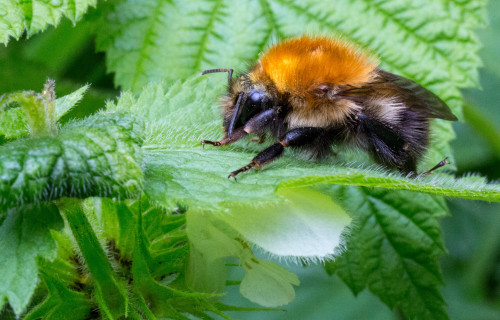
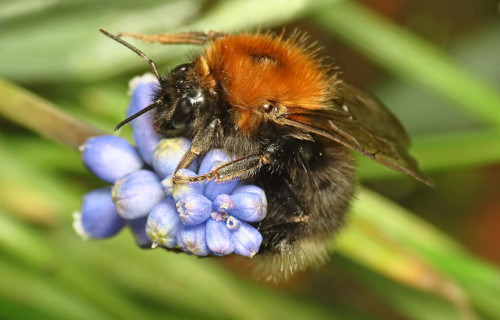
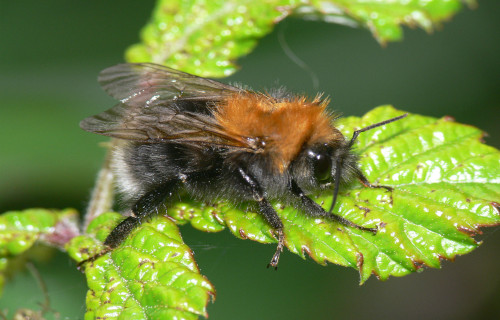
Yet, it’s the stunning coloring of this insect that usually most catches the eye. The thorax of the species presents a covering of hair with a gorgeous ginger shade. Its abdomen, though, displays black hair. But, that on the tail manifests a dazzling white hue, making for an amazing contrast.
- Kingdom: Animalia
- Phylum: Arthropoda
- Class: Insecta
- Order: Hymenoptera
- Family: Apidae
- Genus: Bombus
- Species: B. hypnorum
CCL: https://tinyurl.com/2dcehfvs
Tree Bumblebee Distribution, Habitat, and Ecology
The visually appealing Tree Bumblebee evolved as native to a relatively large expanse of the surface of the earth. The full extent of that zone of habitation, in fact, might surprise some people. That’s true since this natural wonder developed as endemic to most of Europe and northern Asia.
On the European continent, the biological marvel natively inhabits only the continental regions. That natural territorial range additionally reaches as far north as northern France. Elsewhere, though, the creature developed natively as far east as the Kamchatka Peninsula, in Russia.
The awesome product of evolution displays decidedly unique preferences regarding where it chooses to live. These habitat zones all lie within temperate climates, to be certain, however. Yet, within these conditions, the bumblebee makes its home in a range of truly surprising locations.
The bee most frequently appears in forests, usually deciduous one’s. In those regions where trees don’t appear in abundance, though, it tends to seek out an unusual alternative. In such settings, it resides in human residences! There, it makes its nest in almost any available hole it can find.
Workers of the amazing Tree Bumblebee forage for vital pollen and nectar. Once acquired, they return with this to the nest. Intriguingly, the species seems to be especially attracted to various plants with downward-facing blooms, like comfrey. Yet, it does also visit other plants as well.
It’s generally observed between the months of March and July, but sometimes does remain active for longer periods of time. Individuals are also extremely active, moving rapidly from plant to plant. Nest size always varies, of course, but rarely exceeds more than a few hundred individuals.
Mountain Apollo
CCL: https://rb.gy/5ctin
Mountain Apollo Facts
- Our next choice for inclusion in this listing of these 5 Fabulous Insects of France is the stunningly beautiful creature named the Mountain Apollo.
- This gorgeous creation of Nature and evolution most frequently goes by this descriptive common name across its range. The insect does have another, very similar general title that it’s known by, however. That’s the apt, if less imaginative, term of the Apollo Butterfly.
- Within the scientific community, though, it’s much more typically referred to by its technical title. Thankfully, that’s a comparatively simple term for the layperson to pronounce. That’s true since it presently holds the formal moniker in the annals of science of Parnassius Apollo.
- It received that easy to pronounce name due to the efforts of the esteemed Carl Linnaeus. The highly respected Swedish zoologist and botanist accomplished the first recognition of it as a separate and distinct species. That scientifically noteworthy event occurred in 1758.
- The charming invertebrate holds that name in keeping with the practice among entomologists of naming species after deities. In its case, it’s named for the mythological Greek god. It stands out among its many relatives due to the existence of more than 20 known subspecies!
- The magnificent Mountain Apollo itself seems to be maintaining a population base that’s both stable and sufficient. That fortunate fact also appears to hold true throughout the entirety of its native range. The IUCN thus lists it as Least Concern on itd Red List of Threatened Species.
- The remarkable creature nevertheless faces at least some potential threats to its continued existence as a species. Most of these it shares with the majority of other species. Most also stem from the actions of humans. They include the perils of habitat loss and climate change.
CCL: https://rb.gy/vodf0
Mountain Apollo Physical Description
The amazing Mountain Apollo garners a great deal of attention from its observers, and deservedly so. Yet that’s not just due to its scientific interest. It’s also quite popular for its sheer beauty. Not content to rely on that alone, however, Nature also blessed it with some respectable dimensions.
Like many Lepidoptera around the world, this gorgeous marvel of the insect world displays a certain degree of the physiological characteristic of sexual dimorphism. In its specific case, though, this trait manifests itself in terms of simple size. More precisely, females attain a slightly larger size.
Males of the species attain an average wingspan measuring approximately 2.4 – 3.4 in (6.2 – 8.6 cm). Their female counterparts, however, reach sizes ranging from roughly 2.6 – 3.7 in (6.5 – 9.5 cm). Exceptional specimens nevertheless do sometimes occur, of course, regardless of their gender.
That tendency to vary in overall appearance also extends to their color patterns, as well. Known as polymorphism, this trait therefore varies between individuals, wholly independent of their gender. It also occurs in larger groupings, mainly depending upon their precise geographical location.
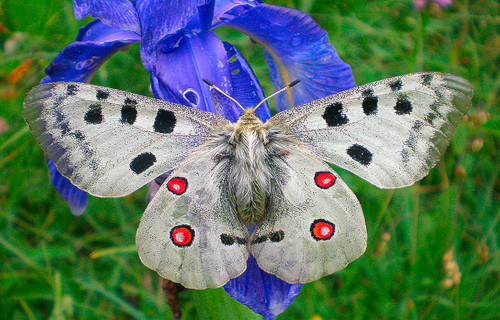
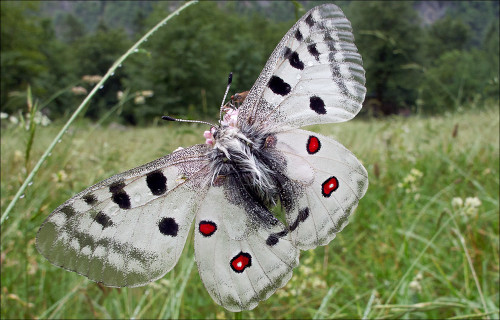
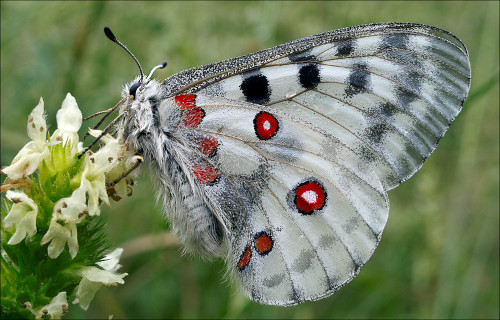
In general, however, both sexes of the Mountain Apollo present the same patterns of color. The wings display a background of white. Intriguingly, along the edges of all wings this appears almost translucent. From there, however, the pattern of coloration changes quite dramatically.
That’s because the forewings of the wonder each display five large, black eyespots. Two additional such spots appear on the hindwings. They usually develop as bright red, but sometimes show as orange. These also vary in size and exact form between individuals of the amazing species.
- Kingdom: Animalia
- Phylum: Arthropoda
- Class: Insecta
- Oder: Lepidoptera
- Family: Papilionidae
- Genus: Parnassius
- Species: P. apollo
CCL: https://rb.gy/p1lhz
Mountain Apollo Distribution, Habitat, and Ecology
The dazzling Mountain Apollo evolved as native to a comparatively wide expanse of the surface of the globe. The precise location of that range might surprise some people, though. That’s true since the amazing Arthropod appears throughout much of Europe and a small part of Asia.
In Europe, it’s known from Scandinavia, through the central part of the continent, to Spain. The insect also makes its presence felt in such regions as parts of the Balkans, northern Greece, and parts of Italy and France. But the insect also lives within a few select sections of central Asia.
The truly lovely Lepidoptera also evolved decidedly strong and clear preferences in terms of its choice of habitat. Due to this characteristic, the great majority of populations dwell in mountainous areas, thus the name. It apears at altitudes ranging from 1,300 ft (400 m) to 7,500 ft (2,300 m).
Its choices also serve to distinguish the stunning invertebrate from its many related species, due to their inhospitable nature. Individuals typically choose to live in largely stony and rocky areas. This creation of Nature does, however, sometimes appear in alpine meadows and pastures.
Adult specimens of the Mountain Apollo generally fly between the months of May and September. That exact timeframe varies somewhat, though, depending on the exact region and altitude at which the individuals appear. These feed on the nectar of a wide variety of local flowering plants.
After mating, the females of the species lay their eggs before winter, and in a wide variety of locations. In spring, these hatch into the caterpillar form. These subsequently feed voraciously on locally common flora. In most parts of its range, the creature typically has a single brood per year.
Spiked Magician
CCL: https://rb.gy/ohror
Spiked Magician Facts
- Now appearing in this compendium of 5 Fabulous Insects of France comes the dynamic work of Nature known as the Spiked Magician.
- This unquestionably attention-grabbing term serves as the most frequently used common name for this intriguing insect. The creature does have at least one other general title that it’s known by, though. That’s the somewhat surprising appellation of Predatory Bush Cricket.
- Inside of scientific circles, though, it’s perhaps much better known by its entirely formal moniker. Thankfully, that’s a much easier designation for the average layperson to pronounce than most. That’s because the invertebrate holds the short formal epithet of Saga pedo.
- It received that simple label due to the efforts of Peter Simon Pallas. The highly respected Prussian zoologist accomplished the first formal acknowledgement of it as a separate and distinct species. He managed that scientifically noteworthy deed back in the year 1771.
- Sadly, the population base of the Spiked Magician appears to be dwindling. That sad situation additionally seems to hold true throughout the entirety of its range. The IUCN therefore presently lists the creature as Vulnerable on its Red List of Threatened Species.
- It now faces multiple threats to its continued existence as a species. Like many forms of life today, most of these stem from the actions of mankind. Its perils include habitat loss and the dangers of pesticide use. It must also now deal with the ongoing effects of climate change.
CCL: https://rb.gy/b59wc
Spiked Magician Physical Description
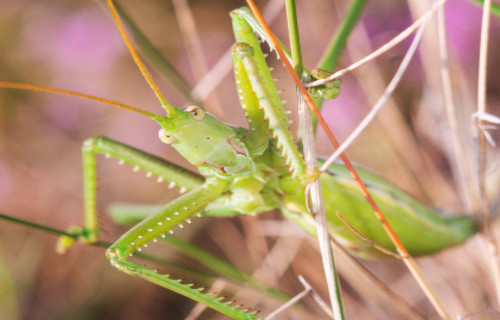
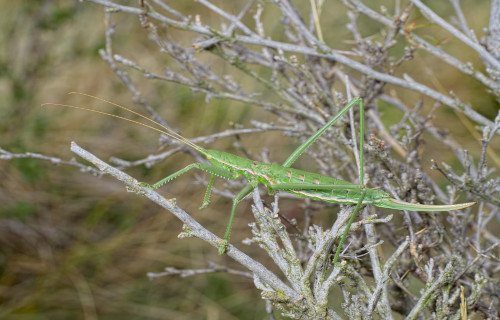
The Spiked Magician immediately captures the full attention of those individuals fortunate enough to encounter it in the wild. Yet it does so for several reasons. It has a noteworthy appearance, to be sure. But it’s likely best known for the sheer physical size that individuals of the species reach.
Unlike many types of insects on earth, though, this wonder actually displays no noticeable degree of the physiological characteristic of sexual dimorphism. Distinguishing the genders with only a casual observation thus frequently challenges all but the most experienced observers of the species.
Specimens of both sexes of the species usually attain an impressive overall length that measures approximately 4.1 in (10.5 cm). That alone makes it one of the longest members of its Order on earth. Yet exceptional examples sometimes occur, reaching lengths of 4.7 in (12 cm).
These measurements include the ovipositor, though, of course. The head and body length itself typically measures a mean stretch of 2.0 – 2.8 in (5 – 7 cm). Those highly exceptional individuals mentioned previously, meanwhile, sometimes reach 3.1 in (7.8 cm) in this specific regard.
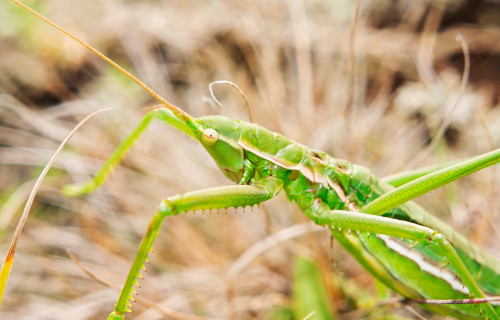
In coloring, the marvelous Spiked Magician generally presents various combinations of different shades of brown and green. This mixture of shades usually presents as slightly darker on the upper side of the body, and lighter on the under side. These amazing creatures also possess no wings.
- Kingdom: Animalia
- Phylum: Arthropoda
- Class: Insecta
- Order: Orthoptera
- Family: Tettigoniidae
- Genus: Saga
- Species: S. pedo
CCL: https://shorturl.at/epzP3
Spiked Magician Distribution, Habitat, and Ecology
The amazing Spiked Magician evolved as native to a considerable expanse of the surface of the globe. The full extent and nature of that zone of habitation might surprise some people, though. That’s true since it developed as endemic to roughly half of Europe and west and central Asia.
In Europe, it appears as far south as northern Greece, Italy, and the Iberian Peninsula. Northerly, it shows up as far away as both Ukraine and Slovakia. To the west, it also lives in such countries as Switzerland and France. The intrepid insect does not, however, live north of the Alpine region.
Meanwhile, in Asia, the remarkable invertebrate additionally makes its home as far south as southern sections of several countries. These locations include Armenia, Anatolia, Azerbaijan, and Turkmenistan, among others. Yet it also ranges as far north as Kurgan Oblast, in Russia.
Fortunately, this creation of Nature displays a moderate degree of adaptability in terms of its habitat preferences. Due to this flexibility, it makes its presence known within several different, albeit related, types of ecosystems. That’s a definite evolutionary advantage over its competitiors.
The Arthropod primarily dwells within one of three types of grassland biomes. Semi-natural dry grasslands with a chalky nature comprise one. Pseudo-steppe grasslands with the presence of dry grasses is another. The last one consists of similar areas in sub-Mediterranean areas.
The stunning Spiked Magician distinguishes itself from its kindred in yet another manner. While most grasshoppers developed as herbivores, this one actually feeds carnivorously! It mainly preys on other grasshoppers, crickets, and locusts. It nevertheless consumes other fare, as well.
These other victims of its voracious appetite include various types of similarly sized insects. Incredibly, these sometimes even include the usually deadly mantises, such as the European Mantis. On occasion, this extraordinary Orthoptera sometimes even consumes very small lizards.
Though technically active throughout the day, it’s principally so during the period of, and around, dusk. Its this time of the day that usually represents its preferred hunting time. Its own natural predators understandably include many birds, frogs, toads, larger lizards, and rodents.
European Mantis
European Mantis Facts
- Closing out this article about these 5 Fabulous Insects of France we present the aptly-named wonder best known as the European Mantis.
- Intriguingly, the term applied to it here serves as one of the common names of a particularly large variety of the amazing mantis. However, this extremely fascinating insect also goes by another term. That’s the other frequently used common name of the praying mantis.
- It’s perhaps also of interest that many people often employ the latter term for all types of mantises, regardless of origin. Meanwhile, the scientific name of this extremely impressive creature remains the relatively simple, for the layperon, to pronounce Mantis religiosa.
- Regardless of which term one chooses to use to refer to it, this species, like most of its numerous relatives, often fascinates many people. In point of fact, quite often, this species represents the archetype of all mantises, in the minds of individuals, when polled on the topic.
- Intriguingly, although not endemic to North America, this remarkable Arthropod eventually became introduced into that non-native region of the world. Although no proof currently exists, many experts believe this introduction occurred accidentally, via shipping containers.
- It’s also believed that this introduction, whether it took place accidentally or otherwise, occurred near the end of the 19th century. Regardless of how it occurred though, it has now spread incredibly. This has had a beneficial result for this marvel of Nature and evolution.
- Quite fortunately, the incredible European Mantis appears to be maintaining a population base that’s both stable and sufficient. This pleasant state further appears to be true across the majority of its range. This places it in the small group of species to make that claim.
- The IUCN, therefore, presently lists it as Least Concern on its published Red List. This status appears on the organization’s Red List of Threatened Species. Like many species, this animal nevertheless may be considered to be at risk, due to the effects of climate change.
European Mantis Physical Description
Although not the largest of all known mantids, the gorgeous European Mantis nevertheless stands out from the crowd in certain ways. In point of fact, it actually ranks as among the largest of all varieties. However, differences in physical sizes quite frequently occur among individuals.
Yet, this status also holds true due to a remarkably common trait. That’s the fact that this species, like most related creatures, displays a certain natural physiological tendency. This holds true since the insect shows a moderate degree of the physiological characteristic of sexual dimorphism.
In this variety, the females attain a greater length and weight than the male of the species. The female typically achieves a length averaging between 2.75 – 3.5 in (7 – 9 cm). On the other hand, in addition to a thinner shape, the male only reaches an average length of 2.4 – 2.75 in (6 – 7 cm).
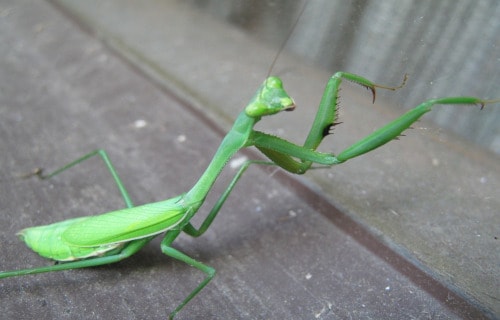
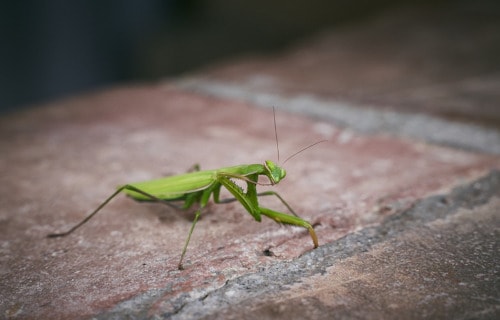
The coloring of the European Mantis also varies significantly among individuals. Gender plays no apparent role in this pattern, however. The subtle shades displayed by individuals also differ. The basic pattern consists of shades of brown, green, and yellow. A few display a dark black.
- Kingdom: Animalia
- Phylum: Arthropoda
- Class: Insecta
- Order: Mantodea
- Family: Mantidae
- Genus: Mantis
- Species: M. religiosa
European Mantis Distribution, Habitat, and Ecology
Although the stunning European Mantis, as the name indicates, originated in southern Europe, it now inhabits an extremely broad swathe of the world. In addition to areas to which the actions of man introduced it, the Arthropod also spread naturally to many other regions of the globe.
Due to that spreading, the marvel of biology now naturally inhabits much of the continents of Africa and Asia. Man also introduced it to the continent of Australia. Fortunately for it, therefore, this invertebrate displays a remarkable degree of adaptability in regards to its choice of habitat.
That holds true since it inhabits a notably wide range of ecosystems. These settings include such locations as temperate and tropical forests, urban areas, and even semi-arid regions. It does, however, prefer the area it appears in to have sufficient quantities of grass and herbaceous plants.
Not surprisingly, one reason for this preference occurs due to the need for a sufficient and steady food supply. The captivating European Mantis, like its many kindred, evolved as a powerful, carnivorous insect. The invertebrate also hunts its prey as a highly effective ambush predator.
This prey typically consists of several types of locally abundant insect species. These include such varied creatures as grasshoppers, crickets, moths, bees, and flies. Individuals of this wonder nonetheless also occasionally tackle significantly larger prey, such as smaller invertebrates.
CCL: https://rb.gy/vodf0
5 Fabulous Insects of France
We sincerely hope that each of you thoroughly enjoyed reading, and hopefully learning from, this article we’ve written about these 5 Fabulous Insects of France. It’s also our true hope that doing so has left you with either a new or renewed appreciation for such varied wonders of Nature.
Unfortunately, however, many of their numerous kindred found around the world now find themselves facing strong threats to their continued existence as a species. Many of those dangers, in fact, stem from the actions of mankind. We must do all we can to protect and preserve them all.
Check out or other articles on 5 Incredible Italian Herbaceous Plants, Earth’s Amazingly Abundant Avians, 7 Captivating United States Lakes, The Mighty Tornado, Africa’s Many Geological Masterpieces

Leave a Reply