


CCL: https://tinyurl.com/22y23f9m
We hope that each of you, our readers, will enjoy and appreciate this article we present to you about these 5 Incredible Invertebrates of Idaho. It was our very great pleasure to compile the various information for you. May it serve to provide you with both education and increased awareness.
Certainly, these few species listed within this article represent only a portion of the similar marvels in this region. It’s our belief, though, that they nonetheless serve as excellent representations of the wonders that exist. Check out some of our other numerous articles for similar marvels.
Autumn Meadowhawk
CCL: https://tinyurl.com/yswn2ycv
Autumn Meaowhawk Facts
- Starting off this article about these 5 Incredible Invertebrates of Idaho we give you the beautiful creature best known as the Autumn Meadowhawk.
- This dazzling creation of Nature and evolution most frequently goes by the unusual and distinctive common name across its native range. Yet, it also has a few other general titles that it’s known by, too. These include the similar term of yellow-legged meadowhawk.
- Among scientific professionals, however, it holds another tag that it’s perhaps much better known by. That’s its technical moniker. Unfotunately, as such epithets often are, it’s a difficult one for the layperson to pronounce. It has the official name of Sympetrum vicinum.
- The remarkable invertebrate received that comparatively hard to utter designation due to the efforts of Hermann August Hagen. The highly respected German entomologist accomplished the first official recognition of it as a fully separate and distinct species in the year 1861.
- Fortunately, the Autumn Meadowhawk appears to be maintaining a population base that’s both stable and sufficient. That pleasant state also seems to hold true across the entirety of its range. The IUCN therefore presently lists the insect as Least Concern on its published Red List.
- The wonder of Nature and evolution nevertheless still faces several potential threats to its continued existence. Like all forms of life on earth today, most of these dangers stem from the actions of man. They include the dual threats now posed by habitat loss and climate change.
CCL: https://tinyurl.com/3ywffcfy
Autumn Meadowhawk Physical Description
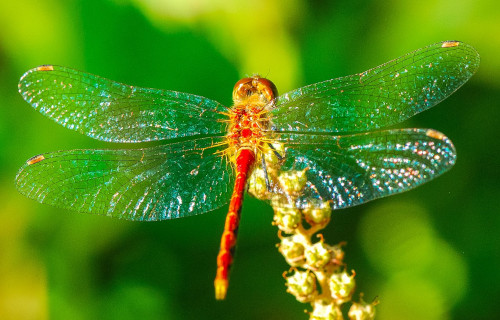
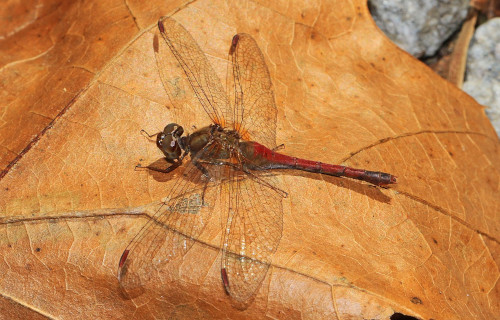
The stunning Autumn Meadowhawk presents of dazzling form to those fortunate enough to encounter it. Yet, this creature does so purely in terms of its impressive visual appeal. That’s due to the fact that, as dragonflies go, it’s a comparatively small member of its amazing Family.
It also follows a pattern of development common among many species around the world. That’s in the fact that it displays a certain degree of the physiological characteristic of sexual dimorphism. In its particualr case, though, this natural trait manifests purely in terms of its appearance.
Mature adults of both sexes o this barvel of biology attain the same general physical dimensions. The body length averages approximately 1.2 – 1.4 in (3.0 – 3.5 cm). Wingspans also measure the same in both genders. The species achieves a mean width in this aspect of roughly 2 in (5 cm).
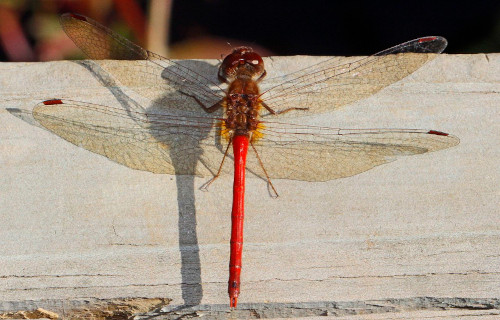
Those same wings themselves also merit their own appreciation for their remarkable construction. Each of these appendages develops as primarily clear in color. Yet, a small amount of color does still appear. A small patch manifests at the base of both wings, ranging from orange to yellow.
In most cases, though, it’s the small body of the awesome Autumn Meadowhawk that receives the most widespread attention from observers. It’s also the aspect of its form that presents the gender-based differences. That’s because the males and females present differing color schemes.
Mature males show a very dark brown to black on their thorax and face. Meanwhile, the abdomen of this sex displays the brilliant red shade. Females, however, present a light brown thorax with a brownish-red abdomen. In both genders, though, the legs present a brilliant shade of yellow.
- Kingdom: Animalia
- Phylum: Arthropoda
- Class: Insecta
- Order: Odonata
- Family: Libellulidae
- Genus: Sympetrum
- Species: S. vicinum
CCL: https://tinyurl.com/3ywffcfy
Autumn Meadowhawk Distribution, Habitat, and Ecology
The eye-catching Autumn Meadowhawk evolved as native to a comparatively large swathe of the earth’s surface. Given its nature, though, the exact location of that zone of habitation comes as no surprise to anyone. This amazing invertebrate developed as endemic to parts of North America.
Yet, within that greater overall territory, its range remains somewhat broken in nature. It mainly inhabits the eastern sections of the United States, and much of southern Canada. It also inhabits much of the Great Plains region, too. Another population dwells in Washington and Orgeon.
This remarkable product of evolution displays decidedly strong and clear preferences regarding its choice of habitat type. Sadly, though, that very nature tends to limit its possibilities for expansion and even survival. That’s especially true today, as man spreads out across most of its native range.
The intrepid Arthropod appears to most strongly prefer to make its home in permanent areas composed of lakes, marshes, bogs, and pools. It also, though somewhat less frequently, resides both in and around slow-moving streams. In such instances, however, these usually lie within a forest.
Fully mature adults of the Autumn Meadowhawk typically fly sometime between the months of late July to early November in the majority of parts of their range. At this time, they feed voraciously as carnivores on a wide range of various small insects. These include such species as ants and flies.
After mating, females lay their eggs in close proximity to the shoreline of their habitat. Eggs are typically laid individually in differing locations. These generally hatch the following spring. Adult males, though, usually perish soon after mating, with females following after laying their eggs.
Orange-belted Bumblebee
Orange-belted Bumblebee Facts
- Now appearing in this compilation of 5 Incredible Invertebrates of Idaho comes the remarkable insect named the Orange-belted Bumblebee.
- This vibrant creation of Nature and evolution most frequently goes by the appropriate common name we’ve chosen to use herein. Yet, the natural wonder does have at least one other widely accepted general title. That’s the similar term of tricolored bumblebee.
- Inside of the scientific community, however, it’s perhaps somewhat better known by its technical appellation. Fortunately for the layperson, though, that’s a comparatively simple tag, as such things go. That’s because it holds the official epithet Bombus ternarius.
- The marvelous Arthropod received that moniker due to the efforts of Thomas Say. The widely respected American entomologist accomplished the first recognition of it as a separate and distinct species. He managed that scientifically noteworthy feat in the year 1837.
- Pleasantly, the amazing Orange-belted Bumblebee seems to still possess a stable and sufficient population base. That fortunate situation also appears to hold true throughout the entirety of its range. The IUCN thus currently lists it as Least Concern on its published Red List.
- The insect nevertheless faces the same potential threats to its continued existence as all species on earth now do. Most of those dangers stem from the actions of mankind. These perils include such perils as habitat loss and the ongoing effects of climate change.
Orange-belted Bumblebee Physical Descriptio
The remarkable Orange-belted Bumblebee typically draws much appreciation from those individuals who appreciate Nature. As a general principle, however, the invertebrate does not do so due to its size. That’s true since the creature ranks as a fairly small member of its Genus.
Like related species around the globe, this animal displays a certain degree of the physiological characteristic known as sexual dimorphism. In keeping with the pattern prevalent among members of its Family, though, the species manifests this trait in a different way than most others.
It’s still true that the two genders display varying physical characteristics. But, given that it’s an Apidae, it also possesses what might be considered a sub-class, as well, depending on perspective. The different groups display a range of physical characteristics that serve to distinguish them.
The queen, of course, is female. She ranges in average length from 0.67 – 0.75 in (1.7 – 1.9 cm). Her body width attains a mean measurement of approximately 0.33 – 0.35 in (0.85 -0.9 cm). Given these dimensions, it’s apparent that she developed as slightly slimmer than most of her relatives.
Males of the species, though, known as drones, achieve much smaller measurements. The shorter bodies reach an average length equaling approximately 0.37 – 0.51 in (0.95 – 1.3 cm). In terms of width, at the abdomen this sex manages a mean of between 0.18 – 0.22 in (0.45 – 0.55 cm).
Then, the species additionally has a worker class. Though technically female, they differ from the queen in tht they’re sterile. They’re also smaller than either the queen or the drones. Each only measures about 0.31 – 0.51 in (0.8 – 1.3 cm) in length. In breadth, they’re the same as males.
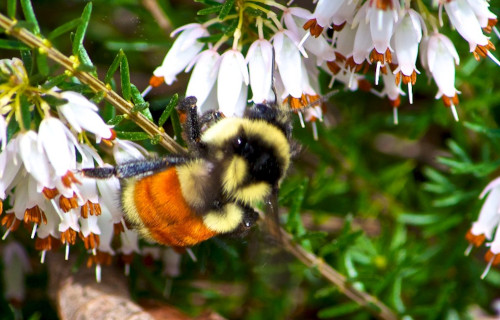
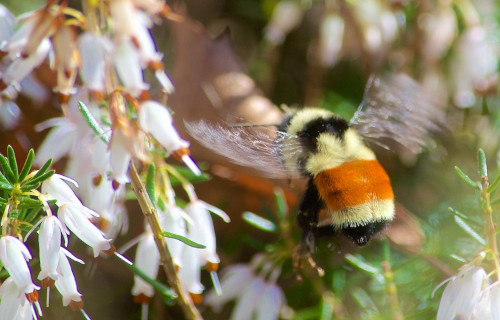
Differences also manifest in appearance among the various groups of the Orange-belted Bumblebee. Queens and worker show a black head, with light yellow hairs. These also present bands of yellow, orange, and black on the bodies. That trait serves as the source of the common name.
The drones, however, show a distinctlly different pattern of coloring. Its head develops as yellow in color, with a scattering of small black hairs. The pattern of hues on the body is similar, but not identical to, that of the others. This group also develops much longer fur than that of the others.
- Kingdom: Animalia
- Phylum: Arthropoda
- Class: Insecta
- Order: Hymenoptera
- Family: Apidae
- Genus: Bombus
- Species: B. ternarius
Orange-belted Bumblebee Distribution, Habitat, and Ecology
The Orange-belted Bumblebee evolved as native to a relatively large expanse of the surface of the earth. The exact location of that zone of habitation rarely comes as a surprise to those who learn of it, however. That’s true since the natural marvel developed as endemic to North America.
Within that greater area of habitation, though, the Arthropod only appears in parts of the overall range. To the north, it inhabits much of the country of Canada. The southern section of its habitation range includes much of the northern and northeastern parts of the United States.
Just like most of its many relations, the intriguing Arthropod evolved fairly clear preferences regarding its choice of habitat. It strongly prefers the more temperate conditions found in the northern extent of its territory. On occasion, though, some do venture further south.
Yet, it does show some moderate flexibilty pertaining to what types of local ecosystems it lives in. The amazing insect prefers to make its nests in undisturbed areas, such as forests, fields, and meadows. It’s not unknown, however, for these to appear in parks or even private yards.
The Orange-belted Bumblebee further developed as a species with only a single lifecycle per season. Queens generally emerge from hibernation in late April. These constructs their nests in shallow cavities on the ground, an dlays her eggs. Its colonies rarely exceed 200 individuals.
The lovely invertebrate follows the same pattern as its numerous kindred regarding its diet. This consists solely of the nectar and pollen of various locally available plants. It does show a small preference, though. Its favorite sources include goldenrod, milkweed, and many berries.
Aphrodite Fritillary
CCL: https://tinyurl.com/22y23f9m
Aphrodite Fritillary Facts
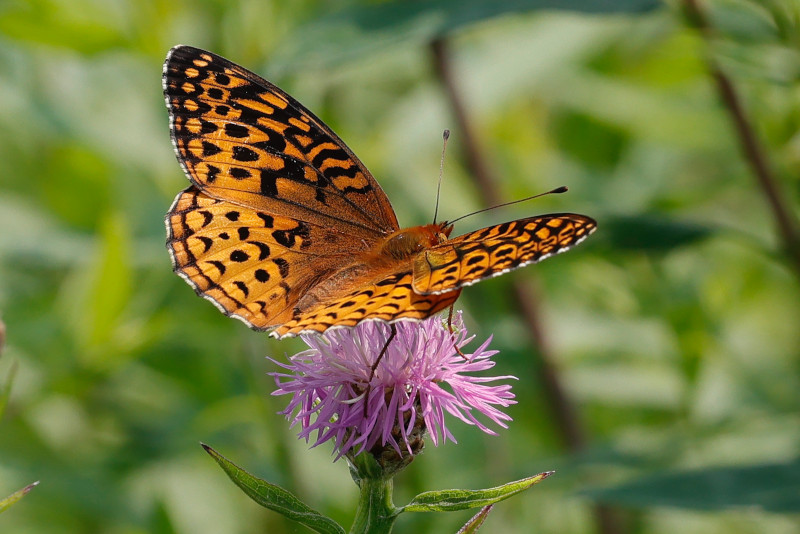
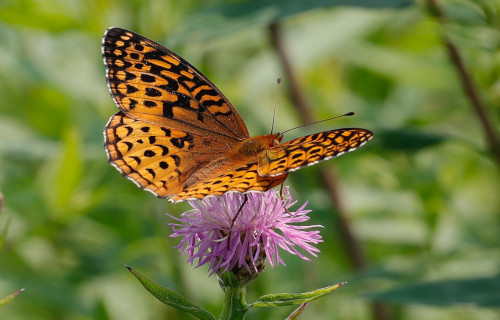
- Our next choice for inclusion in this listing of these 5 Incredible Invertebrates of Idaho is the stunning Lepidoptera named the Aphrodite Fritillary.
- The evocative term we’re applying serves as the most often employed common name for this beautiful species of Lepidoptera. It does have a few other general titles it’s known by, though. Those include Aphrodite Butterfly and Silver-spotted Fritillary, among several others.
- Within the scientific world, however, it’s perhaps much better known by its purely technical designation. But, like many such epithets, that’s one that’s difficult for the layperson to pronounce. That’s because it invertebrate holds the official tag of Speyeria aphrodite.
- It received that distinctive moniker due to the efforts of Johan Christian Fabricius. The highly respected Danish zoologist accomplished the first formal recognition of it as a separate and distinct species. He achieved that scientifically noteworthy deed in the year 1787.
- For the moment, science knows of at least an astounding 12 confirmed subspecies of this remarkable creation of Nature and evolution. Each of these also shares the same general habitat range of the parent species. This frequently makes distinguishing them difficult.
- Fortunately, the beautiful Aphrodite Fritillary appears to be maintaining a population base that’s both stable and sufficient. That state also seems to hold true across the entirety of its range. The IUCN thus currently has no listing for it on the Red List of Threatened Species.
- The marvel of Nature and evolution nevertheless still faces multiple potential threats to its continued existence as a species. Like all forms of life on earth today, most of these stem from the actions of man. They include the closely related perils of habitat loss and climate change.
Aphrodite Fritillary Physical Description
The stunning Aphrodite Fritillary typically captivates those individuals fortunate to encounter one of these beauties in its natural environment. Unlike some species, though, it does so for several reasons. That’s due to the fact that it’s not only a lovely creature, but also boasts a respectable size.
The remarkable invertebrate also follows a pattern common to many of its relatives. That’s the fact that it displays a certain degree of the physiological characteristic of sexual dimorphism. In it specific case, however, that particular trait manifests itself in terms of both size and appearance.
Overall, though, the amazing Lepidoptera typically attains a wingspan averaging roughly between 2.5 – 4 in (6.4 – 10.2 cm). This ranks as the first of the gender-based differences. Females typically measure at the higher end of this range, while the males remain at the lower end of the same.
The body of both sexes of the creature presents approximtely the same general shape and proportions. Its thorax develops as fully robust and covered with fine, soft hairs, and typically brown or blackish. Yet, the abdomen remains slim and tapered, matching the color of the thorax.
The head, meanwhile, evolved as comparatively small and covered with fine hairs, with a pair of clubbed antennae that are black with orange tips. It has a long, coiled proboscis, used for feeding on nectar from various flowers. The legs also develop as slender and adapted for perching.
It’s the patterns of coloring in the breathtaking Aphrodite Fritillary that most often garner the greatest degree of attention, though. That’s also the other physical characteristic that separates the genders. Males generally manifest much more vivid and darker markings compared to the females.
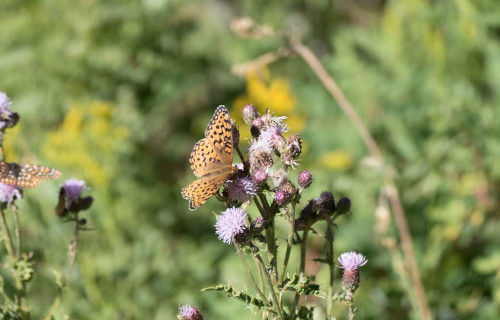
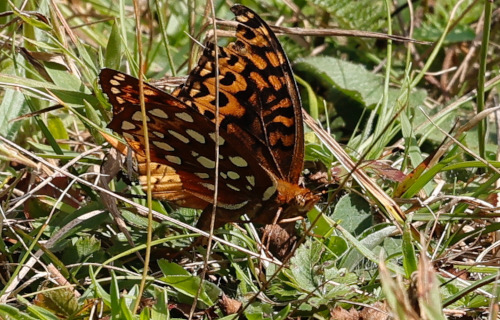
The upperside of both the forewings and hindwings each primarily display as orange with black spots. This pattern includes several rows of black spots and lines, more concentrated near the margins. The spots vary in size, with those on the margins being smaller and densely packed.
The underside of both sets of wings of this wonder of Nature, though, evolved a vastly different pattern. Its forewings typically show a remarkable shade of orange-brown, combined with a series of very pale spots. Some of these markings also present themselves outlined in shades of black.
Impressively, the hindwings of the wonder appear more even striking. These develop with a brownish or yellowish base color, accompanied by a series of large silvery or pearly white spots. These frequently vary greatly in both number and size, but typically remain distinct and reflective.
- Kingdom: Animalia
- Phylum: Arthropoda
- Class: Insecta
- Order: Lepidoptera
- Family: Nymphalidae
- Genus: Speyeria
- Species: S. aphrodite
CCL: https://tinyurl.com/22y23f9m
Aphrodite Fritillary Distribution, Habitat, and Ecology
The gorgeous Aphrodite Fritillary evolved as native to a moderately broad section of the surface of the earth. Precisely where that indigenous zone of habitation lies, however, probably won’t surprise many people. It’s a region already well known for its abundance of similar natural wonders.
The beautiful Arthropod developed as native to a certain range found within the confines of the continent of North America. There, the northern limits of its range reach southern Canada, including provinces like Alberta, Manitoba, Ontario, Quebec, and parts of the Maritime provinces.
To the south, however, it’s extensively widespread across the north-central parts of the United States. To the east, it ranges from New England and the Appalachian Mountains down to northern Georgia. In the Midwest, it is found in states such as Ohio, and across to the Great Plains.
In the west, its native range extends to the mighty Rocky Mountains and even includes states such as Montana, Wyoming, Colorado, and parts of New Mexico. The beautiful insect’s also commonly found in parts of the Pacific Northwest, including many regions in Washington and Oregon.
Across its broad range, this marvel of Nature and evolution clearly displays decidedly flexible preferences regarding its choice of habitat. It’s therefore found living within a wide range of local ecosystems. The insect nevertheless does display favoritism for several specific types of these.
It’s demonstrably quite fond of meadows and grasslands, or similar open areas with abundant herbaceous vegetation. Such settings remain rich in wildflowers, which provide nectar sources. These habitats often remain mostly sunny and have a various mix of grasses and flowering plants.
The butterfly’s additionally frequently seen in praries, and similar large, wide open, and either flat or gently rolling areas of native grasses. These settings serve similar purposes to meadows, but often measure significantly larger and with a particularly unique composition of grasses and forbs.
Many woodland edges and clearings also serve as common locations for the stunning small creature. These transitional zones between dense forests and open areas have their own appeal. They offer a mix of shade and sunlight, with diverse plant life, including flowers that it feeds on.
It’s even recorded as being present in areas of both alpine and sub-alpine meadows. It seems surprisingly fond of the high-altitude grasslands found in such mountainous regions. Here it also finds cool, moist environments with a short growing season and a diverse array of flowering plants.
The larvae of the amazing Aphrodite Fritillary feed primarily on the leaves of violets. They’re also almost exclusively nocturnal feeders, hiding during the day and emerging only to feed at night. The adults primarily feed on nectar from a variety of wildflowers, including many milkweeds.
After mating, the females lay eggs singly, typically either on or near host plants, usually the same violets the larvae later feed on. The eggs themselves are small, spherical, and pale in color. Both larvae and adults are preyed on by various predators, including birds, spiders, and other insects.
California Mantis
CCL: https://tinyurl.com/462rnnjn
California Mantis Facts
- Here, in this position in this compendium of 5 Incredible Invertebrates of Idaho we present you with the mighty predator named the California Mantis.
- This remarkable Arthropod most frequently goes by this descriptive and informative common name for excellent reasons. For the moment, this wonder of Nature has no other broadly accepted general title. Though certainly not unknown, that’s somewhat uncommon.
- Within the scientific community, however, it’s possibly markedly better known by its purely technical moniker. That term, though, remains somewhat difficult for most laypeople to pronounce. That’s because this natural wonder holds the epithet Stagmomantis californica.
- The impressive invertebrate received that designation due to the efforts of the duo of James Abram Garfield Rehn and Morgan Hebard. The noted American entomologists accomplished the first recognition of it as a separate and distinct species. He achieved that feat in 1909.
- The amazing California Mantis appears to be maintaining a population base that’s both stable and sufficient. That pleasant state also seems to hold true throughout its entire range. The IUCN therefore does not presently show it on its own Red List of Threatened Species.
- The biological marvel nevertheless still faces multiple potential threats to its continued existence as a species. Like all other forms of life on earth today, most of these stem from the actions of man. These dangers include such perils as habitat loss and ongoing climate change.
CCL: https://tinyurl.com/4883uvy3
California Mantis Physical Description
The intriguing California Mantis captures the attention of most of those individuals who encounter it, like most of its many relatives around the world. It does not do so due to impressive size, however. That’s because this lovely biological masterpiece is an average-sized species of mantis.
It also follows a well-established pattern common among its kindred. That’s in the fact that it displays a certain amount of the physiological characteristic of sexual dimorphism. In the particular case of this creature, that natural trait manifests in both structure and general appearance.
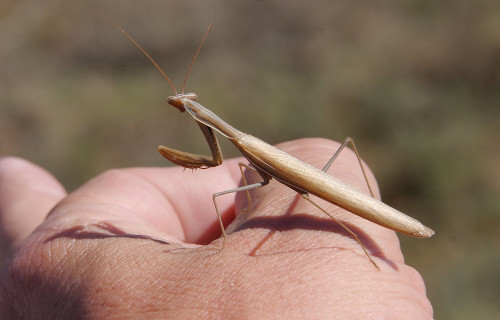
Collectively, the two genders of this remarkable invertebrate attain average body lengths of between 2 – 3 in (5.1 – 7.6 cm). Males, though, possess a total of eight abdomenal segments. The females, meanwhile, only have six of these. Females thus tend to be slightly shorter than the males.
The fascinating Arthropod also displays additional gender-based physical variations, as well. Among females of the intriguing species, the hindwings develop as either a deep purple or dark brown in color. These features also generally have either a light reddish-brown or orange-yellow base.
Males of the captivating California Mantis, however, present a significantly different pattern of coloring. For them, the forewings show an almost translucent color. These do, though, have narrow, lightly-colored marginal strips. Yet, the hindwings show a dark brown, with a mottled pattern.
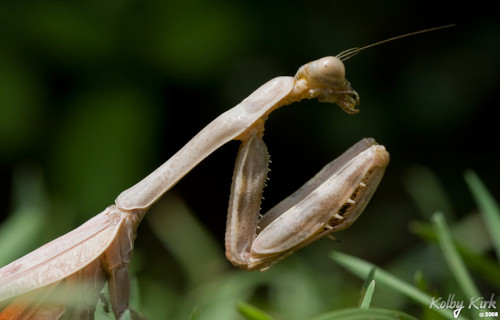
The body itself, though usually hidden from easy view by the wings, presents a chocolate to light brown hue. The inner forelegs show an orange shade, while a scattering of small black spots appear near the powerful mandibles. The sharply oval face also holds two outsized compound eyes.
- Kingdom: Animalia
- Phylum: Arthropoda
- Class: Insecta
- Order: Mantodea
- Family: Mantidae
- Genus: Stagmomantis
- Species: S. californica
CCL: https://tinyurl.com/462rnnjn
California Mantis Distribution, Habitat, and Ecology
The gorgeous California Mantis evolved as endemic to a moderately broad expanse of the surface of the earth. The precise location of that native zone of habitation might surprise many of you, however. It does appear inside of North America, yes, but the name’s somewhat deceptive.
It’s found almost exclusively within the national borders of the country of the United States. To the far south, though, a small population also lives in northern Mexico. Concentrated in southern California, its territory extends from there eastward as far as western sections of Texas.
Like many related invertebrates scattered nearly everywhere across the globe, this product of specialized evolution displays decidedly strong preferences regarding its choice of habitat type. For starters, it’s virtually never seen at altitudes great than 10,000 ft (3,048 m) above sea level.
Inside of that restriction, however, this incredible creation of evolution shows further favoritism. It prefers areas that are both drier and warmer. The favorite location for the mantis appears to be desert ecosystems and regions of chaparral. Areas with creosote bushes enhance this even further.
Like all currently recognized mantids, the stuning California Mantis developed as a powerful, entirely carnivorous, predator. It’s also indiscriminate in its prey. The insect eats virtually any other invertebrate small enough to be eaten. Amazingly, this even extends to members of its own species.
It additionally lives a primarily solitary life by nature. The two sexes typically only come together for mating purposes. Mating and reproduction takes place in Autumn, with eggs hatching in early spring. A typical lifespan equals approximately nine months, and rarely more than a full year.
Giant Swallowtail
CCL: https://tinyurl.com/2dcehfvs
Giant Swallowtail Facts
- Finishing up this article about these 5 Incredible Invertebrates of Idaho we give you the winged wonder best known as the Giant Swallowtail.
- This magnificent work of Nature most frequently goes by the appropriate common name across it entire range for good reasons. For the moment, at least, this marvel of evolutionary processes holds no other broadly accepted general title. That’s not very common.
- Inside of scientific circles, however, the creature does have another moniker by which it’s perhaps much better known. Thankfully for the layperson, that’s a comparatively simple one to pronounce. That’s because it bears the technical designation of Papilio cresphontes.
- The beautiful Lepidoptera received that specific epithet due to the efforts of Pieter Cramer. The respected Dutch entomologist accomplished the first recognition of it as a separate and distinct species. He managed that scientifically noteworthy deed in the year 1777.
- The species currently remains most noted for several factors. This stunning invertebrate ranks as the largest of all known species of butterfly found in its part of the world. Sadly, though, its caterpillar form is now considered an extreme pest by those in the citrus industry.
- Fortunately, the amazing Giant Swallowtail appears to presently be maintaining a fully healthy population base. That pleasant state additionally seems to hold true across its entire range. The IUCN therefore presently lists the insect as Least Concern on its published Red List.
- The stunning Arthropod nevertheless faces the same potential threats to its continued existence as a species that all other forms of life on earth now do. Most of these dangers stem from the actions of man. These perils include the dangers of habitat loss and climate change.
CCL: https://tinyurl.com/3ywffcfy
Giant Swallowtail Physical Description
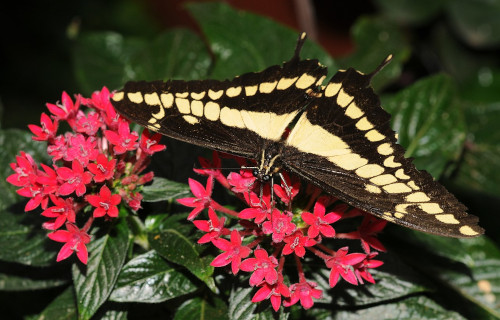
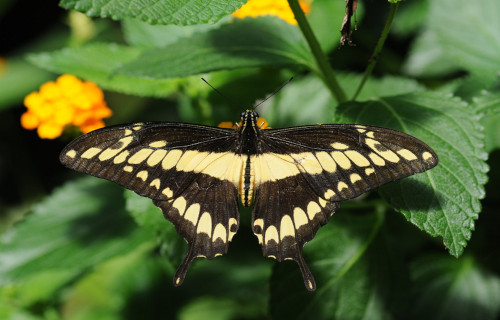
The breathtaking Giant Swallowtail certainly captures the attention and appreciation of most individuals fortunate enough to encounter it. Given its very name, its sheer size alone easily serves as one clear reason. Yet, the beauty and majesty of its appearance also distinguishes the insect.
The lovely creature also shares certain of the natural aspects typical of its many kindred. Among those is the fact that it displays a certain degree of the physiological characteristic of sexual dimorphism. In this instance, the natural trait manifests itself in terms of both its size and coloring.
Females of the species attain a greater average wingspan than that of their males counterparts. The actual difference remains relatively minor, though. The wings of the females measure a mean span equaling 5.8 in (15 cm). Those of males, meanwhile, only average approximately 5.5 in (14 cm).
Obviously, exceptional specimens of the wonder of the insect world do occur occasionally. These examples, when they do appear, develop greater dimension wholly regardless of gender. Yet, even the largest of these rarely exceed the typical measurements by any significant amount.
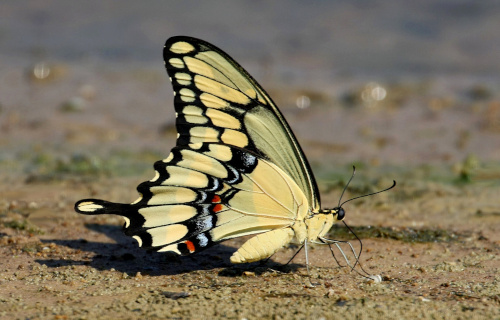
The other way in which the different sexes of the enthralling Giant Swallowtail differ mainly lies in their coloring. On the upperside, all its wings display primary background of black. A line of yellow markings crosses the upper wings, along with a row of yellow dots along the back edges.
The underside of the delicate, gorgeous wings, however, display a much different pattern of coloring. That portion of the Arthropod principally presents a background composed of various shades of yellow. Accents do appear in several places on these, but those consist of shades of black.
All of this contrasts with a few other highly notable physical features. Also situated on the back, inner corner of the upper side of the wings, two very small red spots lie within a tiny blue circle. Females also set separate themselves from the males by having slightly more rounded wings.
- Kingdom: Animalia
- Phylum: Arthropoda
- Class: Insecta
- Order: Lepidoptera
- Family: Papilionidae
- Genus: Papilio
- Species: P. cresphontes
CCL: https://tinyurl.com/22y23f9m
Giant Swallowtail Distribution, Habitat, and Ecology
The appropriately-named Giant Swallowtail apparently evolved as endemic to a relatively large swathe of the surface of the earth. The location of that zone of habitation probably won’t surprise our readers, however. That’s because this marvel developed as native to North America.
Within that greater overall range, though, the species primarily makes its home inside the borders of the United States. There, the fabulous invertebrate lives in virtually all regions of the country. Its range also extends into southern Canada, northern Mexico, and even Cuba and Jamaica.
This remarkable Lepidoptera displays an impressive versatility regarding its choice of habitat. Provided the specific region inside its greater range possesses a temperate climate, it appears in an extremely braod range of local ecosystems. That’s a truly great evolutionary advantage.
The beautiful butterfly does mainly choose to live in regions of either deciduous forests of orange orchards. Yet, due to its adaptability, the fascinating insect also occurs in such areas as open woodlands, fields, bogs, and marshes. Amazingly, it even frequents cities, towns, and suburbs.
The voracious larvae of the intriguing Giant Swallowtail further show a truly strong preference for citrus fruits. They do, however, also now feed on several introduced species. The adults, though, mainly consume the nectar of a variety of plants, including honeysuckle, azaleas, and lantana.
Subsequent to mating, the females generally lay their eggs on the top of the leaves of a suitable host plant. Once hatched, the larvae go through five stages of development. Among both larvae and adults, its main predators consist of most avian species found in its natural environment.
CCL: https://tinyurl.com/22y23f9m
5 Incredible Invertebrates of Idaho
We sincerely hope that each of you thoroughly enjoyed reading, and hopefully learning from, this article we’ve written about these 5 Incredible Invertebrates of Idaho. It’s also our hope that doing so has left you with either a new or renewed appreciation for such remarkable wonders of Nature.
Unfortunately, however, many of their kindred around the world now find themselves facing strong threats to their continued existence as a species. Many of those dangers, in fact, stem from the ongoing actions of mankind. We must do everything we can to protect and preserve them all.
Check out our other articles on Earth’s 7 Mightiest Rivers, New Zealand Sea Lion, Lake Van, Rila Primrose, Socotra Starling, Great Barracuda, Baltimore Checkerspot, Keeled slug-eating Snake