


CCL: https://tinyurl.com/22y23f9m
We truly hope that each of you, our readers, will greatly enjoy and appreciate this article we present to you about these 5 Louisiana Herbaceous Plants. It was our pleasure to gather the various information for you. May it serve to provide you with both education and increased awareness.
Certainly, although wondrous themselves, these few species listed herein represent only a small portion of the similar marvels in this region. It’s our belief, though, that they serve as excellent representations of the wonders that exist. Check out some of our other articles for similar marvels.
Hairy Shadow Witch

CCL: https://tinyurl.com/bdes27an
Hairy Shadow Witch Facts
- Starting off this article about these 5 Louisiana Herbaceous Plants comes the remarkable flora named the Hairy Shadow Witch.
- The highly unusual term it’s known by easily serves as the most often employed common name for this beautiful variety of orchid. It does have several other similar titles that it’s also known by, though. These include Racemose Shadow Witch and Raceme Shadow Witch.
- Inside of the scientific community, however, it’s possibly markedly better known by its purely technical designation. But, like many such tags, that’s rather difficult for the layperson to pronounce. That’s because the flora holds the official moniker of Ponthieva racemosa.
- The amazing plant received that complex epithet due to the efforts of Thomas Walter. The highly respected British-born American botanist recorded the first recognition of it as a separate and distinct species. He achieved that scientifically noteworthy feat in the year 1788.
- Thankfully, the gorgeous Hairy Shadow Witch appears to still be maintaining a population base that’s both stable and sufficient. That pleasant state also seems to hold true across its entire range. The IUCN thus does not currently place it on its Red List of Threatened Species.
- This true natural wonder nevertheless still faces multiple potential threats to its continued existence as a species. Like all forms of life of earth today, most of those dangers stem from the actions of man. High among those stand the perils of habitat loss and climate change.

CCL: https://tinyurl.com/2s4apsss
Hairy Shadow Witch Physical Description
The remarkable Hairy Shadow Witch certainly grabs the attention of most people lucky enough to encounter it. Yet, the plant does so for more than just its beauty. That’s true since it distinguishes itself from most other orchids in terms of its nature. Unlike most, it grows from the soil.
The surprising Angiosperm produces a single stem. This feature quickly grows strongly vertical, and usually varies significantly in height. A typical range, though, averages roughly 8 – 24 in (20 – 60 in ). That same stem also usually appears a mild green in color, and covered in countless fine hairs.
The leaves of this botanical marvel also stand out in the minds of viewers. This foliage generally develops at or near the base of the plant. In color, it typically presents a darker green shade. Most frequently, each leaf holds a relatively smooth texture and a shiny, almost waxy appearance.
The shape of these further distinguishes them from many other related species around the world. The leaves also evolved as strongly lance-shaped in structure, tapering to a pointed tip. Lengths naturally vary, of course. Yet, on average, this ranges from approximately 4 – 8 in (10 – 20 cm).
Yet, it’s undoubtedly the unusual flowers of the amazing work of Nature that usually garner the most attention from observers. These typically develop as part of what’s known as a raceme. That’s an elongated cluster with individual flowers attached by short stalks along the central stem.
The number of these blooms in each separate cluster varies fully randomly, but generally ranges from somewhere between 10 – 30. Individually, though, each of the blossoms remain quite small. Each separate flower only measures an average diameter of roughly 0.4 – 0.8 in (1 – 2 cm).
The nature of the flowers of the Hairy Shadow Witch also frequently piques one’s interest. In color, that’s most commonly a greenish-white to yellowish-green. They’re also bilaterally symmetrical with a very distinctive lip, known as a labellum. This part’s most commonly fringed or lobed.
The petals and sepals further stand out to the keen eye. These features develop as narrow and spreading, with the sepals being slightly longer than the petals. The final petal, called the labellum, appears quite prominent, usually three-lobed, and often projects a hairy or fringed appearance.
- Kingdom: Plantae
- Phyllum: Angiosperms
- Class: Monocots
- Order: Asparagales
- Family: Orchidaceae
- Genus: Ponthieva
- Species: P. racemosa
CCL: https://tinyurl.com/bdes27an
Hairy Shadow Witch Distribution, Habitat, and Ecology
The distinctive beauty known as the Hairy Shadow Witch evolved as endemic to a surprisingly broad expanse of the earth’s surface. Yet, intriguingly, the full extent and precise location of that impressive zone of indigenous habitation might actually surprise some of our regular readers.
The northernmost limits of its native territorial range places this botanical marvel within the boundaries of the continent of North America. There, that range extends as far north as states such as Florida, Georgia, Alabama, Mississippi, Louisiana, and Texas, inside the United States.
Moving southward, though, the incredible plant’s also present in surprising numbers in numerous locations in the country of Mexico, too. Its range continues through Central America, especially in such countries as Belize, Guatemala, Honduras, Nicaragua, Costa Rica, and Panama.
The southern edge of its natural range, meanwhile, reaches all the way to the northern portions of South America. This includes a presence in countries like Venezuela, Colombia, Ecuador, Peru, and Bolivia. Yet, it’s also found on several islands in the Caribbean, including Jamaica and Cuba.
This intrepid product of Nature and evolution displays preferences regarding its choice of habitat that qualify as both broad and specific simultaneously. That’s because the flora appears in a wide variety of locations, as long as the given setting meets its need for moisture and shade.
The fascinating Angiosperm frequently prefers forests. This includes tropical and subtropical varieties. The species prefers humid, shaded forest environments. It’s also present in deciduous and evergreen forests as well. It’s found in both types of forests, most often under dense canopies.
The orchid additionally thrives in a great many other types of moist woodlands. It opportunistically occupies areas with abundant leaf litter and decaying organic matter. The amazing plant further grows in some moist, swampy conditions where the soil remains consistently damp enough.
Oddly enough, elevation seems to also play an important role in its choice of where to call home as well. A certain percentage of its known population dwells in several mountainous regions, present at lower to moderate heights. There, it thrives best in cool, shaded, well-drained settings.
Like many of its multitudinous relatives on earth, the Hairy Shadow Witch achieves its pollination via the actions of specific pollinators such as bees, flies, or moths. The structure of the flower, including the placement of the pollen packets, ensures efficient transfer of pollen between flowers.
This remarkable flora reproduces primarily through seeds produced by the distinctive blooms. Such seeds typically develop as extraordinarily small and lack a nutrient storage tissue. These thus require a symbiotic relationship with fungi in the soil to germinate and establish as seedlings.
Orange Jewelweed
CCL: https://rb.gy/dgnhc
Orange Jewelweed Facts
- Now appearing in this compilation of 5 Louisiana Herbaceous Plants we present you with the marvel best known as the Orange Jewelweed.
- This dazzling flora most frequently goes by the highly descriptive common name we’re using across its entire range. The plant has several other alternate titles, as well, though. These include the terms orange balsam, common jewelweed, and the spotted touch-me-not.
- Within scientific circles, however, the Angiosperm is likely significantly better known by its official title. Fortunately for the layperson, that’s a relatively simple one to pronounce. That’s because this marvel of Nature and evolution holds the technical moniker Impatiens capensis.
- The beautiful plant received that simple name due to the efforts of the respected Dutch botanist, Nicolaas Meerburgh. He accomplished the first official recognition of it as a separate and distinct species. That scientifically noteworthy action occurred back in the year 1775.
- Pleasantly, the Orange Jewelweed seems to be maintaining a population base that’s both sufficient and stable. That fortunate situation also appears to hold true throughout the entirety of its territory. The IUCN thus currently lists it as Least Concern on its published Red List.
- Nevertheless, the beautiful creation of Nature faces some potential threats to its continued existence as a species, at least. Like many forms of life today, most of these dangers stem from the actions of humans. They include the perils of habitat loss and the effects of climate change.
CCL: https://rb.gy/j0qkj
Orange Jewelweed Physical Description
The Orange Jewelweed almost always captures the attention of those individuals fortunate enough to encounter it. Unlike some herbaceous plants, though, it does so for several reasons. That’s due to the fact that it’s not only quite lovely to behold, but also attains a respectabe size for its kind.
Individual specimens do vary significantly in growth, though, largely due to differing local environmental conditions. As a general principle, however, the species ranges from between 3 – 5 ft (0.9 – 1.5 m) in height. A few specimens exceed this, of course, but rarely do so by any great amount.
The wonder of evolution produces thin, yet surprisingly sturdy vertical stems, typically with a distinctive semi-translucent appearance. These features also produce multiple smaller branches. Each of these portions of the plant additionally generally maintain a smooth texture to their surface.
Each example of the impressive Eudicot additionally produces numerous leaves. This interesting foliage generally reaches a length equaling as much as 5 in (13 cm) long and 2.5 in (6 cm) in width. Every leaf also typically possesses sharply serrated edges, and shows an extremely deep green shade.
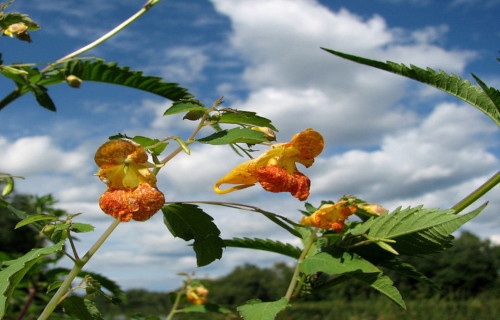
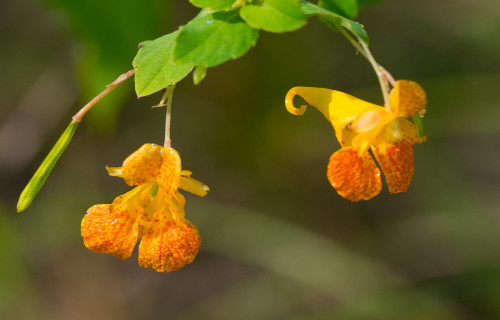
Yet it’s the gorgeous blooms of the captivating Orange Jewelweed that most commonly attract the most attention from observers. These flowers usually present a brilliant orange hue. Some do, however, sometimes show a blood-orange shade, and even more rarely, a pale yellow color appears.
Its color also serves as the source of the principal common name. However, one of its alternates also stems from a remarkable trait of the plant, and a remarkable one at that. When touched, the leaves of the plant often close relatively quickly in response, thus the unusual name touch-me-not.
- Kingdom: Plantae
- Phylum: Tracheophytes
- Class: Eudicots
- Order: Ericales
- Family: Balsaminaceae
- Genus: Impatiens
- Species: I. capensis

Orange Jewelweed Distribution, Habitat, and Ecology
The visually appealing Orange Jewelweed developed as native to a relatively wide expanse of the globe. Within that natural range, it fits perfectly with the bountiful other botanical wonders. That’s because the marvelous Tracheophyte evolved as endemic to the continent of North America.
There, it inhabits virtually all of the eastern portions of the country of Canada. Southward, it also appears throughout most of the Northeastern and southern sections of the United States. That native range extends as far south as Georgia, and also as far west as the state of Oklahoma.
This elegantly beautiful flora also evolved astonishingly intriguing preferences in its choice of habitat. It primarily inhabits regions composed of shaded wetlands. Yet the flora additionally demonstrates relatively moderate adaptability in this specific regard when conditions necessitate it.
Due to that notable flexibility, it frequently appears in locations many might consider unlikely. These settings include such areas as ditches, along creeks, and in regions of bottomland. It also often lives in marshes, bogs, as well as in the forested edges of these same surprising ecosystems.
The awesome Orange Jewelweed developed as a herbaceous annual. Blooming usually occurs between late spring and early fall. Pollination mainly takes place due to the actions of various local varieties of hummingbirds. Nevertheless, certain bees, especially bumblebees, sometimes assist.
Historically, certain parts of the flora also once had their many uses among humans. Certain Native American herbal remedies used the juice of the leaves and stems. The young shoots can also be consumed as a leafy green vegetable, after boiling. Its seeds are also fully edible for humans.
Fall Phlox
CCL: https://tinyurl.com/22y23f9m
Fall Phlox Facts
- Our next choice for inclusion in this gathering of these 5 Lousiana Herbaceous Plants bears the simple title of Fall Phlox.
- The most frequently used common name for this gorgeous product of Nature and evolution continues to be this one across its range. The botanical beauty does, however, have other general titles. These include garden phlox, paniculed phlox, and perennial phlox.
- Within the scientific community, though, it’s perhaps better known by its technical designation. Thankfully, that term’s comparatively easy for the layperson to pronounce, as such things go. That’s because the delicate Angiosperm holds the official epithet of Phlox paniculata.
- The flora received that relatively simple moniker due to the efforts of Carl Linnaeus himself. The highly esteemed Swedish biologist accomplished the first formal recognition of it as a separate and distinct species. He achieved that scientifically noteworthy deed in the year 1753.
- Due to its great beauty, it’s been introduced to numerous other areas around the world, outside its native range. In these non-native regions, it’s been imported and used as an ornamental plant. In many of these areas, though, it escaped cultivation and established itself in the wild.
- Fortunately, even within its native region, the Fall Phlox seems to be maintaining a fully thriving population base. Combined with its artificially expanded range, this currently gives it a reasonable degree of stability. The IUCN therefore has no listing for the plant on its Red List.
- Nevertheless, it faces the same potential threats to its continued existence as a species as all other forms of life on earth today. Like them, the great majority of these stem from the actions of mankind. They include the related perils of habitat loss and ongoing climate change.
CCL: https://tinyurl.com/2s4apsss
Fall Phlox Physical Description
The captivating Fall Phlox remains renowned for its beauty and charm. Both of these serve to capture the attention of most individuals who view the marvel. This forms the very reason it’s become so popular in regions around the globe as an ornamental. It also boasts other attractions.
This perennial plant achieves moderately impressive average physical dimensions. In height, specimens typically grow to between 2 – 4 ft (0.6 – 1.2 m). The mean width for the same examples measures 1 – 2 ft (0.3 – 0.6 m). Under ideal conditions, though, the flora occasionally exceeds this.
The stunning plant evolved a fibrous root system that allows it to establish itself well in garden beds, as well as its native environment. From there, it grows in a vertical direction. Its stems also manifest as sturdy, erect, and slightly branched. These appear green, and often tinged with purple.
The leaves merit their own appreciation, as well. These develop placed opposite, and lance-shaped in structure. Each also possesses smooth edges, and usually shows a rich green color. In terms of length, these average extending 2 – 5 in (5 – 13 cm), and usually end with a pointed tip.
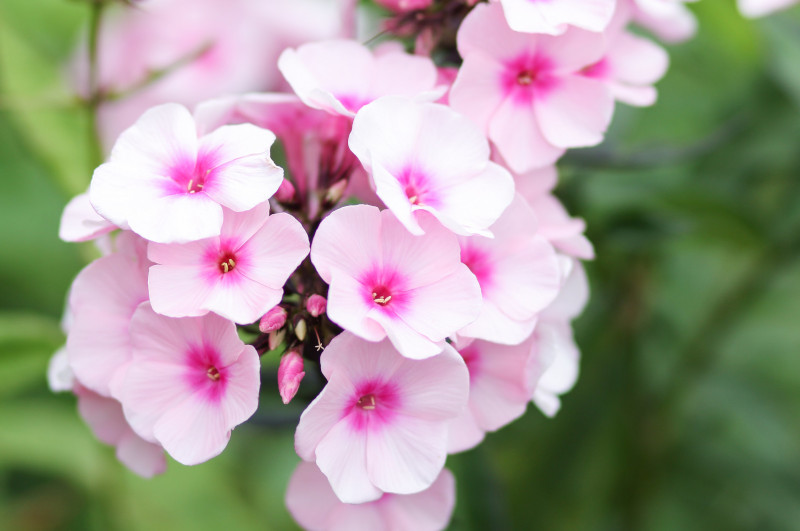
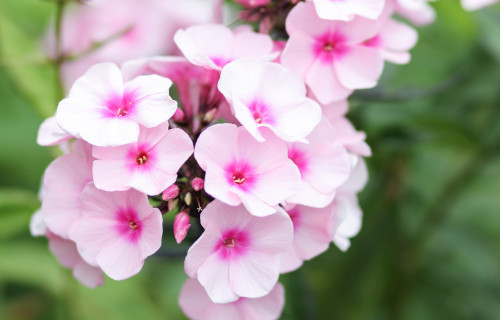
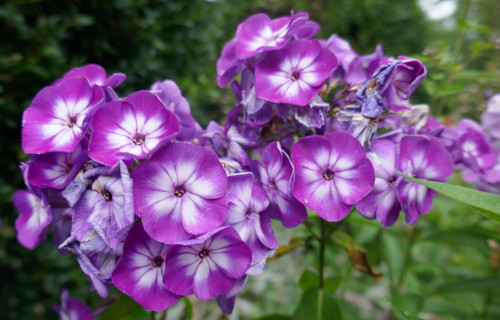
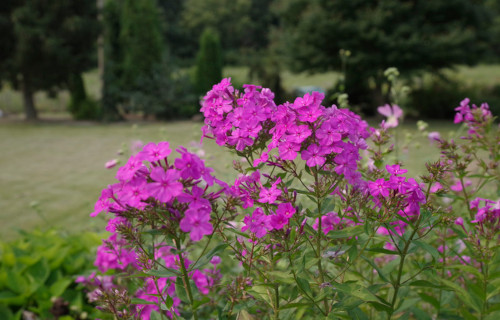
It’s clearly the flowers of the amazing Fall Phlox that typically garner the most attention, however. These breathtaking blooms develop as comparatively small, tubular, and star-shaped, and display five petals. The blossoms also grow in large, dense clusters or panicles at the top of the stems.
These remain well known for two distinct attributes. Nature blessed them with a strong, sweet fragrance. Many cultivars exist, presenting a wide range of colors and shade. The original plant, however, has blooms showing a range from pink to light purple, with a dark pink or magenta center.
The magnificent Angiosperm also produces a tiny fruit, following flowering. This remains far more obscure than the attractive flowers, though. These consist of small, inconspicuous seed capsules. The seeds themselves also develop as quite small, but each pod contains large quantities of these.
- Kingdom: Plantae
- Phylum: Tracheophyta
- Class: Eudicots
- Order: Ericales
- Family: Polemoniaceae
- Genus: Phlox
- Species: P. caniculata
CCL: https://tinyurl.com/ysjddhbz
Fall Phlox Distribution, Habitat, and Ecology
The beautiful Fall Phlox evolved as indigenous to a moderately broad expanse of the surface of the earth. Its natural zone of habitation lies within a region that won’t surprise many people, though. That’s because it developed as native to an area well known for its abundance of similar wonders.
It evolved as native to a specific portion of North America. Within that greater landmass, it only appears naturally in certain portions of the United States. There, it appears in both the central and eastern sections of the country. It’s particularly prevalent in the southeastern regions of the nation.
Perhaps its greatest natural concentration lies within the Appalachian Mountains. Across that range, the botanical wonder thrives in parts of Alabama, North Carolina, Georgia, and Tennessee. Further west, though, it lives in smaller concentrations in the Great Plains and the Mississippi Valley.
Like many related species, this creation of evolution displays decidedly clear preferences regarding its choice of habitat. It typically thrives in habitats that provide a balance of sunlight, moisture, and fertile soil. It thrives best in full sun to partial shade and in moist, well-drained, and rich soils.
The plant prefers the edges of forests where it generally receives some sunlight while still being protected from harsh conditions. Meadows and grasslands also comprise favored areas. These open regions allow for plenty of sunlight and provide the well-drained, rich soil that the flora requires.
Still other regions meet its specific needs. Riverbanks and stream edges additionally form a favorite location. The moist, well-drained soils near bodies of water are ideal for the plant’s growth. This marvel of Nature’s also often found growing on sunny hillsides or slopes with good air circulation.
The mesmerizing Fall Phlox achieves its pollination via the actions of several different types of pollinators. Most frequently, these include various species of butterfly. Its small yet numerous tubular flowers serve as an excellent nectar source for these, including swallowtails and monarchs.
Several varieties of local bees, such as bumblebees, also represent frequent visitors. They remain essential for cross-pollination. It’s also extremely popular with many species of hummingbird. The plant’s bright, fragrant flowers, especially in red or pink hues, attract the winged wonders for nectar.
Honeysuckle
Honeysuckle Facts
- Next up in this compendium of 5 Louisiana Herbaceous Plants is the always popular wonder of Nature known simply as the Honeysuckle.
- Perhaps surprisingly to some, the short term actually names an entire Family of stunningly beautiful plants placed within the Caprifoliaceae family. Due to this nature, each of these beautiful and remarkable species develops as either arching shrubs or highly twining vines.
- A remarkable total of roughly 180 recognized species of the Angiosperm exist at this time. Numerous other plants, however, remain under consideration for inclusion in the tantalizing group at this time. Consideration of that status remains ongoing by multiple researchers.
- All of the presently acknowledged members of this truly impressive Family of plants additionally share yet another characteristic. This particular one, however, has nothing to do with its amazing biology. That’s due to the fact, in this instance, it’s a matter of geography.
- That’s because all known varieties of this sweet-smelling and brilliantly colored plant evolved as native to various portions of the Northern Hemisphere. This geographical restriction also applies to those species presently being considered for inclusion in the very select group.
- As of now, approximately 100 of the recognized Honeysuckle forms evolved as endemic to the country of China, in Asia. The continents of Europe and North America, along with the large country of India, each further serves as home to a total of 20 of the member species.
- The relatively few remaining members of this marvelous botanical Family appear scattered throughout various locations in the continents of Australia and Africa. Members of its group therefore benefit from one of the widest ranges of distribution currently known to science.
Honeysuckle Physical Description
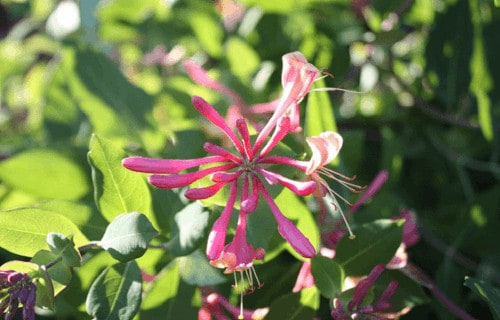
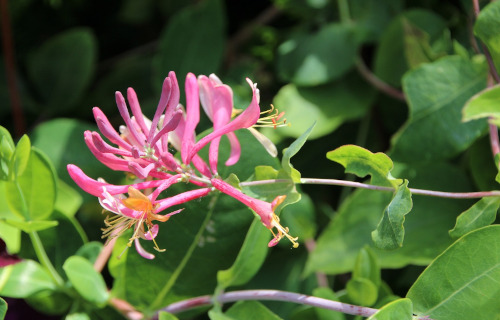
Impressively, the majority of the known types of Honeysuckle evolved as comparatively strong twining climbers in nature. On all of these many varieties, the leaves grow opposite, and develop as very simple ovals. This visually appealing foliage also averages about 4.5 in (10 cm) in length.
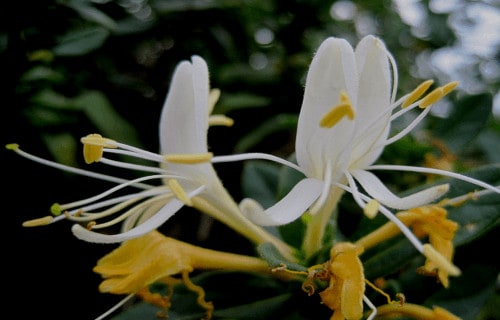
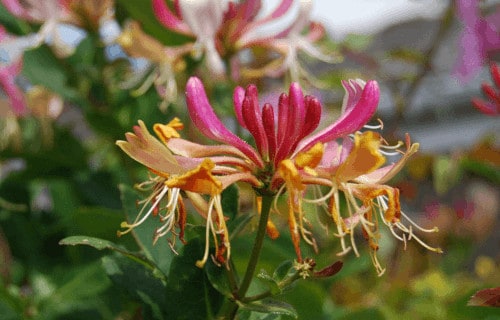
Although most of these marvels evolved as deciduous, some actually develop as evergreens. Many of the individual species also produce strongly sweetly-scented flowers. These blooms also produce small quantities of sweet, edible nectar. Most of the delicate flowers develop in clusters of two.
Both shrubby and vining sorts possess strongly fibrous stems which remain suitable for both binding and textiles. Like many beautiful plants, however, Honeysuckle conceals a somewhat darker secret. That’s because the fruit of the Angiosperm possesses a low level of poisonous compounds.
In appearance, these fruits vary, displaying either a spherical or somewhat elongated shape. Yet, the most commonly seen colors of the small fruit include red, blue, and black. Nonetheless, on very rare occasions, some specimens produce this aspect of the plant in an even wider range of such hues.
- Kingdom: Plantae
- Phylum: Angiosperms
- Class: Eudicots
- Order: Dipsacales
- Family: Caprifoliaceae
- Genus: Lonicera
Honeysuckle Invasiveness
Amazingly, while the fruit of many varieties of Honeysuckle evolved to be comparatively toxic, this trait does have its share of uses. That holds true due to the fact that, in a very few cases, the fruit of the Angiosperm, while extremely small, can be consumed and even used for types of commerce.
This part of the stunning plants also has other natural uses, though. This remains true because the berries of most forms of the natural beauty also remain extremely attractive to numerous forms of local wildlife. For example, an enormous variety of butterflies and hummingbirds adore them.
Most unfortunately, however, several species within this truly remarkable Family have now become considered as invasive. This occurred when human activities introduced them outside their native range. This sad situation holds particularly true in both New Zealand and the United States.
Honeysuckle Popularity
Due to its many fine qualities, the Honeysuckle has now become extraordinarily popular in many regions of the world. This most commonly manifests itself in using it as a garden decoration. Many people now use it both because it smells beautiful, and covers unsightly walls and outbuildings.
This gorgeous and colorful flora has also become quite popular for its sheer pleasure to the different human senses of perception. In fact, a great number of people find it pleasant to employ for the numerous blooms it produces in the summer. These form as quite beautiful and highly aromatic.
The hardy climbing types of this botanical wonder do have certain specific needs, of course. That’s because most forms need the roots located in shade, but the tops prefer sunlight or very light shade. The varieties one uses also need to be chosen with great care because most grow quite prolifically.
Dwarf Crested Iris
CCL: https://bit.ly/3gTEP0a
Dwarf Crested Iris Facts
- Closing out this article about these 5 Louisiana Herbaceous Plants we present you with the stunning flora named the Dwarf Crested Iris.
- The somewhat descriptive term oused for it herein serves as the most frequently used of the common names for this beautiful plant species. The delicate marvel also goes by still another closely related general name. That’s the somewhat simpler term of the crested iris.
- The official scientific name for this beautiful creation of Nature and evolution is the comparatively simple term of Iris cristata. Regardless of which term one uses to refer to it, however, one fact remains consistent. That’s the fact that, while gorgeous, it remains small.
- Though not the first to note it, the Scottish botanist, William Aiton holds the distinction of making the first official recognition of the plant as a separate and distinct species. This scientifically noteable feat the highly renowned researcher accomplished in the year 1789.
- Though it had long been known to the Indigenous Peoples inhabiting its native region, the respected American botanist John Bartram became the first non-native person to notice it. In the 1750’s, he sent several specimens to England. It’s been present there since 1776.
- For the moment, the IUCN has no listing for the breathtaking Dwarf Crested Iris. Any such listing would appear on the organization’s regularly published Red List of Threatened Species. This fortunate state occurs due to its numbers in the wild, as well as in global cultivation.
- The wondrous plant nevertheless still faces some potential threats. Due to this, it’s listed as Endangered in a few parts of its native range. Habitat loss naturally represents one of the dangers it faces. Its greatest threat, though, most likely comes in the form of climate change.
CCL: https://bit.ly/35JhVDl
Dwarf Crested Iris Physical Description
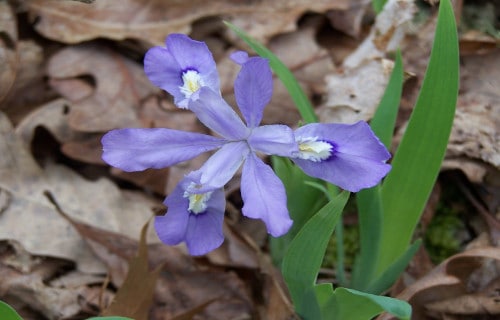
The delicate beauty of the Dwarf Crested Iris certainly merits attention from those who encounter it, of course. That aspect of its biology, however, manifests despite what some might consider a disadvantage. That’s due to the fact that this marvel stands comparatively short in stature.
More precisely, the captivating perennial plant packs all of its outstanding beauty in a package that only attains a maximum known height of around 6 in (15 cm). An average height for this floral variety, however, measures about 4 in (10 cm). Some specimens do not exceed 3 in (7.6 cm).
The iris variety also produces numerous long, slender leaves, which present the observer a moderately deep green color to the observer. This rather distinctive foliage further develops in a highly variable length. These leaves extend outward in lengths ranging from 4 – 16 in (10 – 40.6 in).
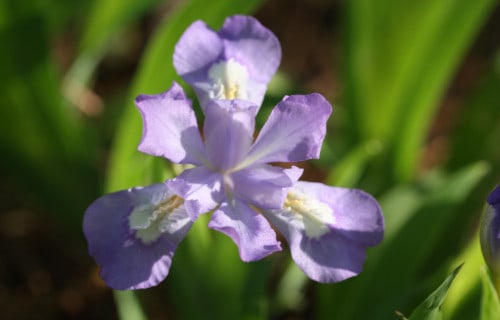
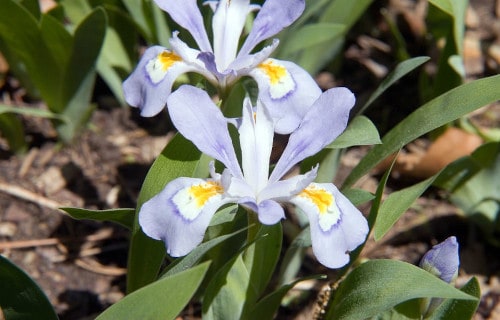
Each separate plant typically produces only a single bloom, though two of these do develop on rare occasions. Remarkably, the petals of these tiny, delicate blooms actually develop in a wide variety of shades. Its sepals, meanwhile, have a white or yellow central band, with a bright purple stripe.
Of further note stands the extreme range of the shades the gorgeous petals of the Dwarf Crested Iris evolved to manifest. These, in fact, develop across the spectrum lying between blue to purple to white. This range additionally varies from individual plant to plant, with no apparent pattern.
- Kingdom: Plantae
- Phylum: Angiosperms
- Class: Monocots
- Order: Asparagales
- Family: Iridaceae
- Genus: Iris
- Species: I. cristata
CCL: https://bit.ly/3gQr95Y
Dwarf Crested Iris Distribution, Habitat, and Ecology
Unfortunately for those who appreciate its beauty in the wild, the Dwarf Crested Iris possesses a somewhat limited native range of distribution. That’s due to the fact that the diminutive beauty appears to currently exist naturally in only a small portion of the Northern Hemisphere.
That indigenous range of habitation covers portions of a total of nineteen states in the United States, in North America. These specific states appear in the northeastern, north-central, and southeastern portions of the country. For now, evidence indicates the plant never spread elsewhere.
Somewhat surprisingly, this tiny Angiosperm evolved as endemic to soil containing relatively high ratios of the mineral lime. Given this, the mesmerizing plant most frequently appears naturally in areas such as rocky hillsides, ravines, oak woodlands, mountain ledges, and along gentle streams.
These regions, however, also need to meet yet another condition for the plant to thrive. These conditions must include the specific site to be well drained in nature. If excessive moisture remains present in the local soil, the species does poorly, severely limiting its potential expansion.
Pollination of the Dwarf Crested Iris principally occurs due to the activities of several types of locally prevalent bees. Several varieties of hummingbirds, though, also seem to favor the flowering plant, finding its nectar especially appealing. In cultivation, it also reproduces via root division.
This wonder of Nature also apparently prefers areas comprised of cool, partially shaded conditions, but also does reasonably well in direct sunlight. Its magnificent flowers typically appear in early Spring. Afterward, the plant most frequently goes dormant during the local Winter season.
Local Native American populations, especially the Cherokee, have long used it in their traditional medicines. Caution must nevertheless be taken with the little beauty. That’s because, like many of its closely related species, many parts of this wonder of evolution are moderately poisonous.
CCL: https://tinyurl.com/2s4apsss
5 Louisiana Herbaceous Plants
We greatly hope that each of you thoroughly enjoyed reading, and hopefully learning something from, this article we’ve written about these 5 Louisiana Herbaceous Plants. It’s also our hope that doing so has left you with either a new or renewed appreciation for such wonders of Nature.
Unfortunately, however, many of their numerous relatives across the globe now find themselves facing strong threats to their continued existence as a species. Many of those dangers, in fact, stem from the actions of mankind. We must each do all we can to protect and preserve them all.
Check out our other articles on 5 Lively North American Lizards, New Zealand Sea Lion, Nile River, Socotra Starling, Cucumber Tree, Rose’s Ghost Frog, Baltimore Checkerspot, Earless Monitor Lizard