CCL: https://tinyurl.com/2s4apsss
We truly hope that each of you, our readers, will greatly enjoy and appreciate this article we present about these 5 Perfect Insects of Poland. It was certainly our pleasure to gather the different information for your perusal. May it provide you with both education and increased awareness.
Certainly, while fascinating, these few species listed herein represent only a tiny portion of the similar wonders found around the world. It’s our belief, though, that they serve as excellent representations of their kind that exist. Check out some of our other articles for similar marvels.
Tree Bumblebee
CCL: https://tinyurl.com/462rnnjn
Tree Bumblebee Facts
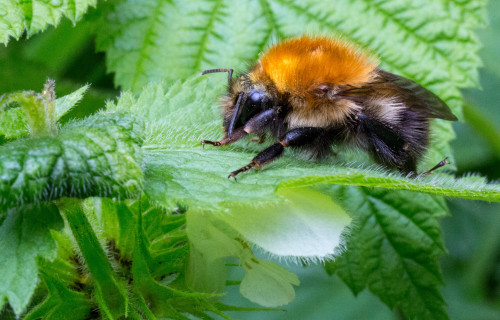
- Leading off this article about these 5 Perfect Insects of Poland we present the lovely and intriguing wonder known as the Tree Bumblebee.
- This very beautiful Arthropod is most typically referred to by this attention-grabbing common name across the entirety of its native range. The small insect does have at least one other general title, though. That’s the somewhat intriguing term of new garden bumblebee.
- Inside of the scientific community, however, the delicate creature perhaps more frequently goes by yet another tag. Fortunately, that’s a relatively simple one for the layperson to pronounce, as such go. That’s because it holds the technical moniker Bombus hypnorum.
- The invertebrate received that specific designation due to the efforts of Carl Linnaeus himself. The highly esteemed Swedish researcher accomplished the first recognition of it as a separate and distinct species. He managed that scientifically noteworthy deed in the year 1758.
- It’s possibly most well known among entomologists due to one particular evolutionary pattern. The small animal generally chooses to inhabit regions that most others of its kind typically avoid. The bumblebee thus fills an environmental niche that would otherwise be vacant.
- Fortunately, the amazing Tree Bumblebee appears to be maintaining a population base that’s both stable and sufficient. That pleasant state also seems to hold true throughut its territory. The IUCN therefore presently lists it as Least Concern on its Red List of Thretened Species.
- The wonder of Nature nevertheless still faces several potential threats to its continued existence as a species. In this, it’s simply following a sad pattern now common to all life on this planet. It’s now facing the perils posed by habitat loss and ongoing climate change.
CCL: https://tinyurl.com/22y23f9m
Tree Bumblebee Physical Description
The remarkable Tree Bumblebee typically draws attention from those individuals fortunate enough to notice one in the wild. Like most of its kindred around the world, however, it usually does so for its appearance more than for size. Yet, in this manner, it distinguishes itself extremely well.
As with virtually all known bees, the insect displays a different type of the physiological characteristic known as sexual dimorphism. The species also evolved as divided into three castes. Queens develop as larger than males or workers. In fact, the difference is often quite noticeable.
The mighty queens of each colony achieve the greatest physical dimensions, by far. This trait varies, sometimes greatly, among individuals, though. But, overall, these average a total body length of approximately 0.63 – 0.87 in (1.6 – 2.2 cm). Though rare, some examples exceed even this.
Members of the worker class, however, generally evolved to remain much smaller. Individuals of this class only reach mean lengths measuring about 0.4 – 0.47 in (1.0 – 1.2 cm). Males, meanwhile, also vary in size, but generally achieve dimensions slightly greater than that of the workers.
Other differences serve to further distinguish the differing social castes of the amazing Tree Bumblebee. The males, for one, display a significantly chunkier shape than the others. Queens and drones, however, have sharper ends to their abdomens, as well as somewhat shorter antennae.
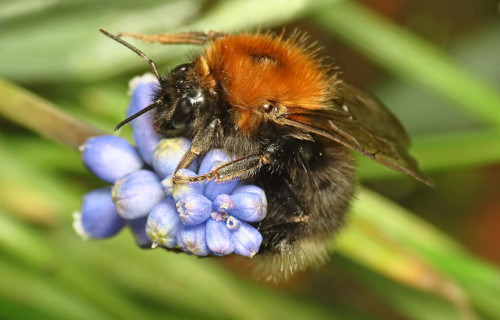
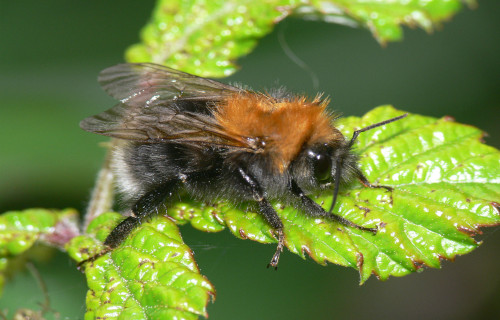
Yet, it’s the stunning coloring of this insect that usually most catches the eye. The thorax of the species presents a covering of hair with a gorgeous ginger shade. Its abdomen, though, displays black hair. But, that on the tail manifests a dazzling white hue, making for an amazing contrast.
- Kingdom: Animalia
- Phylum: Arthropoda
- Class: Insecta
- Order: Hymenoptera
- Family: Apidae
- Genus: Bombus
- Species: B. hypnorum
CCL: https://tinyurl.com/2dcehfvs
Tree Bumblebee Distribution, Habitat, and Ecology
The visually appealing Tree Bumblebee evolved as native to a relatively large expanse of the surface of the earth. The full extent of that zone of habitation, in fact, might surprise some people. That’s true since this natural wonder developed as endemic to most of Europe and northern Asia.
On the European continent, the biological marvel natively inhabits only the continental regions. That natural territorial range additionally reaches as far north as northern France. Elsewhere, though, the creature developed natively as far east as the Kamchatka Peninsula, in Russia.
The awesome product of evolution displays decidedly unique preferences regarding where it chooses to live. These habitat zones all lie within temperate climates, to be certain, however. Yet, within these conditions, the bumblebee makes its home in a range of truly surprising locations.
The bee most frequently appears in forests, usually deciduous one’s. In those regions where trees don’t appear in abundance, though, it tends to seek out an unusual alternative. In such settings, it resides in human residences! There, it makes its nest in almost any available hole it can find.
Workers of the amazing Tree Bumblebee forage for vital pollen and nectar. Once acquired, they return with this to the nest. Intriguingly, the species seems to be especially attracted to various plants with downward-facing blooms, like comfrey. Yet, it does also visit other plants as well.
It’s generally observed between the months of March and July, but sometimes does remain active for longer periods of time. Individuals are also extremely active, moving rapidly from plant to plant. Nest size always varies, of course, but rarely exceeds more than a few hundred individuals.
Old World Swallowtail
CCL: https://tinyurl.com/2s4apsss
Old World Swallowtail Facts
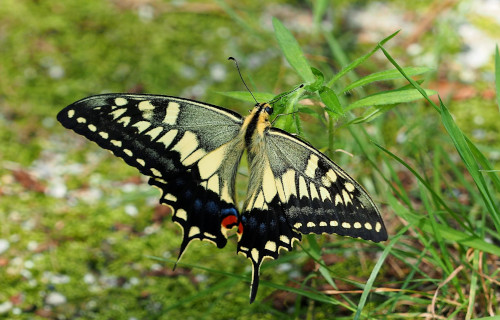
- Next up in this compilation of 5 Perfect Insects of Poland comes the always captivating work of living art named the Old World Swallowtail.
- The most often employed common name for this gorgeous creation of Nature and evolution is the informative term that we’re applying herein. The stunning invertebrate does have other alternate titles, though. These include the similar epithet common yellow swallowtail.
- Within most scientific circles, however, the delicate creature’s likely much better known by its technical label. Thankfully, that’s a relatively simple term for the layperson to pronounce. That’s because the truly lovely Lepidoptera holds the official moniker of Papilio machaon.
- The Arthropod received that scientific designation due to the efforts of Carl Linnaeus himself. The eminent Swedish zoologist accomplished the first recognition of the animal as a separate and distinct species. That scientifically noteworthy deed occurred in the year 1758.
- It’s fully notable for far more than just its great beauty, though. That’s due to an particularly impressive statistic the insect holds. That’s true since, to date, entomologists recognize an extraordinary total of 41 separate subspecies of this intriguing butterfly still in existence.
- Fortunately, the amazing Old World Swallowtail appears to be maintaining a population base that’s both sufficient and stable. This pleasant state of affairs further seems to hold true across the entirety of its range. The IUCN therefore currently lists it as Least Concern on its Red List.
- The magnificent insect nonetheless must be considered as facing the same potential threats to its existence as all other species, at least. Most of these perils stem from the actions of mankind. They include such varied dangers as habitat loss and ongoing climate change.
CCL: https://tinyurl.com/bdes27an
Old World Swallowtail Physical Description
The truly breathtaking Old World Swallowtail typically captivates those individuals fortunate enough to encounter the marvel. Pure physical size isn’t generally one of those, though. That’s because, regardless of its eye-catching appeal, it’s a roughly average-sized member of its Order.
It distingishes itself in this regard in one very specific manner, however. That’s true given that fact that, unlike most of its kindred, it displays no noticeable degree of the physiological characteristic of sexual dimorphism. This makes identifying the genders difficult for many of its observers.
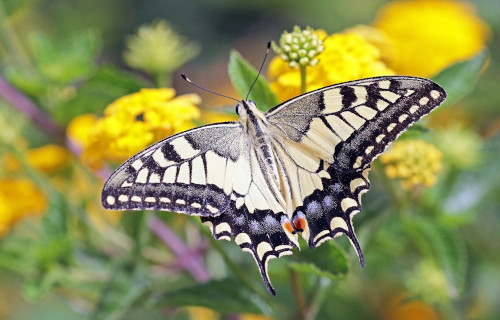
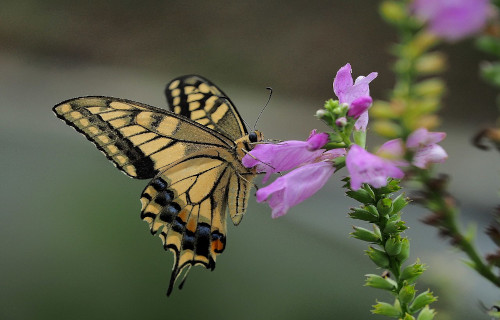
The body of the caterpillar stage of both sexes of the wonder attains an average length equaling approximately 1.8 in (4.6 cm). That of the mature adult retains roughly the same measurement. Though mostly showing black above, with yellow trim, the underside mainly presents as yellow.
It’s the captivating wings of the visually stunning Old World Swallowtail that generally garner the most attention, however. These appendages often vary significantly in wingspan, regardless of gender. On average, this equals between 2.6 – 3.4 in (6.5 – 8.6 cm). Few exceed this by much.
On the upperside of both hindwings, a distinctive feature usually appears. That’s the existence of a relatively large eyespot located near the tail of the remarkable invertebrate. This itself shows a reddish-orange shade, with the presence of a black border near the edge of the hindwing.
Further enhancing this is the presence of 6 small, blue eye-spots located on the same wing. Yet Nature isn’t done with this wonder of evolution yet. These same hindwings also possess a pair of sharply protruding tail-like structures. These provide a resemblance to the bird of the same name.
- Kingdom: Animalia
- Phylum: Arthropoda
- Class: Insecta
- Order: Lepidoptera
- Family: Papilionidae
- Genus: Papilio
- Species: P. machaon
CCL: https://tinyurl.com/33psz7af
Old World Swallowtail Distribution, Habitat, and Ecology
The intensely beautiful Old World Swallowtail apparently evolved as native to an extremely wide expanse of the surface of the earth. The precise location of that zone of habitation, though, probably won’t surprise many people, though. It’s clearly intimated by the very name of the Arthropod.
The mesmerizing insect developed as partly endemic to what’s known as the Old World region of the earth. Yet the invertebrate also evolved as native to an even greater range. That includes the entirety of both Europe and Asia, and even extends to portions of the northern sections of Africa.
The intrepid animal also demonstrates a decidedly flexible approach to its preferences regarding its choice of habitat. The butterfly therefore inhabits a moderately broad range of ecosystems. These typically consist of such regions as areas of meadows, hilltops, and even areas of tundra.
It further displays an amazing adaptability to an extensive range of altitudes across its native range. In some regions, the invertebrate lives near sea level. In other sections, though, like the Kashmir Valley, individuals sometimes appear at heights of up to as great as 16,000 ft (4,877 m).
Like its countless living relatives, the Old World Swallowtail developed as entirely herbivorous in nature. Adults of this particular species primarily feed on the flower nectar of plants from a single Family. In its case, this consists of members of what’s commonly known as the celery Family.
After concluding the mating process, females lay eggs individually, usually on the underside of a food plant. The caterpillar form feeds on a wider variety of sources than the adults. The males of the beautiful butterfly frequently congregates in numbers to compete for approaching females.
European Hornet
CCL: https://tinyurl.com/ysjddhbz
European Hornet Facts
- Our next choice for inclusion in this gathering of these 5 Perfect Insects of Poland bears the wonderfully descriptive title of European Hornet.
- This dazzling Arthropod most frequently goes by this highly informative common name throughout the majority of its natural range. Yet, the lovely invertebrate does have at least a few alternate general titles. These include such terms as giant hornet or brown hornet.
- Within the scientific community, however, it’s perhaps much better known by its purely technical designation. Thankfully, that’s an extremely simple one for the average layperson to pronounce. That’s because this insect holds the official moniker of Vespa crabro.
- The marvel of Nature received that epithet due to the efforts of the famous Carl Linnaeus. The highly esteemed Swedish zoologist accomplished the first recognition of it as a separate and distinct species. He managed that scientifically noteworthy deed in the year 1758.
- Until recently entomologists believed that at least one subspecies of this natural marvel existed. In-depth research, though, subsequently proved this to be an erroneous assumption. What was thought to be a subspecies turned out to be merely regional variations.
- Fortunately, the amazing European Hornet appears to be maintaining a population base that’s both stable and sufficient in nature. That pleasant trend also seems to hold true across its entire native range. The IUCN therefore presently has no listing for it on the Red List.
- The impressive creature nevertheless should be considered as facing several potential threats to its continued existence as a species, at least. Not surprisingly, most of these stem from the actions of mankind. They include the perils of both habitat loss and climate change.
CCL: https://tinyurl.com/2dcehfvs
European Hornet Physical Description
The remarkable European Hornet certainly captures the attention of most individuals fortunate enough to encounter one. Unfortunately, though, that’s not usually due to its visual appeal, despite its presence. Most people hold completely erroneous beliefs concerning its behavioral patterns.
That’s truly a shame, because this invertebrate boasts some highly appreciable phsyical attributes. In this regard, it follows a pattern of development that predominates among its relatives around the world. That’s in the fact that the insect displays a specific version of sexual dimorphism.
In its case, however, this physiological characteristic mainly manifests itself in terms of size. Yet, it also does so in regard to gender, too. That’s true since, like most bees and wasps, the creature possesses a three-caste system. Each of these castes presents very different outward features.
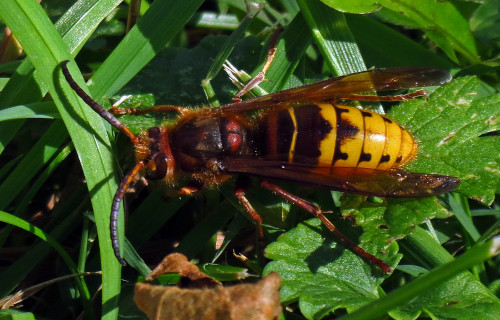
Not surprisingly, queens of the marvel attain the greatest average dimensions. These sometimes reach lengths equaling as much as 1.4 in (3.5 cm). Most, though, do not quite reach this size. She also has a greater mass than either the males or workers. Coloring is the same for all, though.
Workers, meanwhile, typically grow to an average length measuring approximately 1 in (2.5 cm). Their body shape, and likewise mass, also remains notably less than that of the queen. Along with her, these members of the hive additionally possess a total of only six abdominal segments.
Males of the European Hornet distinguish themselves from the other castes. They attain a slightly smaller size than the workers, who are all female. These also lack the stinger that the workers develop. But, while smaller than the others, their abdomens actually have seven sections.
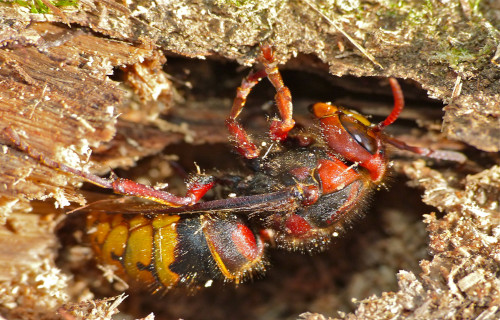
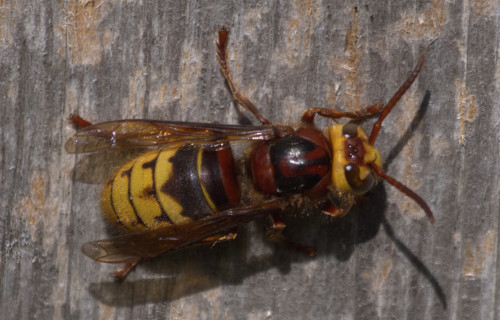
Otherwise, outward appearance remains virtually identical for all members of the species. The wings of this Arthropod generally present a pale reddish-orange. Its thorax, though, displays a striped pattern of yellow and brown. It also has a thing covering of hair on its thorax and abdomen.
- Kingdom: Animalia
- Phylum: Arthropoda
- Class: Insecta
- Order: Hymenoptera
- Family: Vespidae
- Genus: Vespa
- Species: V. crabro
CCL: https://tinyurl.com/2s4apsss
European Hornet Distribution, Habitat, and Ecology
The amazing European Hornet evolved as native to a surprisingly large expanse of the surface of the earth. The exact placement of that zone of habitation might surprise some people, however. That’s because, despite the implication of its name, it isn’t merely native to the landmass of Europe.
The highly impressive Hymenoptera also developed as endemic to certain parts of Asia, as well. Within that greater territory, its range extends from the United Kingdom, in Europe, to as far away as Japan, in Asia. Now, though, it’s also been introduced into many other areas of the world.
Nature provided the marvel of the insect world with an evolutionary advantage over some similar species. That’s due to the fact that it evolved a moderate flexibility regarding its choice of habitat. The hornet therefore appears in a reasonably wide range of marginally similar ecosystems.
All of these, however, are situated with purely temperature climates, wherever they appear. Inside such regions, though, it inhabits a braod array of places. It often lives in such locations as grasslands and forests. It’s even adapted to living in proximity to, and sometimes even inside, human homes.
Like most of its kind, the captivating European Hornet lives as a eusocial animal. It constructs nests, which it makes from chewed paper. Most colonies contain between 200 – 400 workers, along with a handful of males and a single queen. Larger nest, though, may contain as many as 1,000 workers.
The inverebrate further evolved as primarily carnivorous in nature, like its relations. Its typical prey consists of fairly large insects, such as mantises, dragonflies, moths, beetles, and even other wasps. Yet, the insect also consumes small amounts of fallen fruit, or other ready sources of sugar.
Red Wood Ant
Red Wood Ant Facts
- Now appearing in this compendium of 5 Perfect Insects of Poland holds the fully appropriate designation of the Red Wood Ant.
- This impressive Arthropod most frequently goes by the uniquely descriptive common name found in this article for obvious reasons. It does have a few other general titles it’s known by, though. These include the terms southern wood ant, and, for some bizarre reason, horse ant.
- Among scientific professionals, however, it’ typically holds another moniker’s more likely known by another title. That’s it technical appellation. Thankfully, that’s an extremely simple term for the layperson to pronounce. That’s because it holds the formal tag of Formica rufa.
- The amazing invertebrate received this short honorific due to the efforts of the great Carl Linnaeus. That esteemed Swedish zoologist accomplished the first recorded acknowledgement of it as a separate and distinct species. He managed that noteworthy feat in 1761.
- This variety of ant stand out from many others due to a combination of several factors. It constructs massive colonies, often housing over 400,000 individuals, as well as multiple queens. The marvel also forms supercolonies, connecting multiple nests across large areas.
- Unfortunately, the intriguing Red Wood Ant appears to possess a rapidly diminishing population base. That lamentable situation further seems to hold true throughout the entirety of its native range. The IUCN therefore presently lists it as Near Threatened on its Red List.
- It currently faces multiple threats to its continued existence as a species. Like many creatures, most of these stem from human activities. Habitat loss remains its most immediate danger. Nevertheless, the insect also now faces the severe threat on ongoing climate change.
Red Wood Ant Physical Description
The remarkable Red Wood Ant represents a highly intriguing species that quickly beguiles most individuals fortunate enough to encounter it. Visually, though, the creature maintains the same approximate physical pattern displayed by its innumerable relatives found throughout the world.
Like those seemingly innumerable kindred, this particular ant displays a specific variation of the physiological characteristic known as sexual dimorphism. The members of the classes of the invertebrate present differing physical sizes. Each also tends to present slightly varying colors, too.
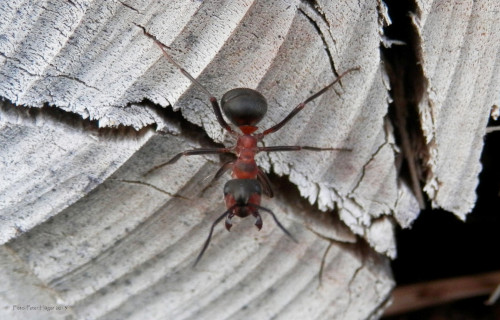
As remains common, the Queen always attains the greatest body length of any members of the species. This individual achieves an average measurement equaling roughly 0.28 – 0.35 in (7 – 9 mm). She further usually displays a darker shade of brown, with her underside being lighter.
The males grow to a much smaller size than their royal counterpart. These develop body lengths equaling an average of only 0.12 – 0.16 in (3 – 4 mm). In coloring, each typically shows a much darker aspect than the queen. This pattern mainly consists of a black and dark brown.
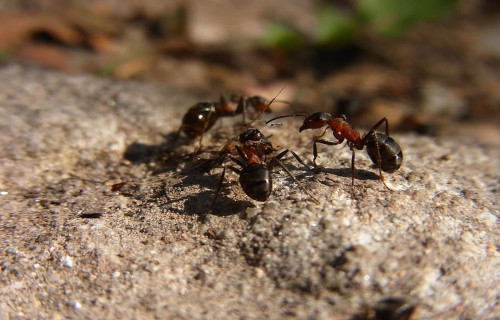
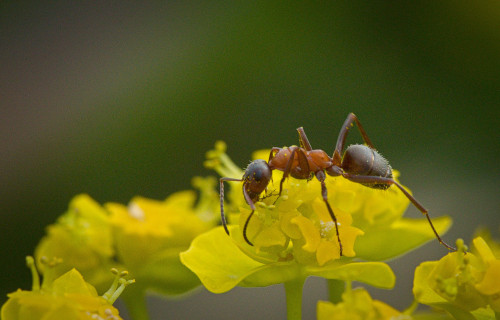
The significantly more numerous worker caste of the distinctive Red Wood Ant manifests yet another color scheme. This evolutionary trait almost always includes a much brighter combination of shades. These usually range from various hues of bright yellow to a brownish-yellow.
Between them, however, the three distinctly different castes also evolved widely varying characteristics in other, minor ways. Workers have far fewer hairs on their heads than the others. Queens have relatively narrower heads than the others. Males, though, generally combine these.
- Kingdom: Animalia
- Phylum: Arthropda
- Class: Insecta
- Order: Hymenoptera
- Family: Formicidae
- Genus: Formica
- Species: F. rufa
CCL: https://rb.gy/c88gh
Red Wood Ant Distribution, Habitat, and Ecology
The remarkable Red Wood Ant evolved as native to an extremely broad swathe of the surface of the globe. The full extent of that natural zone of habitation might surprise some people, though. That’s because it developed as indigenous to much of both the continents of Europe and Asia.
Confirmed reports place the wonder naturally as far north in Europe as parts of Scandinavia. From there, however, its range reaches further outward, through Iberia, Anatolia, and Great Britain. Not stopping there, it also lives as far away as Lake Baikal, situated in remote southern Siberia.
The widespread marvel of Nature also possesses an extremely impressive versatility regarding its choice of habitat. As a result, it resides in a wide range of ecosystems. Nevertheless, the intrepid creation of evolution does display a moderate preference for several types of environment.
Many populations appear in such areas as regions of open heath and grasslands. Others, however, choose to build their homes in areas consisting of either scrub or open glades. Many even construct their colonies in coniferous plantations, unperturbed by the proximity to human presence.
Despite its relatively tiny stature, the Red Wood Ant continues to be considered a keystone species across its full native range. Their nest consist of large, dome-shaped structures on the ground. Each colony generally persists for many years, with their feeding controlling numerous forest pests.
Each ant primarily consumes honeydew, produced by extraordinarily tiny aphids. Yet they also augment this food source with quantities of various local invertebrates. These include arachnids and insects. In this manner, the Arthropod directly affects the food chain in its specific habitat.
Red-Tailed Bumblebee
CCL: https://bit.ly/2YwiYDj
Red-Tailed Bumblee Facts
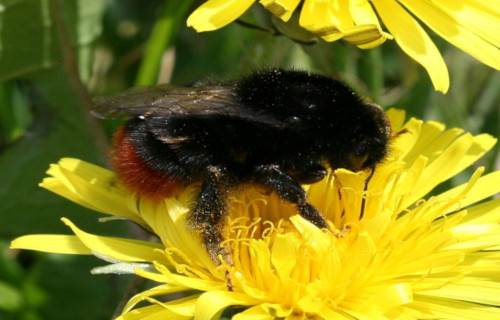
- Closing out this article about these 5 Perfect Insects of Poland we present the other bumblebee on the list, the fittingly named Red-Tailed Bumblebee.
- This beautiful creation of Nature and evolution most frequently goes by the simple, yet descriptive, common name for the entirely obvious reason. It does have a few other titles, though. These include Stone bumblebee, Lapidary bumblebee, and Fire-tailed bumblebee.
- Inside of the scientific world, however, it’s perhaps much better known by its technical designation. Thankfully, that’s a comparatively simple one for the layperson to pronounce. That’s because this beautiful biological wonder bears the official moniker Bombu lapidarius.
- The invertebrate received that epithet due to the efforts of the famous Carl Linnaeus himself. That renowned Swedish zoologist accomplished the first formal acknowledgement of it as a separate and distinct species. He achieved that scientifically noteworthy deed in the year 1758.
- Fortunately, the amazing Red-Tailed Bumblebee appears to be maintaining a population base that’s still stable and sufficient. That state also seems to hold true throughout the entirety of its natural habitat range. The IUCN therefore does not currently show it on its published Red List.
- Lamentably, it does appear to be declining in some agricultural areas, though. That’s generally attributed to a combination of pesticide use, monoculture crops, and intensive farming practices. Due to this, it’s now considered Near Threatened in specific portions of its range.
- It also must deal with the same greater dangers as all other forms of life on the planet today. Most of those hazards stem from the actions of mankind. Although many of these exist, its greatest threats likely consist of the closely related one’s of habitat loss and climate change.
CCL: https://bit.ly/3iNoVoA
Red-Tailed Bumblebee Physical Description
The visually striking Red-Tailed Bumblebee almost always receives its due measure of attention from those who encounter one of these marvels. Yet, that does not happen due to any impressive physical statistics. That’s true since, even among its many relatives, it’s a slightly small bee.
It does, however, follow an evolutionary pattern common among may species, including its kindred. That’s the fact that it displays a moderately high degree of the physiological trait of sexual dimorphism. In its case, this characteristic manifests itself in terms of both color and pure size.
In terms of its size, males of this Arthropod attain a slightly greater average size than their female counterparts. This gender typically averages between 0.55 – 0.63 in (14 – 16 mm) in total length. The females of the species reach mean lengths equaling between 0.43 – 0.63 in (11- 16 mm).
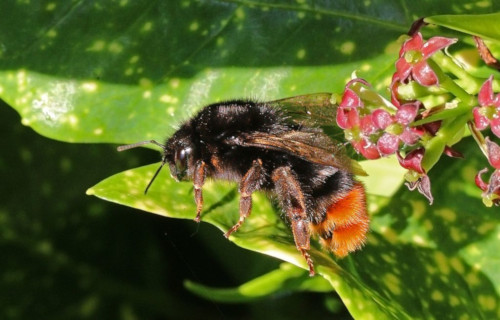
It additionally displays this gender-based difference in terms of patterns of color. That manifests with the males of this awesome insect presenting three bands of yellow, one at the base of the abdomen, and two on the thorax. It also has the standard red tail from which it derives its name.
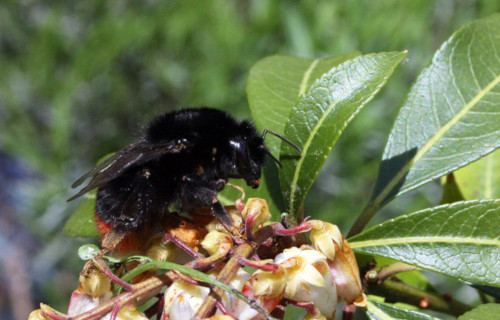
Meanwhile, females of the Red-Tailed Bumblebee, including the queen usually present a slightly different appearance. Interestingly, these lack any of the yellow bands. This gender of the invertebrate also displays a more extensive red-colored section, covering roughly half the abdomen.
Other parts of the body also merit attention, and present the same general patterns regardless of sex. Its wings evolved as semi-transparent, and somewhat darkened with a smoky appearance. The short legs developed as strong and rather hairy, with specialized structures on its hind appendages.
- Kingdom: Animalia
- Phylum: Arthropoda
- Class: Insecta
- Order: Hymenoptera
- Family: Apidae
- Genus: Bombus
- Species: B. lapidarius
CCL: https://bit.ly/3csvBaH
Red-Tailed Bumblebee Distribution, Habitat, and Ecology
There’s very fortunate news for those who appreciate the beauty of Nature. That’s due to the fact that the Red-Tailed Bumblebee evolved as native to a relatively broad swathe of the world. More specifically, it developed as indigenous to a particular portion of the continent of Europe.
With further precision, in this region population concentrations appear throughout the entire zone of habitation. The diminutive creature does, however, appear in greater concentrations in certain areas. These include the countries of Greece, Britain, Sweden, Finland, and Germany.
Sadly though, in the country of Ireland its numbers seem to be declining rapidly. Wherever the insect lives, however, it typically proves itself to be highly adaptable in terms of where it makes its home. That’s because population groupings manifest in several very different habitat types.
These locations even include such public regions as private gardens and public parks. It most commonly chooses to live in areas consisting of very open terrain, though. Unlike some varieties of related species, though, it generally avoids living in areas of moderate to heavy forestation.
The beautiful Red-Tailed Bumblebee generally makes its appearance in the summer, between June and August. Being social insects, like many Hymenoptera, all members of the hive work closely together. In its case, there’s little hierarchy among workers, just between them and the queen.
Most types of bumblebees generally stay close to their own hive when foraging. This one, however, tends to roam relatively great distances in search of food sources. Some individuals, in fact, venture as much as 5,741 ft (1,750 m) from the hive. For one of its kind, that’s an extreme distance.
The hives themselves, meanwhile, appear in widely varied types of locations. In this, it shows itself to be a highly opportunistic species. Locations for nests include such unexpected areas as under large stones or fallen logs. Colonies remains small, though, rarely exceeding 200-300 individuals.
CCL: https://tinyurl.com/bdes27an
5 Perfect Insects of Poland
We hope that each of you enjoyed reading, and hopefully learning something from, this article we’ve written about these 5 Perfect Insects of Poland. It’s also our fervent hope that doing so has left you with either a new or greatly renewed appreciation for such amazing wonders of Nature.
Unfortunately, however, many of their kindred around the world now find themselves facing strong threats to their continued existence as a species. Many of those dangers, in fact, stem from the actions of mankind. We must continue to do all we can to protect and preserve them all.
Check out our other articles on 5 Astouding Asian Wild Cats, Earth’s Amazingly Abundant Avians, 5 Remarkable Bolivian Herbaceous Plants, Spectacular Halloween-Appropriate Species

Leave a Reply