


CCL: https://tinyurl.com/22y23f9m
We truly hope that each of you, our loyal readers, will greatly enjoy and appreciate this article we present to you about these 5 Perfectly Pleasing Primates. It was certainly our pleasure to gather the information for you. May it provide you with both education and increased awareness.
Certainly, these few magnificent species grouped herein represent only a tiny portion of the similar species found throughout the world. It’s our belief, though, that they serve as excellent representations of the members of this Order. Check out our other articles for similar marvels.
Red-shanked douc
CCL: https://bit.ly/3eRYCKx
Red-shanked douc Facts
- Leading off this article about these 5 Perfectly Pleasing Primates we present the colorful creature known as the Red-shanked douc.
- This highly descriptive term perfectly serves as the most frequently used common name for a most remarkable species of primate. The animal does have other general titles, though. These include the terms Costumed monkey, Five-colored macaque, and Red-legged douc.
- In scientific circles, however, this fabulous animal’s likely much better known by its technical designation. LIke most such monikers, though, that’s hard for the layperson to pronounce. That’s because the mammal holds the hard to pronounce name formal of Pygathrix nemaeus.
- But, regardless of which name one uses to refer to it, one fact stands out about the amazing creature. That statement has to do with its intriguing appearance. Quite understandably, many consider this marvel of Nature to be among the most colorful of all known primates.
- Due to the comparative remoteness of its native habitat, it’s only been studied in any detail in modern times. Astoundingly, before the year 1967 this magnificent creation of Nature remained completely unstudied. As a result, even now some details about it remain unknown.
- The limited information currently available about the beautiful Red-shanked douc, however, concerns many individuals. Due to the nature of that data, the IUCN lists it as Endangered. This unfortunate status appears on the organization’s Red List of Threatened Species.
- Lamentably, the known population of the species only totals approximately 1,300 individuals. Its limited native range also makes it vulnerable to habitat loss. Both these factors subsequently render it especially vulnerable to the threat posed by the ongoing effects of climate change.
CCL: https://bit.ly/373BCWp
Red-shanked douc Physical Description
The attention-grabbing Red-shanked douc generally does exactly that with those who see it for the first time, namely seizing their interest. The natural marvel usually does so, though, due to its highly distinctive appearance. In terms of sheer size, it’s a comparatively small example of its kind.
The remarkable creature shares many physical attributes with its related species. Among these stands the fact that it evolved a relatively long, slender body shape. Much like those same relatives, and indeed many species, it also displays a moderate degree of the trait of sexual dimorphism.
In its case, this evolutionary principle manifests itself in terms of pure physical size. As a result, the males of the fascinating creature attain a greater average body length than their female counterparts. However, the degree of mean difference in this regard actually generally equates to less than 10%.
Males reach an average head and body length measuring about 24 in (61 cm). The female, meanwhile, averages around 21.5 in (54.5 cm) in length. Among both genders, the tail usually adds an additional 22 – 30 in (56 – 76 cm). Males further average 24 lb (11 kg), and females 18.6 lb (8.4 kg).
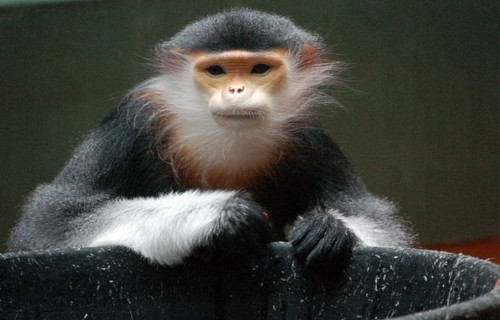
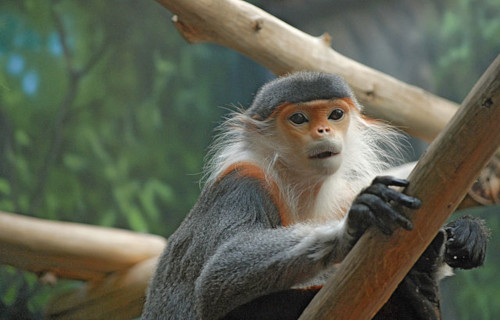
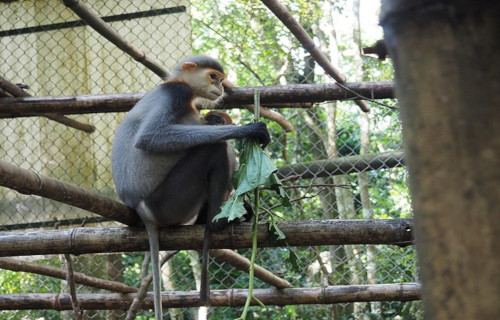
Yet, the coloring of the animal itself easily represents the most distinctive characteristic of the Red-shanked douc. The back and stomach present a light gray color. But the lower legs show a deep red, while the feet and hands appear black. The upper legs and forearms display a white color.
The face, though, displays the most striking appearance. Its skin appears yellowish-orange, along with the ears. The eyelids, however, show a light powder-blue shade. The eyes also have an almond shape, and the nose grows very small. It even displays long white whiskers on the chin and cheeks.
- Kingdom: Animalia
- Phylum: Chordata
- Class: Mammalia
- Order: Primates
- Family: Cercopithecidae
- Genus: Pygathrix
- Species: P. nemaeus
CCL: https://bit.ly/2zspT7l
Red-shanked douc Distribution, Habitat, and Ecology
Unfortunately, the astonishing Red-shanked douc evolved as indigenous to an extremely restricted section of the earths surface. Given its exotic nature, however, the setting for that likely won’t surprise many people. That’s due to the fact that the wonder of evolution’s native to Asia.
Within that greater overall region, though, it only lives in a very tiny portion of the area. That’s because it appears to only live in a very small section of the region known as Indochina. More precisely, the animal lives in scattered parts of the country of Vietnam and southern areas of Laos.
Pleasantly, however, this may not be its only area of habitation in. That’s due to an unsual, and currently unresolved situation. To the hopeful surprise of many, sightings of it occasionally occur in northeastern Cambodia, as well. For the moment, though, these reports still remain unconfirmed.
Within its given range, however, this remarkable primate seems to be relatively adaptable to differing habitats. That holds true since individuals appear in areas of both mountain and lowland areas. Sightings of the monkey also take place in primary, secondary, and partially deciduous forests.
But, in all areas it inhabits, certain preferences clearly predominate. The magnificent Red-shanked douc appears almost exclusively in either the middle or upper regions of the forest canopy. The beautiful mammal rarely descends to the ground, since it acquires its water through its food.
Like its many kin, the remarkable species of mammal evolved as a complete vegetarian. In its specific case, that diet mainly consists of various leaves high in fiber content. It does nonetheless occasionally consume smaller quantities of seeds, bamboo shoots, buds, flowers, and also fruit.
It additionally evolved a principally diurnal pattern of behavior. The primate spends the majority of its life in the canopy. There, and also like others of its kind, it lives as a strongly social animal. Groups typically number 4 -15 individuals. Groupings of as many as 50 have been seen, though.
Gray Mouse Lemur
CCL: https://bit.ly/3jwT5x2
Gray Mouse Lemur Facts
- Next up in this compilation of 5 Perfectly Pleasing Primates comes one with some extraordinary characteristics, the Gray Moust Lemur.
- This distinctive creation of Nature and evolution most often goes by the descriptive common name that we’ve chosen to use herein. Yet the animal also has a few other general titles, as well. These includes the very similar term of lesser mouse lemur, among several others.
- Within the scientific community, however, it’s perhaps much better known by its technical appellation. Like most such titles, though, that’s somewhat hard for the layperson to pronounce. That’s because this mammal holds the formal moniker Microcebus murinus.
- The animal received that name due to the efforts of John Frederick Miller. Though not a scientist, the British illustrator nevertheless achieved credited for the first recognition of it as a separate and distinct species. That scientifically noteworthy event occurred in the year 1777.
- The intriguing Gray Mouse Lemur inhabits a limited range, and quite sadly, its population numbers appear to be diminishing, albeit slowly. Despite that, the IUCN currently lists it as Least Concern on its Red List. That official status might change in the very near future, though.
- The species presently face multiple threats to its continued existence in the wild. At present, its most immediate threat comes from habitat loss due to human activities. Yet the natural marvel also now faces the same looming threat of ongoing climate change as all species do.
CCL: https://bit.ly/3yvG1hT
Gray Mouse Lemur Physical Description
The magnificent Gray Mouse Lemur truly earns the level of appreciation it receives from those individuals fortunate enough to encounter it. The creature does so, though, due to a unique combination of factors. Intriguingly, each of those features pertain to its physical characteristics.
Most lemurs display no noticeable amount of gender-based physical differences. This remarkable species, however, does so. Yet it also manages to do it due to a combination of two very specific traits. This results in a truly intriguing display of the physiological trait of sexual dimorphism.
Incredibly, the female of the species develops a slightly larger head than that of her male counterpart. This part of their body tends to develop as both higher and wider than that of the males. These additionally typically attain a marginally greater average weight than that sex.
Otherwise, both genders of the fascinating small primate attain the same general outward appearance. Amazingly, its head-and-body length only reaches a mean measurement equaling approximately 4.7-5.5 in (12-14 cm). The tail further adds another 5.1-5.7 in (13-14.5 cm) to this.
The mass of the Gray Mouse Lemur additionally varies significantly by season. This natural pattern holds equally true for both sexes. Throughout the course of the year, though, an average weight totals approximately 2.1 oz (60 g). Exceptional specimens do occur, though, of both genders.
Given these remarkably tiny measurements, the wonder easily qualifies as one of the smallest of all known primates in the world. Yet, it’s simultaneously the largest of all presently identified species of mouse lemur. As stated previously, it therefore holds a unique status in the animal world.
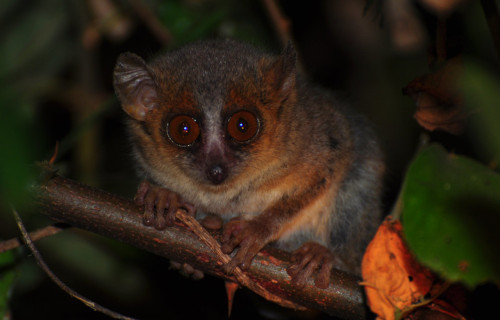
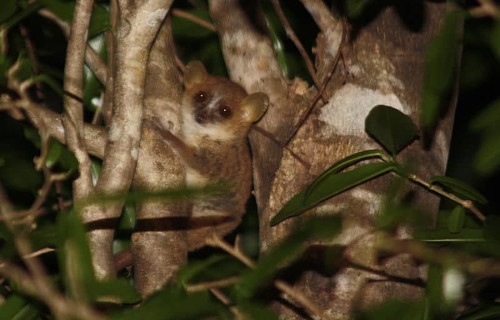
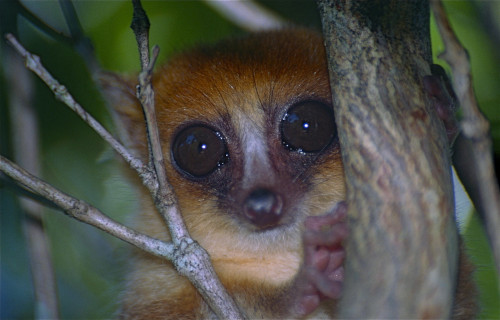
In all other respects, though, males and females alike display the same general appearance. The fur on the upper back typically shows a light brownish-gray shade, with some reddish hues present. The sides, however, show beige or light gray, while the rest of the body manifests a dull white color.
- Kingdom: Animalia
- Phylum: Chordata
- Class: Mammalia
- Order: Primates
- Family: Cheirogaleidae
- Genus: Microcebus
- Species: M. murinus
CCL: https://rb.gy/tlzja
Gray Mouse Lemur Distribution, Habitat, and Ecology
The astounding Gray Mouse Lemur evolved as native to a highly limited portion of the surface of the world. Yet that region suits it perfectly, as it’s also home to a large number of other remarkable forms of life. That’s because it developed as solely endemic to the island of Madagascar.
Geographically situated near the continent of Africa, this site abounds with natural wonders. But, even on this island the mammal only makes its home in certain sections. To date, the grand work of Nature’s only known to inhabit the most southern and western regions of the large isle.
Unlike like many species across the globe, this mammal displays an impressive versatility regarding its choice of habitat. In fact, it seems to be one of the most flexible in this regard of all known lemurs. This represents one of the factors aiding in its survial, despite its relatively low numbers.
It primarily chooses to reside in various types of lowland forest. This includes such diverse ecosystems as gallery forests, scrub forests, secondary forests, and tropical one’s, as well. It also sporadically dwells in areas of dry habitat, degraded habitats, and sometimes even plantations.
Following the pattern of all its kindred, the Gray Mouse Lemur lives as both a nocturnal and arboreal creature. It’s typically highly active, and in all aspects off its overall nature. During the day, however, it often gathers in small groups for sleeping purposes, often in holes in trees.
It evolved to feed omnivorously, mainly consuming various local flowers, nectar, and fruit. Small numbers of insects occasionally augment this. Astonishingly, it’s also been seen to kill and eat its own kind in times of need! Its own predators include snakes, owls, and other, larger mammals.
Aye-aye
CCL: https://tinyurl.com/22y23f9m
Aye-aye Facts
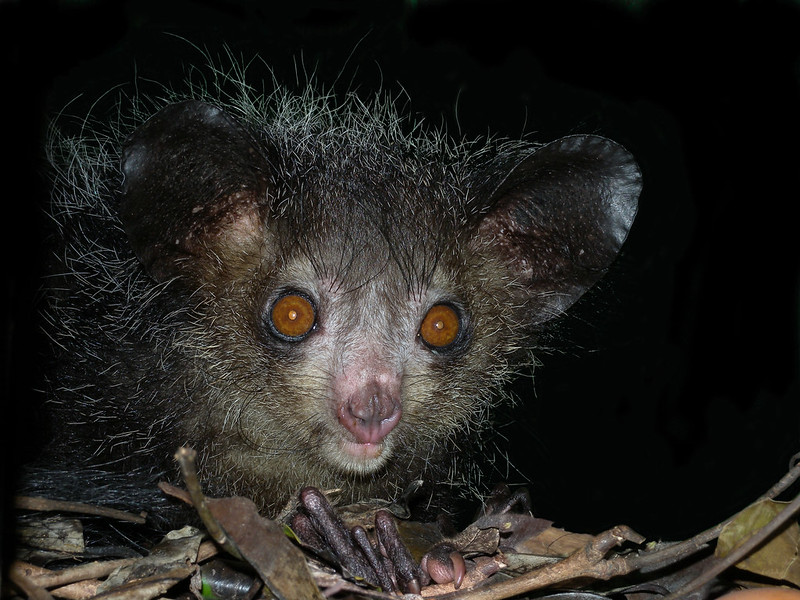
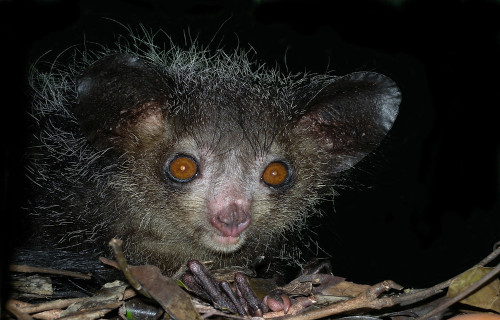
- Our next choice for inclusion in this gathering of these 5 Perfectly Pleasing Primates is the one with the most remarkable appearance, the unforgettable Aye-aye.
- The surprisingly short, yet still quite distinctive, term currently serves as the most typically used moniker for this remarkable mammal. In fact, it’s presently the only broadly accepted common name for the creature. While not unknown, that’s somewhat uncommon.
- Within scientific circles, however, the amazing animal is perhaps much better known to the majority by its technical appellation. Unfortunately for the layperson, though, that’s an extremely difficult label to pronounce, even compared to most other such epithets.
- That’s because this intriguing creation of Nature and evolution holds the tag Daubentonia madagascariensis. It received that honorific due to the efforts of Johann Friedrich Gmelin. The German naturalist recorded the first recognition of it as a fully distinct species.
- Regardless of which of these one chooses to use when speaking of it, the small creature remains a surprising animal. It currrently represents the only known surviving member of both its Family and Genus. Another species in that group went extinct less than 1,000 years ago.
- Regrettably, the remarkable Aye-aye holds a truly precarious position regarding its population in the wild. This seems to be quite small, and easily disturbed. Accordingly, the IUCN now lists the marvel of Nature as Endangered on its published Red List of Threatened Species.
- The fascinating animal now faces multiple threats to its continued existence. Most of these stem from the actions of humans. Due to superstitions, locals often kill them on sight. Deforestation, due to human actions, and climate change also continue to endanger it.

CCL: https://tinyurl.com/5xjp4xys
Aye-aye Physical Description
The unusual Aye-aye almost always captivates those fortunate enough to encounter it in the wild. Though few find it visually appealing, it nonetheless captures one’s attention. It does not do so, though, due to impressive physical stature. That’s true since it’s a physically small species.
In terms of both size and appearance, it follows a pattern prevalent among all known varieties of lemurs. That’s manifested by the fact that it displays no notable degree of the physiological characteristic of sexual dimorphism. The genders therefore appear virtually indistinguishable.
A fully mature individual of this mammal attains an average head and body length measuring approximately 14 – 17 in (36 – 43 cm). The lengthy tail, though, significantly increases the total size. This distinctive appendage reaches a mean growth of 22 – 24 in (56 – 61 cm) itself.
The biological wonder of evolution also achieves similarly diminutive qualities in terms of its weight. The same mature adult specimens reach an average mass equaling only about 4 lbs (1.8 kg). As a result, the overall body shape thus tends to be relatively thin and elongated in structure.
In its youth, the awesome animal presents a significantly different pattern of coloring than mature adults. At this time, the underside of the body shows varying shades of a deep, dark brown. Yet, the upper part of the body usually shows a brilliant silvery shade, with a dark stripe down the back.
As it matures, though, this pattern among examples of the Aye-aye changes. It typically becomes a full-body coverage of dark fur, though it includes random hues. Most tend to consist of dark shades of yellow or brown. On the heqad and back, however, the tips of the hair shows white.
Yet, it’s the hands of the creature that typically garner the most attention from viewers. That’s due to the nature of its distinctive fingers. All of these develop as quite bony in nature, but the third stands out. This digit develops as much longer and thinner than the others on each of its hands.
- Kingdom: Animalia
- Phylum: Chordata
- Class: Mammalia
- Order: Primates
- Family: Daubentoniidae
- Genus: Daubentonia
- Species: D. madagascariensis
CCL: https://tinyurl.com/22y23f9m
Aye-aye Distribution, Habitat, and Ecology
The fabulous, if admittedly unusual, Aye-aye evolved as native to a very small section of the surface of the earth. This location probably won’t surprise many who learn of it, however. That’s because Nature created this biological marvel as endemic to only a single location in the world.
That’s the mesmerizing island of Madagascar, itself an astonishing natural wonder. Situated off the east coast of Africa, it’s a setting filled with a myriad of marvels. Yet, even within this highly limited zone of habitation, it primarily appears in specific portions of the eastern coast of the island.
Thankfully, the unusual creature also evolved a moderately extensive degree of flexibility in terms of its habitat choices. Due to this extreme adaptability, it appears in several separate types of ecosystems. The majority of individuals, though, live in either rainforest or deciduous forests.
Those individuals living in the rainforest spend the largest part of their time in the dense canopy. As a result, most of these are seen at altitudes of roughly 230 ft (70 m). Sadly, however, many are now forced to take up residence in cultivated areas, due to ongoing deforestation in their region.
The Aye-aye also lives as mostly nocturnal in nature, and almost exclusively arboreal, as well. It spends the vast majority of its life high in the tree tops. There, it carries out its activities, such as mating, eating, and sleeping. It does the latter in large nests it builds among the branches.
The animal also lives a principally solitary life, generally with the only exception being for mating purposes. This activity occurs throughout the year. Females generally give birth to one live offpring every 2 -3 years. The young typically remain in the nest for 2 – 3 months, before leaving.
The creature further evolved as omnivorous in both its dietary needs and preferences. The great majority of its typical diet consists of such fare as fruits, nuts, and seeds. Yet, the animal also consumes nectar, honey, fungi, and insects. In turn, its only known predator consists of the Fossa.
Barbary Macaque
CCL: https://bit.ly/2A8mKcQ
Barbary Macaque Facts
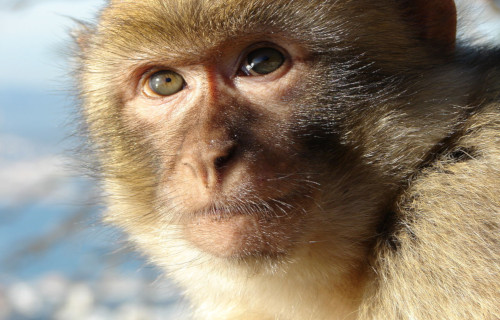
- Appearing next in this compendium of 5 Perfectly Pleasing primates we give you the remarkable animal named the Barbary Macaque.
- That deceptively short term serves as the most frequently used of the common names for one of the best known types of Old World Monkey. This truly marvelous primate does gave several other general titles, though. These include the similar name Barbary ape and magot.
- Within the scientific community, however, the marvel of Nature’s perhaps better known by its technical designation. LIke most such tags, though, that’s somewhat difficult for the typical layperson to pronounce. That’s because it bears the formal epithet of Macaca sylvanus.
- The mammal received that slightly tongue-twisting appellation due to the efforts of Carl Linnaeus himself. The highly esteemed Swedish botanist and zoologist accomplished the first recorded recognition of it as a separate and distinct species. He achieved that in 1758.
- The species continues to be of particular interest to researchers due to a specific behavior. In this unique species, males play an atypical role in the rearing of their young. Because of typically uncertain paternity, as a general rule, males play an integral role in raising all infants.
- Regrettably, the overall population of the magnificent Barbary Macaque appears to be steadily diminishing. Only one particular, isolated concentration of its numbers seems to be stable, at least for the moment. The others, however, continue to rapidly decline in numbers.
- The IUCN therefore presently lists the incredible mammal as Endangered on its Red List. It faces multiple threats to its continued existence as a species, like all forms of life on earth today. In its case, as in theirs, its greatest danger comes from habitat loss and climate change.
Barbary Macaque Physical Description
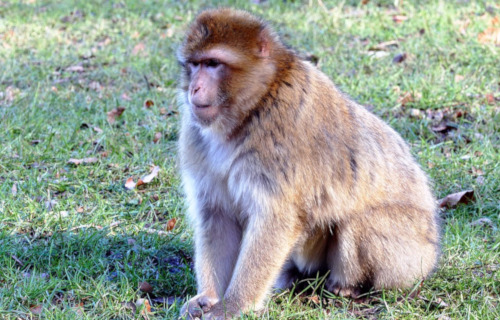
The captivating Barbary Macaque possesses a truly striking and impressive physical appearance that quickly grabs one’s interest. However, the impressiveness does not occur as a result of physical size. That’s because this particular animal ranks as only a moderate-size member of its genus.
The impressively evolved creature also displays a relatively moderate degree of the physiological trait of sexual dimorphism, following a pattern of development common among its kindred around the world. In this particular animal, though, that trait manifests itself in more than one manner.
Size, for instance, ranks as one of these methods of distinction. The male of this amazing species typically attains a slightly greater body length than that of the female. He typically reaches a length measuring roughly 25 in (63.4 cm). The female, meanwhile, only averages about 21.9 in (55.7 cm).
Its males, in the meantime, achieve a mean weight equaling approximately 32 lb (14.5 kg). The females, however, develop as significantly lighter in terms of their body mass. Astonishingly, this gender of the animal only averages 21.8 lb (9.9 kg). While the trait’s not uncommon, this degree is.
Nature didn’t stop there, though. The intriguing Barbary Macaque also displays gender-based differences in one other manner. This variation presents itself in the length of the tail. That holds true because the tail of most males develops as slightly more prominent than that of the female.
Otherwise, however, the genders of this uniquely evolved creature appear generally the same. The animal’s fur possesses an overall color consisting of yellowish-brown to gray, though the underside appears somewhat lighter. Yet, the face of the animal appears as a very dark pink in color.
- Kingdom: Animalia
- Phylum: Chordata
- Class: Mammalia
- Order: Primates
- Family: Cercopithecidae
- Genus: Macaca
- Species: M. sylvanus
Barbary Macaque Distribution, Habitat, and Ecology
Lamentably, the gorgeous Barbary Macaque developed as indigenous to only a very small portion of the globe. Its population also appears disjointed. Both of these hold true due to the fact that this animal only inhabits a small section of the northern part of Africa, and a tiny part of Europe.
More precisly, the stunning mammal’s only known to currently inhabit parts of the countries of Algeria and Morocco, and the territory of Gibraltar. Historically, however, it did once also appear in the what’s now the nation of Tunisia. Most experts now believe it to be extinct in that region.
Most fortunately for those who appreciate Nature, the amazing small primate thankfully appears to be highly adaptable to differing conditions. That’s the standard opinion due to the fact that the remarkable creation of evolution’s been observed in numerous types of habitats across its range.
Within the borders of Gibraltar, the species lives in regions mainly consisting of various rocky cliffs and gorges. Altitude also plays a prominent factor in its placement, at least in this specific part of its territory. It’s typically found there at altitudes ranging from 1,300 – 8,500 ft (400 – 2,600 m).
In the rest of its range, though, it’s most concentrated in the Rif and Atlas Mountains. Within that range, the animal typically appears in an incredible total of four different ecosytems. These zones of habitation consist of local grasslands, numerous temperate forests, scrub, and even rocky ridges.
Technically omnivorous, the amazing Barbary Macaque displays a moderately flexible diet. It primarily consumes a variety of local leaves, fruits, seeds, bark, and roots. Nevertheless, it does occasionally augment this vegetarian fare with small invertebrates it catches opportunistically.
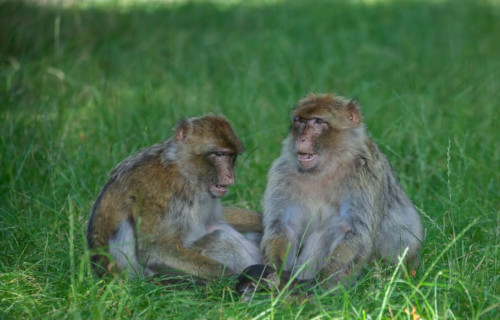
Like most primates, it’s also highly social. The species congregates in small groups, usually being diurnal in terms of activity. These groupings range in number from 10 – 100 individuals, with 24 – 60 being the most common. It also displays a small degree of the practice of dominance hierarchy.
Like most forms of life, it also has its share of natural predators. Traditionally, this included leopards, though experts now believe these wild felines to be extinct in the regions it inhabits. Its principal natural threat now consists of Golden Eagles, which most often preys on the very young.
Black Lemur
CCL: https://bit.ly/3jsptAM
Black Lemur Facts
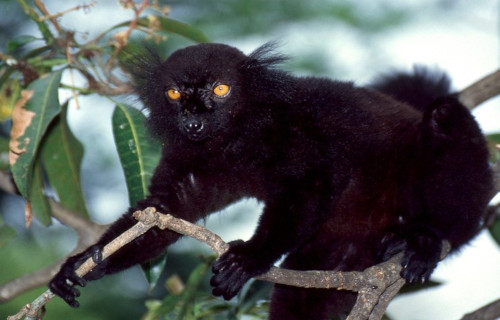
- Finishing up this article about these 5 Perfectly Pleasing Primates comes the highly distinctive mammal appropriately named the Black Lemur.
- This remarkable creation of Nture and evolution most frequently goes by the descriptive common name for good reason. Unlike the majority of animal species around the world, though, it presently has no other broadly accepted general title by which it’s known.
- Inside of the scientific community, however, the wonder does have another name. That’s the technical appellation. Unfortunately, though, that’s somewhat difficult for the layperson to pronounce. That’s because the animal holds the official moniker of Eulemur macaco.
- The amazing mammal received that name due to the efforts of Carl Linnaeus himself. The esteemed Swedish Zoologist accomplished the first official recognition of it as a separate and distinct species. He managed that scientifically noteworthy deed in the year 1766.
- Most experts previously believed two subspecies of the animal existed. Later research, however, subsequently altered that belief, with two new individual species being recognized. The marvel nevertheless remains a highly fascinating creature on its own merits.
- Regrettably, the Black Lemur possesses a small population that seems to be continuing to decline. That unfortunate fact further appears to hold true throughout its range. Accordingly, the IUCN currently lists it as Critically Endangered on its Red List of Threatened Species.
- It presently faces multiple threats to its continued existence as a species. Most of these dangers stem from the actions of mankind. Its most immediate threats include deforestation and the exotic pet trade. It also now faces the looming danger posed by ongoing climate change.
CCL: https://bit.ly/2VDZJZY
Black Lemur Physical Description
The stunning Black Lemur quickly captivates those individuals fortunate enough to encounter one, especially in the wild. It does so primarily due to its appearance though, not sheer physical size. That’s due to the fact that, like most of its many kindred, it’s not an overly large primate.
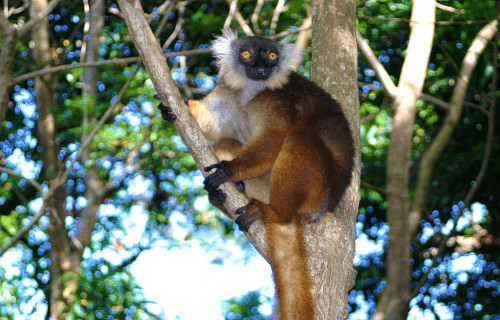
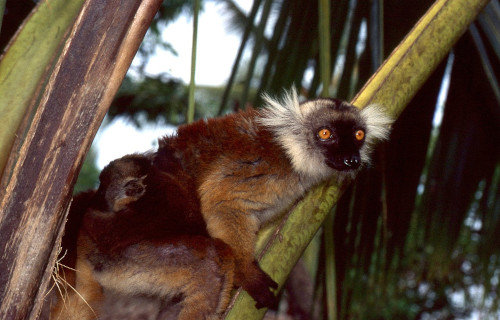
Visually, it truly distinguishes itself dramatically from its numerous relatives. That’s because this specific creature displays one of the most extreme degrees of the physiological characteristic of sexual dimorphism of any primate. In its case, this trait usually manifests itself in appearance.
The bodies of the males of the primate typically display a predominantly black pattern of coloring to the fur. This background understandably serves as the origin of the common name. Despite this, though, some individuals present a background consisting of a dark chocolate brown hue.
Meanwhile, the females of the specis generally develop a sharply different pattern of color. In the case of this gender, the background most often consists of several shades of brown. This mixture typically forms a blending of light, medium chestnut, and even orange-brown on some occasions.
Males of the startling Black Lemur also manifest large black tufts of hair on their ears. Yet the females show white tufts in the exact same location. The creature additionally separates itself from others of its kind in an incredible way. It’s the only primate other than man to have blue eyes!
Both genders of this fabulous primate present virtually identical features otherwise. The average total head-to-tail length equals roughly 38 in (96 cm). However, the lengthy tail actually accounts for more than half of that. In terms of mass, though, the intriguing animal rarely exceeds 5 lb (2.25 kg)
- Kingdom: Animalia
- Phylum: Chordata
- Class: Mammalia
- Order: Primates
- Family: Lemuridae
- Genus: Eulemur
- Species: E. macaco
CCL: https://bit.ly/3itohOv
Black Lemur Distribution, Habitat, and Ecology
Lamentably, the amazing Black Lemur evolved as native to an extremely limited section of the surface of the globe. That exact location won’t surprise anyone who knows much about lemurs, though. That’s because this species, like all of its known relatives, lives in only one region on earth.
This remarkable creation of Nature, along with its related species, developed as endemic almost solely to the breathtaking island of Madagascar. A few specimens do appear on tiny nearby islands, however. This setting places the entire species, and related one’s, very near the continent of Africa.
Even within this already restricted zone of habitation, this creature only lives on the extreme northern part of the main island. It also displays decidedly strong preferences regarding its choice of habitat type. It principally makes its home in regions of undisturbed tropical rainforests.
The animal nonetheless also displays some moderate degree of adaptibility in this respect, at least. A comparatively small percentage of individuals choose to live in local tree farms, and even on farmland. Sadly, though, this frequently brings the lemur into interaction with human beings.
The Black Lemur evolved to be active during both day and night periods. It principally forages for its food at night, though. While technically omnivorous, plants form the vast majority of its diet. Fruit comprises roughly 87% of that fare. It also eats leaves, flowers, and the rare invertebrate.
It’s also a highly social animal, as well. The majority of individuals tend to choose to live as social creatures. These do so in groups numbering somewhere between 7 and 10 individuals. These small groups additionally tend to follow a single female, with infighting occurring only rarely.
CCL: https://tinyurl.com/5xjp4xys
5 Perfectly Pleasing Primates
We hope that each of you greatly enjoyed reading, and hopefully learning from, this article we’ve written for you about these 5 Perfectly Pleasing Primates. It’s also our fervent hope that doing so has left you with either a new or fully renewed appreciation for such remrakble wonders of Nature.
Unfortunately, however, many of their numerous kindred around the world now find themselves facing strong threats to their continued existence as a species. Many of those dangers, in fact, stem from the actions of mankind. We must do all that we can to protect and preserve them all.
Check out our other articles on 5 Thrilling Animals of Thailand, Africa’s Many Geological Masterpieces, 6 Stunning North American Bees, Spectacular Dolphins Throughout Our World