Bobcat Facts
- This beautiful wild feline most frequently goes by the deceptively short term of Bobcat across its entire native territory. Yet, the stunning creation of Nature also holds several other general titles by which it’s known. Those include the options Bay lynx, Red lynx, and swamp tiger.
- Inside the hallowed halls of science, however, it’s possibly much better known by its purely technical designation. Fortunately, that remains an extremely easy one for the layperson to pronounce. That’s because the remarkable creature bears the official moniker of Lynx rufus.
- The mammal received that notably brief epithet due to the efforts of Johann Christian Daniel von Schreber. That renowned German naturalist accomplished the first recognition of it as a separate and distinct species. He achieved this scientifically noteworthy deed in the year 1777.
- The animal holds distinction among researchers due to several reasons. It currently represents one of only four known extant members of its entire Genus. This captivating product of feline evolution also stands out due to the fact that it constitutes the smallest of these species.
- Thankfully, for the moment, the mesmerizing Bobcat appears to be maintaining both a stable and sufficient population base. That pleasant state also seems to hold true throughout its native range. The IUCN thus presently shows it as Least Concern on its published Red List.
- The fabulous feline nevertheless still faces numerous potential threats to its continued existence as a species. In this respect, it faces the same dangers as all forms of life on earth today. Most of those stem from the actions of man, including habitat loss and climate change.
Related Articles
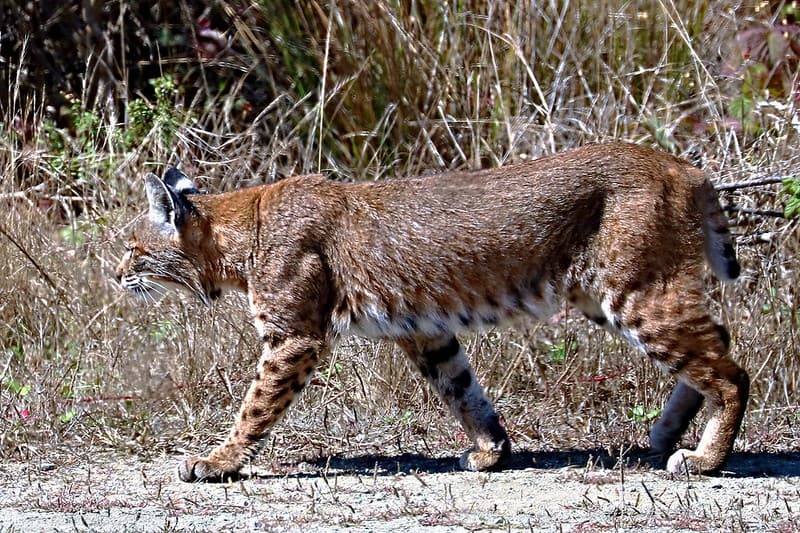
Bobcat Physical Description
The gorgeous Bobcat never fails to immediately capture the interest and awe of those individuals fortunate enough to encounter one. Unlike some varieties of wild feline, however, it does not do so due to impressive physical stature. That’s true since it remains a medium-sized wildcat.
In regards to its description, it also follows a pattern of development shared by the majority of mammals. That’s the fact that it displays a certain degree of the physiological characteristic of sexual dimorphism. In its specific case, though, this natural trait manifests in several manners.
Males of the species consistently attain a greater mean weight than females. These average between 20 – 40 lbs (9 – 18 kg) in body mass. In length, they also typically measure 32 – 41 in (0.8 – 1.05 m). Males additionally generally possess proportionally larger heads and more muscular builds.
Females, meanwhile, usually reach smaller dimensions, though exceptions do occur. For them, an average weight equals roughly 13 – 24 lbs (6 – 11 kg). In length, these generally measure between 26 – 35 in (65 – 90 cm). Due to these statistics, females typically appear slimmer and lighter.
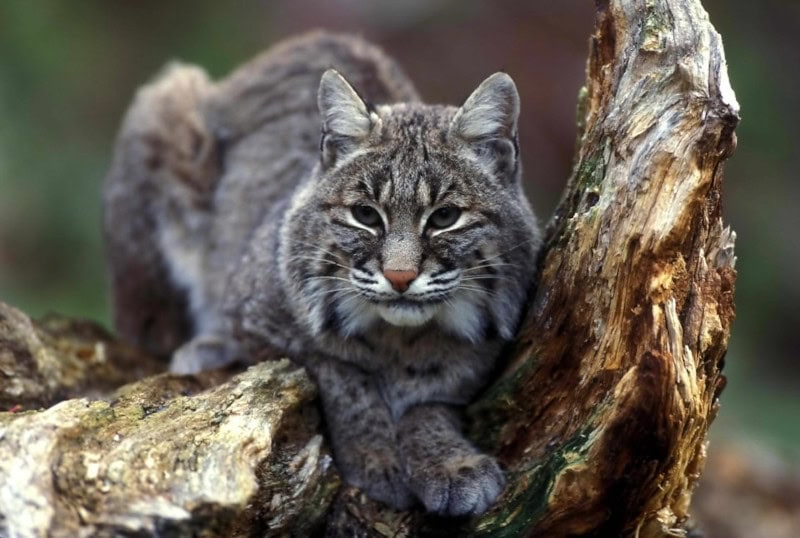
Individuals generally develop as notably muscular, with long legs, a short, or bobbed, tail, and prominent cheek ruffs. That shortened appendage usually measures somewhere between 4 – 8 in (10 – 20 cm) in length. It also shows dark black on the upper surface of the tip, white underneath.
The color of the Bobcat varies with geography and season, ranging from gray to tawny brown with darker streaks or spots. Its underside, however, presents as whitish, often with dark spots or bars. The winter coat develops as denser and paler, while the summer coat is shorter and redder.
Its face evolved a short muzzle with tufts of black hair on the ears that remains slightly smaller than those of other lynx species. Black lines run from the eyes down the face. The amazing creature also possesses hind legs that develop as longer than front legs, giving a slightly sloping appearance.
Its paws remain smaller than those of the related Canada lynx, not being as highly specialized for deep snow. The eyes of this awesome product of Nature and evolution also merit interest. They appear as golden to yellow-brown with round pupils that contract vertically in bright light.
- Kingdom: Animalia
- Phylum: Chordata
- Class: Mammalia
- Order: Carnivora
- Family: Felidae
- Genus: Lynx
- Species: L. rufus
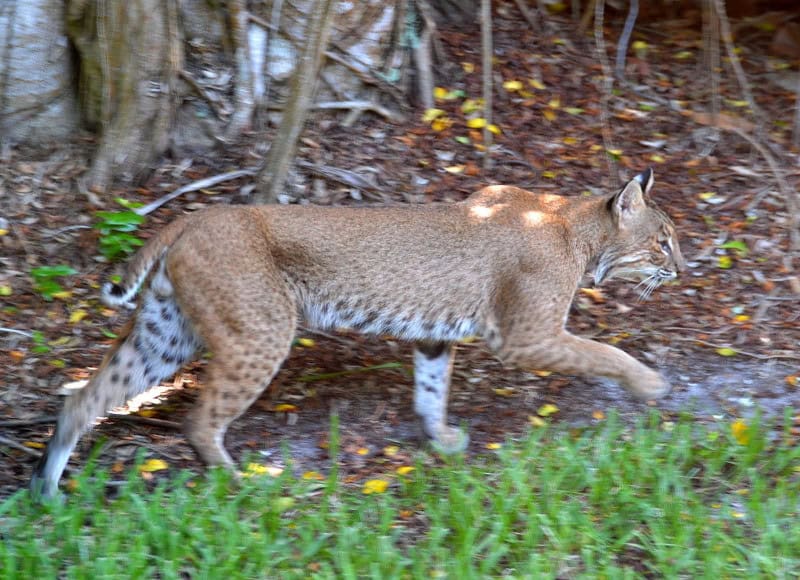
Bobcat Distribution, Habitat, and Ecology
The mesmerizing Bobcat evolved as indigenous to a comparatively broad swathe of the surface of the earth. In fact, it has the largest zone of habitation of any wild cat in its part of the world. Precisely where that native territory lies, though, likely won’t surprise many people who learn of it.
This amazing mammal solely inhabits North America, though it appears across much of its extent. The breathtaking wild feline thrives in certain portions of the nation of Canada. Within its borders, the animal lives in the southern sections, appearing from British Columbia across to Nova Scotia.
It also resides in the United States. Inside that nation, it lives in every state except parts of the far north, not being well established in Alaska. It also appears in Mexico, as well. There, the animal lives in most of the country, except for the arid deserts of Baja California Sur and the Yucatán Peninsula.
This wonder of the animal Kingdom further distinguishes itself by displaying one of the most adaptable natures in regards to its choice of habitat of any wild cat in its part of the world. Its presence in so many regions proves it to be able to thrive in an extremely wide variety of habitats.
This marvelous creature frequently appears in areas formed mostly of expansive forests, including deciduous, coniferous, and mixed woodlands. Yet, the wild feline also favors numerous regions composed of shrublands and scrub, such as zones of chaparral, desert scrub, and thickets.
Still other widely varied ecosystems also serve as home to the intrepid species. These settings include grasslands and semi-deserts, along with regions of swamps and wetlands. It also prefers aras of mountains and rocky areas with rugged terrain with caves or rock crevices for dens.
In keeping with its nature, the beautiful Bobcat evolved as a pure carnivore. In this respect, it represents a mid-sized predator in its zone of habitation. That allows it to help regulate prey populations. It also sometimes competes with larger predators, such as cougar, coyote, and wolves.
It’s principally a combination of crepuscular and nocturnal creature in its patterns of activity. The animal hunts in a solitary manner, using stealth and ambush techniques. It mainly eats rabbits and hares, squirrels, mice, and rats. Secondary prey, though, mostly includes birds, reptiles, and insects.
Its own natural predators include various larger types of animals. These dangers primarily include cougars, wolves, coyotes, and sometimes eagles. Sadly, however, humans constitute its leading mortality factor. This occurs due to a combination of trapping, hunting, and vehicle collisions.
Breeding season for this wonder takes place during the winter, usually between the months of January to March. Gestation lasts 60 – 70 days. Females typically give birth to anywhere from 1 – 6 kittens, with 2 -4 being the most common. After birth, kittens stay with the mother for up to a year.
Species Sharing Its Range

Check out our other articles on 5 Amazing African Herbaceous Plants, Northern Raccoon, Alexander Island, Silky Afgekia, Spiny Butterfly Ray, Little Auk, Baltimore Checkerspot, Eyelash Viper










Leave a Reply