Cow Killer Facts
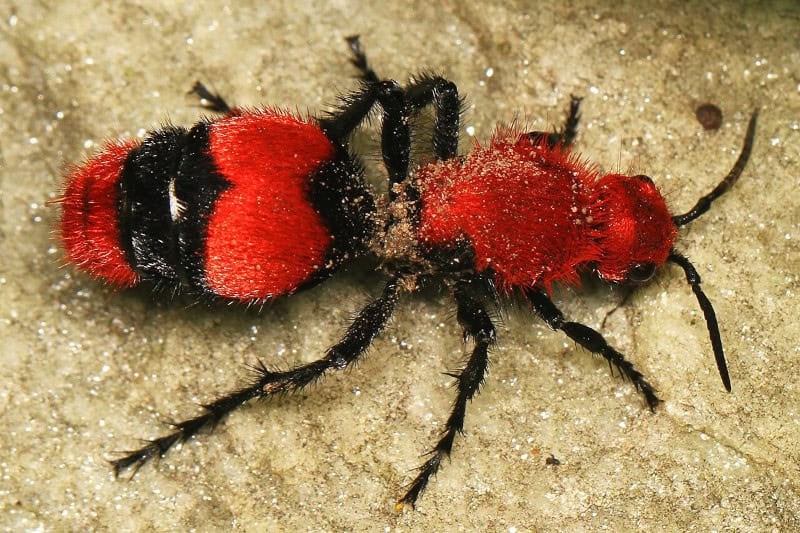
- The attention-grabbing, if somewhat deceptive, term of Cow Killer represents the most frequently used common name for this insect. It does have a few other general titles by which it’s known, though. Those options include red velvet ant and eastern velvet ant, among others.
- Inside the hallowed halls of science, however, it’s perhaps better known by its entirely technical designation. Unfortunately, though, that particular tag is quite hard for the layperson to pronounce. That’s because it holds the formal moniker of Dasymutilla occidentalis.
- It received that especially tongue-twisting epithet due to the efforts of Carl Linnaeus himself. That highly esteemed Swedish biologist accomplished the first official recognition of it as a separate and distinct species. He achieved that scientifically noteworthy deed in the year 1758.
- It does so due to one particularly distinguishing fact. The amazing creature forms the largest of all known species considered velvet ants still extant within its native territorial range.
- Thankfully, the stunning Cow Killer appears to be maintaining a population base that’s both stable and sufficient. That pleasant state also seems to hold true throughout the entirety of its range. Accordingly, the IUCN therefore does not presently place it on the famous Red List.
- This wonder nevertheless should still be considered as facing numerous potential threats to its continued existence as a species. Like all forms of life on earth today, the majority of those dangers stem from the actions of man. They include habitat loss and ongoing climate change.
Related Articles
Cow Killer Physical Description
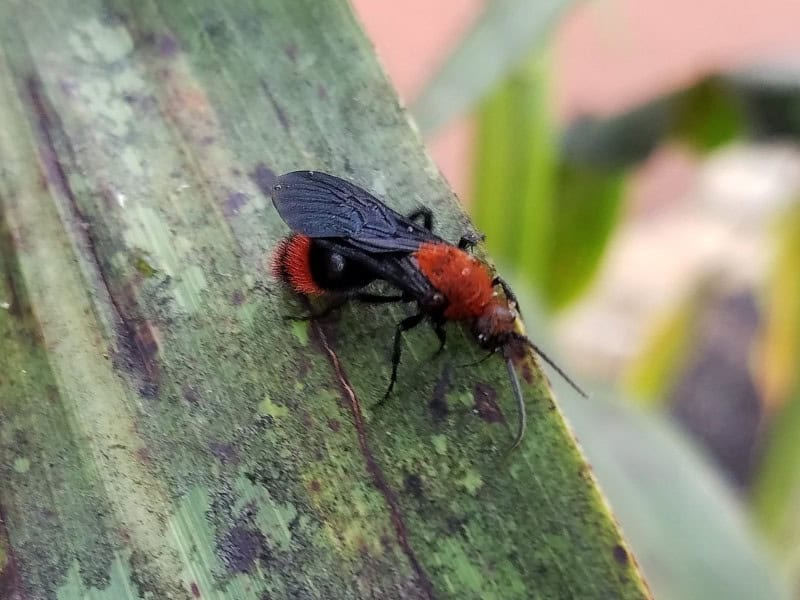
The startling Cow Killer virtually never fails to capture the immediate attention and interest of those individuals who encounter one. Unlike some of its many relations, though, it does so for several reasons. That’s true since this wonder of the insect world displays both respectable size and beauty.
Regarding its physical nature, it also follows a natural pattern of development common among insects around the world. That’s the fact that it displays a certain degree of the physiological characteristic of sexual dimorphism. In its case, however, this trait manifests in multiple manners.
Overall, individuals of this remarkable species attain a wide range of sizes. As a general principle, this runs from approximately 0.5 – 1 in (1.27 – 2.54 cm). Females of this creature typically appear on the larger end of this spectrum, while their male counterparts remain notably shorter.
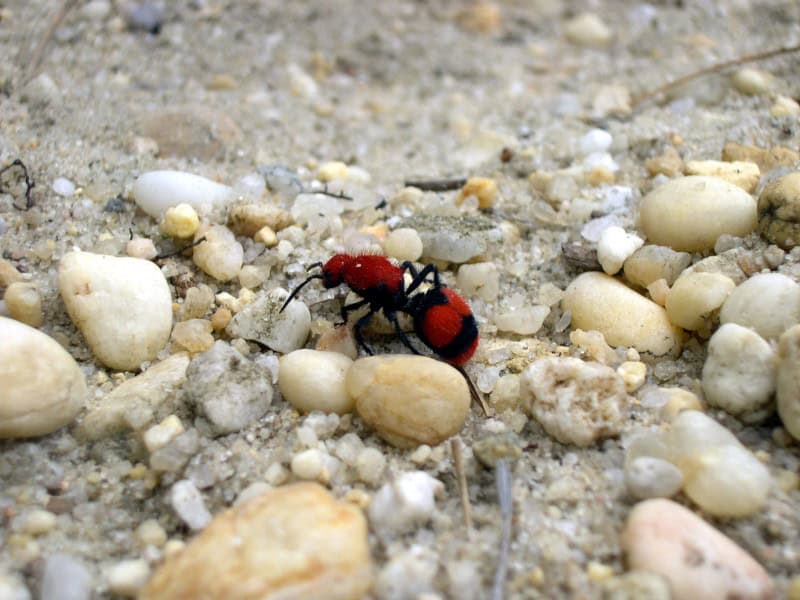
The two genders also vary significantly in appearance in other ways. Females evolved to be wingless and more robust in body shape, resembling large, hairy ants. Males, meanwhile, appear quite different. These develop as winged, far more slender in form, and with a much more wasp-like form.
The coloring of the Cow Killer garners attention as well. It’s densely covered with bright, velvety red-orange hairs contrasting with a black body. Legs and stomach usually show black and less hairy. Males have lighter wings, translucent to dark brown. The dense hairs give it a soft, velvety look.
Nature also differentiates the two sexes of this wonder in still one more manner. The smaller males possess no stinger at all. Females, however, evolved to have an extremely long, powerful stinger, capable of delivering an extremely painful sting. This serves as the source of the common name.
- Kingdom: Animalia
- Phylum: Arthropoda
- Class: Insecta
- Order: Hymenoptera
- Family: Mutillidae
- Genus: Dasymutilla
- Species: D. occidentalis
Cow Killer Distribution, Habitat, and Ecology
The mesmerizing Cow Killer evolved as indigenous to a moderately broad swathe of the surface of the earth. That happens to be a region of the globe already well known for its abundance of natural wonders. To no surprise to anyone, the amazing species developed as native to North America.
Within that greater continental landmass, however, it only appears naturally within the borders of the United States. It most pervasively appears throughout both the eastern and southeastern sections of the large nation. Nonetheless, it also resides in other areas, though in smaller numbers.
Its territory extends from the Atlantic coast west to parts of the Great Plains, including Texas, Nebraska, and Kansas. Northward, it moves into the Midwest, in states like Ohio, Indiana, and parts of southern New England. Its southern range extends into Florida and along the Gulf Coast.
This captivating Arthropod displays decidedly strong and clear preferences regarding its choice of habitat. These settings each remain closely linked with its specific life cycle. In virtually all observed instances, the amazing insect chose to make its home in various types of sunny, open environments.
The fantastic ant principally resides in such locations as field, meadows, and pastures. Other areas, though slightly less commonly inhabited, include roadsides, forest edges, and areas of sandhills and scrublands. In all of these ecosystems, though, the insect strongly favors dry, sandy, and loose soils.
The ecology of the Cow Killer evolved as highly complex and specialized in nature. In the larval stage, it feeds exclusively as an ectoparasitoid. Females lays their eggs in the underground nests of ground-nesting bees or wasps, often bumblebees. The larva then feeds on the host larva or pupa.
Adults, meanwhile, follow an entirely different dietary practice. Mature individuals of this marvel of Nature solely consume either nectar, or other sugary plant exudates. Although a wide variety of flora meet their requirements, they display an apparent preference for members of the Milkweed Family.
Despite its relatively small size, it has very few natural predators. Its bright coloring also serves as a visual warning to potential predators. The exoskeleton developed as quite tough for an insect its size. The existence of its exceptionally powerful sting also serves as a strong deterrent to predation.
Species Sharing Its Range
Check out our other aticles on 4 Herbaceous Plants of England, New Zealand Sea Lion, Rio Grande River, Socotra Dsert Rose, Great Potoo, Blue Baboon Tarantula, Keeled slug-eating Snake

Leave a Reply