CCL: https://tinyurl.com/hp6b93c7
We hope that each of you, our readers, will enjoy and fully appreciate this article we present to you about these 5 Wondrous Washington State Insects. It was certainly our great pleasure to compile the various information for you. May it provide you with both education and increased awareness.
Obviously, these few species listed herein represent only a miniscule portion of the natural wonders found throughout the region, though. Yet, it’s our belief that they serve as excellent representations of the wonders found here. Check out some of our many other articles for similar marvels.
Anise Swallowtail
CCL: https://tinyurl.com/44ka7ja6
Anise Swallowtail Facts
- Starting off this article about these 5 Wondrous Washington State Insects we present you with the visually captivating Anise Swallowtail.
- This beautiful Lepidoptera most frequently goes by the comparatively simple common name that we’re using here across its entire range. The marvel of Nature does have at least one other general title by which it’s known, though. That’s the similar term of Western Swallowtail.
- Within the scientific community, however, it’s possibly much better known by its purely scientific designation. Thankfully, that’s a relatively easy one for the layperson to pronounce, compared to most such tags. That’s because it holds the official appellation of Papilio zelicaon.
- The gorgeous invertebrate received that particular moniker due to the efforts of Pierre-Hippolyte Lucas. That respected French entomologist recorded the first formal recognition of it as a separate and distinct species. This scientifically noteworthy deed occurred in 1852.
- In modern times, this marvel of evolution began playing a role of moderate importance in the educational system of the region in which it appears. School systems began frequently using it to teach the principle of metamorphosis, due to the striking appearance of its caterpillars.
- Thankfully, the eye-catching Anise Swallowtail seems to be maintaining a population base that’s both sufficient and stable. That pleasant state also appears to hold true throughout the entirety of its range. Accordingly, the IUCN now shows it as Least Concern on its Red List.
- The small beauty should nevertheless still be considered as facing several potential threats to its existence as a species. In this, it faces the same dangers as all forms of life on earth today. Most of these dangers stem from the actions of mankind, and include ongoing climate change.
CCL: https://tinyurl.com/2uwyub7v
Anise Swallowtail Physical Description
The magnificent Anise Swallowtail always captures the interest and attention of those individuals fortunate enough to spot one of these wonders. Unlike some of its relatives, it doesn’t rely solely on its beauty to do so, however. That’s true since it’s also an above-average sized butterfly.
In terms of physical appearance, it also follows a pattern of development shared by many species around the world. That’s the fact that it displays a certain degree of the physiological characteristic known to science as sexual dimorphism. In its case, this mainly appears in simple physical size.
The body of both sexes attains an average length that’s slightly shorter than another, very similar relative with which it shares a territorial range. This part of the lovely creature ranges in length from somewhere between 1 – 1.4 in (2.5 – 3.5 cm). In color, it’s mostly black, with yellow stripes or spots.
It’s the wings of this stunning creation of Nature that garner the most attention, though. It’s also the area in which it displays gender-based differrences. These reach a mean wingspan ranging from 2.5 – 3.5 in (6.5 – 9 cm). Those of females tend to be slightly larger and more rounded in their form.
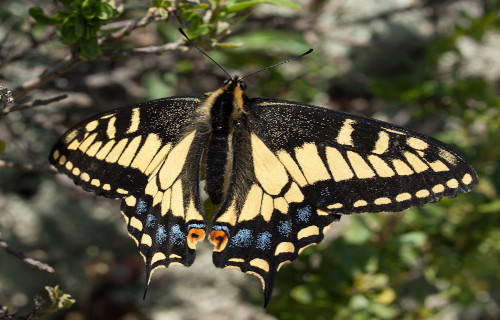
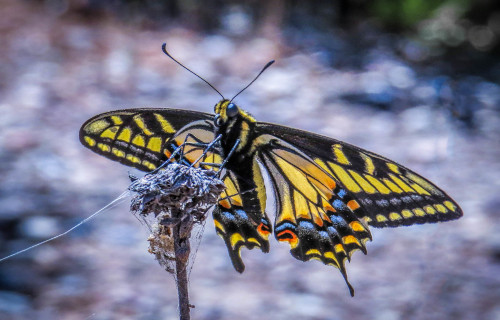
Yet, it’s the bewildering colors of these appendages of the Anise Swallowtail that most immediately draw the eye. The overall pattern consists of a bright yellow background marked by bold black vein markings. Each set of wings, however, present different patterns, creating a highly distinctive effect.
The forewings of this wonder of natural evolution evolved to be the physically larger of the two sets possessed by the colorful insect. They’re also broader in shape. These display a yellow base, with thick black borders. Each wing also has black stripes, or veins, extending across their length.
Though smaller, the hindwings remain the more striking of the set, though. These feature a prominent blue band near the rear edge. A bright orange eyespot also appears near the tail. Amazingly, each wing also manifests a short black tail-like extension, earning the name swallowtail.
- Kingdom: Animalia
- Phylum: Arthropoda
- Class: Insecta
- Order: Lepidoptera
- Family: Pailionidae
- Genus: Papilio
- Species: P. zelicaon
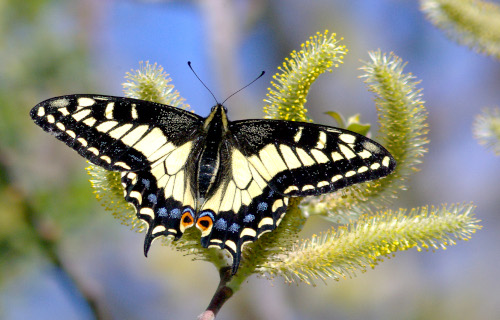
Photo: NatureShutterbug
CCL: https://tinyurl.com/btdm3sjj
Anise Swallowtail Distribution, Habitat, and Ecology
The magnificent Anise Swallowtail developed as indigenous to a moderately broad swathe of the surface of the earth. Precisely where that zone of habitation occurs probably won’t surprise too many people. That’s true since it evolved as native to a portion of the continent of North America.
Within the greater area, however, it primarily resides along the western portions of the landmass. The majority of its numbers appear inside the the United States. From north to south, it lives in Washington, Oregon, and California. Inland, it’s found in parts of Idaho, Nevada, Utah, and Arizona.
Further to the north, though, the marvel also resides in one portion of the nation of Canada. There, the insect lives in parts of southern British Columbia. In the most southern parts of its range, meanwhile, it also appears in part of Mexico. There, it’s found in parts of northern Baja California.
This gorgeous Lepidoptera also displays an impressive level of versatility regarding its choice of habitat. It’s therefore found in a surprisingly wide variety of ecosystems. Nevertheless, each of these locales understandably shares certain basic environmental conditions to meet its specific needs.
Each of these represents a type of open, mainly sunny habitats. It’s additionally comparatively versatile in terms of the heights at which it chooses to make its home. Impressively, despite its seeming fragility, populations appear at altitudes ranging from about sea level to 6,500 ft (2,000 m).
All regions it lives in contain its host plants, upon which it depends. These areas include such diverse settings as grasslands, meadows, coastal scrublands, and foothills. Yet, it’s also not adverse to living along roadsides, in fields, and other such disturbed areas, even including backyard gardens.
The ecology of the mesmerizing Anise Swallowtail developed to be shaped by its interactions with host plants, predators, and even its role in pollination. Its caterpillars feed herbivorously, solely doing so with members of the Order Apiales, including such garden plants as celery and parsley.
Adults, though, feed on numerous plants, consuming their sweet nectar. In the process of doing so, their actions serve to contribute to the pollination of those same flora. Being stron, relatively fast fliers, these often appar in multiple open, sunny areas, feeding or seeking out prospective mates.
Females lay their eggs on the leaves of host plants, favoring carrots. After hatching, these progress through the stages of pupae to larvae, then finally to adults. This stage emerges in either late spring or early summer. Multiple broods per year sometimes occur, depending on local climate.
Orange-belted Bumblebee
Orange-belted Bumblebee Facts
- Next up in this compilation of 5 Wondrous Washington State Insects we give you the only bee on the list, the Orange-belted Bumblebee.
- This vibrant creation of Nature and evolution most frequently goes by this appropriate common name for the fully obvious reasons. Yet, the natural wonder does have at least one other widely accepted general title. That’s the term of tricolored bumblebee.
- Inside of the scientific community, however, it’s perhaps somewhat better known by its technical appellation. Fortunately for the layperson, though, that’s a comparatively simple tag, as such things go. That’s because it holds the official epithet Bombus ternarius.
- The marvelous Arthropod received that moniker due to the efforts of Thomas Say. The widely respected American entomologist accomplished the first recognition of it as a separate and distinct species. He managed that scientifically noteworthy feat in the year 1837.
- Pleasantly, the amazing Orange-belted Bumblebee seems to still possess a stable and sufficient population base. That fortunate situation also appears to hold true throughout the entirety of its range. The IUCN thus currently lists it as Least Concern on its published Red List.
- The insect nevertheless faces the same potential threats to its continued existence as all species on earth now do. Most of those dangers stem from the actions of mankind. These perils include such perils as habitat loss and the ongoing effects of climate change.
Orange-belted Bumblebee Physical Description
The remarkable Orange-belted Bumblebee typically draws much appreciation from those individuals who appreciate Nature. As a general principle, however, the invertebrate does not do so due to its size. That’s true since the creature ranks as a fairly small member of its Genus.
Like related species around the globe, this animal displays a certain degree of the physiological characteristic known as sexual dimorphism. In keeping with the pattern prevalent among members of its Family, though, the species manifests this trait in a different way than most others.
It’s still true that the two genders display varying physical characteristics. But, given that it’s an Apidae, it also possesses what might be considered a sub-class, as well, depending on perspective. The different groups display a range of physical characteristics that serve to distinguish them.
The queen, of course, is female. She ranges in average length from 0.67 – 0.75 in (1.7 – 1.9 cm). Her body width attains a mean measurement of approximately 0.33 – 0.35 in (0.85 -0.9 cm). Given these dimensions, it’s apparent that she developed as slightly slimmer than most of her relatives.
Males of the species, though, known as drones, achieve much smaller measurements. The shorter bodies reach an average length equaling approximately 0.37 – 0.51 in (0.95 – 1.3 cm). In terms of width, at the abdomen this sex manages a mean of between 0.18 – 0.22 in (0.45 – 0.55 cm).
Then, the species additionally has a worker class. Though technically female, they differ from the queen in tht they’re sterile. They’re also smaller than either the queen or the drones. Each only measures about 0.31 – 0.51 in (0.8 – 1.3 cm) in length. In breadth, they’re the same as males.
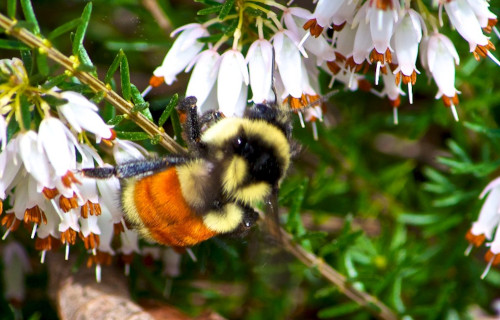
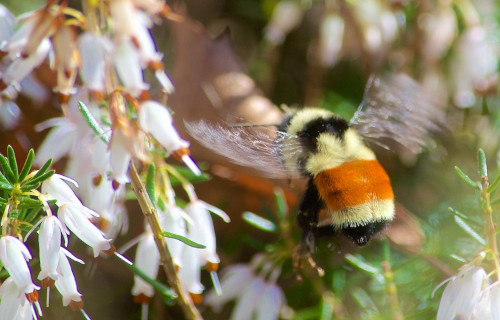
Differences also manifest in appearance among the various groups of the Orange-belted Bumblebee. Queens and worker show a black head, with light yellow hairs. These also present bands of yellow, orange, and black on the bodies. That trait serves as the source of the common name.
The drones, however, show a distinctlly different pattern of coloring. Its head develops as yellow in color, with a scattering of small black hairs. The pattern of hues on the body is similar, but not identical to, that of the others. This group also develops much longer fur than that of the others.
- Kingdom: Animalia
- Phylum: Arthropoda
- Class: Insecta
- Order: Hymenoptera
- Family: Apidae
- Genus: Bombus
- Species: B. ternarius
Orange-belted Bumblebee Distribution, Habitat, and Ecology
The Orange-belted Bumblebee evolved as native to a relatively large expanse of the surface of the earth. The exact location of that zone of habitation rarely comes as a surprise to those who learn of it, however. That’s true since the natural marvel developed as endemic to North America.
Within that greater area of habitation, though, the Arthropod only appears in parts of the overall range. To the north, it inhabits much of the country of Canada. The southern section of its habitation range includes much of the northern and northeastern parts of the United States.
Just like most of its many relations, the intriguing Arthropod evolved fairly clear preferences regarding its choice of habitat. It strongly prefers the more temperate conditions found in the northern extent of its territory. On occasion, though, some do venture further south.
Yet, it does show some moderate flexibilty pertaining to what types of local ecosystems it lives in. The amazing insect prefers to make its nests in undisturbed areas, such as forests, fields, and meadows. It’s not unknown, however, for these to appear in parks or even private yards.
The Orange-belted Bumblebee further developed as a species with only a single lifecycle per season. Queens generally emerge from hibernation in late April. These constructs their nests in shallow cavities on the ground, an dlays her eggs. Its colonies rarely exceed 200 individuals.
The lovely invertebrate follows the same pattern as its numerous kindred regarding its diet. This consists solely of the nectar and pollen of various locally available plants. It does show a small preference, though. Its favorite sources include goldenrod, milkweed, and many berries.
Spring Azure
CCL: https://tinyurl.com/hp6b93c7
Spring Azure Facts
- Our next choice for inclusion in this listing of these 5 Wondrous Washington State Insects is the stunning Spring Azure.
- This beautiful creation of Nature and evolution most frequently goes by this particularly charming common name across its native range. Yet, it does have a few other general titles that it’s also known by. These include such terms as Northern Azure, Spring Blue, and Echo Blue.
- Inside the hallowed halls of science, however, it’s perhaps much better known by its purely technical designation. Thankfully, that one’s simpler for the layperson to pronounce than most such tags. That’s because the stunning Lepiodtera bears the official moniker Celastrina ladon.
- The lovely insect received that particular epithet due to the efforts of Pieter Cramer. That highly respected Dutch entomologist recorded the first formal acknowledgement of it as a separate and distinct species. He achieved that scientifically noteworthy deed in the year 1780.
- Along with its undeniable appeal, the beautiful invertebrate also currently represents a source of some debate among taxonomic authorities. That’s due to a disagreement between members. Some consider it a subspecies of another insect, while others consider it a full species.
- Fortunately, the remarkable Spring Azure appears to be maintaining a population base that’s both stable and sufficient. That pleasant state also seems to hold true throughout the entirety of its known range. The IUCN therefore does not yet show it on its published Red List.
- It nevertheless should be considered as facing several potential threats to its continued existence as a species, at least. In this regard, it’s endangered by the same perils as all forms of life on earth. Most of these hazards stem from the actions of man, including climate change.
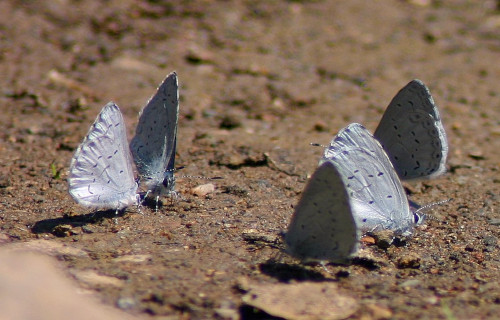
Photo: David A. Hofmann
CCL: https://tinyurl.com/4trju48p
Spring Azure Physical Description
The stunning Spring Azure generally captivates and enthralls those individuals fortunate enough to encounter one of these marvels. It typically does so, though, due more to its mesmerizing beauty than impressive physical stature. That’s because it’s a comparatively small type of butterfly.
Regarding this part of its nature, it also follows a natural pattern quite common among most fauna, including its many relatives. That’s the fact that it displays a certain amount of the physiological characteristic of sexual dimorphism. In its case, this trait manifests in terms of its coloring.
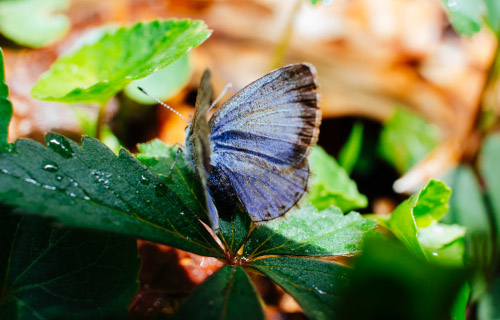
The lovely creatures reach a mean body length equaling approximately 0.3 – 0.5 in (0.8 – 1.2 cm). Overall, individuals of both genders also attain an average wingspan measuring between 0.75 – 1.25 in (1.9 – 3.2 cm). Although exceptional individuals naturally occur, they rarely exceed this by much.
The body itself additionally develops a form similar to others of its kind. This evolved as relatively slender, and slightly blue-gray in color. It’s also covered in fine, short scales, providing it with a fuzzy appearance. The antennae evolved as black and white banded, with small clubs at the tips.
Without doubt, however, it’s the wings of the gorgeous Spring Azure that capture the most attention from its many admirers. This feature also forms the primary sex-based difference between males and females. The contrast, though, remains minimal, and easily overlooked by casual observers.
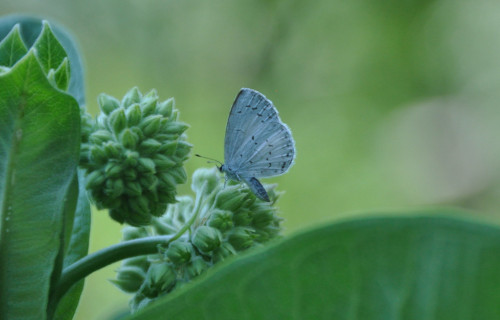
Among males of the species, the upper wing presents a very bright, uniform shade of blue. Yet, the underside displays a pale gray to whitish with fine black dots. Meanwhile, a dark margin frequently, though not always, appears on the upper wing. It’s also slightly smaller than the female.
Females, however, manifest a somewhat duller blue with dark borders, especially on the forewings. The underside of their wings evolved as similar, but sometimes slightly darker or more marked. And the margins on their upper wings, when present, at least, tend to be broader than in males.
- Kingdom: Animalia
- Phylum: Arthropoda
- Class: Insecta
- Order: Lepidoptera
- Family: Lycaenidae
- Genus: Celastrina
- Species: C. ladon
CCL: https://tinyurl.com/4dx9vfwf
Spring Azure Distribution, Habitat, and Ecology
The fabulous Spring Azure evolved as indigenous to a moderately broad expanse of the surface of the earth. Just exactly where that zone of habitation lies likely won’t surprise anyone, though. That’s because the remarkable insect developed as native to a specific portion of North America.
Within the borders of the United States, it primarily appears throughout the eastern and central portion of the country. In the northern part of the nation, that range extends from both the state of New England and the Great Lakes region, south to northern Florida, and west to the Great Plains.
It’s also common in the southern sections of Canada. There, the marvel remains especially prevalent in and around southern Ontario, Quebec, and parts of Manitoba and the Maritimes. Though it’s rarely spotted there, the southern part of its range extends into northern Mexico.
Much like many Lepidoptera, this work of Nature displays decidedly clear and strong preferences regarding its choice of habitat. Although the butterfly occupies a variety of habitats, it shows a strong preference for environments that support the flowering shrubs and trees its larvae feed on.
Its most common type of environment consists of combinations of deciduous woodlands and forest edges. The invertebrate prefers openings, trails, and sunny edges in or near mixed hardwood regions. It’s also frequently seen in riparian areas, such as along streams, rivers, and wetlands.
Other regions away from populated areas that it favors include open, sunny areas with scattered shrubs and early-flowering plants. Yet, it doesn’t shy away from man’s presence, either. It sometimes visits ornamental flowering shrubs, especially early in the spring, in human-altered landscapes.
The ecology of the breathtaking, and aptly-named, Spring Azure developed as shaped by its role in multiple facets of Nature. These include early spring ecosystems, its relationships with host plants and ants, and its various interactions with other Celastrina species within its native regions.
In its larval stage, it feeds as a herbivore. These principally, though not exclusively, consume flower buds and young fruits of woody plants and shrubs. Typical hosts consist of Dogwood, New Jersey Tea, Spirea, Viburnum, and Cherry. The adults, however, only feed on nectar, aiding in pollination.
Intriguingly, it displays the same mutualistic relationship with ants as other members of its Family. Larvae have nectary organs that secrete sugary substances. This sweet serves to rewards ants, which in turn protect the larvae from the numerous predators and parasitoids that threaten them.
Across the majority of its range, this wonder of evolution produces only a single generation per year. Adults emerge early in the Spring, thus the principal common name. This usually occurs between March and May, depending on latitude. Females lay their eggs on host plant flower buds.
Powder Blue Damselfly
CCL: https://tinyurl.com/2s4apsss
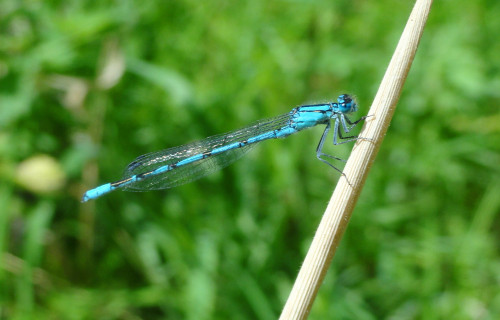
Powder Blue Damselfly Facts
- Now appearing in this compendium of 5 Wondrous Washington State Insects we give you the gorgeous Powder Blue Damselfly.
- Most people who know of it refer to this dazzling product of Nature and evolution by the common name we’ve chosen to employ here. Yet, this marvel also has a few other general titles. These include such terms as common bluet, northern bluet, among many others.
- Scientific professionals, however, perhaps know the small wonder somewhat better by its techinical moniker. Unfortunately, that’s a difficult one for the layperson to pronounce. That’s because the beautiful Arthropod bears the formal epithet of Enallagma cyathigerum.
- The delicate creature received that appellation due to the efforts of Toussaint von Charpentier. The acclaimed German entomologist accomplished the first acknowledgement of it as a separate and distinct species. He managed that scientifically noteworthy feat in 1840.
- It represents one of many species considered important to researchers studying human impact on the environment. Due to its specific nature and habitat, it presently serves as an important indicator of the relative health of certain specific types of ecosystems within its range.
- Thankfully, the Powder Blue Damselfly appears to be maintaining a population base that’s both stable and sufficient. That pleasant state also seems to hold true across the entirety of its range. The IUCN therefore currently lists the insect as Least Concern on its published Red List.
- The wonder of evolution nonetheless faces many potential threats to its continued existence as a species. Like all forms of life on this planet, most of these stem from the actions of man. These dangers include the dual perils posed by both habitat loss and climate change.
CCL: https://tinyurl.com/33psz7af
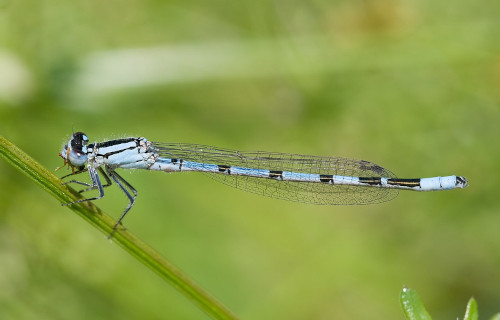
Powder Blue Damselfly Physical Description
The visually stunning Powder Blue Damselfly generally captivates those individuals fortunate enough to notice one of the lovely creatures. Unlike some of its kindred, though, it does no do so due to size. That’s true given the fact that it ranks as somewhat smaller than some of them.
It does follow one pattern of development common to the group, though. That’s in the fact that it displays a certain degree of the physiological characteristic of sexual dimorphism. In its specific case, however, this trait only manifests itself in terms of outward physical appearance.
Regarding dimensions, both genders of the wonder attain the same overall measurements. Among mature adults, this ranges from approximately 1.3 – 1.4 in (3.2 – 3.5 cm). Exceptional individual do occur, of course, regardless of sex. Yet, few of these exceed thus length by any great amount.
It also sets itself apart from all other closely related damselflies in one particular aspect. That’s due to the fact that the side of its thorax presents a single black stripe. In all other close kindred, two such features appear in this location. It also displays a spot between thorax sections others lack.
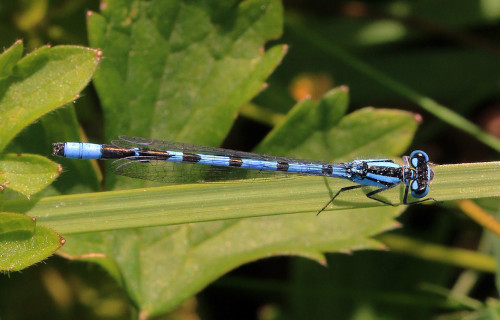
But, it’s the gorgeous patterns of color of the mesmerizing Powder Blue Damselfly that most viewers most notice and appreciate. This aspect is also where the two genders separate themselves. The males almost exclusively present an overall cerulean blue shade, with some black markings.
Females of the species, though, manifest a markedly wider variety of base colors, shades, and even patterns than their male counterparts. Other colors occasionally presented include greenish-brown or brown. Some examples further separate from the males by showing more black features.
- Kingdom: Animalia
- Phylum: Arthropoda
- Class: Insecta
- Order: Odonata
- Family: Coenagrionidae
- Genus: Enallagma
- Species: E. cyathigerum
CCL: https://tinyurl.com/bdes27an
Powder Blue Damselfly Distribution, Habitat, and Ecology
The breathtaking Powder Blue Damselfly evolved as endemic to an extremely broad swathe of the surface of the earth. Impressively, the full extent of that native zone of habitation may surprise many people, though. This insect dwells in most of two of earth’s eight biogeographical regions.
In North America, the species inhabits virtually all of both Canada and the United States. In Mexico, its range reaches into the northern areas. Yet, this intrepid insect also resides across much of Europe, including in Sweden and Norway. In Asia, meanwhile, it also appears in South Korea.
This spectacular small marvel displays decidedly clear preferences regarding its choice of habitat. The nature of these, though, do leave the creature somewhat vulnerable to local changes in its immediate environment. These appear in various places, though, including forests and parks.
It generally lives either on or in very close proximity to small bodies of water. While their conditions vary, each of these must meet certain criteria. Each must be relatively shallow and slow moving. These even include patches of weeds in ditches, wadis, and oases, or small, still streams.
The Powder Blue Damselfly feeds as a carnivore. The vast majority of its diet is comprised of the types on small insects that usually frequent its own preferred ecosystem. That prey mainly includes flies, mosquitoes, and aquatic insects. Yet, it also eats larger fare, such as bees and moths.
Its larvae emerge as adults between May and August. The Arthropod focuses on feeding for only a short time, however, before inevitably turning its attention to mating. Many species feed on both the young and adults, though. These multiple predators include fish, birds, frogs, and water spiders.
Blue-winged Wasp
CCL: https://shorturl.at/mPTZ4
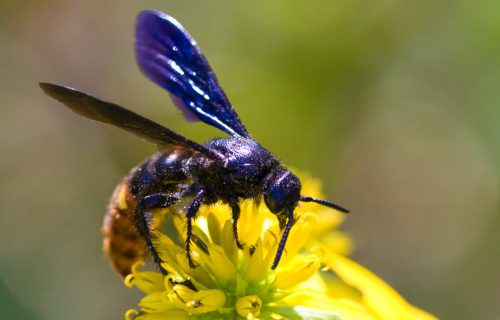
Blue-winged Wasp Facts
- Closing out this article about these 5 Wondrous Washington State Insects comes the brilliantly-hued flying marvel named the Blue-winged Wasp.
- The most frequently used common name for this remarkable invertebrate is the descriptive one you find in this article. The eye-catching insect does have at least one other generally accepted title, though. That’s the very similar term of two-spotted scoliid wasp.
- Inside of scientific circles, however, it’s probably much more often refered to by its purely technical designation. Thankfully, that’s an extremely easy term for the layperson to pronounce, compared to most. The Arthropod bears the official moniker of Scolia dubia.
- The beautiful creature received that epither due to the work of Thomas Say. The highly respected American entomologist accomplished the first official recognition of it as a separate and distinct species. That scientifically noteworthy deed occurred in the year 1837.
- Fortunately, the Blue-Winged Wasp appears to be maintaining a population base that’s both stable and sufficient. That pleasant condition further seems to hold true throughout the entirety of its native range. The IUCN thus currently has no listing for it on its Red List.
- The intriguing species nevertheless faces the same potential threats to its continued existence as all species on earth today. Most of these multiple dangers stem from the actions of mankind. They include the related perils of habitat loss and the effects of ongoing climate change.
CCL: https://shorturl.at/lnqUV
Blue-Winged Wasp Physical Description
The mesmerizing Blue-Winged Wasp quickly captures the attention of those individuals fortunate enough to notice one of these wonders of Nature. It typically does so due to more to its appearance than size, however. That’s due to the fact that, in size, it ranks as an average-sized wasp.
Much like many of the countless other invertebrates around the world, it also displays a certain degree of the physiological characteristic known as sexual dimorphism. In this particular insect’s case, though, this natural trait manifests itself in differences in the physical form of the body itself.
That’s partly because the posterior section of the body of the male possesses a total of seven segments. The female, however, only develops six of these. Males of the visually dazzling species additionally typically display somewhat longer antennae than their female counterparts.
Yet the genders present the same outward appearance to the observer otherwise. This includes overall body length. Among fully mature individuals of both sexes, this ranges from an average of approximately 0.8 – 1.0 in (2.0 – 2.5 cm). Even exceptional examples rarely exceed this by much.
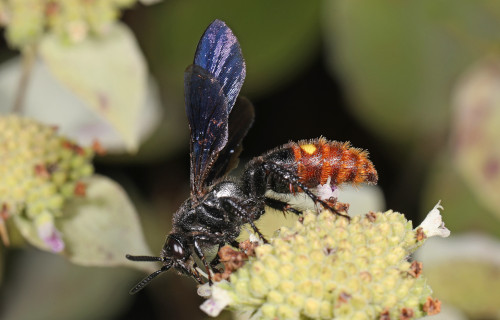
In terms of coloring, the mesmerizing Blue-Winged Wasp presents one with a captivating combination of colors. The head and thorax show dark black. This also extends through either the second or third segment of the abdomen. From there, though, the rest usually presents a bright red.
It’s the wings of the creature that nevertheless garner the most attention. These stunning appendages also serve as the source of its common name. These features develop as long and thin. But it’s their color that most draws the eye, given that they display a vibrant shade of violet-blue.
- Kingdom: Animalia
- Phylum: Arthropoda
- Class: Insecta
- Order: Hymenoptera
- Family: Scoliidae
- Genus: Scolia
- Species: S. dubia
CCL: https://shorturl.at/mPTZ4
Blue-Winged Wasp Distribution, Habitat, and Ecology
The attention-grabbing Blue-Winged Wasp evolved as native to a moderately large expanse of the globe. That consists of a general region already well known for its abundance of natural wonders. That’s because the Arthropod developed as endemic to a specific portion of North America.
Within that greater range, however, the gorgeous invertebrate lives almost entirely inside the borders of the nation of the United States. There, though, it resides in all but the most western part of the country. Yet, the most southern part of its territory reaches as far as Coahuila, Mexico.
This remarkable creature also evolved as quite versatile in terms of its habitat requirements. Due to that impressive flexibility, it makes its home within a wide variety of ecosystems. Essentially, any locale inside its overall range possessed of a temperate climate suffices, in that respect.
This appealing Arthropod does have one other vital need concerning where it makes its home, however. Understandably, that’s the presence of an abundant food source for the young. To that end, it’s most commonly found in such similar settings as meadows, fields, and even lawns.
The Blue-Winged Wasp also exhibits a diurnal behavioral pattern. It’s additionally typically only active above ground during the summer months. During that time, the extremely social species generally groups together. Males usually fly close to the ground, in groups of about a dozen.
Following the conclusion of mating, the female digs into the soil, to locate a grub. Once she finds it, she stings it, and lays an egg on its body. Once that hatches, it uses the grub as its food source. Mature adults, though, consume the nectar of various locally available types of flowers.
Photo: David A. Hofmann
CCL: https://tinyurl.com/4trju48p
5 Wondrous Washington State Insects
We sincerely hope that each of you thoroughly enjoyed reading, and hopefully learning something from, this article we’ve written about these 5 Wondrous Washington State Insects. It’s also our hope that doing so has left you with either a new or renewed appreciation for such wonders of Nature.
Unfortunately, however, many of their equally amazing kindred around the world now find themselves facing strong threats to their continued existence as a species. Many of those dangers, in fact, stem from the actions of mankind. We must do all we can to protect and preserve them all.
Check out our other articles on 5 Lively North American Lizards, Earth’s Amazingly Abundant Avians, 3 Wondrous South American Waterfalls, Wonderful Wild Cats of the World










Leave a Reply