CCL: https://bit.ly/3xCsjtN
We sincerely hope that each of you, our readers, will greatly enjoy and appreciate this article we present about these 5 Fantastic Fungi of Europe. It was certainly our pleasure to compile the information for you. May it provide you with both education and increased awareness.
Obviously, while amazing, these few species listed herein represent only a portion of the natural wonders found throughout the region, however. Yet, it’s our belief that they serve as excellent examples of the wonders found here. Check out some of our other articles for similar marvels.
Basket Stinkhorn
CCL: https://tinyurl.com/bdes27an
Basket Stinkhorn Facts
- Starting off this article about these 5 Fantastic Fungi of Europe we give you the intriguing natural wonder known as the Basket Stinkhorn.
- This visually distinctive product of Nature and evolution most often goes by the equally unusual common name we’ve used here. It does have several other general titles it’s known by, though. These tags include such terms as the latticed stinkhorn and red cage.
- Inside of the scientific community, however, it’s possibly significantly better known by its technical designation. Fortunately, that’s a much simpler one for the layperson to pronounce than most. That’s because the fungus holds the official moniker of Clathrus ruber.
- This remarkable form of life received that tag originally due to the efforts of Pier Antonio Micheli. The noted Italian botanist made the first official recognition of it as a separate and distinct species. That scientifically noteworthy achievement occurred in the year 1729.
- Credit for its naming becomes somewhat murky, though, later. That confusion happens due to the fact that, in 1801, the South African mycologist, Christian Hendrik Persoon assigned it to a new group of fungi. Presiding bodies thus now assign dual credit for its designation.
- Thankfully, the amazing Basket Stinkhorn appears to be maintaining a population base that’s both stable and sufficient. This pleasant state also seems to hold true throughout its entire range. The IUCN thus does not currently show it on its Red List of Threatened Species.
- The wonder of Nature nevertheless still faces multiple potential threats to its continued existence as a species, at least. Like all forms of life on earth today, most of these perils stem from the actions of man. They include the dangers posed by habitat loss and climate change.
CCL: https://tinyurl.com/33psz7af
Basket Stinkhorn Physical Description
The fabulous Basket Stinkhorn typically draws the attention of most individuals fortunate to encounter it. Like many of its relatives around the world, however, it does so due more to its eye-catching appearance than sheer physical size. That’s because it’s not an overly large type of fungus.
The fruiting body of this marvel typically measures somewhere between 2 – 4 in (5 to 10 cm) in diameter. When this part of it first emerges, though, it’s usually enclosed in a somewhat whitish, egg-shaped structure known as a volva. This splits open to reveal the mature lattice structure.
The volva itself represents the basal structure from which that fruiting body eventually emerges. That part of the structure, though, initially appears as egg-shaped. It’s also a white to pale gray, and gelatinous. As that same fruiting body expands, the volva ruptures and remains at the base.
Distinguishing itself in yet another manner, however, this wonder of Nature does not have a distinct stem, known as a stipe, like many other fungi. Instead, the lattice structure arises directly from the volva or from the ground. This helps to further augment its remarkable physical appearance.
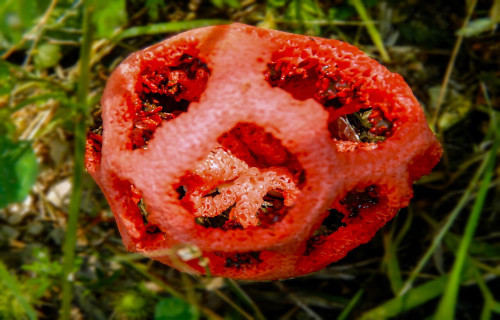
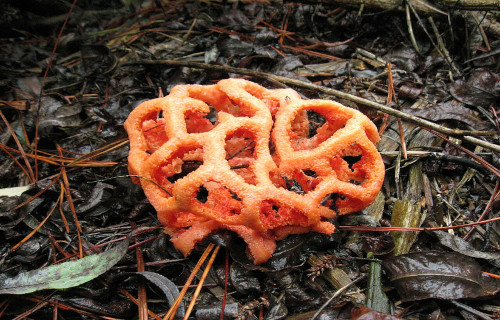
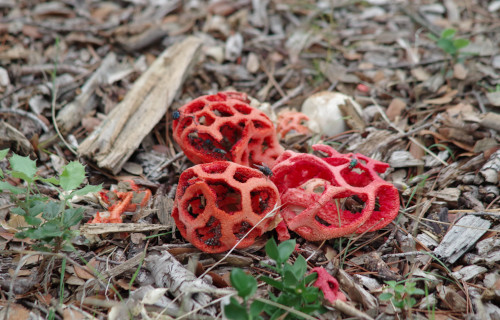
It’s the aforementioned fruiting body of the Basket Stinkhorn, though, that’s its most truly striking feature. This consists of a hollow, spherical or oval structure resembling a lattice or cage. This lattice structure’s made up of interconnected, spongy, and porous red or orange-red branches.
Overall, the color of this intriguing creation of natural processes frequently varies. This pattern of coloration often ranges from bright red to orange-red, often fading to a lighter pink or orange as it ages. The inner surface of the lattice also often shows slightly paler than the outer surface.
- Kingdom: Fungi
- Phylum: Basidiomycota
- Class: Agaricomycetes
- Order: Phallales
- Family: Phallaceae
- Genus: Clathrus
- Species: C. ruber
CCL: https://tinyurl.com/2s4apsss
Basket Stinkhorn Distribution, Habitat, and Ecology
The intrepid Basket Stinkhorn evolved as indigenous to an impressively broad expanse of the surface of the globe. The full extent of that zone of habitation, in fact, might surprise some people. That’s because it’s native to many parts of Europe, Northern Africa, and southwestern Asia.
Due to the actions of mankind, though, the amazing fungus now appears in regions outside of this original territorial range. It’s now been naturalize in portions of North America. There, it’s been seen in California, in the United States, as well as a few locations in the country of Mexico.
Following a pattern prevalent among fungi, this wonder of evolution displays an extremely high degree of flexibility regarding its choice of habitat type. It’s therefore found in a remarkably wide range of ecosystems. A few specific types of these nevertheless do typically tend to predominate.
It’s quite commonly found in such locations as lawns, gardens, and parks. It prefers locations where there’s ample organic matter for decomposition. It additionally typically grows on the ground amidst grass, humus, mulch, wood chips, woody debris, or decomposing organic material.
Yet, this incredible product of evolution also frequently thrives well in leaf litter on garden soil and woodchip garden mulches. These substrates offer the species a rich supply of decaying plant material, which remains essential for the saprobic lifestyle that Nature provided it with.
Given the nature of that highly specific form of evolved lifestyle, the Basket Stinkhorn, again like many others of its kind across the globe, plays an interesting and significant role within its ecosystem. That’s due to the fact that the distinctive fungus feeds on decaying organic material.
This role’s highly crucial, as the wonder helps decompose dead plants, contributing to nutrient cycling within its habitat. By breaking down woody debris, leaf litter, and other organic materials, it helps convert these into simple compounds that enrich the soil and support plant growth.
Intriguingly, it also has a unique strategy for the dispersal of its spores. The fully mature fruiting body emits a foul odor that mimics rotting flesh, which attracts flies and other insects. These insects feed on the spore-laden slime and subsequently help disperse the spores over a wider area.
Scarlet Elf Cup
CCL: https://tinyurl.com/462rnnjn
Scarlet Elf Cup Facts
- Next up in this compilation of 5 Fantastic Fungi of Europe comes the remarkable species known mainly as the Scarlet Elf Cup.
- This intriguing product of Nature and evolution is best known by the descriptive common name of the Scarlet Elf Cup across its range. The fungus does, however, have several other general titles. These terms include Moss Cup, Fairies Baths, and simply Scarlet Cup.
- Within the scientific world, though, it’s perhaps much better known by its purely technical moniker. Unfortunately, that’s an extremely difficult term for the layperson to pronounce. That’s because the unique fungus holds the official epithet of Sarcoscypha coccinea.
- It received that hard to utter designation due to the efforts of Jean Baptiste Émil Lambotte. The respected Belgian mycologist applied the name to this natural marvel that it holds today. He did so in the year 1889. But, this moniker wasn’t the original name of the unique species.
- The credit for that achievement goes to the Italian naturalist Giovanni Antonio Scopoli. This highly noted researcher accomplished the first recognition of it as a separate and distinct species, though he applied a different tag. This scientifically noteworthy deed occurred in 1772.
- Thankfully, the remarkable Scarlet Elf Cup continues to maintain a population base that’s both stable and sufficient. That pleasant state also seems to hold true throughout the entirety of its range. the IUCN therefore currently does not show it on the Red List of Threatened Species.
- The wonder nevertheless should still be considered as facing the same potential threats to its continued existence as all species on earth today. Like the rest of us, most of those dangers stem from the actions of man, and include the perils of habitat loss and climate change.
CCL: https://tinyurl.com/3ywffcfy
Scarlet Elf Cup Physical Description
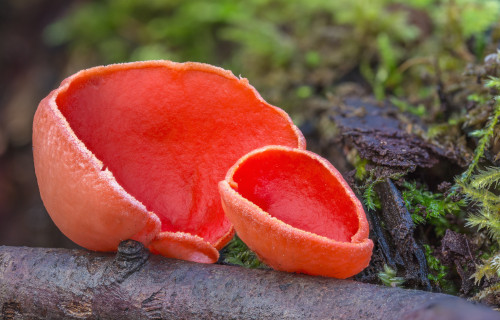
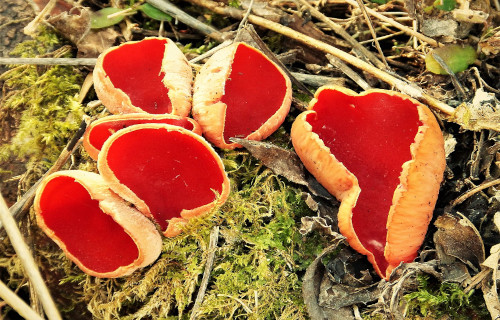
The stunning Scarlet Elf Cup dazzles those individuals fortunate enough to encounter this amazing marvel of Nature. The fabulous fungi typically does so, however, due more to its brilliant hue than its sheer size. That’s true since it actually ranks as a comparatively small variety of mushroom.
Its form varies in nature somewhat, though, regarding the structure known as its stem. Most specimens lack a distinct version of such a feature, yet a few exceptions do manifest one. Those examples that do produce this structure, however, typically show a relatively short, stubby version.
Younger examples of this visually intriguing fungus generally have a generally spherical shape, while, mature specimens display a roughly cup-shaped form. This also tends to be comparatively shallow in nature. Adding to its visual appeal comes the fact that it also possesses rolled-up edges.
Despite its numerous wonders, however, it’s undeniably a small species of mushroom. It’s also quite variable in this respect. The fruiting bodies usually range in width from about 04. 2.4 in (1 – 6 cm). Though exceptional examples sometimes do occur, they rarely exceed this by very much.
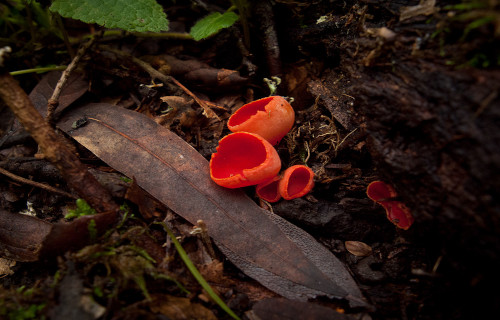
The most striking feature of the stunning Scarlet Elf Cup remains its vibrant red color, though. The outer surface of the fungus usually shows a deep scarlet or crimson hue, while the inner surface frequently varies from a paler pinkish-red to a deeper red. Other variants do exist, including orange.
The surface often appears extremely smooth when young, becoming slightly wrinkled with age, with the texture feeling rubbery. Inside, you’ll find a smooth, shiny surface that contrasts sharply with the outer texture. This sometimes has a more translucent appearance compared to the outer layer.
- Kingdom: Fungi
- Phylum: Ascomycota
- Class: Pezizomycetes
- Order: Pezizales
- Family: Sarcoscyphaceae
- Genus: Sarcoscypha
- Species: S. coccinea
CCL: https://tinyurl.com/yswn2ycv
Scarlet Elf Cup Distribution, Habitat, and Ecology
The Scarlet Elf Cup evolved as native to an extraordinarily broad swathe of the surface of the earth. In fact, the full extent of that zone of habitation covers much of the Northern Hemisphere. The marvel appears in Africa, Asia, Europe, North and South America, and even Australia.
In North America, it’s especially common in the eastern United States, where it’s found in states such as Connecticut, Virginia, Maryland, and others. It’s also in the midwest and western sections, in states like Ohio, Michigan, Oregon, and Washington. It appears in the nation of Canada, too.
Meanwhile, in Europe, the marvel of Nature remains equally widespread. Many countries such as the United Kingdom, France, Germany, and Scandinavia are known to have substantial populations of this fungus present. In Asia, it’s also extremely common on the island country of Japan.
This remarkable creation of evolutionary processes additionally displays decidedly clear and strong preferences regarding its choice of habitat. Like all of its countless relatives located around the world, this amazing fungus thrives best in comparatively moist or humid environments.
Because of this, it’s commonly found either in areas with ample quantities of rainfall or where there’s frequent moisture, such as near streams, in damp woodlands, or in areas with high humidity levels. In these same areas, it’s also typically located under the canopy of trees, in the shade.
The impressive Scarlet Elf Cup evolved as a saprophytic fungus, meaning it obtains its nutrients by decomposing dead organic matter. It primarily grows on decaying hardwood logs, branches, or stumps. It’s often found on fallen or rotting wood, especially in advanced stages of decay.
Its fruiting bodies generally appear in late winter to early spring, often coinciding with periods of cooler temperatures and moisture. The red or orange cup-shaped structures develop to release its spores, which it disperses by various means, primarily including wind, rain, and animal activity.
Indigo Milk Cap
CCL: https://bit.ly/3xCsjtN
Indigo Milk Cap Facts
- Our next choice for inclusion in this listing of these 5 Fantastic Fungi of Europe bears the descriptive common name of the Indigo Milk Cap.
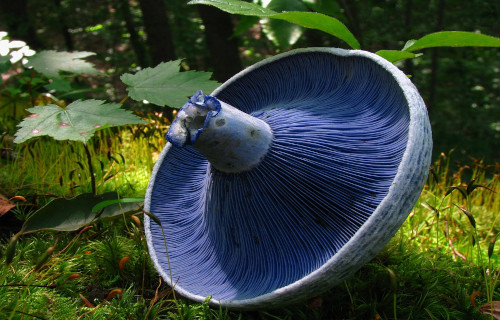
- Most frequently known by this fascinating common name, this brilliantly colored mushroom easily dazzles the eye of the observer. It also has several other general names it’s known by, though. These alternate terms include the similar blue milk mushroom and indigo lactarius.
- Scientific professionals, however, typically refer to the amazing fungus by its official, purely scientific name. That’s the relatively simple term, as such things go, of the Lactarius indigo. Regardless of which term one chooses to employ, though, it’s a marvel of evolution.
- The remarkable species received its present name at the hands of the respected German-American mycologist, Lewis David de Schweinitz. This highly noted researcher assigned it the term it’s now known by as a result of reclassification. He took this action in the year 1838.
- The very first known recognition of it as a separate and distinct species, however, actually took place in the year 1822. The same renowned researcher that later changed the name due to reclassification also made the first formal acknowledgement of the incredible fungus.
- The intriguing Indigo Milk Cap appears to be maintaining a population base that’s both sizeable and stable. This further seems to hold true throughout the entirety of its natural range. The IUCN therefore has no listing for it on the organization’s Red List of Threatened Species.
- Nevertheless, that status could potentially change in the very near future. That’s because, like most species on earth, it faces several threats to its continued existence. Habitat loss naturally poses a danger. It’s greatest threat, though, likely consists of the peril of climate change.
CCL: https://bit.ly/3rkjMdQ
Indigo Milk Cap Physical Description
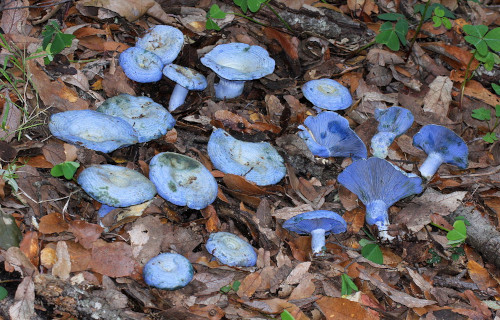
The visually distinctive Indigo Milk Cap quickly draws the attention of all those individuals fortunate enough to encounter it. It does so for several reasons, though, not just because of its remarkable coloring. This marvelous fungus is truly an impressive creation of Nature and evolution.
For starters, the brightly shaded mushroom varies in size, frequently significantly, like most of its realtives around the world. That’s due to a wide a variety of reasons, including local environmental factors. Most specimens, however, attain a cap diameter ranging between 2 – 6 in (5 – 15 cm).
The stem of this marvel of the world of mycology, meanwhile, ranges from 0.8 – 3 in (2 – 8 cm) in height. The thickness of this specific portion of the species also varies markedly. This measurement itself ranges from between 0.4 – 1. in (1 – 2.5 cm). This usually provides it with a stable base.
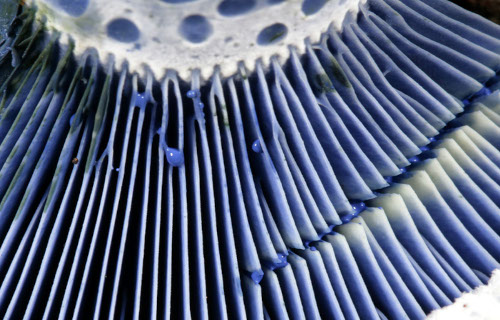
The edges of the cap also roll under as the fungus slowly matures. It shares this trait with several other members of its genus. The mushroom also shares the characteristic that serves as part of its very name. That’s because, if the flesh is damaged, a milk-like substances slowly oozes out.
Yet it’s the coloring of the stunning Indigo Milk Cap thata generally garners the most attention. That’s due to the fact that this presents as a brilliant shade of indigo blue. Even the aforementioned milky substance within it shows the same shade! This slowly changes to green in air, however.
- Kingdom: Fungi
- Phylum: Basidiomycota
- Class: Agaricomycetes
- Order: Russulales
- Family: Russulaceae
- Genus: Lactarius
- Species: L. indigo
CCL https://bit.ly/316D6Ae
Indigo Milk Cap Distribution, Habitat, and Ecology
Fortunately, both for the Indigo Milk Cap itself, and those of us who appreciate Nature, the mushroom has an extremely large range of habitation. That’s because the marvel of evolution inhabits various portions of the continents of North America, Central America, Asia, and Europe.
In Europe, it’s only known to appear in parts of southern France. In Asia, though, the wonder lives in both China and India. Meanwhile, in Central America, the fungus is known to inhabit Costa Rica, Guatemala, and Colombia. Elsewhere, it thrives in the southern and eastern United States.
There, the majority of specimens of this impressive fungus develop across a range that runs along the Gulf Coast of the United States, to the Appalachian Mountains. There, however, its population concentrations become somewhat scarce. Small groupings do appear elsewhere, though.
All regions in which it makes its home, though, share various natural attributes, of course. Chief among these requirements tands the presence of sufficient moisture. Warm temperatures also represent another factor. Common locations include damp forests, frequently of pine or oak.
Much like many of its numerous relatives, the intriguing Indigo Milk Cap evolved a highly mutualistic relationship with certain species of plants. These include pine and oak, thus explaining its preference for forests containing a high ratio of such species. It mainly thrives on the roots.
There, the intriguing mushroom extracts fixed carbon from its host tree. In exchange, however, the tree itself also benefits. That’s due to the quantities of various amino acids and minerals the fungus removes from the surrounding soil. These it feeds to the host, ensuring mutual survival.
Jelly Ear
CCL: https://bit.ly/3NE4ZDb
Jelly Ear Facts
- Next up in this compendium of 5 Fantastic Fungi of Europe we give you the unusual product of Nature named the Jelly Ear.
- This distinctive variety of fungus most frequently, and understandably, goes by the simple yet uncannily descriptive common name. Like many species on earth, though, it also bears still other, alternate names. These options include such terms as Jew’s Ear and the Judas’s Ear.
- Among professionals, such as researchers, however, it’s perhaps much better known by its technical name. That term, though, as such things do, remains quite difficult for the layperson to pronounce. That’s because it holds the technical name of Auricularia auricula-judae.
- Its naming took a rather circuitous path. The eminent Swedish botanist, Carl Linnaeus recorded the first known description of the mushroom, in 1753. Later, however, the French botanist Jean Bulliard renamed it. The wonder received the name it presently holds in 1822.
- The Jelly Ear appears to presently be maintaining a population base that’s both stable and sufficient. This fortunate fact further seems to hold true throughout the entirety of its native range. The IUCN thus presently has no listing for it on its Red List of Threatened Species.
- The marvel of Nature nevertheless must be considered as facing at least some threats to its continued existence as a species. These, though, remain the same most species face. Habitat loss certainly qualifies. Its greatest threat, however, most likely consists of climate change.
CCL: https://bit.ly/3QgzHUF
Jelly Ear Physical Description
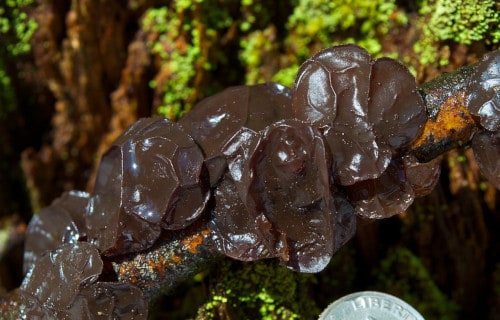
The Jelly Ear unquestionably constitutes an intriguing variety of fungus. It fully merits the attention it garners from those who encounter it. It further does so due to several factors. Its sheer size qualifies as one of those. Though by no means the largest, it’s an above-average sized specimen.
Individual specimens sometimes attain a diameter measuring as much as 3.5 in (9 cm). Most, however, tend to remain slightly smaller than that. The species also achieves a thickness of up to 0.12 in (3 mm). Each example, though, tends to develop in its own entirely unique exact shape.
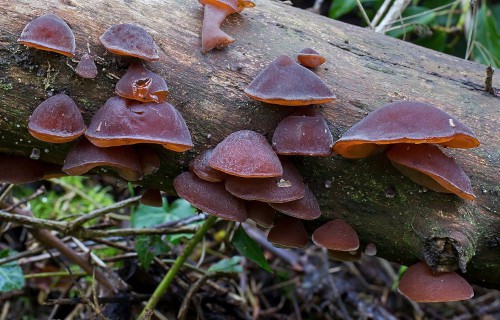
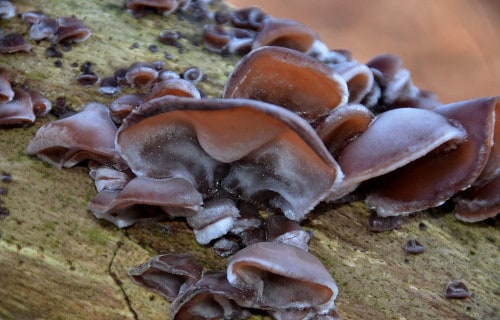
But overall, members of the species develop as a shape often compared by observers to that of a floppy human ear. That therefore serves as the origin of the most often used name. Some examples, though, occasionally display a somewhat different shape. These typically appear cup-shaped.
Most specimens of the highly distinctive Jelly Ear attach themselves laterally to a surface. This means that these do not possess a stalk. A small percentage of them, do, however, develop this feature. Among these less common forms, the stalk nevertheless remains extremely short in length.
While living, the body displays a realtively tough, gelatinous texture that’s slightly elastic to the touch. The majority of the upper surface also displays a mainly reddish-tan shade. This same part of the fungus also often possesses a light purplish hue. It also frequently manifests tiny gray hairs.
- Kingdom: Fungi
- Phylum: Basidiomycota
- Class: Agaricomycetes
- Order: Auriculariales
- Family: Auriculariaceae
- Genus: Auricularia
- Species: A. auricula-judae
CCL: https://bit.ly/39php2X
Jelly Ear Distribution, Habitat, and Ecology
The remarkable Jelly Ear evolved as native to an extremely large swathe of the surface of the globe. Not surprisingly, that same region’s already well known for its great abundance of intriguing flora and fauna. That’s because this wonder of Nature developed natively in what’s now Europe.
In fact, the fascinating fungus appears in virtually all parts of this beautiful continent. Intriguingly, however, evidence additionally indicates that this product of Nature never existed naturally beyond this region. Related species do live in other parts of the world, but not this specific fungus.
It also displays decidedly clear preferences for where it chooses to appear. This primarily consists of areas of temperate forest. The natural wonder even manifests obvious preferences for which types of hosts. This consists almost exclusively of several species of deciduous trees and shrubs.
This intriguing product of evolution most commonly develops on elder trees. Other, less popular, hosts include varieties such as spindle, ash, beech, and sycamore. Conifers, though, rarely play host to this particular fungus. It also prefers to develop on notably older, or even dead, branches.
The amazing Jelly Ear most frequently develops as an entirely solitary species. It nevertheless does occasionally develop in small clusters. Fascinatingly, it also makes appearances throughout the year, even during winter. Its numbers do usually tend to be slightly fewer during that season, though.
Like other all other known fungi on earth, this unique looking variety reproduces via the spreading of its very tiny spores. In its particular case, however, it ejects these from the underside of the fruit body. It also produces and ejects as many as several hundred thousand of these per hour!
Black Witches’ Butter
CCL: https://bit.ly/3beRCsv
Black Witches’ Butter Facts
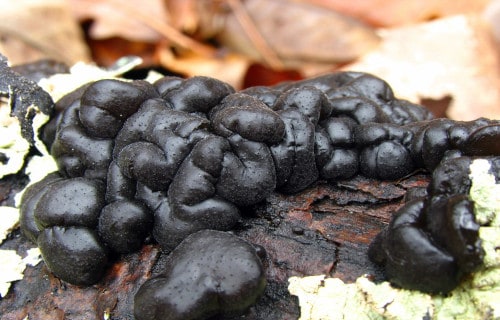
- Closing out this article about these 5 Fantastic Fungi of Europe comes perhaps the most attention-grabbing of them all, the Black Witches’ Butter.
- The intriguingly distinctive term we’re using herein serves as only the most frequently used name for this amazing fungus. It actually goes by several other alternate titles, as well. These options include the unique terms of the black jelly roll, and the warty jelly fungus.
- Its purely scientific name, however, is that of the Exidia glandulosa. Regardless of which of these choices one uses to refer to it, though, it’s an impressive species. Unfortunately, it’s often confused with another, visually similar species with which its shares its habitat range.
- The first known official recognition of it as a separate and distinct species took place in the year 1789. Regrettably, though, the remarkable fungus also served as the center of some controversy in scientific circles. This holds true due to several questions about its naming.
- The French botanist Jean Baptiste François Pierre Bulliard made the original identification and taxonomic naming. In 1822, however, the Swedish botanist and mycologist Elias Magnus Fries placed it in another genus. This action served to combine it with the related species.
- Then, in 1936, other experts separated the two once again. This occurred at the hands of the German mycologist, Walther Neuhoff. He, however, made yet another mistake in the naming of the two. Later, still another mycologist, Marinus Anton Donk, finally corrected this.
- The impressive and distinctive Black Witches’ Butter seems to have a stable and sufficient population base. This further appears to hold true throughout the entirety of its native range. The IUCN therefore presently has no listing for it on its Red List of Threatened Species.
- The fungus nevertheless does face certain threats to its continued existence as a species. Habitat loss certainly poses a danger to it, as the forests in which it thrives in vanish. Likely, though, the greatest danger it faces comes in the form of the ongoing effects of climate change.
CCL: https://bit.ly/30cIBcU
Black Witches’ Butter Physical Description
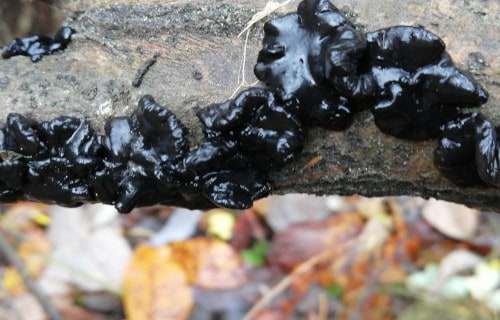
It must be pointed out that the intriguing Black Witches’ Butter frequently possesses a highly irregular shape. This tendency therefore makes an accurate description of its physical appearance extremely difficult. Certain basic patterns do appear, however, and it’s those we’ll elaborate on.
Overall, the fruit bodies of this particular fungus attain an average diameter measuring around 1.2 in (3 cm). This feature develops on top of an irregularly shaped stalk, which usually measures almost as wide as the cap itself. These parts further generally appear in small groupings or clusters.
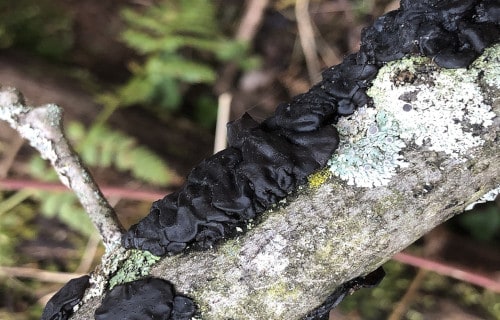
The body of the fascinating fungus also develops a somewhat surprising texture. That’s because this outer covering evolved a principally gelatinous or rubbery feel to it. This aspect of the species remains firm, though. This, however, only maintains itself if the mushroom is fresh and young.
When this wonder of nature becomes either wet or aged, this changes to a lax nature. Its shape also often becomes distorted at this time. The stark black hue of the aptly-named Black Witches’ Butter, though, remains its most noticeable feature. It also frequently has a shiny appearance to it.
- Kingdom: Fungi
- Phylum: Basidiomycota
- Class: Agaricomycetes
- Order: Auriculariales
- Family: Auriculariaceae
- Genus: Exidia
- Species: E. glandulosa
Public Domain Image
Black Witches’ Butter Distribution, Habitat, and Ecology
For the moment, the precise extent of the range of distribution of the astonishing Black Witches’ Butter remains undetermined by researchers. That’s due to the fact that it’s so often confused with another, visually similar, species. The two appear to roughly share the same territorial range.
It can only be said for certain that this product of evolution inhabits the continent of Europe. It’s frequently spotted in both the United Kingdom and Ireland, among others. Reports further indicate the possibility of its presence, naturally or otherwise, in much of the Northern Hemisphere.
Wherever this distinctive marvel of Nature makes an appearance, its habitat preferences continue to be quite clear displayed. That’s because it’s commonly seen in regions of forest. Although it lives among evergreens as well, it typically appears in regions formed of mainly deciduous trees.
Even within that ecosystem, however, it still displays even further preferences. The intrepid fungus most frequently makes its home on various broadleaf trees. These most commonly consist of various oak trees. Others, such as beech or hazel, sometimes serve as host to the fungus, though.
Like many of its many related kindred across the globe, the Black Witches’ Butter evolved as a wood-rotting variety. When it makes an appearance on a host tree, it usually does so on a long-dead limb. Once there, it typically produces the distinctive fruit bodies in Autumn and Winter.
CCL https://bit.ly/316D6Ae
5 Fantastic Fungi of Europe
We sincerely hope that each of you thoroughly enjoyed reading, and hopefully learning something from, this article we’ve written about these 5 Fantastic Fungi of Europe. It’s also our hope that doing so has left you with either a new or renewed appreciation for such wonders of Nature.
Unfortunately, however, many of their kindred around the world now find themselves facing strong threats to their continued existence as a species. Many of those dangers, in fact, stem from the actions of mankind. We must all do everything that we can to protect and preserve them all.
Check out our other articles on 5 Lively North American Lizards, Africa’s Many Geological Masterpieces, 4 Herbaceous Plants of England, The Mighty Tornado, 5 Magical Mammals of Ohio










Leave a Reply