CCL: https://tinyurl.com/33psz7af
We sincerely hope that each of you, our readers, will greatly enjoy and appreciate this article we present about these 4 Startling Squids. It was certainly our great pleasure to compile the various information for you. May it serve to provide you with both education and increased awareness.
Obviously, these few species listed herein represent only a small portion of the natural wonders found throughout the world, though. Yet, it’s our belief that they serve as excellent representations of the wonders found here. Check out some of our many other articles for similar marvels.
Stubby Squid
CCL: http://tinyurl.com/2s4apsss
Stubby Squid Facts
- Leading off this article about these 4 Startling Squids we give you the remarkable cephalopod best known as the Stubby Squid.
- This amazing creation of Nature and evolution most freuently goes by the somewhat amusing common name applied to it here. Yet, the animal also possesses a few other general titles. These options include the terms North Pacific Bobtail Squid and Pacific bob-tailed squid.
- Inside of the scientific community, however, it’s perhaps better known by its technical designation. Fortunately for the layperson, that’s an extremely easy to pronounce epithet compared to most. That’s because it currently holds the formal tag of Rossia pacifica.
- The amazing cephalopod received that official moniker due to the efforts of Samuel Stillman Berry. This respected American marine zoologist accomplished the first recognition of it as a separate and distinct species. He managed that scientifically noteworthy feat in the year 1911.
- This marvel of Nature and evolution garners interest among researchers for a variety of reasons. Among those is the fact that scientists currently acknowledge two separate subspecies. It’s entirely possible, though, that ongoing research may discover others in the future.
- For the moment, data on the population and relatively density of this for the Stubby Squid continues to be scarce. The IUCN therefore understandably currently lists the creature as Data Deficient. That status is reflected on the organization’s Red List of Threatened Species.
- Despite this degree of uncertainty, it’s reasonable to assume that the biological wonder faces, at least, the same potential threats to its existence as all other life on this planet. Most of these perils stem from the actions of man, including the danger posed by climate change.
CCL: http://tinyurl.com/22y23f9m
Stubby Squid Physical Description
The remarkable Stubby Squid fully earns its respect and appreciation from those few individuals fortunate enough to encounter it. Yet, it does not do so due to any impressive physical stature. That’s because, while Nature provided it many wonderful features, size doesn’t rank among them.
In that regard, the creature follows a pattern common to its numerous relatives across the globe. That’s in the fact that it displays a certain degree of the physiological characteristic of sexual dimorphism. In its specific case, this natural trait manifests itself in terms of physical dimensions.
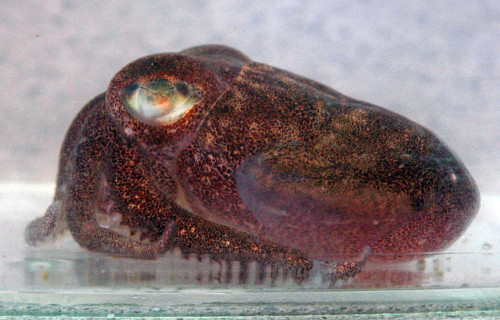
More precisely, females of the species attain a greater overall average size than their counterparts. The total difference, however, remains relatively very minor. In general, the awesome animal only reaches a mantle length of only 2 in (5 cm). Arms included, it only reaches 4.3 in (11 cm).
Not being fused to the head, the mantle developed as somewhat flattened, but rounded near the back portion. On either side of this, though, two large, semi-circular fins, with wide bases, appear. Yet, the animal conspicuously lacks the large bone here typical to most members of its Family.
It’s the head of the Stubby Squid that stands out the most in the minds of many, however. This body part hosts two greatly out-sized eyes. It also holds a pair of retractable tentacles. Not done there, evolution also placed eight arms here. Short in length, they serve as the source of the name.
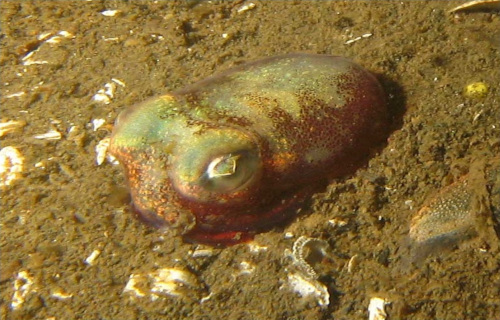
As with most of its kindred, the coloring of the astounding creature’s skin varies at will. Typically, though, this primarily consists of a background of dark reddish-brown. Nonetheless, a scattering of small spots of yellow or brown also appear. Yet, this changes to a grayish-green in times of stress.
- Kingdom: Animalia
- Phylum: Mollusca
- Class: Cephalopoda
- Order: Sepiida
- Family: Sepiolidae
- Genus: Rossia
- Species: R. pacifica
CCL: http://tinyurl.com/2s4apsss
Stubby Squid Distribution, Habitat, and Ecology
The intriguing Stubby Squid evolved as native to a moderately large expanse of the marine regions of the earth. Its indigenous zone of habitation consists of very specific sections of the Pacific Ocean, as its scientific name suggests. More precisely, it lives within the northern areas of that range.
One end of that approximate territorial reach extends from Japan and Korea, in Asia. From there, though, the cephalopod also appears in the waters of the Bering Sea. Yet, extending outward, its territory also reaches as far as California, on the west coast of the United States, in North America.
Evolution provided this marvel with a strong advantage over other, related species. That’s due to the fact that it displays a decidedly clear and strong flexibility regarding its choice of habitat depth, at least. It’s been seen at depths ranging from only 66 ft (20 m) to as great as 4,300 ft (1,311 m).
However, in all regions it does choose to live in, the marine animal displays the same precise patterns. The animal typically remains near the seafloor. This often includes regions of muddy sand, often with a sloping nature closer to shore. Amazingly, it’s even been spotted in polluted bay areas.
The aptly-named Stubby Squid lives a primarily solitary life. Due to this tendency, it’s rarely seen in groups, except for mating purposes. Like its relatives, it also developed as an entirely carnivorous species. It’s diet principally consists of shrimp. Yet, it also eats other prey, such as crabs and fish.
For breeding purposes, the animal usually moves out to deep water. That process generally occurs in either late summer and autumn. Having an average lifespan of roughly two years, both male and female typically die soon after mating. Females usually lay between twenty-five and thirty eggs.
Humboldt Squid
Humboldt Squid Facts
- Next up in this compilation of 4 Startling Squids comes the mysterious denizen of the depths named the Humboldt Squid.
- This remarkable creation of Nature and evolutionary processes most frequently goes by the common name across its range. Yet, the amazing animal does have a few other general titles, too. These include the terms jumbo squid, jumbo flying squid, Pota, and Jibia.
- Within the scientific community, however, it’s perhaps far better known by its entirely technical moniker. Like so many such tags, though, that’s somewhat difficult for the layperson to pronounce. That’s because it holds the formal designation of Dosidicus gigas.
- That’s not the name it started out with, however. The Chilean priest and polymath first brought the creature to the attention of the scientific world in the year 1782. At that time, he named it after the genus of the cuttlefish. He then applied the epithet Sepia tunicata at that time.
- Later, in 1835, the French naturalist Alcide d’Orbigny renamed it Loligo gigas. Subsequently, in 1857, the Danish zoologist Japetus Steenstrup proposed the genus name Dosidicus. Eventually, in 1912, discoveries led to the taxonomic change to the one the creature holds currently.
- Sadly, researchers do not presently have sufficient data regarding either the current population numbers or trends surrounding the Humboldt Squid. The IUCN therefore temporarily lists the marvelous marine marvel as Data Deficient on its Red List of Threatened Species.
- The amazing animal nonetheless still faces the same multiple threats to its continued existence as a species as all forms of life on earth today, at least. These dangers include the closely related threats of habitat loss and ongoing climate change, as well as numerous others.
Humboldt Squid Physical Description
The rarely photographed Humboldt Squid typically captivates those individuals fortunate enough to encounter one of these wonders. Those individuals, typically divers or researchers, of course, find it impressive due to a variety of reasons. That’s true since it boasts several distinctive traits.
This wondrous cephalopod evolved as a fairly large example of its kind. Like many of its numerous brethren, it follows a common pattern in this regard. That’s because it displays a certain degree of the physiological characteristic of sexual dimorphism. But it does so to only a small degree.
On average, females attain a mean body length measuring up to 4.9 ft (1.5 m). These also weight as much as 110 lb (50 kg). Males, meanwhile, typically remain smaller. They rarely exceed 3.9 ft (1.2 m) in body length, and generally have correspondingly lighter body masses than the females.
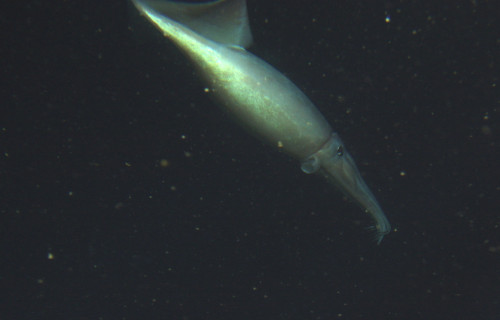
This particular species of squid developed an extremely robust and comparatively elongated mantle. That feature also tapers to a relatively sharp point at the rear of the body. The mantle appears as extremely muscular and streamlined, aiding the animal in its powerful swimming capabilities.
The impressive creature’s also well known for its naturally evolved ability to change its coloring rapidly. When it does so, it most often flashes between various shades of red and white. Most researchers believe this ability to be used for the purposes of communication and camouflage.
The head of the incredible work of Nature and evolution also holds large, prominent eyes that provide excellent vision. A strong, sharp beak used to tear apart prey also appears. The beak’s surrounded by a buccal mass that includes a radula, a tongue-like organ with rows of teeth.
The intriguing Humboldt Squid additionally developed highly unique fins. Though relatively small in size, they’re nevertheless fully functional and located on the sides of the mantles. These fins the creature primarily utilizes for the purpose of maneuvering rather than for its propulsion.
It also possesses eight arms and two longer tentacles. The arms come equipped with two rows of suckers, each of these features having sharp, serrated rings, while the tentacles possess suckers only on their clubbed ends. These appendages the animal uses to grasp and hold onto its prey.
- Kingdom: Animalia
- Phylum: Mollusca
- Class: Cephalopoda
- Order: Oegopsida
- Family: Ommastrephidae
- Genus: Dosidicus
- Species: D. gigas
Humboldt Squid Distribution, Habitat, and Ecology
The fascinating Humboldt Squid developed as indigenous to a region of the marine waters of the globe that’s already known for its abundance of natural wonders. Intriguingly, however, that zone of habitation qualifies as simultaneously extensive and restricted, depending on perspective.
The fabulous cephalopd’s native to a very specific portion of the Eastern Pacific Ocean. It’s most commonly found along the coasts of North, Central, and South America. That range extends from the southern tip of Chile up to California, in the United States, located in North America.
In recent decades, though, scientific evidence indicates the possibility that it’s now beginning to expand its territory. That new range potentially extends as far north as the coastal waters of the state of Alaska, and even possibly as far south as just off the coast of the country of Argentina.
Like many of its relatives around the world, this animal demonstrates decidedly clear preferences regarding its choice of habitat. Accordingly, it typically inhabits what’s called the neritic zone, which is the relatively shallow part of the ocean above the drop-off of the continental shelf.
Yet, the remarkable mollusc also occasionally resides in significantly deeper waters as well. It’s sometimes seen at depths ranging from approximately 656 – 3,281 ft (200 – 1,000 m). Given its natural territorial range, the squid also obviously prefers temperate to tropical temperatures.
Understandably, the Humboldt Squid evolved a purely carnivorous diet. It’s also known for being an aggressive, highly efficient, and opportunistic feeder. A typical diet includes various fish, crustaceans, and other cephalopods. Common prey includes lanternfish, hake, and sardines.
It also migrates vertically, moving to deeper waters during the day and ascending to shallower waters at night to feed. This behavior’s apparently driven by prey availability and predator avoidance. It also sometimes forms large schools for both hunting efficiency and its protection.
Like its many kindred, it reproduces via spawning. Females lay up to several million eggs in gelatinous masses, which float in the water column. Following their hatching, juvenile squids grow quite rapidly, and their growth rates can be influenced by water temperature and food availability.
Sadly, this amazing creature has a comparatively short average lifespan of only about one or two years. Though considered a top predator itself, it also has its own share of natural threats to deal with. These include larger marine animals, such as sharks, sperm whales, and large fish.
Glitter Squid
CCL: https://tinyurl.com/33psz7af
Glitter Squid Facts
- Our next choice for inclusion in this gathering of these 4 Startling Squids bears the fully appropriate title of the Glitter Squid.
- The colorful term we’re using represents only one of the common names given to this visually appealing creation of Nature and evolution. The wonder does have several other general titles, though. These include the unique tags tiger squid, oval squid, and bigfin reef squid.
- Inside of scientific circles, however, it’s perhaps much better known by its purely technical name. This moniker, however, like so many such, remains quite difficult for the average layperson to pronounce. That’s because it holds the official epithet of Sepioteuthis lessoniana.
- The highly respected French naturalist René Primevère Lesson collected the first recognized specimen, sometime between 1822-1825. Another Frenchman, the naturalist, André Étienne Justin Pascal Joseph François d’Audebert de Férussa, later became the first to describe it.
- Presently, this marvel of Nature forms one of only three known species placed within its genus. Its also notable to science for playing an important role in ongoing medical research. The stunning creature serves as a valuable source of what are known as giant axons in the field.
- For the moment, researchers sadly lack sufficient information on the population of this wonder of evolution. That state also holds true both for its numbers and trends. The IUCN thus presently shows it as Data Deficient on its published Red List of Threatened Species.
- The fascinating creature nevertheless should be considered as facing the same potential threats to its continued existence as all forms of life on earth today. Most of those dangers stem from the actions of man. Those perils include, among others, habitat loss and climate change.
CCL: https://tinyurl.com/2s4apsss
Glitter Squid Physical Description
The amazing Glitter Squid typically captivates those individuals lucky enough to encounter one of these intriguing animals in the wild. Yet, unlike some of their many cousins, they generally do so for reasons other than size. That’s true since this species is relatively small compared to others.
The amazing product of evolution also distinguishes itself from the majority of its kindred in yet another manner, as well. That’s in the fact that this marine beauty displays almost no noticeable amount of the physiological trait of sexual dimorphism. Telling the sexes apart can thus be difficult.
Mature specimens of both genders attain mantle lengths of roughly the same approximate size. A mean measurement for this equals roughly 8 – 12 in (20.3 – 30.5 cm). Exceptional individuals do occasionally develop, of course. These, though, appear wholly regardless of their gender.
Body masses also understandably remain relatively light. Examples of the species further tend to vary quite significantly in this regard, depending on various factors, such as age, gender, and even environmental conditions. On average, however, this ranges from 0.5 – 4.5 lb (0.23 – 2.04 kg).
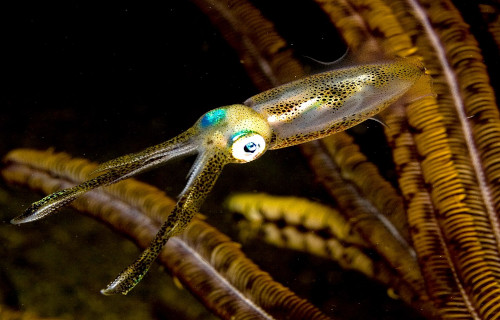
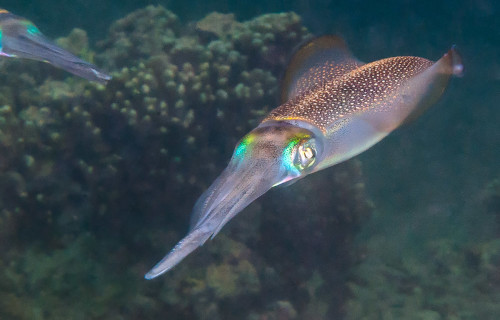
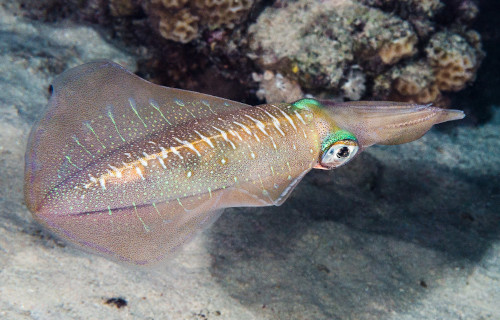
In shape, the mantle, or body, develops as highly elongated and cylindrical in shape, tapering towards the posterior end. As its common name suggests, this Cephalopod also has prominent fins. The animal also possesses a pair of large, broad fins extending along the sides of its mantle, too.
It’s the coloring of the aptly-named Glitter Squid that receives the most attention from observers, though. This trait varies depending on factors such as age, gender, mood, and environmental conditions. But, it typically exhibits a range of colors and patterns that allow for camouflage.
These gorgeous hues include such dazzling shades as translucent white, sometimes accompanied by purple or reddish-brown patches. It also occasionally produces stripes, bands, and other patterns on parts of its body, appearing in colors of its choice. It accomplishes this change at will, in fact.
Like all squids, it also possesses a total of eight tentacles, attached to the mantle. These start as thick at the base, tapering at the ends to a narrow point. They develop as unequal in length, with each pair attaining different measurments. All pairs, though, display two rows of suckers.
- Kingdom: Animalia
- Phylum: Mollusca
- Class: Cephalopoda
- Order: Myopsida
- Family: Loliginidae
- Genus: Sepioteuthis
- Species: S. lessoniana
CCL: https://tinyurl.com/2s4apsss
Glitter Squid Distribution, Habitat, and Ecology
The astonishing Glitter Squid evolved as native to a reasonably broad expanse of the marine waters of the earth. Given its extremely exotic nature, though, the location of that zone of habitation likely won’t surprise many people. It’s endemic to large parts of the Indian and Pacific Oceans.
Its primary range extends from the eastern coast of the continent of Africa, across the Indian Ocean, to Southeast Asia, Australia, and the western Pacific Islands. Evidence also indicates that it’s possibly now even present in the Mediterranean Sea. It’s unknown if it ever lived elsewhere.
This awesome wonder of the world’s seas displays both strong preferences in its choice of habitat, and a high degree of adaptibility in that regard when necessary. As a general principle, the impressive squid greatly prefers to maintain residence in various coastal and nearshore regions.
The intriguing mollusc also prefers to do so throughout both the tropical and subtropical Indo-Pacific region. The animal further shows a powerful favoritism for very shallow waters, generally being located at depths ranging from 0 – 328 ft (0 – 100 m) beneath the surface of the water.
Being so close to the shoreline, though, provides this natural marvel ample opportunities for residency. This mainly consists of such diverse regions as rocky shores and rocky reefs. Yet, it’s also quite fond of inhabiting dense areas of seagrass beds. Its favorite, however, seems to be coral reefs.
The remarkable Glitter Squid follows the typical pattern of its numerous realtives in that it feeds entirely as a carnivore. In its particular case, it does as an opportunistic predator. It typically feeds, however, on a wide array of prey, including fish, crustaceans, mollusks, and other invertebrates.
In turn, it itself is commonly preyed upon by a wide variety of marine predators, including some larger fish species, sharks, marine mammals, and seabirds. To avoid predation, the animal relies on its agility, camouflage abilities, and rapid color changes to avoid detection by its own hunters.
It generally exhibits truly complex reproductive behavior, including impressive courtship displays, mate selection, and spawning. The species typically spawns in shallow coastal waters, with the females depositing clusters of eggs attached to submerged structures such as rocks or coral.
Glass Squid
Public Domain Image
Glass Squid Facts
- Closing out this compendium of 4 Startling Squids we present the wonder of the marine world best known as the Glass Squid.
- The attention-grabbing term perfectly serves as the most frequently used common name for any member of an entire Family. These creatures do have a few other general titles by which they’re known, though. These options include Cockatoo squids and Cranchiid squids.
- This remarkable collection of marine wonders stands out in the minds of many researchers for an interesting reason. That’s not only due to their extremely unique appearance, though. These amazing animals also merit note because cientists currently recognize 60 known members.
- Naturally, a great many different scientists acknowledged each individual species as separate and distinct at differing times. The German naturalist Johann Georg Christian Lehmann first named the Family, however. He achieved that scientifically noteworthy deed in the year 1822.
- Fortunately, all recognized types of Glass Squid seem to be maintaining population bases that remain both stable and sufficient. That pleasant state also seems to hold true throughout the entirety of their ranges. The IUCN does not currently show any of them on its Red List.
- These fascinating creations of Nature and evolution nevertheless still face numerous potential threats to their continued existence. In this regard, they face the same dangers as all forms of life on earth today. Most of these stem from the actions of man, including climate change.

Public Domain Image
Glass Squid Physical Description
The stunning grouping of marine marvels collectively known by the moniker Glass Squid never fail to capture the immediate attention of those who view them. Given the large current number of species within the group, though, each example understandably does so for slightly varying reasons.
This trend also holds true in regards to a basic natural pattern common among their many kindred across the globe. That’s the fact that each separate species displays a certain degree of the physiological characteristic of sexual dimorphism. That trait varies widely among members, though.
Every member of the Family represents a member of a highly diverse group of deep-sea squids with striking physical features. While their physical appearances do vary notably between species, several basic traits nonetheless still prevail, remaining present in all of them, thereby unifying them.
Every squid in this Family possesses a mantle, like all squids. This typically develops as elongated and tubular, though some species develop as more rounded. Sizes also differ significantly. The smallest have mantle lengths of only about 1.2 in (3 cm), while some reach a length of 9 ft (2.75 m)!
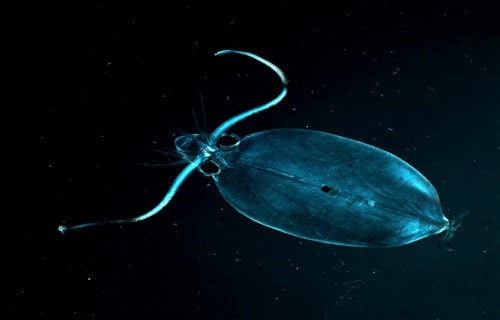
Unquestionably, the most notable attribute of each form of Glass Squid, though, obviously remains the transparent nature of the body. This allows for camouflage even in areas of open water. Intriguingly, organs such as the digestive gland and eyes often appear as the only visible structures.
These amazing animals also possess a total of eight arms and two long tentacles. Each of these appendages typically also has specialized suckers or hooks. Although many species within the grouping lack a functional ink sac, some of the members nevertheless retain a slightly reduced one.
The eyes evolved as large and forward-facing. Impressively, in some species, one eye develops as notably larger than the other. Every member also possesses several fins, located at the rear end of the mantle. These also vary, being small and oval, or large and ear-like, depending on the genus.
- Kingdom: Animalia
- Phylum: Mollusca
- Class: Cephalopoda
- Order: Oegopsida
- Family: Cranchiidae
Public Domain Image
Glass Squid Distribution, Habitat, and Ecology
Given the sheer number of species collected within the Family that bears the name Glass Squid, the members inhabit an extremely broad range of the marine regions of the globe. It therefore remains quite easy to understand the widely scattered locations where one finds these amazing animals.
They have a virtually global presence, appearing in tropical, temperate, and polar oceans. The Atlantic Ocean and Pacific Ocean each host many species within several genera. The Indian Ocean also contains several midwater species, while the Southern Ocean and Antarctic waters host a few.
Examples of these wonders also display very strong and clear preferences regarding their choice of habitat. All live in the open ocean, and not near the sea floor. Most reside at depths ranging from between 656 – 13,123 ft (200 – 4,000 m). Many migrate to higher points at night to feed.
Other conditions also play important factors in their choice of residence. They require low-light or near-dark conditions, to maximize their transparency. Most adapted long ago to the great pressures found at greater depths. Relative salinity levels also play an important role in their selections.
The majority of Glass Squid species feed primrily on small fish, crustaceans, and other cephalopods. Some, however, specialize in copepods and krill when young or small. Many use bioluminescence to attract their prey, attacking as ambush predators, using their tentacles or hooks to grab them.
Following another evolutionary pattern common among their kind, they reproduce only once in their lives. Females produce large, gelatinous egg masses, often in deeper waters. Hatchlings emerge as planktonic in nature, drifting with currents before migrating into adult midwater habitats.
Many of them also serve as key prey species for others. Some fish consume the smaller one’s or the hatchlings. Multiple marine mammals also consume them in numbers. Surface feeding seabirds form another predator when they rise to the surface. Larger squids also prey on them, as well.
CCL: https://tinyurl.com/33psz7af
4 Startling Squids
We legitimately hope that each of you fully enjoyed reading, and hopefully learning something from, this article we’ve written about these 4 Startling Squids. It’s also our fervent hope that doing so has served to leave you with either a new or renewed appreciation for such wonders of Nature.
Unfortunately, however, many of their innumerable kindred around the world now find themselves facing strong threats to their continued existence as a species. Many of those dangers, in fact, stem from the actions of mankind. We must each do all we can to protect and preserve them all.
Check out our other articles on 4 Fabulous Geological Features of Texas, Earth’s 7 Mightiest Rivers, 5 Astounding Volcanoes of Africa, Spectacular Dolphins Throughout Our World










Leave a Reply