

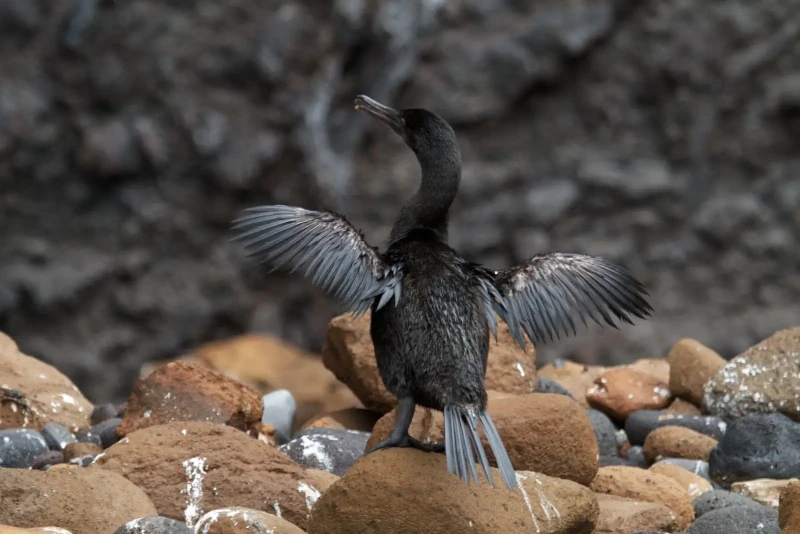
Flightless Cormorant Facts
- This remarkable winged-wonder most frequently goes by the informative common name of the Flightless Cormorant across its range. Yet, the avian does have at least one other general title by which it’s known. That’s the equally descriptive option of the Galápagos Cormorant.
- Inside of the halls of science, however, it’s perhaps better known by its purely technical designation. Unfortunately, like many such tags, this one’s extremely difficult for the layperson to pronounce. That’s because this bird holds the official moniker Nannopterum harrisi.
- The intriguing creature received that particular epthet due to the efforts of Lionel Walter Rothschild. That respected British zoologist accomplished the first formal recognition of it as a separate and distinct species. He achieved that scientifically noteworthy deed in the year 1898.
- This marvel of Nature and evolution holds a place of distinction in the annals of science. The reason for that’s actually indicated by its most often used common name. It stands out from its kin due to the fact that it’s the only known species of cormorant that’s lost the ability to fly.
- Sadly, though, since the discovery by man of its native location, the population base of the amazing Flightless Cormorant has declined notably. This lamentable state holds true across its already limited habitat range. Accordingly, the IUCN now lists it as Vulnerable on its Red List.
- Already in a perilous situation, this impressive animal now faces multiple other threats to its continued existence as a species. Like all forms of life on earth today, most of these dangers stem from the actions of man. They include both habitat loss and ongoing climate change.
Related Articles
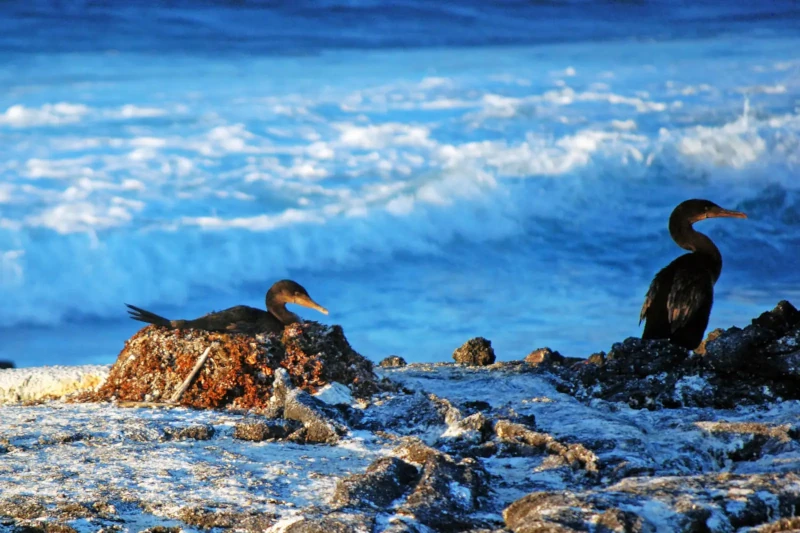
Flightless Cormorant Physical Description
The stunning Flightless Cormorant rarely fails to captivate those individuals fortunate enough to encounter one of these creatures. Yet, unlike some other species around the world, it does so for several reasons. It’s not only lovely, but also possessed of unique attributes and moderate size.
The avian also follows an evolutionary pattern of development common among fauna all across the planet. That’s the fact that it displays a certain amount of the physiological characteristic of sexual dimorphism. In its specific case, however, that trait’s only present to a very marginal degree.
In terms of length, individuals typically range from roughly between 35 – 39 in (89 – 100 cm). On average, the males of the remarkable species tend to be on the higher end of this average than their female counterparts. Exceptional specimens do occur, of course, entirely regardless of gender.
In terms of its sheer body mass, the variation’s even more extensive. Overall, specimens generally weigh somewhere between 5.5 – 11 lb (2.5 – 5 kg). Again, males usually appear on the higher end of this spectrum than the females. The same principle regarding exceptions also applies here, though.
Meanwhile, although they’re now completely non-functional, it does possess wings. Greatly reduced in wingspan, these generally average approximately 12 – 14 in (30 – 35 cm) across. Relative to birds still able to fly, this ranks as about one-third the extent expected for a bird of its mean body weight.
Nevertheless, the awesome Flightless Cormorant still holds features to intrigue its observers. On the sides of and upper portions of the body, its plumage presents as a dark brown to black in color. On the stomach of this wonder of Nature, the feathers typically display a slightly lighter shade.
The winged wonder’s also well known for its eyes, which many consider its most striking feature. These generally present an amazingly bright turquoise-blue shade. The fascinating bird also evolved a neck that’s comparatively long and slender, aiding it in its underwater hunting endeavors.
A few more physical attributes also serve to catch the eye of those people who view it. The animal evolved a bill that’s relatively long, hooked, and dark in color. It’s also slightly longer in males. The avian additionally boasts somewhat outsized feet, attached to extremely strong, muscular legs.
- Kingdom Animalia
- Phylum: Chordata
- Class: Aves
- Order: Suliformes
- Family: Phalacrocoracidae
- Genus: Nannopterum
- Species: N. harrisi
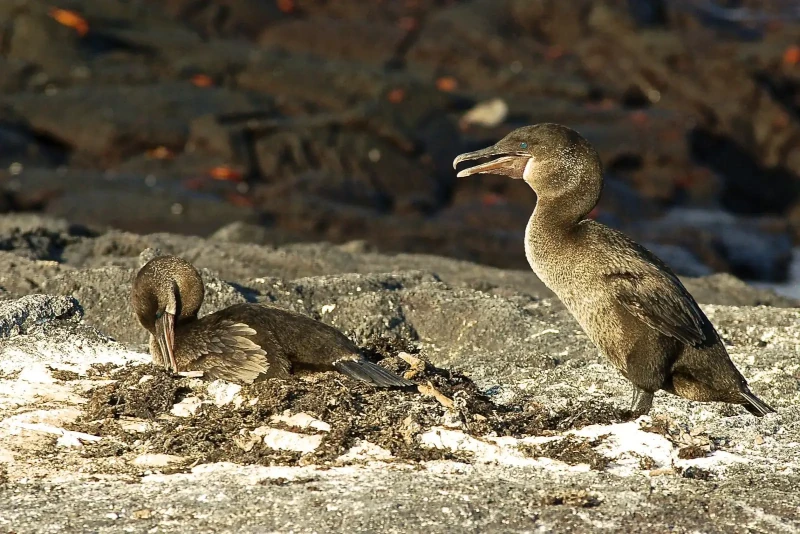
Flightless Cormorant Distribution, Habitat, and Ecology
As alluded to previously, the gorgeous Flightless Cormorant regrettably evolved as indigenous to a highly restricted portion of the earth’s surface. Exactly where that zone of habitation lies won’t surprise many people, though. That’s because one of its common names clearly implies its location.
This magical creation of natural processes developed as solely endemic to the awesome Galapagos Islands. That places its natural range to a tiny spot situated roughly 605 mi (973 km) off the coast of South America. In the landmass, the nation of Ecuador represents the closest to its setting.
Yet, even within the greater overall confines of this island chain, this marvel only appears within a small portion of its full extent. It appears on only two of them, in fact. On Fernandina Island, it lives on the western and northern coasts. On Isabela Island, it’s mainly seen along the western coast.
Given the specific and unique nature of its territory, this impressive bird occupies a very specific and restricted habitat that reflects its flightless, coastal lifestyle. Even within this limited range, however, it displays decidedly strong and clear preferences regarding exactly where it chooses to live.
It’s found virtually exclusively at low elevations, usually just above sea level. In these areas, it prefers to make its home along the volcanic, extremely rocky shorelines so prevalent in the region. The bird also shows a fondness for specific areas, including sheltered coves, lava ledges, and tide pools.
Understandably the ecology of the magnificent Flightless Cormorant developed in accordance with several factors. Each of these various elements closely pertains to its limited and specific environment. These principally include its flightless condition, marine diet, and island ecosystem.
Like its many kin around the world, it evolved as a carnivorous species. Its diet mainly consists of benthic fish, eels, and small octopuses. It’s an expert diver, using its legs and webbed feet to propel itself rapidly. It usually hunts close to shore in water measuring no deeper than 65.6 ft (20 m).
The wondrous avian also typically does so relatively close to the shoreline. In keeping with its instinctive preferences for shallow depths, the marvel generally remains within 330 ft (100 m) of the coastline. It hunts throughout the day, but does so especially in cooler morning and late afternoon.
The amazing bird breeds throughout the year, with peak periods occurring between the months of May to October. Nests are typically constructed close to the sea, using seaweed and marine debris. A typical clutch consists of 1 – 3 eggs, with both parents providing care, though usually only 1 survives.

Species Sharing Its Range
Check out our other articles on 5 Magnificent Mountains of Europe, Red-legged Pademelon, Alexander Island, Hairy Shadow Witch, Fire Salamander, Emerald Ash Borer, Inland Taipan