

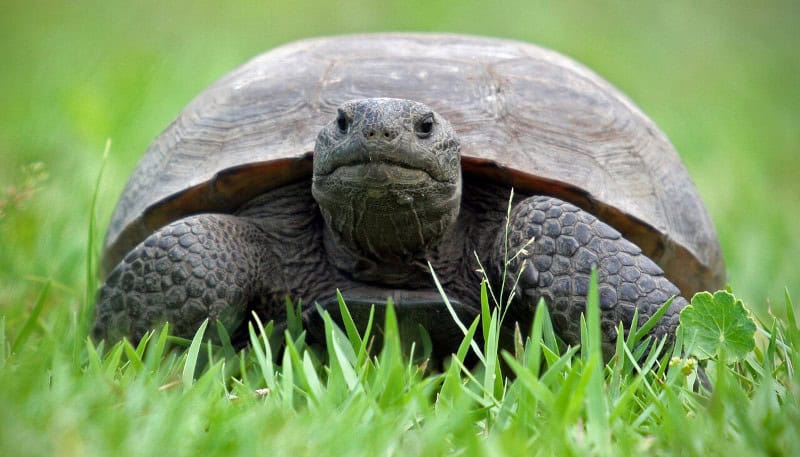
Gopher Tortoise Facts
- This beautiful small reptile most frequently goes by the somewhat confusing common name of the Gopher Tortoise across its entire range. Yet, the animal does have a few other general titles by which it’s known. These include the similar Gopher Turtle and Eastern gopher tortoise.
- Within the scientific community, however, it’s possibly much better known by its technical designation. As such terms go, that’s one that’s relatively easy for the layperson to pronounce. This remains true because the tortoise holds the formal moniker Gopherus polyphemus.
- It received that specific epithet due to the efforts of François Marie Daudin. That respected French zoologist accomplished the first recorded acknowledgement of it as a separate and fully distinct species. He further achieved that scientifically noteworthy deed in the year 1802.
- Unfortunately, the moderately small yet nonetheless beautiful Gopher Tortoise now finds itself in a reasonably dire predicament. The intriguing reptile possesses a population base that appears to be steadily declining. That state also holds true throughout all of its known range.
- Accordingly, the IUCN currently has a placement for this lovely creation of Nature and evolution. That status appears on the organization’s published Red List of Threatened Species. Lamentably, due to its steadily reducing numbers, the creature now lists there as Vulnerable.
- It faces numerous potential threats to its continued existence as a species. Like all forms of life on the earth today, the majority of these many perils stem from the actions of mankind, either directly or indirectly. These dangers include habitat loss and ongoing climate change.
Related Articles
Gopher Tortoise Physical Description
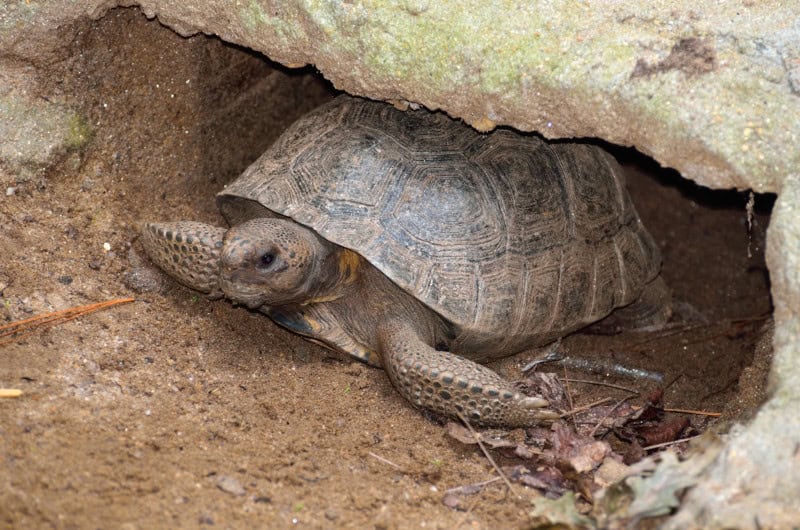
The captivating Gopher Tortoise frequently capture the attention and interest of those individuals fortunate enought to encounter one. While the animal does so for several reasons, sheer size doesn’t rank among them. That’s true since this reptile only represents a medium-sized land turtle.
It also follows a pattern of natural development shared by a large percentage of fauna around the world, including its many relatives. That’s the fact that it displays a degree of the physiological characteristic of sexual dimorphism. In its case, this trait manifests itself in several ways.
Adults reach an average shell length of roughly 9 – 11 in (23 – 28 cm). Exceptional examples, however, sometimes attain a measurement of 15 in (38 cm). A typical weight for this species also measures between 8 – 15 lbs (3.5 – 6.8 kg). Females usually appear on the higher end of these ranges.
Another gender-based difference shows up in the form of the shell, known as the carapace. The underside of this, called the plastron, develops as notably concave in shape among the males. Among the females of the species, though, this evolved as both shorter and much less noticeable.
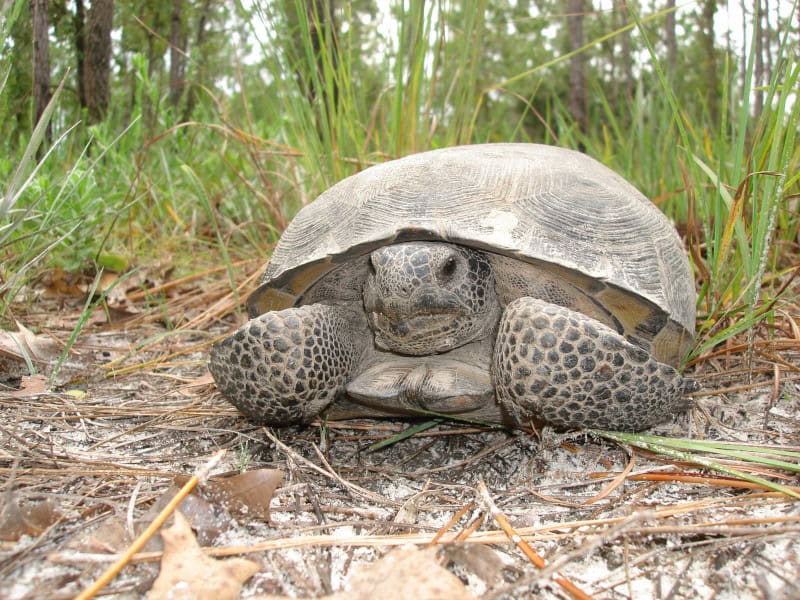
It’s perhaps the color scheme of the remarkable Gopher Tortoise that garners the most attention, though. The carapace usually presents as brown, gray, or tan, often being darker in juveniles and lighter in older adults. Meanwhile, the plastron displays a yellow to light tan, and usually unmarked.
The body of this marvel of Nature and evolution itself also merits a measure of note. Its front legs develop as quite strong, flattened, and shovel-like with large scales, being adapted for digging burrows. The hind legs remain somewhat more elephant-like, rounded, and sturdy for support.
With this amazing tortoise, the head also stands out for its distinctiveness. This generally develops as dark brown to black, often with lighter markings formed around the eyes and nose. The tail of this visually intriguing creature, however, typically remains rather short and stubby in general shape.
- Kingdom: Animalia
- Phylum: Chordata
- Class: Reptilia
- Order: Testudines
- Family: Testudinidae
- Genus: Gopherus
- Species: G. polyphemus
CCL: https://tinyurl.com/yc3j69x4
Gopher Tortoise Distribution, Habitat, and Ecology
The distinctively-named Gopher Tortoise evolved as indigenous to only a moderate-sized portion of the surface of the earth. Precisely where that native zone of habitation lies, however, probably won’t surprise many people. That’s because its region’s already well known for its natural wonders.
This remarkable example of earth’s endlessly variable fauna developed as native to just an extremely limited section of the continent of North America. Within that greater landmass, the reptile lives solely in a restricted portion of the United States. Yet even there, it limits itself to a smaller area.
It inhabits a territory that begins in the southeastern section of Louisiana. From there, though, it stretches outward along the coast through southern Mississippi, Alabama, Georgia, South Carolina, and into northern and central Florida. The core and most stable populations live in Florida.
Like many forms of life, it displays decidedly strong and clear preferences regarding its choice of habitat. It generally prefers well-drained, deep, sandy soils that make it easier to dig its burrows. The animals also studiously avoids areas containing large quantities of either heavy clay or rocky ground.
Its habitat selections also reflect its dependence upon open-canopy regions. Historically, its favorite ecosystem consists of longleaf pine and wiregrass one’s. Yet, it also lives in a few others, too. These include sandhills and oak scrub, dry prairies and coastal dunes, and areas of pine flatwoods.
Despite its comparatively small stature, the intrepid Gopher Tortoise qualifies as a keystone species within the ecosystems it inhabits. Its burrows provide shelter for over 350 other species, including snakes, such as the eastern indigo snake, frogs, innumerable insects, and even small mammals.
Many of these species depend on burrows for survival during fires, high temperatures, or drought. By digging, these marvels aerate the soil, influence plant communities, and create microhabitats. Not only that, but its grazing additionally assist in maintaining open, grassy understory vegetation.
It evolved as primarily herbivorous in nature. The principal dietary fare includes grasses, legumes, fruits, and low-growing herbs, called forbs. It also occasionally consumes mushrooms and berries, and even rarer still, insects, carrion, and animal bones or snail shells sometimes makes this list.
After mating, females lay anywhere from 3 – 15 eggs in sandy nests, usually near burrow entrances. Unfortunately, high egg and hatchling mortality exists due to its major predators. These mostly consist of raccoons, armadillos, snakes. Adults typically live 40 – 60 years, though some live longer.

Species Sharing Its Range
Check out our other articles on 5 Awesome Canines of Asia, Mountain Hare, Cradle Mountain, Hairy Shadow Witch, Sooty Gull, Goldentail moray, Empress Cicada, Keeled slug-eating Snake