

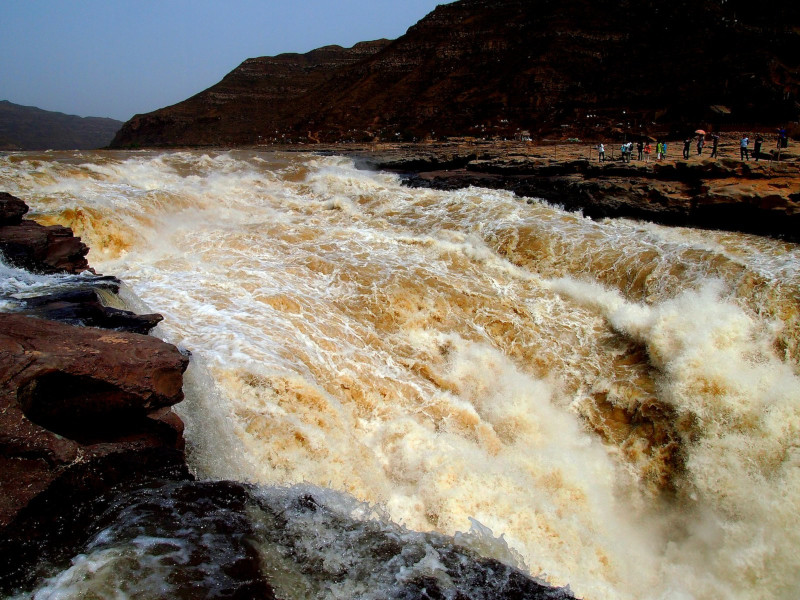
Hukou Waterfall Facts
- The short term Hukou Waterfall serves as the english language translation of the most commonly used title for this marvel. It has only a few other names by which it’s known. These, however, simply represent more descriptive one’s, such as Hukou Waterfall of the Yellow River.
- It’s unknown when ancient man first discovered this marvel of geology. That’s because that incident predates written records. Researchers feel it reasonable to assume that the earliest inhabitants of its region knew of it. Nomadic tribes perhaps did so as early as 2000 BCE.
- In more recent times, it gained broader national attention during the Ming Dynasty, between 1368–1644. Later, in the 20th century, it began to be promoted as a national scenic site. Though not exactly known, it’s thought the first outsiders to see it did so in the late 19th century.
- Thankfully, Hukou Waterfall now enjoys protection from the depredations of man. In the nation it formed in, it now lists as a National AAAA Scenic Area. This designation ensures regulations on environmental conservation, tourism development, and cultural preservation.
- Although protected, it nonetheless still faces several environmental and human-made threats that could impact its long-term preservation. These include the presence of dams and hydropower projects upstream. Industrial pollution and climate change also now threaten it.
Related Articles
Hukou Waterfall Physical Description
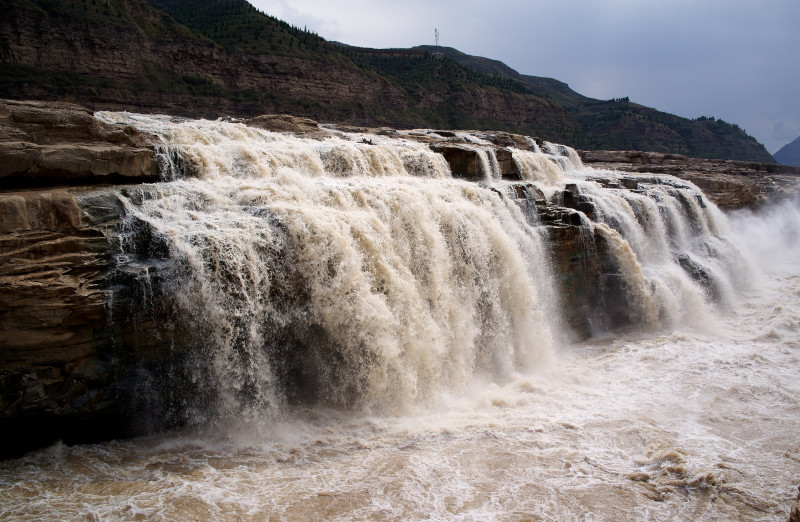
The astounding Hukou Waterfall never fails to mesmerize and astonish those individuals fortunate enough to visit this breathtaking feature. Unlike some cascades around the world, however, it doesn’t do so just because of its beauty. That’s true since it also boasts impressive statistics.
This remarkable creation of natural geological processes common to Nature constitutes the largest such on the river of which it’s part. It also ranks as the second-largest in its immediate part of its continent. Its unique geography and turbulent power serve to make it a standout natural wonder.
Its dimensions understandably vary due to numerous factors. These include seasonal variations in rainfall, which affect its volume. Most of the year, it possesses an average width of roughly 98 ft (30 m). But, during the local flood season this swells to as wide as an impressive 164 ft (50 m).
While its height doesn’t compare to some of the greatest found on the plant, that’s nevertheless still of respectable measurements. This also varies, again depending on the volume of the water flowing over the edge. On average, however, this typically ranges from between 50 – 65 ft (15 – 20 m).
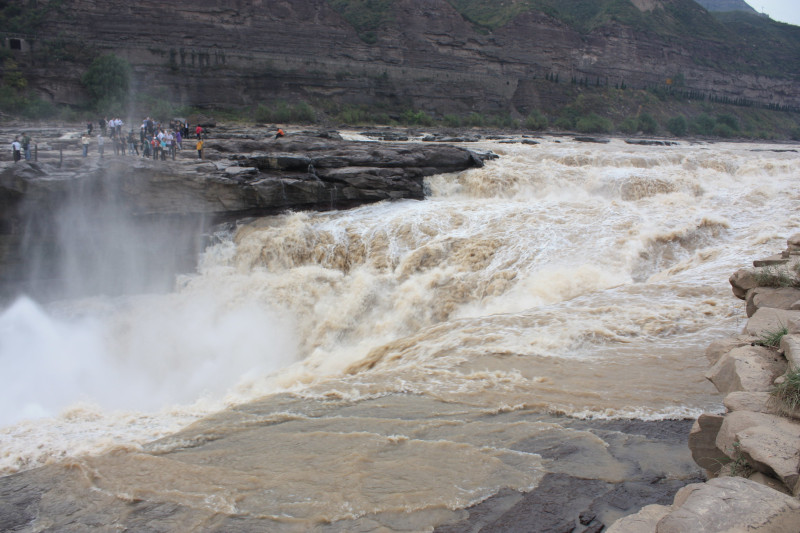
It’s perhaps the water of which the mind-blowing Hukou Waterfall is comprised that usually garners the greatest attention from the viewer. In color, this usually appears as a somewhat muddy-yellow. That unique shade occurs due to the presence of exceptionally high levels of sediment.
Other features also add to its visual distinctiveness. The riverbed itself remains extremely uneven, causing turbulent flow, eddies, and whirlpools at the base of the plunge. During high flow, mist rises into the air, creating rainbows on sunny days. It’s quite loud as well, often compared to thunder.
Hukou Waterfall Location, Formation, and Ecology
The otherworldly splendor of Hukou Waterfall formed in a region of the world already well known for its abundance of natural wonders of all kinds. Its exact location of the earth’s surface therefore isn’t likely to surprise anyone. That’s because Nature created it as part of the continent of Asia.
Within that greater landmass, the marvelous flow lies entirely within the national borders of the country of China, in the approximate eastern portion of the region. That exact geographical location places it roughly 250 mi (400 km) southwest of Taiyuan, and 220 mi (350 km) northeast of Xi’an.
This wonder of Nature came into existence due to a unique combination of powerful natural forces. That process also occurred over a vast span of time, believed to measure in the millions of years. Those factors include tectonic activity, erosion, and the unique geological structure of the region.
It’s located on the Loess Plateau, a region made of thick deposits of fine, wind-blown silt, known as loess, and underlying sedimentary rock. The Yellow River, one of the most sediment-rich rivers in the world, inexorably carved through these soft layers. Seismic activity also possibly contributed.
Upstream, its river’s wide and slow, but at its site, the river narrows abruptly from many times the size it is at the cascade. Over time, water erosion deepened and cut into the rock, forming a steep gorge. Upstream the riverbed’s harder than at the falls, eroding faster, leaving a lip at the cascade.
As alluded to previously, the river itself carries massive amounts of silt and sediment. These deposits constantly reshape the riverbed and waterfall profile, especially during seasonal floods. The waterfall therefore isn’t geologically static, but actually remains a dynamic, evolving landform.
The ecological environment of Hukou Waterfall is shaped by its location, setting, and the dramatic conditions of the area. While it’s certainly not a biodiversity hotspot like either the tropical or mountainous regions, it still supports a distinct ecosystem with aquatic and terrestrial elements.
The water at the site’s fast-moving, shallow, and sediment-laden, which severely limits aquatic biodiversity compared to clear, slow rivers. Only silt-tolerant and cold-resistant fish species survive here. Though not documented, these possibly include Chinese loach, Carp, and Yellow catfish.
The surrounding area consists of semi-arid steppe and shrubland. The vegetation surrounding it, and supported by its waters, include drought-resistant grasses, wormwood, and wild shrubs like Caragana and Sophora. Planted forests also now appear here, in an effort to prevent erosion.
The ecosystem’s home to small mammals, birds, and reptiles adapted to dry, open environments. Animals commonly seen in its vicinity include hares, hedgehogs, various lizards and snakes. Others often observed include numerous avian species, such as magpies, swallows, and sparrows.

Features Sharing Its Region
Check out our other articles on 4 Fabulous North American Caves, Elk, Salton Sea, Achiote Tree, Spotted Seahorse, Epirus Dancing Grasshopper, Hellbender Salamander, Mugger Crocodile