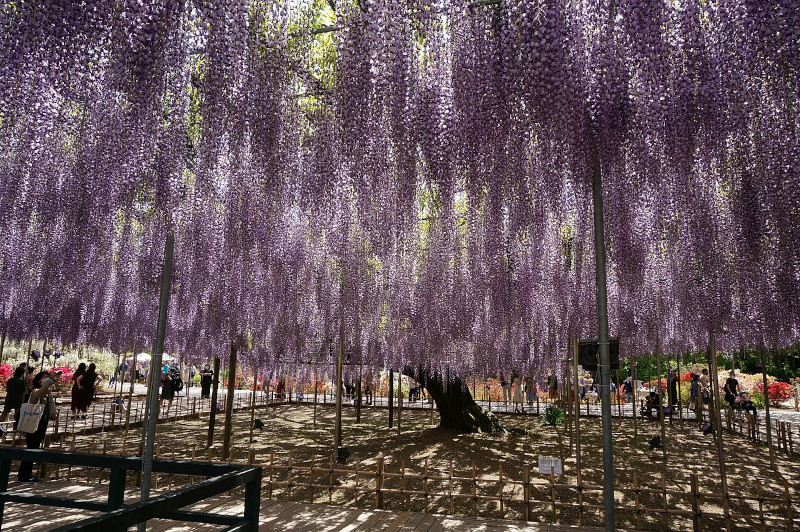
Japanese Wisteria Facts
- This breathtaking product of botanical evolution most frequently goes by the descriptive and informative common name of Japanese Wistera. Yet, it does have a few other general titles. These include the terms Noda wisteria, Japanese wisteria vine, and simply Fuji.
- Inside of the scientific community, however, it’s perhaps much better recognized by its purely technical designation. Thankfully, that one’s relatively simple for the layperson to pronounce, at least compared to others. The flora bears the formal moniker Wisteria floribunda.
- This marvel of Nature received that specific epithet due to the efforts of the renowned Dutch botanist, Carl Ludwig Blume. The noted researcher achieved the first official recognition of it as a separate and distinct species. He accomplished that noteworthy deed in 1825.
- This Angiosperm stands out from related species found around the world for several reasons. It produces the longest racemes of any known wisteria, for one. Yet, this remarkable flora also currently ranks as the species that attains the greatest length of any variety on earth.
- Fortunately, the stunning Japanese Wisteria has a population base that’s both stable and sufficient. That pleasant state also appears to hold true throughout its entire native range. It’s also popular in gardens around the world. The IUCN thus has no listing for it on the Red List.
- It nevertheless must be considered as facing some potential threats to its continued existence as a species, at least. In this respect, it faces the same perils as all forms of life on earth today. Like them, it’s now dealing with the danger posed by both habitat loss and climate change.
Related Articles
Japanese Wisteria Physical Description
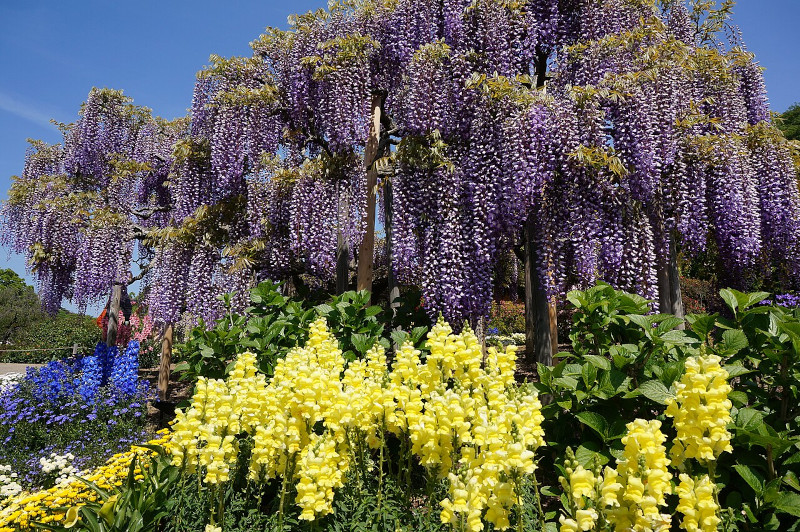
The beautiful Japanese Wisteria entrances virtually everyone who encounters this otherworldly beauty. Unlike some other Angiosperms across the globe, though, it does so for several reasons. Its sheer visual appeal obviously qualifies as one reason. Yet, it’s always startling just how large it grows.
This botanical wonder evolved as a vigorous, deciduous climbing vine in nature and form. Its woody, twisting vines wrap themselves around whatever supports become available. Fascinatingly, these always do so in a clockwise pattern. These features also attain extraordinarily great lengths.
Impressively enough, a typical mature length for the vines of this remarkable plant equals roughly 30 ft (9.1 m). That’s astonishing enough, to be certain. Yet, under fully ideal conditions the species sometimes exceeds this greatly. In such specific situations, some vines reach 66 ft (20 m) in length!
The nature of these also merits notice, as it changes over the lifetime of the flora. Younger stems appear green, flexible, and intertwine. As these mature, however, they also acquire a thick, woody, gnarled nature. On these, the bark shows gray-brown, often with furrows on the older specimens.
Its leaves garner their own share of attention, too. This foliage develops as somewhat feather-like in structure. An average of 13-19 leaflets, oval to elliptical in form, manifest on each leaf. These usually reach 8 – 12 in (20 – 30 cm) in length. Each shows bright green in spring and summer; yellow in fall.
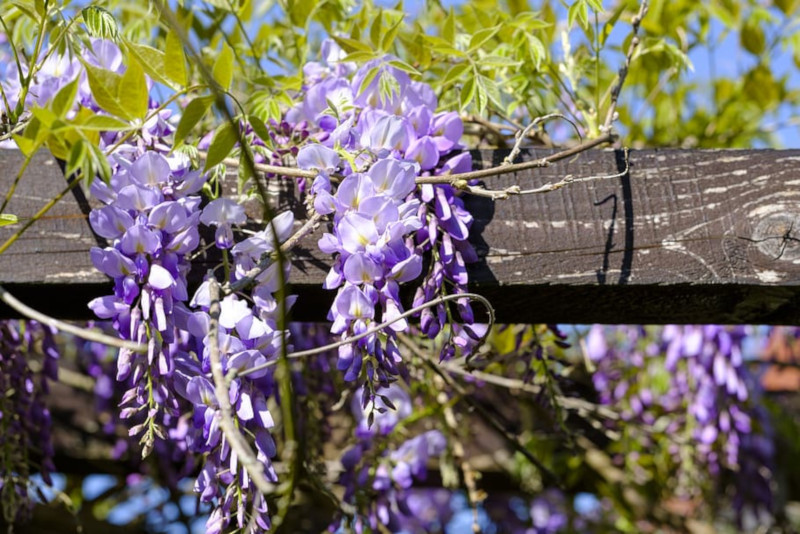
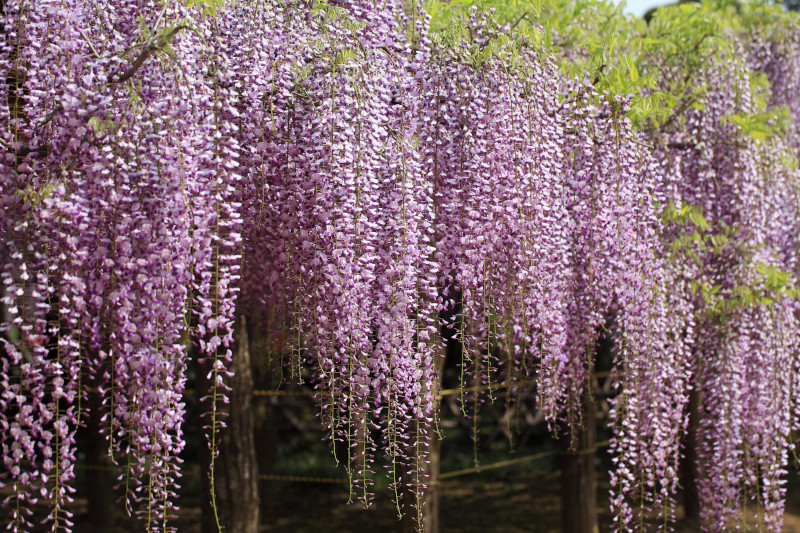
Obviously, though, it’s the mind-boggling blooms of the Japanese Wisteria that attract the most interest and awe. These evolved as small, pea-like structures, in drooping racemes. Versions of these also average 12 – 36 in (0.3 – 0.9 m) long. In color they include lavender, pink, violet, and white.
The fruit, meanwhile, frequently gets overlooked. This develops as a flattened, bean-like pod. It generally averages 4 – 6 in (10 – 15 cm) long itself. Intriguingly, it also has a smooth, velvety outer texture. Both the pods and the seeds within contain toxins, though remain harmless unless ingested.
- Kingdom: Plantae
- Phylum: Tracheophyta
- Class: Magnoliopsida
- Order: Fabales
- Family: Fabaceae
- Genus: Wisteria
- Species: W. floribunda
Japanese Wisteria Distribution, Habitat, and Ecology
Sadly, the staggeringly lovely Japanese Wisteria evolved as native to a moderately restricted portion of the surface of the earth. Exactly where that zone of habitation lies isn’t going to surprise any, though. That setting’s clear, given the plants name. It’s indigenous to the island nation of Japan.
Being comprised of many separate landmasses, however, this marvelous species does not appear natively on all of them. In fact, out of all of them, it only lives naturally on three of them. These settings consist of Honshu, the largest of the four main islands, Shikoku, the smallest, and Kyushu.
Given its nature, it’s not surprising that this remarkable product of Nature displays decidedly clear preferences regarding its choice general habitat. Yet, within that overall favoritism, it nevertheless also manifests a moderate degree of flexibility regarding specific localized environments.
As a general principle, it makes its home in the many regions of temperate forests found on the islands. On Honshu, it primarily appears in areas of forest edges, slopes, and woodlands. Meanwhile, on Shikoku, it lives in mountainous and forested areas. On Kyushu, it appears in all of these regions.
In all of these ecosystems, though, it requires the same specific combination of factors. It grows best in well-drained, loamy soils, that also have a slightly acidic to neutral pH level. The flora tolerates a range of soil types as long as drainage remains good. It thrives best in full sun to partial shade.
The ecology of the amazing Japanese Wisteria involves its interactions with the environment, other organisms, and its impact on ecosystems. Like many legumes, even it forms symbiotic relationships with Rhizobium bacteria, enabling it to fix atmospheric nitrogen and improve soil fertility.
It achieves its pollination via the activities of numerous locally prevalent insect species. These most commonly include various types of honeybees and bumblebees. However, it also manages some of this process through the actions of butterflies, drawn by the extremely fragrant blossoms.
It also evolved an uncommon method of dispering its many seeds. The large seed pods mature in late summer. These dry and actually split explosively, flinging seeds short distances. But, these aren’t very mobile, so successful propagation more often occurs via vegetative spread, with runners.
Species Sharing Its Range
Check out our other articles on 4 Fabulous North American Caves, Mountain Hare, Amazon River, Douglas Iris, Southern Darwin’s Frog, Spotted Eagle Ray, Fulvous Skimmer, Mugger Crocodile

Leave a Reply