

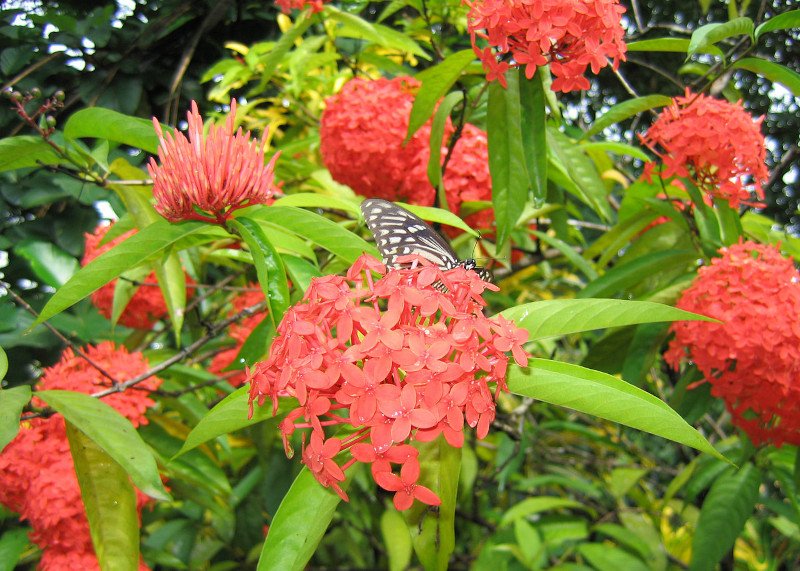
Jungle Geranium Facts
- The simultaneously descriptive and informative term of Jungle Geranium represents the most frequently used common name for this flora. Yet, it also holds other general titles by which it’s known. These many alternatives include flame of the woods, jungle flame, and pendkuli.
- Within the halls of science, however, it’s perhaps better recognized by its technical designation. Thankfully, that tag’s one that’s relatively easy for the layperson to pronounce. That’s because this lovely wonder of Nature and evolution holds the formal moniker Ixora coccinea.
- The stunning Angiosperm received that brief epithet due to the efforts of the highly esteemed Carl Linnaeus himself. That Swedish biologist accomplished the first official recognition of it as a separate and distinct species. He achieved that scientifically noteworthy feat in the year 1753.
- This wonder’s long played several roles of importance in the culture of the region of the world in which it appears. Certain religions prevalent among the local population still use it in rituals, even today. Traditional folk medicine and Ayurveda also still make use of it in several ways.
- Fortunately, the amazing Jungle Geranium appears to be maintaining a population base that’s both stable and sufficient. This pleasing state also seems to hold true throughout the entirety of its native range. The IUCN thus has no listing for it on its Red List of Threatened Species.
- Nevertheless, the marvel should still be considered as facing multiple potential threats to its continued existence, at least. Like most forms of life on earth today, most of those dangers stem from the actions of man. They include the perils of habitat loss and climate change.
Related Articles
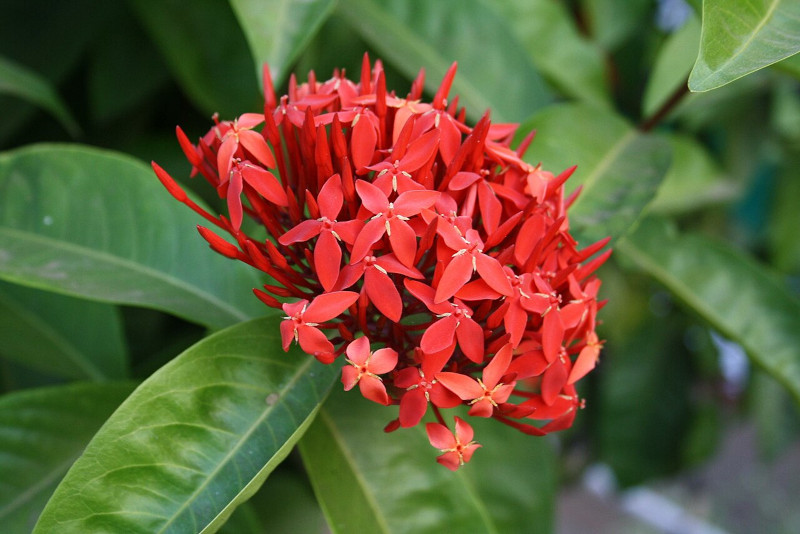
Jungle Geranium Physical Description
The captivating Jungle Geranium evolved as a natural wonder that rarely fails to capture the immediate attention of those individuals fortunate enough to encounter it. Unlike many of its relatives around the world, though, it does so not merely for its beauty, but also for its dimensions.
This stunning plant develops from a fibrous, well-developed root system. The species also grows as an evergreen shrub. Specimens typically attain a dense, bushy, rounded shape. Most examples reach a height measuring roughly 3.3 – 6.6 ft (1 – 2 m). Some, however, occasionally reach 10 ft (9.9 m).
Its distinctive foliage also merits mention. These leaves appear on very short, thin, light brown colored stems, attached to the small branches, which display the same shade. Each evolved to grow in opposing pairs. This intriguing verdure typically boasts a relatively thick, slightly leathery texture.
This part of the flora averages between 1.6 – 4 in (4 -10 cm) in length. Their coloring also earns some notice from observers, due to the combination. The upperside usually presents a glossy dark green hue. The underside of these, meanwhile, generally shows a markedly lighter shade of green.
It’s undoubtedly the flowers of the Jungle Geranium that typically garner the most attention, though. The botanical wonder produces multiple small tubular flowers grouped in dense, rounded clusters. These range in diameter from 0.8 – 2 in (2 – 5 cm), with colors ranging from red to white.
Its fruit, however, frequently remains overlooked. This aspect of its biology grows as a small, rounded berry. These begin as a light green in color, but slowly turn to dark purple or black when ripe. Given their diminutive nature, each of these structures generally contains only 1 -2 small seeds.
- Kingdom: Plantae
- Phylum: Tracheophyta
- Class: Magnoliopsida
- Order: Gentaianales
- Family: Rubiaceae
- Genus: Ixora
- Species: I. coccinea
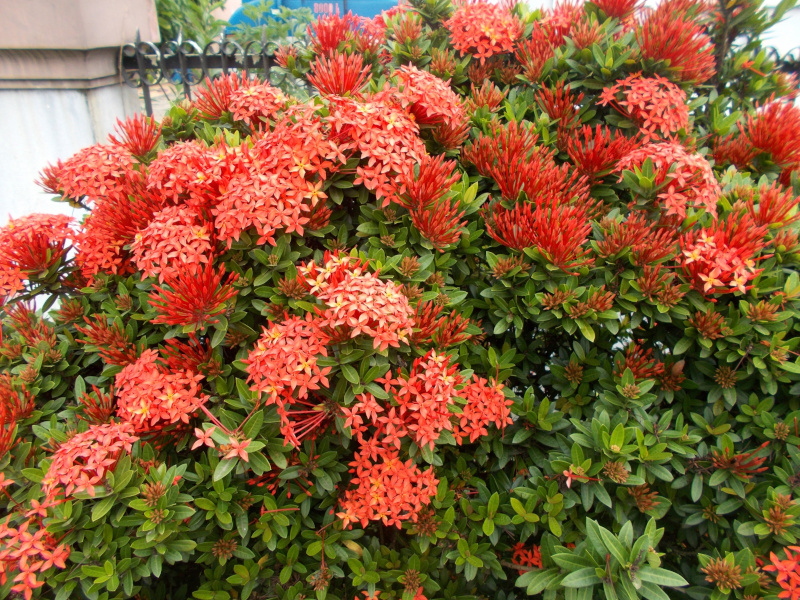
Jungle Geranium Distribution, Habitat, and Ecology
The breathtaking Jungle Geranium apparently evolved as indigenous to a moderately wide portion of the surface of the earth. Given its seemingly exotic nature, however, the precise setting for that zone of habitation likely won’t surprise anyone. That’s true since it’s native to parts of Asia.
Within that greater overall area, though, this marvel of Nature and evolution only appears natively in three specific sections. It’s mainly present in the nation of India, especially in the southern part. Yet, the wonder’s also apparent in a few certain areas of the countries of Sri Lanka and Bangladesh.
Due to its beauty, however, it’s now spread to many other parts of the world as an ornamental plant. That includes at least five countries in the Asia-Pacific region, four in Africa, two in Oceania. It’s also found in the Americas and the Caribbean, from the United States to Brazil, in South America.
This gorgeous plant, like its many kindred, displays preferences regarding its choice of habitat that are simultaneously broad and specific. That’s true given the fact that, in its native range, it primarily thrives in three different ecosystems. Each of them, though, share certain basic environmental traits.
The remarkable species most frequently resides in regions composed of moist, tropical forests. However, it also often appears, albeit in slightly smaller concentrations, in areas of deciduous forest understories. Smaller groupings also sometimes live in the edges of rainforests or woodlands.
Elevation and local climate play additional roles as well. In all these ecosystems, the flora lives at altitudes ranging from approximately sea level up to around 4,921 ft (1,500 m). It demonstrates a clear favoritism for tropical settings, possessing high levels of humidity, and with consistent rainfall.
Within all of the several ecosystems that the beautiful Jungle Geranium inhabits in the wild, it plays a surprisingly important role. In these locations, it serves as both a common nectar source and understory plant. Its extensive root system also aids in stabilizing the soil, helping to reduce erosion.
It achieves its pollination via the actions of multiple species. These primarily consist of various species of bees and butterflies. Nonetheless, in the portions of its habitat zone where they’re present in numbers, several varieties of hummingbirds, drawn by the tubular flowers, also aid in said efforts.
The main action of the spreading of the seeds occurs due to the actions of numerous local avian species. The birds consume the fruits, and who later disperse them via their droppings. Not stopping there, however, the plant also serves to provide shelter for many smaller mammals and reptiles.

Species Sharing Its Range
Check out our other articles on 5 Amazing Mammals of Antarctica, Red-legged Pademelon, Nile River, Socotra Dragon Tree, Spotted Seahorse, Epirus Dancing Grasshopper, Earless Monitor Lizard