
Socotran Pomegranate Facts
- The clearly informative term of Socotran Pomegranate serves as the most fequently employed common name for this intriguing plant. It does have a few other, very similar titles, though. These include the closely related terms Wild pomegranate and Proto-pomegranate.
- Within the scientific community, however, this marvel of Nature and evolution’s perhaps better known by its technical moniker. Fortunately for the layperson, that’s one that’s relatively easy to pronounce. That’s because it holds the formal designation Punica protopunica.
- This remarkable flowering plant received that particular epithet due to the efforts of the respected researcher Isaac Bayley Balfour. That Scottish botanist recorded the first formal recognition of it as a separate and distinct species. He achieved that noteworthy deed in 1910.
- Impressively, various parts of the tree have long been used by locals for numerous reasons. Local goats eat the leaves and especially the new shoots of smaller and more prostrate shrubs, while sheep eat dry plant litter. Though cattle avoid it, goats also like the fruit of the plant.
- Sadly, like many plants around the world, the Socotran Pomegranate now finds itself with a limited population. That state also holds true througout its native range. The IUCN therefore lists the product of ages of evolution as Vulnerable on its Red List of Threatened Species.
- The intriguing flora currently faces numerous threats to its continued existence as a species. That’s especially true given the limits of its range. Like most forms of life on earth today, the majority of the dangers it faces stem from the actions of man. They include climate change.
Related Articles
Socotran Pomegranate Physical Description
Regrettably, only a comparatively limited number of people ever encounter the fascinating Socotran Pomegrante. Those scattered individuals that do have that pleasure typically find it a most impressive species, though. That reaction rarely occurs due to matters of physical size, however.
That’s true due to the variable nature of this particular flora. Individual specimens vary significantly in size, ranging from that of a simple shrub to a small tree. Regardless of which form an example takes, though, the wonder of Nature and botanical evolution presents an unusual appearance.
In terms of its sheer height, the vast majority of members of this distinctive species range from approximately 6.5 – 16.4 ft (2 – 5 m). Its canopy, meanwhile, reaches somewhat comparable proportions. That part of the Angiosperm typically measures roughly between 5 – 10 ft (1.5 – 3 m).
Its many branches also develop as relatively thin in relation to their individual length. These same parts of the plant often possess a spiny nature, providing it with a somewhat scraggly appearance. The bark of each generally develops a moderately rough texture, and shows a brown shade.
From each of these extends a random number of leaves, typically located toward the outer portion of the length. This foliage also evolved as somewhat small, situated in opposition, and narrow and pointed in shape. Each of these displays a slightly glossy green color, and bears a waxy texture.
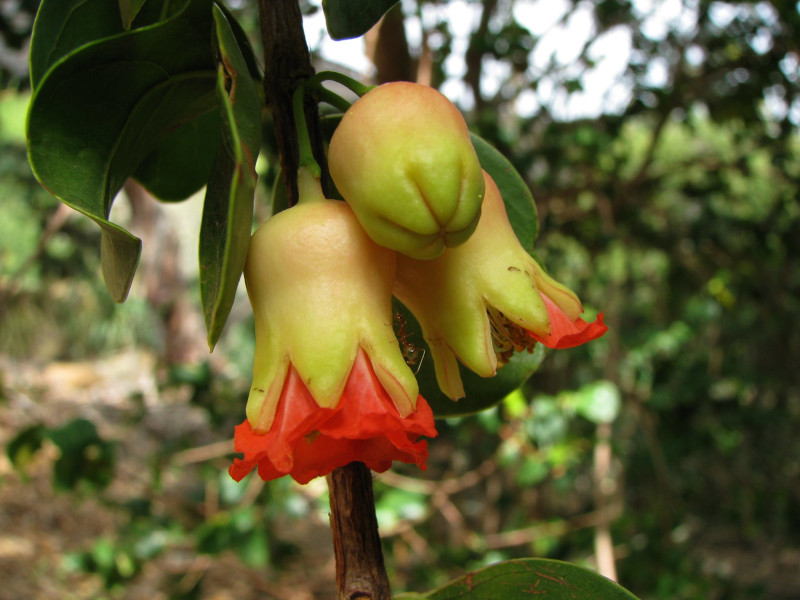
The unusual flowers of the Socotran Pomegranate certainly garner a great deal of attention, as well. Though variatons occur, these generally present a distinctive pink shade. The amazing blooms remain quite small, though. In diameter, these attain a mean range between 0.8 – 1.2 in (2 – 3 cm).
The fruit also merits its own respectable degree of appreciation. This develops as both smaller and more rounded, though sometimes slightly oblong, than common pomegranates. Usually measuring between 0.8 – 1.6 in (2 – 4 cm), each generally presents a dull reddish-brown or yellowish when ripe.
- Kingdom: Plantae
- Phylum: Tracheophyta
- Class: Magnoliopsida
- Order: Myrtales
- Family: Lythraceae
- Genus: Punica
- Species: P. protopunica
Socotran Pomegranate Distribution, Habitat, and Ecology
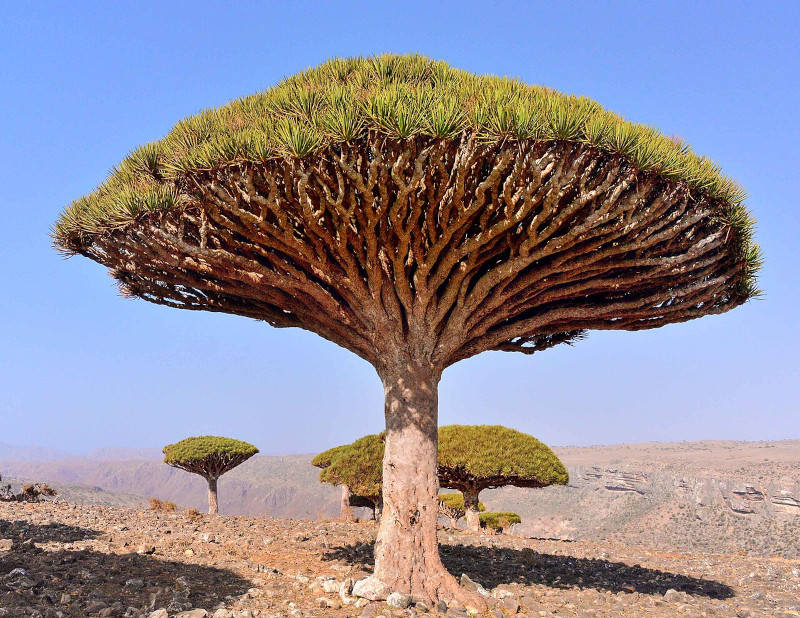
Lamentably, the captivating Socotran Pomegrante evolved as indigenous to an extremely limited, as well as isolated, portion of the earth’s surface. Exactly where that zone of habitation lies, however, won’t surprise any of you. As its very name implies, it’s native solely to the island of Socotra.
The island itself lies in the waters between the Guardafui Channel and the Arabian Sea. Relative to the nearest landmasses, it’s only moderately far from the nearest continent. It sits 205 nautical mi (380 km) south of the Arabian Peninsula. It lies 130 nautical mi (240 km) east of Somalia.
Even within this extraordinarily small range, though, the plant only appears in certain portions of the landmass. The vast majority of its population resides in the eastern and central parts of the island. It’s not presently known if the botanical marvel ever possessed a greater territorial range.
Interestingly, this mesmerizing flora displays decidedly clear, as well as surprising, preferences regarding its choice of habitat. It actually thrives best in regions and environments most similar plants would find too harsh. This, however, does serve as a limiting factor to its potential to expand.
It prefers to grow in regions comprised of dry, rocky, and sparse terrain. These areas typically possess little soil and minimal water retention. It’s usually found at higher elevations, typically between 650 – 4,265 ft (200 – 1,300 m) above sea level. That includes local wadis and gullies.
The Socotran Pomegranate evolved as highly adapted to its dry environment. It survives with minimal water and can tolerate long periods of drought. It additionally has a deep-root system that allows it to access water from underground sources and survive in nutrient-poor, rocky soils.
Though research remains limited, its beautiful flowers likely achieved their pollination via the actions of various insects, including bees. The plant reproduces sexually via seed production, but its fruits lack of palatability limits the number of species that consume it, and then spread the seeds.
Despite this, though, while not widely distributed, it serves an important ecological role in its native habitat. It does provide food for local wildlife and insects, particularly those small, less-sweet fruits. The plant also contributes to the astounding biodiversity of Socotra’s highly unique flora.
Species Sharing Its Range
Check out our other articles on 5 Thrilling Animals of Thailand, Red-legged Pademelon, Mount Etna, Indigo Milk Cap, West Indian Ocean Coelacanth, Black and scarlet Cicada, Green Iguana

Leave a Reply