CCL: https://tinyurl.com/bd3jn23y
Southern Right Whale Facts
- The informative term of Southern Right Whale perfectly serves as the most frequently used common name for this remarkable cetacean. Yet, the wonder does have a few other general titles by which it’s known. These other options include Southern Whale and the Black Whale.
- Within the annals of science, however, the animal’s perhaps much better known by its purely technical designation. As such monikers go, though, that one’s actually comparatively simple for the layperson to pronounce. That’s because it holds the formal tag Eubalaena australis.
- The amazing creature received that specific epithet due to the efforts of Antoine Desmoulins. The highly respected French anatomist accomplished the first official recognition of it as a separate and distinct species. He achieved that scientifically noteworthy deed in the year 1822.
- This creation of Nature and evolution holds a notable place of distinction in the halls of marine biology. Due to the nature of its range, it represents one of best-studied whale species. Of the three recognized species of Right Whale, it also boasts the largest remaining population.
- Thankfully, despite once being hunted nearly to extinction, the gorgeous Southern Right Whale now holds a respectable population base. That state holds true across the entirety of its range. In response to this pleasant trend, the IUCN now shows it as Least Concern on its Red List.
- The marvel nevertheless still faces numerous potential threats to its continued existence as a species. Like all forms of life on earth today, most of these stem from the actions of mankind. Those dangers include the closely related perils posed by habitat loss and climate change.
Related Articles
CCL: https://tinyurl.com/duw2twa6
Southern Right Whale Physical Description
Like most whales, the Southern Right Whale almost never fails to capture the attention and awe of those individuals fortunate enough to encounter one. Unlike some other creatures around the world, however, it does so not just due to its amazing visual appeal, but also for its great size.
Regarding its appearance, though, it also follows an evolutionary pattern that, while uncommon among mammals in general, remains typical of its relatives. That’s the fact that the stunning mammoth of the seas displays a degree of the physiological characteristic of sexual dimorphism.
In its specific case, this natural trait manifests itself solely in terms of sheer physical dimensions. That’s true since females attain a greater overall size than their male counterparts. That extends to both length and mass. However, the gender-based differences remain relatively minor on average.
Adult females attain an average maximum length equaling between 55.8 – 59.1 ft (17 – 18 m). Males, though, only reach mean measurements of 45.9 – 52 ft (14 – 16 m). The females additionally achieve masses between 60 – 90 tons, unless pregnant, while the males merely average 40 – 80 tons.
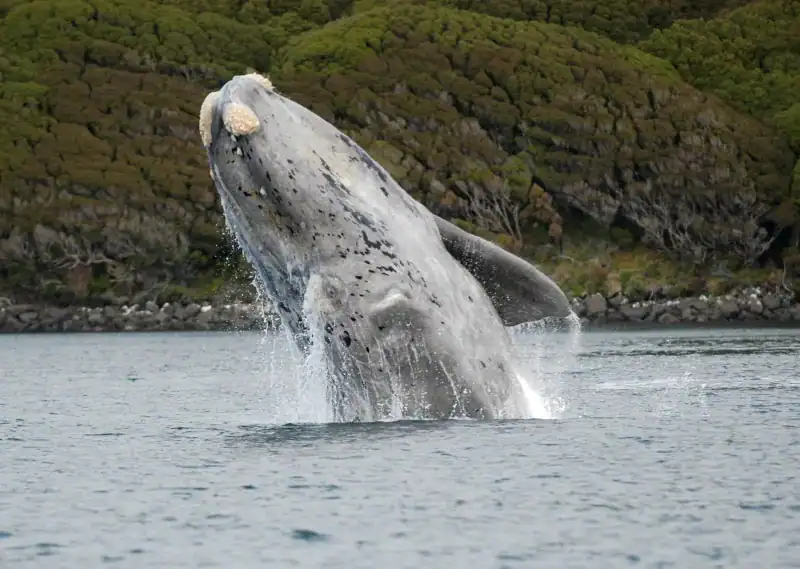
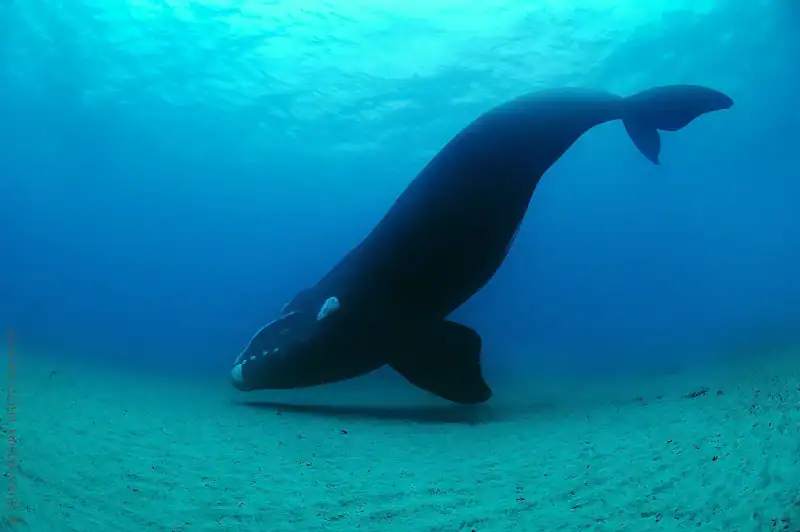
Both sexes, however, present a general body shape best described as stocky and rotund, with a broad back. Its pectoral flippers, meanwhile, evolved as broad paddle-shaped. It also has a wide tail, with smooth trailing edges. Unlike most of its kindred, it remains conspicuously absent a dorsal fin.
Perhaps the most remarkable anatomical feature of the awesome Wouthern Right Whale is the head of the animal. This actually represents almost one-third of the total body length! This hosts two separate blow-holes on top, as well as roughened, raised patches of skin, known as callosites.
Its distinctive coloration also merits its fair share of mention. Among adults, this most typically consists of a primarily black or dark gray background. Many of these individuals additionally display white patches on the belly or chin. Calves usually begin life slightly lighter and darken as they age.
- Kingdom: Animalia
- Phylum: Chordata
- Class: Mammalia
- Order: Artiodactyla
- Family: Balaenidae
- Genus: Eubalaena
- Species: E. australis
CCL: https://tinyurl.com/bd3jn23y
Southern Right Whale Distribution, Habitat, and Ecology
The beautiful Southern Right Whale evolved as indigenous to a moderately broad swathe of the marine regions of the globe. As the name implies, though, this zone of habitation consists of several distinct areas situated within the Southern Hemisphere. Those areas likely won’t surprise anyone.
Part of that specific territorial range consists of the waters of the Southwestern Atlantic Ocean off the coast of South America. Within that particular section of its range, its breeding grounds mainly include those locations lying offshore of the nations of Argentina, Uruguay, and southern Brazil.
This wonder of Nature’s also present in the waters off of South Africa, in the Southeastern Atlantic Ocean. Inside of this smaller zone, its breeding grounds appear in the waters just off of the southern coast of the country of South Africa. That holds particularly true between Cape Town and Durban.
Yet, the magnficent creature’s also present in portions of the waters around both Australia and New Zealand. Those final locations lie within the Southern Indian and Pacific Oceans, respectively. There, its breeding grounds lie just off Southern Australia, Tasmania, and parts of New Zealand.
Like its many relatives across the globe, this marvel displays a high degree of flexibility regarding the regions it inhabits, at least in certain ways. That classification occurs due to the fact that the habitats of the species change seasonally as the whale migrates between breeding and feeding areas.
From Winter to Spring, it favors coastal, temperate waters. Here, it prefers certain ecosystems. These commonly include shallow bays and sheltered coastal areas, calm waters and gentle slopes, and waters warm enough to support newborn calves, since this forms the breeding and calving area.
During the period between Summer to Autumn, though, it inhabits its major feeding habitat. This typically consists of higher latitude, offshore locations hosting notably cooler waters. Prime features include nutrient-rich waters, and high concentrations of zooplankton, especially copepods and krill.
In keeping with its migratory habits, the ecology of the Southern Right Whale developed as highly complicated in nature. In fact, this aspect of its life cycle encompasses its many interactions with the local environment, individuals and group behavior, life history, and role in marine ecosystems.
It feeds as a filter feeder, consuming vast quantities of zooplankton, mainly composed of krill and copepods. To do this, it swims slowly with its mouth open, filtering prey through fringed baleen plates. Later, as a byproduct of this, its fecal plumes play an important role in nutrient recycling.
The awe-inspiring creature typically lives either solitary, or in small, loose-knit groups. After breeding, females give birth, usually to a single calf, roughly 12 months later. Subsequent to the birth, mothers nurse their calves for between 6 – 12 months, varying significantly between individuals.
Due to its great size, this wonder of evolution possesses very few natural predators. Nonetheless, a few denizens of the depths do prey on it on occasion, though usually on either calves, juveniles, or severely weakend adults. These enemies include Orcas, and larger sharks, such as the Great White.
Species Sharing Its Range
Check out our other articles on 5 Amazing Mammals of Antarctica, Striped Possum, Lake Maracaibo, Hairy Shadow Witch, Vietnamese Mossy Frog, Goldentail moray, Aphrodite Fritillary, Eyelash Viper

Leave a Reply