We sincerely hope that each of you, our readers, will greatly enjoy and appreciate this article we present about these 3 Awesome Canines of Africa. It was certainly our pleasure to gather the various information for your perusal. May it provide you with both education and increased awareness.
Certainly, while fascinating, these few species listed herein represent only a tiny portion of the similar wonders found around the world. It’s our belief, though, that they serve as excellent representations of members of their Family. Check out our other articles for similar marvels.
Golden Jackal
CCL: https://bit.ly/41t9Gq5
Golden Jackal Facts
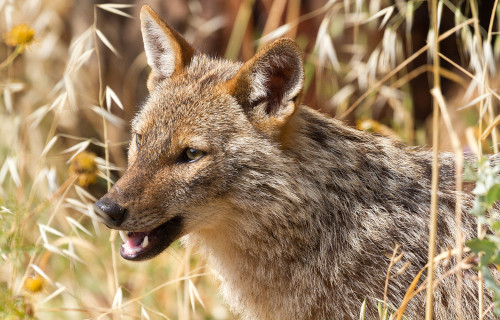
- Leading off this article about these 5 Awesome Canines of Africa comes the beautiful creature usually known as the Golden Jackal.
- This beautiful wild canid most frequently goes by the descriptive common name that it does due to its appearance. This wonder of Nature also has another, slightly less often used general name, though. That short erm’s the simple yet deceptive term of the common jackal.
- Within scientific circles, though, it’s better known by its formal moniker. Thankfully for the layperson, that’s a much easier to pronounce name than many such titles. That’s because it bears the formal name of the Canis aureus. yet, by either term, it’s quite impressive.
- The mammal received its technical title due to the efforts of the highly esteemed Carl Linnaeus himself. The Swedish zoologist accomplished the first recognition of the animal as a separate and distinct species. He also managed this scientifically noteworthy deed in the year 1758.
- Both common names remain somewhat deceptive in their nature, however. Despite those terms, the fascinating creature actually holds no close genetic relationship to jackals. Instead, it’s actually much more closely related to coyotes and wolves. It also has 6 known subspecies.
- Fortunately, the magnificent Golden Jackal has a population base that appears to be both stable and sizeable. That also seems to hold true throughout the entirety of its known native range. The IUCN, therefore, now lists it as Least Concern on its Red List of Threatened Species.
- It nevertheless faces some potential threats to its continued existence as a species, at least. Most of these stem either directly or indirectly from the actions of mankind. They include habitat degradation and loss. It also faces the danger posed by climate change, as all species.
Golden Jackal Physical Description
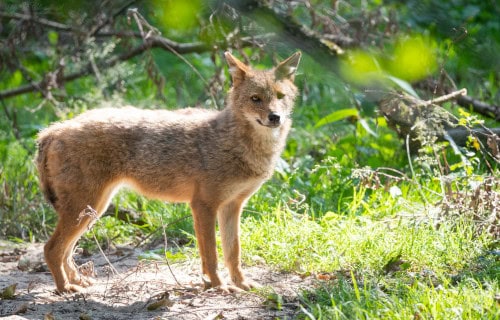
The gorgeous Golden Jackal immediately captivates those individuals fortunate enough to encounter it. The amazing product of evolution typically does so, however, due to its appearance more than its sheer size. That’s due to the fact that it resembles the gray wolf, but is slightly smaller.
The magnificent animal also possesses a markedly more elongated torso than that genetic cousin. It additionally attains a much lighter weight, shorter legs and tail, a narrower muzzle, and a less prominent forehead. These same tendencies also hold true for individuals of both genders.
It does follow an evolutionary pattern similar to other wild canids in that it displays a certain degree of the physiological characteristic of sexual dimorphism. In its specific case, this trait manifests in terms of simple physical size. More specifically, males of the species reach greater sizes.
Mature males of this intriguing species typically reach a body length of approximately 28 – 33 in (71 – 85 cm). These same specimens grow to an average body weight of roughly 13 – 31 lb (6 – 14 kg). An average height for the animal at the shoulder also measures between 18 – 20 in (45 – 50 cm).
Females of the Golden Jackal, however, generally reach a body length that equals about 27 – 29 in (69 – 73 cm). Their weight also remains slightly less, averaging approximately 15 – 24 lb (6.8 – 10.9 kg). Despite these differences, they attain the same average height at the shoulder, though.
Otherwise, both genders display the same general physical appearance. The fur develops as somewhat coarse and relatively short. As the name implies, the base color is a golden hue. A mixture of brown, white, and black hair appears on the back, and a ginger or cream on the stomach.
- Kingdom: Animalia
- Phylum: Chordata
- Class: Mammalia
- Order: Carnivora
- Family: Canidae
- Genus: Canis
- Species: C. aureus
CCL: https://bit.ly/41t9Gq5
Golden Jackal Distribution, Habitat, and Ecology
Thankfully, the Golden Jackal evolved as native to a relatively large swathe of the globe. The location of that range might not surprise many people. The full extent of that zone of habitation, though, might do so. It’s currently unknown to science if the animal ever appeared elsewhere.
More precisely, it lives in an area that includes most of Asia and northern Africa. Yet, the creature also makes its home in portions of southeast Europe. The oldest known fossil evidence of the mammal in Europe occurs in what’s now Greece, and dates back to roughly 7,000 years ago.
This marvelous creation of Nature and evolution displays decidedly clear preferences in its choice of habitat. The great majority of its numbers make their homes in either regions of dry, open country, dry, short grasslands, or the steppe landscapes so abundant in most of its known range.
Though rare, some few individuals do occur in parts of the foothills and low mountain regions. In all zones it does appear in, however, the wild canid displays further habitat requirements. It’s generally abundant in valleys, near rivers, lakes, canals, and even occasionally seashores.
The intriguing Golden Jackal also evolved as a comparatively social creature. Its primary social structure isn’t pack based, though, like many of its relatives. Instead, breeding pairs often live with young offspring. This distinguishes it even further from many other varieties of wild canines.
Though mainly carnivorous, it supplements its diet with a moderate variety of fruits and insects. It hunts its main prey opportunistically, and usually prefers comparatively smaller mammals, such as wild or domestic fowl. It will, however, attack prey as large as the young of larger animals.
Fennec Fox
Fennec Fox Facts
- Our next choice for inclusion in this compilation of 3 Awesome Canines of Africa bears the surprisingly short title of Fennec Fox.
- This undeniably remarkable mammal most frequently goes by the deceptively simple common name that it does across its native range. That term derives from the Arabic word fanak. For the moment, this small wonder of evolution has no other accepted generally accepted name.
- In scientific circles, though, it’s typically significantly better known by its entirely formal moniker. Fortunately for the layperson, that’s a term more easily pronounced than many others. That’s because this intriguing wild canine bears the official name of the Vulpes zerda.
- The animal received that title due to the efforts of the respected German zoologist, Eberhardt August Wilhelm von Zimmermann. He accomplished the first recognition of it as a separate and distinct species. This scientifically noteworthy event occurred in the year 1780.
- This charming creation of Nature and evolution stands out in the annals of science for one extremely notable reason. Currently, it represents the smallest of all known species of fox on earth today. This distinction serves to make it a subject of great interest to many researchers.
- Fortunately, the Fennec Fox appears to be maintaining a population base that’s both sufficient and stable. This pleasant trend also seems to hold true throughout the entirety of its known range. The IUCN currently classifies the animal as Least Concern on its published Red List.
- Nevertheless, this fascinating creature faces several threats to its continued existence as a species. In its native range, wild specimens are commonly trapped, either for sale to toursits or for exhibition. It also now faces the same threat of ongoing climate change as all species.
CCL: http://bit.ly/2xQPH8p
Fennec Fox Physical Description
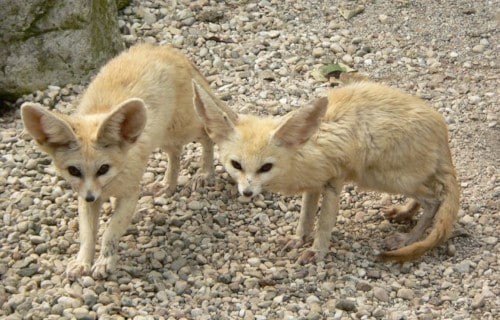
The gorgeous Fennec Fox easily captivates most people fortunate enough to encounter one of these wonders. Unlike some species, however, this occurs more due to its appearance than sheer size. That’s due to the previously noted fact that it’s the smallest of all known species of wild canines.
The lovely mammal does share a very common trait with its many relatives, though. That’s true given the fact that it displays a certain degree of the physiological characteristic of sexual dimorphism. In its specific case, this trait manifests itself purely in terms of physical measurements.
More precisely, males attain a larger average size than their female counterparts. The difference remains relatively minor, though. With the exception of this trait, the two genders are virtually indistinguishable to the untrained eye. This situation often complicates casual identification.
The females of the amazing, visually impressive species reach an average head and body length equaling approximately 13.6 – 15.6 in (34.5 – 39.5 cm). Male specimens, meanwhile, grow to an average measurement equaling 15.4 – 15.6 in (39 – 39.5 cm) for the same physical structure.
Weights vary accordingly between the different sexes as well. The females typically weigh somewhere between 2.2 – 4.2 lb (1.0 – 1.9 kg). The males, however, usually tend to attain a slightly greater mass. The tail for both genders of the wonder averages roughly 9.1 – 9.8 in (23 – 25 cm).
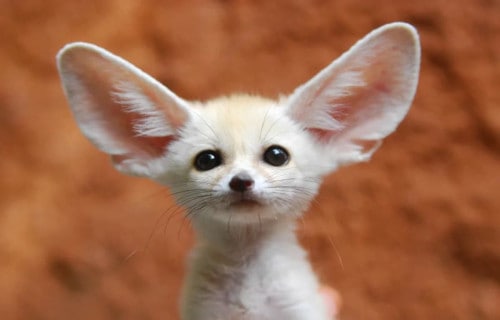
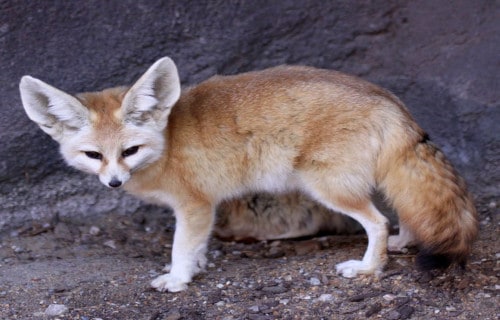
The appealing coat of the Fennec Fox typically presents a blending of creamy tan and white shades. The fur itself also has a fluffy nature, serving to help keep it warm at night. The ears represent its most recognizable feature. In ratio to body size, they’re the largest of all known wild canines.
- Kingdom: Animalia
- Phylum: Chordata
- Class: Mammalia
- Order: Carnivora
- Family: Canidae
- Genus: Vulpes
- Species: V. zerda
CCL: http://bit.ly/2xQPH8p
Fennec Fox Distribution, Habitat, and Ecology
The visual wonder that’s the Fennec Fox evolved as native to a respectable range of the surface of the globe. The location of that zone of habitation, though, might surprise some people. That true since it remains endemic to portions of Africa, as well as a small section of the Middle East.
In Africa, the lovely creature principally appears in certain portions of the Sahara. That area extends from Mauritania to Morocco. From there, its range extends through Egypt. The canine even appears in sections of the Sanai Peninsula. Some specimens also live in the country of Israel.
Nature additionally guided this animal through a very precise evolutionary path. It developed decidedly unexpected preferences in terms of its choice of habitat. The animal primarily inhabits areas that most mammals, especially smaller ones, would scrupulously avoid at all costs.
That’s true since it’s principally a desert environment species. The mammal typically makes its home in small sands. Some, however, also live in various vast, treeless sandy areas with sparse vegetation. That flora generally consists of various species of sedges, grasses, and small shrubs.
The Fennec Fox developed a primarily nocturnal nature. It commonly prefers to spend its days in its den, usually dug in the sand and located near patches of vegetation. This also appear highly organized, measuring as much as 1,291 sq ft (120 sq m), with up to 15 entrances and exits.
It also evolved as an omnivorous creature. The animal’s diet primarily consists of various insects, rodents, eggs, and occasionally rabbits. It typically hunts by pouncing on its prey, leaping from a stationary position. Its own main predators consist of owls, jackals, and sometimes hyenas.
Ethiopian Wolf
CCL: https://tinyurl.com/2dcehfvs
Ethiopian Wolf Facts
- Closing out this listing of these 3 Awesome Canines of Africa we present the majestic animal appropriately known as the Ethiopian Wolf.
- This beautiful and distinctive product of Nature and evolution most frequently goes by the informative common name used herein. It does have a few other general titles, though. These include such widely differing terms as the red jackal, Simien jackal or Simien fox.
- Within the scientific community, however, it’s perhaps better known by its technical designation. Thankfully, that’s much simpler for the layperson to pronounce than many of its type. That’s because the remarkable mammal bears the formal appellation of Canis simensis.
- This amazing animal received that epithet due to the efforts of Wilhelm Peter Eduard Simon Rüppell. The respected German naturalist recorded the first official recognition of it as a separate and distinct species. He achieved that scientifically noteworthy deed in the year 1840.
- Regrettably, this marvelous example of fauna remains noted among researchers for several negative reasons. It presently ranks as one of the rarest canids on earth. The awesome creature also now represents the most endangered carnivore on the continent to which it evolved.
- Due to the combination of these, the Ethiopian Wolf now finds itself in severe peril. That lamentable situation also seems to hold true throughout the entirety of its native range. Accordingly, the IUCN currently shows the mammal as Endangered on its Red List.
- Its estimated population now stands at only 360 – 440 individuals. Given that, it faces numerous threats to its continued existence as a species. Like all forms of life on earth today, many of those stem from the actions of man. They include habitat loss and climate change.

CCL: https://tinyurl.com/2s4apsss
Ethiopian Wolf Physical Description
The captivating Ethiopian Wolf rarely fails to to capture the attention of those fortunate enough to encounter the marvel. The canid typically does so, however, due more to its appearance than sheer size. That’s true since, in that respect, it ranks as a medium-sized member of its Family.
In that regard, it also follows a pattern common among its many kindred across the globe. That’s the fact that it displays a certain degree of the physiological characteristic of sexual dimorphism. In its case, this trait manifests itself with males generally being larger than their female counterparts.
That difference principally appears in terms of mass. Males attain an average body weight between 31 – 42 lb (14 – 19 kg). Females, though, only reach a mean weight of 24 – 31 lb (11 – 14 kg). The males therefore have a notably stockier, more robust build than that of the females of the species.
Otherwise, both genders present the same general appearance. An average body length equals roughly 33 – 39 in (84 – 100 cm). The animal’s tail, however, adds an additional 12 – 16 in (30 – 40 cm) to this. Its average height at the shoulder further measures between 21 – 24 in (53 – 62 cm).
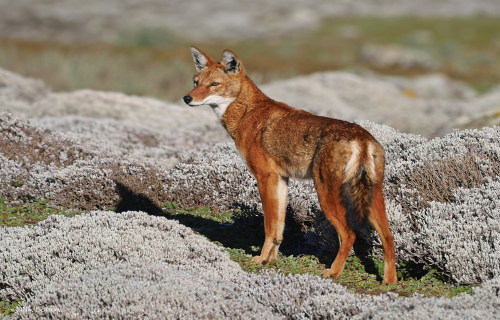
Compared to other wolves, it evolved a slender, more fox-like face, It also has large, pointed ears that often display a black tip. The muzzle also grows longer and narrower than most of its kind. Almond-shaped eyes, typically yellowish-brown in color, serve to add to its distinctiveness.
The coat of the visually impressive Ethiopian Wolf also garners appreciation. This presents with a distinctive reddish-brown to rusty-colored coat with white markings on the underbelly, chest, throat, and inner parts of the legs. Its fur develops as short and dense, more so in cold weather.
Meanwhile, it also has long legs adapted for hunting in open, high-altitude terrain. The legs evolved as slender yet muscular, allowing for agility and speed. The tail typically presents as relatively bushy in nature. It’s also often tipped with black, and gets carried quite low when the wolf relaxes.
- Kingdom: Animalia
- Phylum: Chordata
- Class: Mammalia
- Order: Carnivora
- Family: Canidae
- Genus: Canis
- Species: C. simensis
CCL: https://tinyurl.com/yswn2ycv
Ethiopian Wolf Distribution, Habitat, and Ecology
Unfortunately, the magnificent Ethiopian Wolf evolved as indigenous to a very small portion of the earth’s surface. That zone of habitation’s also highly fragmented now, in terms of distribution of population. As its name implies, it only appears natively in one small and specific portion of Africa.
That, of course, represents what’s now the country of Ethiopia. Even within that already limited region, though, it only dwells in a precise portion of the area. That consists of the highlands section of the country. Yet, even there it resides only in widely scattered portions of the region.
The beautiful Bale Mountains in the southern part of the nation constitute its greatest stronghold. The Bale Mountains National Park holds the majority of the remaining wolves. A few other small populations in the immediate vicinity also reside on the Sanetti Plateau and Web Valley.
Another significant population resides in the Simien Mountains National Park, although this population remains much smaller and more fragmented than that in the Bale Mountains. A handful on groups also dwell in the Arsi Mountains, Menz Range, Gaysay grasslands, and Guassa-Menz.
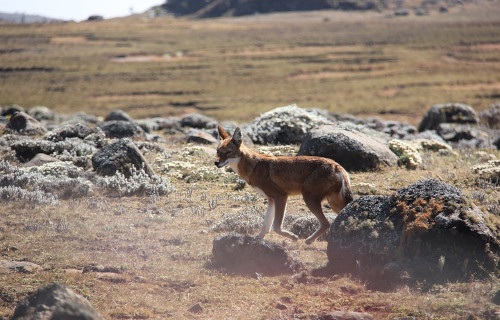
Due to its range, it clearly displays very specific habitat requirements. It inhabits high-altitude ecosystems known as Afroalpine regions, unique to the Ethiopian highlands. These unique ecosystems usually form at elevations between 9,800 – 14,800 ft (3,000 – 4,500 m) above sea level.
Here, it largely prefers grasslands and heathlands. These areas remains characterized by open, grassy plains interspersed with patches of shrubs, particularly giant lobelia and everlasting flowers. The wolves prefer these expansive open habitats for hunting, as they rely on sight to locate prey.
It also often resides on large, flat plateaus covered in short grasses or tussocks, providing ample habitat for the species that make up the bulk of its diet. It also avoids steep, rocky areas, but sometimes use gentler slopes adjacent to valleys for resting or as routes between hunting grounds.
Other areas include subalpine heaths. These areas consist of sparse shrubs and often form at the edges of its habitat range, transitioning from grasslands to more barren and rocky alpine areas. Small bushes and ground cover plants are common here, and it roams this area while searching for food.
The incredible mammal also differs from most of its relatives in another manner. That’s its diet. While most of its kindred evolved as what might be called broad spectrum carnivores, this animal has an extremely specific diet. This highly specialized carnivore mainly hunts small animals.
Rodents, particularly the Ethiopian highland hare and giant mole-rats, proliferate in the Afroalpine grasslands. These constitute the bulk of its prey. Other small rodents, including rats, mice, and grass rats also serve. Though rare, it occasionally eats small birds or even scavenges from carcasses.
The Ethiopian Wolf lives in social packs, with a unique society. While highly territorial and living in groups of 3 to 13 individuals, it usually hunts alone. Pack cooperation typically remains much more focused on defense of territory from rival packs than on any efforts at cooperative hunting.
Breeding occurs between August and November, with pups born after a gestation period of about 60-63 days. Litters typically consist of 2-6 pups, and the pack works together to raise them. Impressively, non-breeding pack members guard and feed the pups, ensuring their survival.
CCL: http://bit.ly/2xQPH8p
3 Awesome Canines of Africa
We hope that each of you thoroughly enjoyed reading, and hopefully learning some things from, this article we’ve written about these 3 Awesome Canines of Africa. It’s also our hope that doing so has left you with either a new or renewed appreciation for such awesome wonders of Nature.
Unfortunately, however, many of their numerous kindred situated around the world now find themselves facing strong threats to their continued existence as a species. Many of those dangers, in fact, stem from the actions of mankind. We must do all we can to protect and preserve them all.
Check out our other articles on 5 Fantastic Fauna of Tunisia, Spectacular Dolphins Throughout Our World, 5 Wonderful North American Wild Canines, Africa’s Many Geological Masterpieces










Leave a Reply