CCL: https://bit.ly/3L3Qs51
We sincerely hope that each of you, our readers, will greatly enjoy and appreciate this article we present about these 4 Awesome Lizards of Asia. It was certainly our great pleasure to compile the information for you. May it provide you with both education and increased awareness.
Obviously, while amazing, these few species listed herein represent only a portion of the natural wonders found throughout the region, however. Yet, it’s our belief that they serve as excellent examples of the wonders found here. Check out some of our other articles for similar marvels.
Earless Monitor Lizard
CCL: https://tinyurl.com/4f25epkn
Earless Monitor Lizard Facts
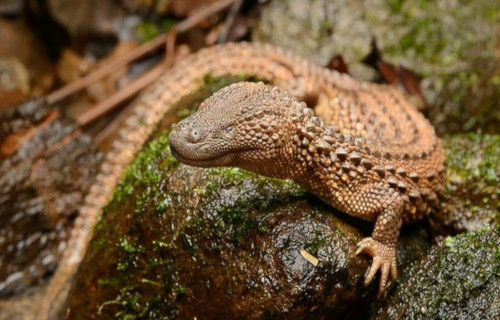
- Leading off this article about these 4 Awesome Lizards of Asia we present you with the aptly-named wonder of Nature known as the Earless Monitor Lizard.
- This extraordinary reptile most frequently goes by the highly descriptive common name that we’re using here across its entire range. The creature does have several other general titles it’s known by, though. These include the Borneo Dragon and Lesser Earless Monitor Lizard.
- Within scientific circles, however, it’s possibly significantly better known by its technical designation. Sadly, though, that term’s extremely difficult for the layperson to pronounce easily. That’s because the animal holds the tongue-twisting formal tag Lanthanotus borneensis.
- The amazing animal received that difficult moniker due to the efforts of Franz Steindachner. The respected Austrian herpetologist recorded the first recognition of it as a separate and distinct species. He achieved that scientifically noteworthy accomplishment in the year 1878.
- The marvel of Nature and evolution remains notable to the world of science for several reasons. Most importantly in this regard, the reptile represents the only known surviving species in the Family Lanthanotidae. It’s also related to the true monitor lizards of the world.
- Regrettably, the remarkable Earless Monitor Lizard finds itself in a precarious position for several reasons. The very nature of its habitat range ranks high among these factors. Due to its situation, the IUCN currently shows it as Endangered on its Red List of Threatened Species.
- The intriguing product of Nature also currently faces other threats to its continued existence, of course. Like all other forms of life on earth today, most of those dangers stem from the actions of mankind. High on any such list stands the threat posed by ongoing climate change.
Earless Monitor Lizard Physical Description
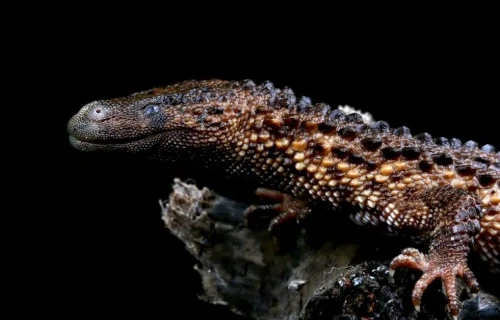
The incredible Earless Monitor Lizard generally captures the attention of those individuals fortunate enough to encounter one of these marvels. The animal typically does so, however, due to its distinctive appearance, not its size. That’s because it’s not an overly large species of reptile.
Regarding its physical appearance, though, the interesting lizard tends to follow a general pattern of physical development common to many creatures. That’s evidenced by the fact that this marvel of Nature displays a certain degree of the physiological characteristic of sexual dimorphism.
This natural trait actually manifests itself in several ways, however. As a general principle, females typically attain slightly greater body lengths than their male counterparts. The difference remains minor, though. Overall, the species averages roughly 8 – 10 in (20 – 25 cm), including the tail.
Females also often exhibit a slightly more rounded body shape than the males, especially during the breeding season when they’re carrying eggs. This occurs due to the development of eggs within the reproductive tract, which understandably leads to a noticeable increase in terms of girth.
Meanwhile, males of this amazing reptile typically distinguish themselves by having slightly broader and more robust heads compared to the females of the species. This feature’s possibly associated with differences in its behavior or diet, as sometimes occurs among other lizard species.
Otherwise, the two genders present the same basic outward appearance to the observer. Except for any gravid females, it possesses a comparatively slender, elongated body covered with small, smooth scales. The coloration generally presents as either a light to dark brown or dark gray
The tail develops as slightly shorter than the body, yet extremely muscular and robust. It’ also likely used for balance and swimming. This appendage further tapers to a very fine point. Like many lizards, the unjique animal also has a forked tongue, which it uses to sense its surroundings.
This astounding reptile holds yet still more points of interest for the viewer. It additionally evolved short, sturdy limbs, relative to its body size. Each of these appendages comes equipped with well-developed claws, which help it in digging and navigating through its native environment.
Yet, it’s the head of the remarkable Earless Monitor Lizard that usually receives the most attention. This body part remains somewhat flattened, and boasts a clearly pointed snout. Unlike many other lizards, this particular species developed very small eyes, situated on the sides of the skull.
Despite its partially deceptive common name, the intriguing creature actually does have ear openings. These do, however, remain extremely small and not usually externally visible. This occurs due to a combination of their small size and the rough quality of the texture of their skin.
- Kingdom: Animalia
- Phylum: Chordata
- Class: Reptilia
- Order: Squamata
- Family: Lanthanotidae
- Genus: Lanthanotus
- Species: L. borneensis
CCL: https://tinyurl.com/4f25epkn
Earless Monitor Lizard Distribution, Habitat, and Ecology
Unfortunately, the remarkable Earless Monitor Lizard evolved as indigenous to a relatively small portion of the surface of the earth. Precisely where that zone of habitation lies might surprise some of our readers, though. It’s only native to a very specific section of southeastern Asia.
In fact, the wonder’s only known to dwell on the island of Borneo. But even there it’s known presence remains limited to a few highly select areas. It’s found primarily in the regions of Sarawak and Sabah in the section claimed by Malaysia, as well as the part claimed by Indonesia, Kalimantan.
This fascinating lizard also displays decidedly strong, clear, and extremely specific preferences regarding its choice of habitat. These, in fact, remain crucial for its survival, given its limited territory and population numbers. Due to its range, however, its typical nature isn’t at all surprising.
This wonder of the reptilian world frequently makes its home in regions comprised of lowland tropical rainforests. These settings serve to provide it a humid and stable climate essential for its well-being. The dense forest cover also offers protection and an abundance of food sources.
The fascinating creature’s also often associated with areas near freshwater sources, such as various streams, rivers, and swamps. These various bodies remain crucial for its habitat, providing hydration, and contributing to a moist environment that suits its typically semi-aquatic lifestyle.
It’s often found in leaf litter or under decaying wood and logs, which provide it with both shelter and hunting grounds. The lizard also prefers warm, humid conditions typical of its chosen habitat. These support its many physiological needs, particularly its skin and respiratory systems.
This wonder of Nature and evolution fills a very unique evolutionary niche within its ecosystem. It evolved a carnivorous diet, primarily feeding on small invertebrates, such as insects, worms, and others. Its feeding habits possibly also include small vertebrates such as small fish and amphibians.
It’s generally nocturnal in its activity patterns, hunting either during the night or twilight hours when it can more easily avoid predators and competition. The animal’s also semi-aquatic, often being found near small, calm bodies of water. It’s a good swimmer as well, often foraging in water.
Meanwhile, the reproductive behavior of the Earless Monitor Lizard isn’t very well-documented, since it’s highly reclusive. But, like many reptiles, the majority of researchers believe it to lay eggs. The number of eggs and specific nesting behaviors continue to still be subjects of ongoing studies.
Likewise, specific knowledge regarding its own predators remains scant. Based on its size and habitat, potential predators likely include several possibilities, though. It most likely represents a prey species to birds of prey, larger mammals, various snakes, and even other, larger lizards.
Philippine sailfin lizard
CCL: https://bit.ly/3L3Qs51
Philippine sailfin lizard Facts
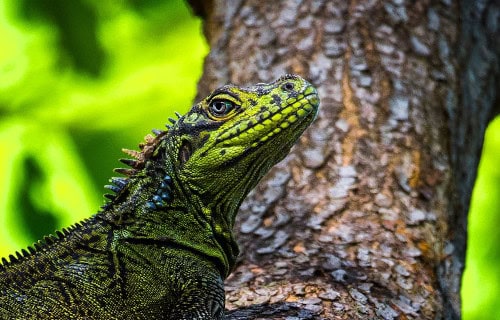
- Our next choice for inclusion in this compilation of 4 Awesome Lizards of Asia bears the distinctive title of the Philippine sailfin lizard.
- This remarkable creation of Nature and evolution most frequently goes by the informative common name that we’ve chosen to use. It also has several alternate names by which it’s sometimes known. These include such terms as crested lizard and soa soa water lizard.
- Within scientific circles, however, it’s often referred to by yet another title. That’s its formal, scientific name. Unfortunately, that’s a term that’s somewhat hard for the layperson to pronounce. That’s because it bears the purely technical moniker of Hydrosaurus pustulatus.
- The amazing animal received that difficult title due to the efforts of the Baltic German naturalist, Johann Friedrich Gustav von Eschscholtz. He recorded the first official recognition of the reptile as a separate and distinct species. He managed this noteworthy feat in 1829.
- Sadly, it has long been a target of the exotic pet trade, due to its unique appearance. Thankfully, though, it now enjoys the status of a protected species in the region of the world it lives in. Nevertheless, illegal hunting of it for that same reason still continues across its range.
- Fortunately, the intriguing Philippine sailfin lizard appears to be maintaining a wild population that’s both sizeable and stable. That situation further seems to hold true throughout the entirety of its territory. The IUCN, therefore, now lists it as Least Concern on its Red List.
- Nonetheless, the reptile still faces several potential threats to its continued existence as a species. Most of these stem from the actions of man. They include such perils as habitat loss and hunting for consumption. Now, however, it faces the threat of ongoing climate change.
CCL: https://bit.ly/3H9dTHN
Philippine sailfin lizard Physical Description
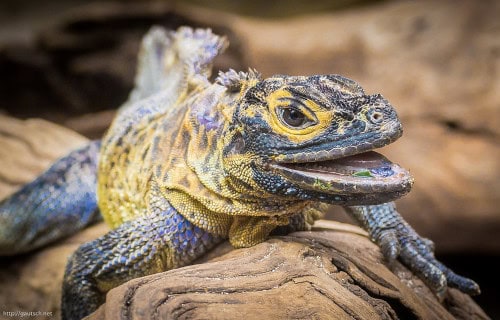
The Philippine sailfin lizard constitutes one of those marvels of Nature and evolution that quickly captivates those who encounter them. Unlike some species, though, it does so for a variety of reasons. Though certainly not its most intriguing aspect, the animal boasts an impressive size.
Like many reptiles, however, it also displays a certain degree of the physiological characteristic of sexual dimorphism. In its specific case, this natural trait manifests itself in terms of both size and physical appearance. Though not unknown, that’s nevertheless somewhat less common.
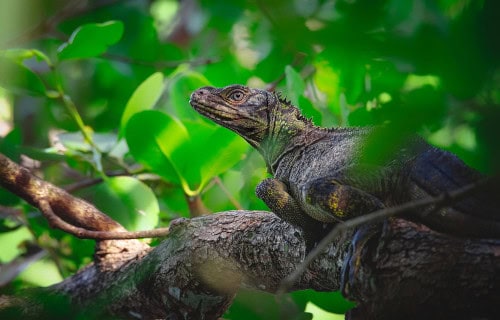
Regarding size, males of the remarkable creature typically attain a much greater size on average than their female counterparts. Including the lengthy tail, the males reach an average length measuring somewhere between 3 – 4 ft (0.91 – 1.2 m). Females, though, only average 2 -3 ft (61 – 91 cm).
Despite the difference in length, body masses of mature adults remain approximately the same, wholly regardless of gender. This results in many females having a slightly stockier build than the males. Overall, though, fully grown individuals attain weights of about 3 – 5 lbs (1.4 – 2.3 kg).
Yet the astonishing Philippine sailfin lizard also displays other gender-based differences in terms of the crest, or sailfin. This, thin, upright feature extends from the base of the tail to the lower section of the back. Males of the awesome species develop a larger crest, in addition to bigger heads.
Even the general coloring differs between the sexes, though to only a minor degree. This principally consists of a background of dark green and brown. Yellow patches sometimes appear on the back and near the head. The limbs of the male, though, show a darker shade than that of females.
- Kingdom: Animalia
- Phylum: Chordata
- Class: Reptilia
- Order: Squamata
- Family: Agamidae
- Genus: Hydrosaurus
- Species: H. pustulatus
CCL: https://bit.ly/405HN6g
Philippine sailfin lizard Distribution, Habitat, and Ecology
The amazing Philippine sailfin lizard evolved as endemic to a portion of the world already quite well known for its abundance of natural beauty. Its very name indicates part of that range, of course. However, that same moniker also qualifies as slightly deceptive, as it appears elsewhere, as well.
The vast majority of observed specimens happen to appear on several of the islands comprising the Philippines. It does not, however, live on Palawan Island. A smaller population also makes its home in New Guinea, and even a small part of Indonesia. It’s unknown if it ever lived elsewhere.
Like many related species across the globe, the animal also displays decidedly strong preferences for its choice of habitat. Due to this instinctive tendency, though, its choices remain somewhat limited. The intrepid reptile makes its home almost exclusively in regions of tropical wooded areas.
Yet, the wonder of the animal kingdom also requires reltively close proximity to calm or slow-moving water. This includes such diverse regions as riverbanks, mangrove areas, and even rice fields. The specifically evolved animal further prefers the presence of loosely piled rocky debris.
Still following a pattern common to its numerous relatives, the Philippine sailfin lizard developed as an omnivore. Intriguingly, the creature strikes a very even balance between meat and plants. Its diet thus consists of such food sources as fruits, leaves, insects, and even smaller crustaceans.
The species additionally evolved as diurnal in nature. Individuals typically spend a significant majority of the day sunning themselves. Breeding occurs once per year, though the female may lay several clutches. Each of these typically produces between 2 – 8 eggs each, placed in shallow pits.
Mangrove Monitor
Public Domain Image
Mangrove Monitor Facts
- Now showing in this gathering of these 4 Awesome Lizards of Asia is the remarkable work of evolution known as the Mangrove Monitor.
- This majestic creation of Nature is most frequently known by the descriptive common name across its range for excellent reasons. It also has a few other, less often used titles, though. Those include such terms as the mangrove goanna and Western Pacific monitor lizard.
- Scientific professionals, however, perhaps more often tend to refer to the creature by its official moniker. Thankfully, that’s a comparatively simple name for the layperson to pronounce. That’s because this remarkable reptile now holds the formal name of Varanus indicus.
- The widely respected French zoologist, François Marie Daudin, holds the distinction of being the first person to formally acknowledge it as a separate and distinct species. That occurred in the year 1802. He, however, gave it a different name. It first bore the title Tupinambis indicus.
- Later research subsequently changed that appellation to the moniker applied today. This took time, though, due to ongoing research and new insights into its place in evolution. The intriguing lizard eventually acquired the appellation it holds now approximately 100 years later.
- No matter what one calls it, the Mangrove Monitor seems to be maintaining a population base that’s both sufficient and stable. That pleasant trend also appears to hold true throughout the entirety of its range. The IUCN thus lists it as Least Concern on its published Red List.
- The marvel of Nature nevertheless does faces some potential threats to its continued existence as a species. Most of these stem from the actions of humans. In some regions, it’s actively hunted for its flesh and skin. Its greatest peril, however, likely comes from climate change.
CCL: https://bit.ly/42cMOvv
Mangrove Monitor Physical Description
The magnificent Mangrove Monitor easily merits the admiration and appreciation of those fortunate enough to encounter it. Its visual appeal certainly plays a factor in that notice, of course. Yet, its sheer physical dimensions also help the reptile to acquire that same high degree of notice.
That’s true since the stunning reptile achieves some very respectable measurements. One gender of the intriguing species especially does so. That’s true since the fascinating animal actually displays an extremely strong degree of the physiological characteristic known as sexual dimorphism.
In its case, this evolutionary trait manifests itself in terms of pure physical size. More specifically, males of the species attain a significantly greater size than their female counterparts. This situation commonly occurs among its numerous kindred, but few display the principl to quite this extent.
Mature males of the impressive lizard typically grow to lengths equaling between 3.5 – 4 ft (1.1 – 1.2 m). It must be noted, however, that the vast majority of that’s formed of the tail, which usually measures almost twice the length of the body! Males also reach weights of as much as 4.2 lb (1.9 kg).
Females of the Mangrove Monitor reach much shorter lengths than their males, though. That gender also evolved as slimmer in their body shape. These tend to be only around half the length of their counterparts. Being less stocky than males, they generally only weigh around 1.1 lb (0.5 kg).
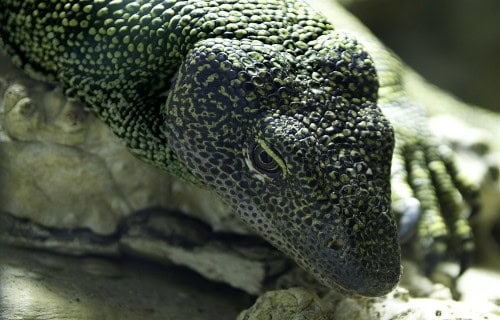
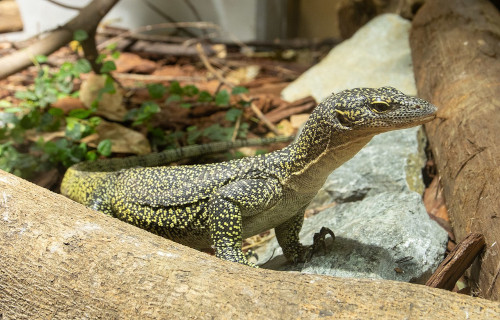
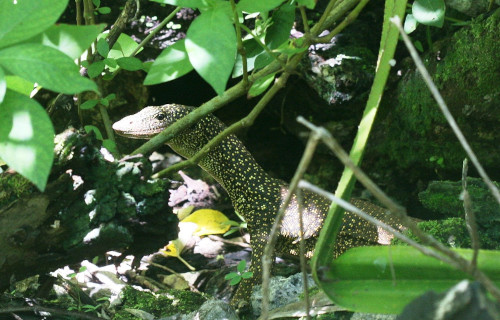
The animal also displays an interesting pattern of coloring. Both genders show either a black or dark green background onthe upper part of the body. The stomach, though, tends to be a cream color, without markings. Golden-yellow spots on a lighter background show on the top of the head.
- Kingdom: Animalia
- Phylum: Chordata
- Class: Reptilia
- Order: Squamata
- Family: Varanidae
- Genus: Varanus
- Species: V. indicus
CCL: https://bit.ly/3M49Sa9
Mangrove Monitor Distribution, Habitat, and Ecology
The gorgeous Mangrove Monitor evolved as indigenous to a reasonably large portion of the surface of the world. The general area, though, likely won’t surprise many people. That’s true since it developed as endemic to a range that occurs entirely in the Southern Hemisphere, south of Asia.
More precisely, the known native zone of habitation for the amazing species extends all the way from northern Australia and New Guinea to the Solomon Islands. Within that extensive territory, it appears in scattered regions. That’s partly because it actually lives on literally hundreds of islands.
Within that extremely broad range, though, this marvel displays decided preference in its choice of habitat. Its very name supplies a clear indication of the nature of those preferences, to be certain. As evidenced by that informative title, it mainly lives in regions comprising dense mangrove forests.
Yet this marvel of Nature and evolutionary processes also lives in other, very similar locations within its range. These include areas of damp forests close to coastal rivers, and even permanent inland lakes. It’s one of only two known varieties of monitor lizard capable of surviving in such a habitat.
The captivating Mangrove Monitor achieves that adaptability due to its having salt-excreting nasal glands. These allow it to survive there, and even consume marine prey. It feeds opportunistically, and as a pure carnivore. It consumes such prey as insects, rodents, crustaceans, among others.
Males frequently fight fiercely for females during the mating season. Following their mating, though, the female lays 2 – 12 eggs that hatch in seven to eight months. In captivity, the remarkable creature lives for up to 20 years. Currently, though, its lifespan in the wild still remains undetermined.
Rough-nosed Horned Lizard
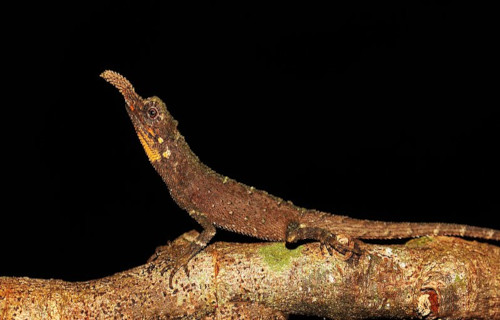
Rough-nosed Horned Lizard Facts
- Closing out this listing of 4 Awesome Lizards of Asia we present you with the extraordinary work of evolution rightly called the Rough-nosed Horned Lizard.
- Understandably, this intriguing reptile, with its distinctive appearance, most frequently goes by that common name due to its appearance. However, like many species found throughout the world, the remarkable animal also holds another generally used common name.
- In this case, that’s the much more informative term of the Sri Lanka horned agama. Scientific professionals, such as researchers, though, tend to more often use the formal scientific name when referring to it. But that’s the relatively simple name of the Ceratophora aspera.
- It received this designation due to the work of a respected researcher. The German-born British zoologist, Albert Charles Lewis Gotthilf Günther holds that distinction. That’s because he accomplished the first recognition of it as a separate and distinct species in 1864.
- Regardless of which term one chooses to use, however, it’s a fascinating product of evolution. Its unique physical attributes also serve to set it apart from all other known members of its genus. This situation only serves to enhance its particular appeal to researchers, though.
- Unfortunately, the fabulous Rough-nosed Horned-Lizard also seems to be dwindling rapidly in population. This regrettable trend further appears to hold true throughout the entirety of its known range. The IUCN, therefore, currently lists the astounding lizard as Endangered.
- Several factors now threaten it. Habitat loss due to human activities ranks high among those, to be certain. Its greatest threat, however, now comes from climate change. Its own very limited habitat range also serves to greatly augment the effects of each of these many dangers.
Rough-nosed Horned-Lizard Physical Description
Perhaps most incredibly, the Rough-nosed Horned-Lizard manages to pack all its intriguing characteristics into a surprisingly small body. That’s not completely unexpected , though. That’s because Nature holds no distinction regarding such unimportant factors as size and impressiveness.
The intriguing creature does, however, stand out from the other members of its Genus in one specific way. That’s where sheer physical size is concerned. That holds true due to the amazing fact that the animal only displays a moderate degree of the physiological trait of sexual dimorphism.
More specifically, this wonder of evolutioon manifests this aspect of its nature in the fact that females attain a slightly greater overall length than their male counterparts. This gender, though, only reaches lengths equaling about 1.6 in (4 cm). Yet the males remain moderately smaller in size.
This diminutive reptile also displays a visually striking pattern of natural coloring. This principally consists of a background composed of either dark yellow or light brown. A total of 17 darker bands, however, also extend from the head to the tail. The space between these shows a lighter shade.
Its body further develops to display a slightly compressed shape. Each individual also possesses a highly unique, x-shape dorsal ridge, located directly behind the head. The unique creature additionally develops a small crest, typically appearing along the region of the neck of the species.
The most noticeable trait of the Rough-nosed Horned-Lizard, though, remains the appendage to the nose of the creature. This marvel of natural processes distinguishes itself from its many related species yet again in this. That’s due to the fact the rostrum comprises up to 24% of the total length!
- Kingdom: Animalia
- Phylum: Chordata
- Class: Reptilia
- Order: Squamata
- Family: Agamidae
- Genus: Ceratophora
- Species: C. aspera
CCL: https://bit.ly/32p97oh
Rough-nosed Horned-Lizard Distribution, Habitat, and Ecology
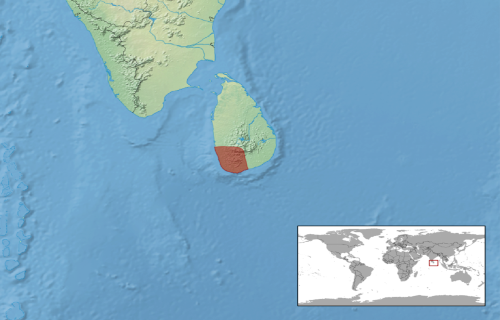
The astonishing Rough-nosed Horned-Lizard has one natural attribute that unfortunately works against it. That’s the fact that this species evolved as indigenous to an extremely limited habitat range. Evidence indicates that it never existed anywhere outside that specific part of the world.
This holds true because it only appears within a tiny part of the overall portion of the earth’s surface consisting of southern Asia. In point of fact, the unique lizard lives only on one specific island. That’s the island comprising the nation of Sri Lanka, a site holding many other natural wonders.
Yet even there, its habitat preferences continue to limit its potential zone of habitation. Due to those strong preferences, the amazing reptile only dwells in areas of high moisture, with copious vegetation. This most frequently consists of forested regions, the greater the density the better.
It also demonstrates even more extensive levels of choice. The regions in which it chooses to make its home also tend to be predominantly comprised of local hardwood tree species. The great majority of individuals also seem to prefer to live at altitudes of no more than 2,953 ft (900 m).
Although the impressive Rough-nosed Horned-Lizard dwells amid so many trees, it’s actually not an arboreal species. Instead, the animal makes its home amid the copious quantities of leaf litter found on the ground. The lizard also tends to live in mated pairs, at least once it reaches adulthood.
This marvel of Nature also feeds quite indiscriminately, consuming a wide range of local prey. This dietary fare includes various insects and other small invertebrates. Following mating, the female later lays her eggs in a well-concealed nest. Typically, a clutch consists of two eggs for this species.
CCL: https://bit.ly/3H9dTHN
4 Awesome Lizards of Asia
We sincerely hope that each of you thoroughly enjoyed reading, and hopefully learning something from, this article we’ve written about these 4 Awesome Lizards of Asia. It’s also our hope that doing so has left you with either a new or renewed appreciation for such wonders of Nature.
Unfortunately, however, many of their kindred around the world now find themselves facing strong threats to their continued existence as a species. Many of those dangers, in fact, stem from the actions of mankind. We must all do everything that we can to protect and preserve them all.
Check out our other articles on 7 Incredible Insects of Europe, Africa’s Many Geological Masterpieces, 3 Remarkable South American Reptiles, Earth’s 7 Mightiest Rivers










Leave a Reply