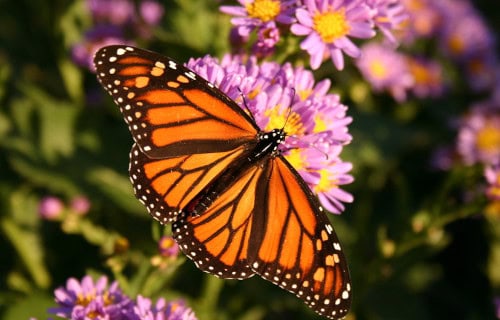
CCL: https://bit.ly/40Y7Yx7
We sincerely hope that each of you, our readers, will greatly enjoy and appreciate this article we present about these 4 Charming Lepidoptera of Chile. It was certainly our pleasure to compile the information for you. May it provide you with both education and increased awareness.
Obviously, while amazing, these few species listed herein represent only a portion of the natural wonders found throughout the region, however. Yet, it’s our belief that they serve as excellent examples of the wonders found here. Check out some of our other articles for similar marvels.
Claudina Butterfly
CCL: https://bit.ly/3v5zKHc
Claudina Butterfly Facts
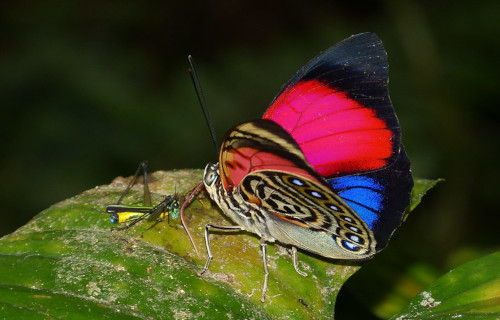
- Starting off this article about these 4 Charming Leipidoptera of Chile comes the gorgeous creature known as the Claudina Butterfly.
- This beautiful variety of Lepidoptera most frequently goes by the common name across its native range. It also has another common name that it’s known by, however. That’s because, though it’s less frequently heard, it’s also sometimes known as the Claudina agrias.
- In a comparatively uncommon pattern, both of these terms remain very similar to the formal scientific name of the marvel of Nature and evolution. That’s due to the fact that researchers commonly refer to the beautiful insect by its technical name, the Agrias claudina.
- Regardless of which of these related and similar terms one chooses to use to refer to it, one truth remains paramount. That’s the simple fact that it’s a truly beautiful species of butterfly. Interestingly, many subspecies of the invertebrate also exist, many in the same region.
- It received its technical name at the hands of the highly respected French entomologist, Jean-Baptiste Godart. The respected researcher made the original recognition of it as a separate and distinct species. This action took place as a result of his research, in the year 1824.
- For the moment, this bilogical wonder appears to be maintaining a sufficient and stable population base. That fact further seems to hold true throughout its range. Therefore, the IUCN has no listing for the Claudina Butterfly on its Red List of Threatened Species.
- Local governments and organizations nevertheless consider the invertebrate to be Threatened, due to several factors. Given where it lives, habitat loss clearly represents an ever-present danger. The ongoing process of climate change also represents a potential threat to it.
CCL: https://bit.ly/2TJx30M
Claudina Butterfly Physical Description
The breathtaking Claudina Butterfly is a truly dazzling species of Lepidoptera. Although best known for its extreme visual appeal, this marvel also qualifies as impressive for yet another reason. That’s the fact that, along with that beauty, the creature also attains a highly respectable physical size.
Total wingspan varies significantly between individuals, as with many related species. In its case, however, that variation has nothing to do with gender. Overall, though, a wingspan for a mature adult varies from about 2.8 – 4.7 in (7 – 12 cm). That’s an impressively large size for for a butterfly.
In terms of its overall general appearance, however, the insect mafiests only a very small degree of sexual dimorphism. The sole exception to this remains the presence of prominent yellow tufts on the hindwings of the males. These are special scales that release pheremones to attract females.
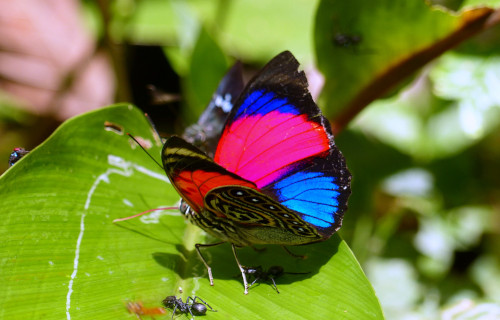
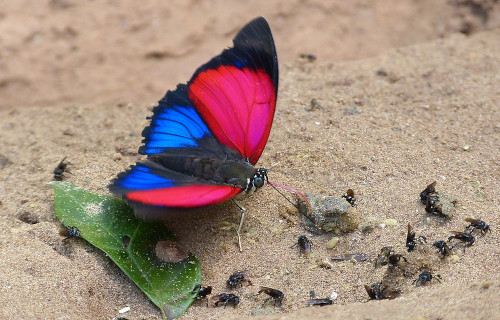
The upperside of the wings of this natural wonder present a magnificent view. More precisely, these delicate appendages typically present as dark black, with brilliant crimson red patches showing on the forewings. The fascinating insect also generally manifests very small patches of blue.
The underside of the wings of the Claudina Butterfly, though, display a markedly different pattern than the upperside. This part of the anatomy of the invertebrate presents a visually striking combination of colors and patterns. Overall, though, the colors include red, blue, black, and gold.
- Kingdom: Animalia
- Phylum: Arthropoda
- Class: Insecta
- Order: Lepidoptera
- Family: Nymphalidae
- Genus: Agrias
- Species: A. claudina
CCL: https://bit.ly/353cj6A
Claudina Butterfly Distribution, Habitat, and Ecology
Fortunately, both for the magnificent Claudina Butterfly itself, as well as those of us who appreciate Nature, the insect inhabits a moderately large section of the surface of the globe. That’s due to the fact that it appears in the approximate northern half of the continent of South America.
More precisely, its habitat range begins in the far northern portion of the continent, with it mainly appearing in the countries of Guyana and Venezuela. From there, the marvelous Arthropod additionally extends its known zone of habitation as far as the western-central country of Bolivia.
Within that relatively extensive range, however, the habitat preferences displayed by the captivating butterfly reduce its potential areas of habitation somewhat. That’s due to the fact that all of the observed individuals only appear at altitudes ranging from around 656 – 1,969 ( 200 – 600 m).
Throughout that entire area, though, the marvelous Lepidoptera appears in both primary and secondary regions of rainforest. The nature of this ecosystem provides the gorgeous invertebrate with everything that it needs. It further spends the majority of its time high the in thick canopy.
Individuals of the amazing species generally only descend to the lower heights to feed. When they do, however, they typically find their choice of food in abundance. That’s because the adults usually feed on either decomposing fish, or on various rotting fruit that has fallen to the forest floor.
After mating, the female Claudina Butterfly lays her eggs on the leaves of food plants She generally does so placing just one egg per plant. After hatching, the larvae feed nocturnally, and rest on the twigs of the food plant by day. When formed, the chrysalis hangs from the same food plant.
White Witch Moth
CCL: https://bit.ly/2JMectJ
White Witch Moth Facts
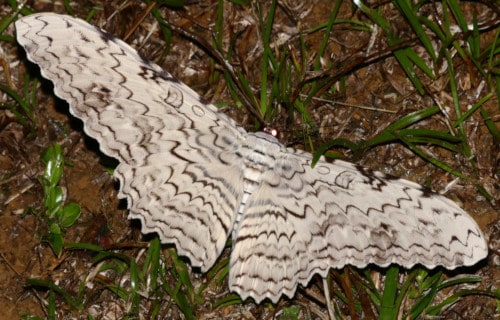
- Next up in this compilation of 4 Charming Lepidoptera of Chile we present you with the incredible invertebrate named the White Witch Moth.
- Perhaps most notably, the this descriptive term serves as the common name for one of the largest Lepidoptera in the world. This marvelous insect also holds several other general titles, though. These include the optional terms of Ghost Moth and Great owlet moth.
- Within scientific circles, however, it’s perhaps much better known by its entirely technical designation. Unfortunately, that one’s somewhat difficult for the layperson to pronounce. That’s because this marvel of Nature holds the official moniker of Thysania agrippina.
- The memserizing product of evolution received that particular epithet due to the efforts of Peiter Cramer. The highly respeced Dutch entomologist recorded the first formal recognition of it as a separate and distinct species. He achieved that noteworthy deed in the year 1776.
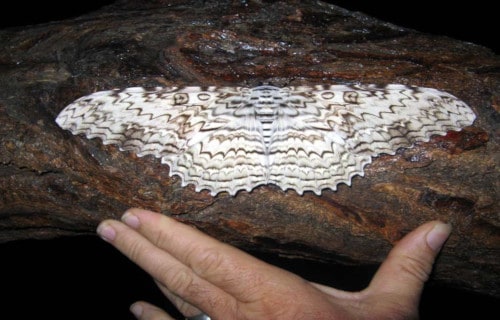
- This remarkable creature stands out in the annals of science for a most spectacular reason. It possesses the broadest wingspan of any known insect on the planet. One studied specimen displayed a set of wings that, when extended, measured nearly 12 in (30 cm) across!
- For the moment, the IUCN does not have a listing for the breathtaking White Witch Moth on its published Red List of Threatened Species. This occurs partly because of the relatively wide distribution of the insect. Many experts nonetheless consider it to presently be at risk.
- That’s at least partially due to a significant reduction of its natural habitat. Sadly, that further holds true throughout the entirety of its established range. It must also be considered to be at risk due to the effects of climate change, though. In that it mirrors many other creatures.
CCL: https://bit.ly/3e2FaLw
White Witch Moth Physical Description
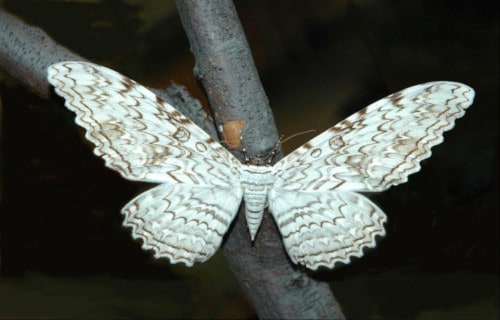
The first thing the majority of those individuals who spot it notice about the extraordinary White Witch Moth is its incredible beauty. That fact’s certainly quite understandable, of course. However, the lovely Lepidoptera also equally deserves full attention for its extremely large size.
The fabulous Arthropod also follows a pattern of development mirroring that of many species around the world, including its many relatives, as well as numerous other insects. That’s the fact that it displays a certain degree of the physiological characteristic known as sexual dimorphism.
Some of the earth’s fauna manifest this trait in terms of appearance alone. Others, however, do so purely in respect to physical dimensions. Still more manage to combine the two in the presentation of gender-based distinction. In its case, though, it does so solely in overall physical appearance.
Its wings frequently reach a span measuring as much as 12 in (30 cm). Overall, the upper side of the wings of both sexes displays either a creamy white or light brown in color. Several black and brown lines additionally zigzag across the wings. The underneath, however, appears differently.
This part of the large yet delicate wings mainly shows a vivid violet-black, along with white spots and markings. The males of the White Witch Moth, though, tend to have more patterns, as well as a white spot on the forewings. This minor difference is what visually distinguishes the genders.
- Kingdom: Animalia
- Phylum: Arthropoda
- Class: Insecta
- Order: Lepidoptera
- Family: Erebidae
- Genus: Thysania
- Species: T. agrippina
CCL: https://bit.ly/2VcMYSe
White Witch Moth Distribution, Habitat, and Ecology
Most fortunately, the magnificent White Witch Moth inhabits a relatively broad portion of the surface of the world, compared to the majority of Lepidoptera. That partly holds true due to the fact that the Arthropod occurs in a range that begins in southern Mexico, in North America.
Following that natural pattern, however, its native territory expands dramatically. In fact, this extends through all of Central America. After that, it also reaches all the way to the northern sections of the continent of South America. This remains among the greatest of ranges for a moth.
Quite lamentably, entomologists do not presently know a great deal about some facets of the life of this beautiful and intriguing insect. Some facts about its native habitat, however, have been noticed. For one, the marvelous creature appears to be extremely adaptable to different habitats.
That’s because the wonder’s been observed in regions formed of rainforest, temperate forests, open grasslands, rural areas, and even within the confines of a city. One key factor about the ecology of the gorgeous and somewhat mysterious White Witch Moth does present itself, however.
That’s the fact that the caterpillar form of this species predominantly feeds on the India-rubber tree. This occurs because that’s where the female lays her eggs. This has the effect of limiting the areas in which eggs are laid. The leaves of these select plants the caterpillars consume voraciously.
Monarch Butterfly
Monarch Butterfly Facts
- Our next choice for inclusion in this listing of these 4 Charming Lepidoptera of Chile bears the fitting designation of Monarch Butterfly.
- This truly breathtaking creation of Nature and evolution most frequently goes by the well deserved name we’re using for it herein. The wonder has several other less often used titles, though. These include such terms as common tiger, wanderer, and black-veined brown.
- Inside of scientific communities, however, it’s possibly better known by its purely official moniker. Fortunately for the layperson, that’s a comparatively simple title, as such things go. That’s because this marvelous Lepidoptera bears the official name of Danaus plexippus.
- The invertebrate received that name due to the efforts of the esteemed Swedish zoologist, Carl Linnaeus himself. He recorded the first recognition of the creature as a separate and distinct species. The researcher accomplished this scientifically noteworthy feat in the year 1758.
- Interestingly, a total of three species actually bear the same general appellation. The specific creature referred to in this article, though, remains by far the best known and most commonly referred to. A total of six acknowledged subspecies of the insect also exist across the globe.
- The gorgeous Monarch Butterfly inhabits a moderately large territorial range. It also engages in impressive seasonal migrations. Sadly, the amazing beauty now finds itself in danger. Accordingly, the IUCN thus lists it as Endangered on its Red List of Threatened Species.
- It now faces many threats to its continued existence as a species. That’s true in both short and long term. Most of these, though, stem from human activities. Human herbicide use has killed much of its food source. It also now faces the same threat of climate change as we all do.
Monarch Butterfly Physical Description
The captivating Monarch Butterfly fully merits appreciation by those individuals fortunate enough to encounter it. Unlike some of its many relatives, though, it does so for several reasons. Its sheer beauty certainly qualifies as one factor. Yet it also boasts some impressive statistics in terms of size.
This gorgeous animal does follow one pattern that’s common among its kind, as well. That’s due to the fact that the insect displays a degree of sexual dimorphism. In its case, this physiological trait manifests itself in terms of both size and appearance. As the very name implies, its quite regal.
Physically, males of the species attain a slightly greater average wingspan than their female counterparts. But this specific gender also displays a noted difference in terms of its appearance. It’s a very minor one, though. On one vein on each hindwing of the males, a tiny black spot displays.
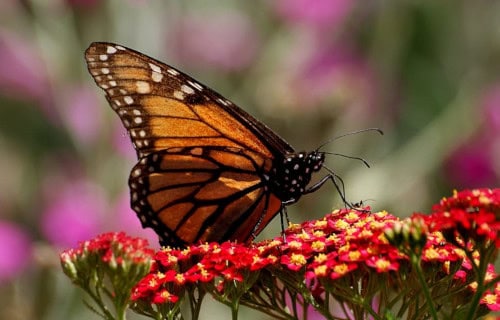
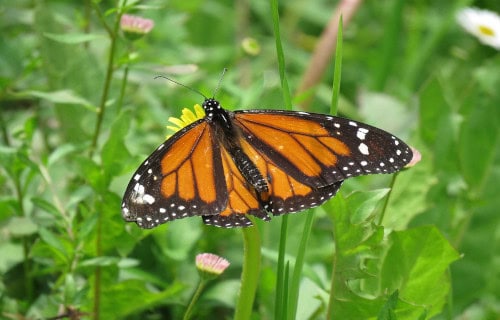
Otherwise, the two genders of the magnificent Arthropod present an extremely similar structure. The wings of both sexes reach an average width of approximately 3.5 – 4 in (8.9 – 10.2 cm). The body, meanwhile, develops as elongated, mostly black, except for a few white spots on the head.
It’s the wings of the aptly-named Monarch Butterfly that typically garner the most attention, however. The uppersides of these appendages typically show a tawny orange hue. The veins of the wings also show black, along with the margins. Two series of small white spots also line those edges.
The forewings additionally evolved to manifest small orange spots near the tips. The underside usually displays very similar, but not completely identical patterns. Their hindwings are yellowish brown, with large white spots. Its forewings also manifest the same coloring pattern on the tips.
- Kingdom: Animalia
- Phylum: Arhropoda
- Class: Insecta
- Order: Lepidoptera
- Family: Nymphalidae
- Genus: Danaua
- Species: D. plexippus
Monarch Butterfly Distribution, Habitat, and Ecology
The stunning Monarch Butterly evolved as native to a relatively broad swathe of the surface of our world. The sheer scope of that zone of habitation might surprise some people, though. That’s true since this insect marvel appears in parts of both the Northern and Southern Hemispheres.
Part of that extends all the way from southern Canada, in North America, to southern South America. It’s also found in Hawaii, Bermuda, the Cook Islands, and other islands in the Caribbean. From there, the insect also appears from Australia to the Philippines, and as far as Morocco.
This wonder of Nature and evolution developed as mainly present in several specific habitat types. Yet it nonetheless displays some degree of versatility and adaptability. Most examples, however, make their home in regions consisting of meadows, grasslands, praries, and along roadsides.
Most examples of the wonder further display a strong preference for the presence of other determining factors. These include such things as proximity to smaller streams, and areas of sufficient sunlight. The awesome creature also prefers the presence of sufficient roosting plant life.
The magnificent Monarch Butterfly also remains world famous for its massive seasonal migrations. A majority of the population migrates to a singly location in Mexico for the winter. Following this, the female lays her eggs during the return trip. These she places on the underside of leaves.
Those eggs most commonly appear on the foliage of milkweed plant. Despite their extreme toxicity to most species, the larvae of this butterfly consume them vorcaciously. Adults typically live 2 -5 weeks. During that time, they too consume vast quantities of nectar from a wide variety of flora.
Black Witch Moth

CCL: https://bit.ly/1xMszCg
Black Witch Moth Facts
- Closing out this compendium of 4 Charming Lepidoptera of Chile comes the stunning large insect named the Black Witch Moth.
- This visually stunning work of art probably remains best known by the common name of the Black Witch Moth. In other languages, though, this marvel’s typically much better known by such other terms as La Sorcière Noire, in French, and Mariposa de la Muerte, in Spanish.
- Its official scientific name, however, remains that of the tongue-twisting Ascalapha odorata, one hard for the layperson to pronounce. By whichever term one chooses to refer to it, though, its stands apart from many of its related species. It also does so for more than one reason.
- The impressive invertebrate also owes its place in the annals of entomology due to the actions of someone well known in the field. That’s because the highly respected Swedish entomologist, Carl Linnaeus made the first formal recognition of it as a species, back in the year 1758.
- Unfortunately, in some cultures within a part of its greater range, it has also long been associated with either misfortune or death in superstition. The precise reason for this, however, eludes most modern researchers. The reputation is, of course, completely unfounded.
- Fortunately, the marvelous Black Witch Moth also appears to be maintaining a population base that’s both stable and sufficinet. The IUCN, therefore, currently has no listing for the beautiful insect on the organizations Red List of Threatened Species of Threatened Species.
- Despite this fortunate situation, though, the wonder of Nature and evolution must be considered to be facing at least some potential risk. This holds true due to a combination of two factors. Throughout its range, both habitat loss and climate change continue to escalate.

CCL: https://bit.ly/1xMszCg
Black Witch Moth Physical Description
Most of its numerous relatives around the world seem content to impress observers based on one trait alone, but not the magnificent Black Witch Moth. That’s because this Lepidoptera merits appreciation due to both its appearance and size. This insect shines in terms of both attributes.
Like many of those kindred creatures, this awesome Arthropod displays the physiological trait of sexual dimorphism. In its specific case, however, it manifests this trait in two separate ways. Those ways, not surprisingly, happen to be in terms of both its sheer wingspan and uniqueness.
It’s in terms of sheer wingspan, though, that it displays its gender-based difference in the fact that males typically develop a lesser span than females. The larger females, though, sometimes attain a truly incredible width. More precisely, their wings can span as much as 6.7 in (17 cm) across.
The sex-based differences presented by the stunning Black Witch Moth also present themselves in terms of coloring. Females of the species, in addition to being slightly larger, also develop a notably lighter color. The males, meanwhile, predominantly present a much darker black background.
Both genders of this invertebrate additionally develop one specific shared trait. That’s the presence of a light brown on the dorsal part of the wings. This is frequently accompanied by a mottling of almost iridescent shades of pink and purple. Females, however, sometimes show a thin white bar.
- Kingdom: Animalia
- Phylum: Euarthropoda
- Class: Insecta
- Order: Lepidoptera
- Family: Erebidae
- Genus: Ascalapha
- Species: A. odorota

CCL: https://bit.ly/3jeHh2c
Black Witch Moth Distribution, Habitat, and Ecology
The breathtaking Black Witch Moth possesses yet another natural attribute fully worthy of respect. That’s the fact that it evolved as indigenous to a comparatively broad section of the globe. This range, in fact, extends through portions of both the Northern and Southern Hemispheres.
More precisely, the southern end of that territorial range extends as far to the south as the country of Argentina, in South America. From there, its territory extends northward, through Central America, Mexico, and into the southern portions of the United States, in North America.
During the late Spring and Summer seasons, the marvelous Arthropod typically migrates northward. It sometimes even does so over incredibly vast distances. At this time, it usually moves from Mexico to the continental United States. A few scattered individuals have been even seen in Hawaii.
Like most animals, it displays decidedly strong and clear preferences regarding its choice of habitat. It favors tropical and subtropical environments, especially areas with dense vegetation. It’s usually found in areas of woodlands, forests, gardens, and agricultural areas where host plants appear.
In terms of its basic nature, the stunning moth evolved as primarily nocturnal, like most. It therefore most commonly forages for its food at night. Interestingly, adult specimens most frequently feed on overripe fruit, usually bananas. The larva also generally consumes plant leaves voraciously.
As with most recognized species of Lepidoptera, its adult life cycle evolved to be extremely short. A typical lifespan for the fabulous Black Witch Moth usually equals no more than a few weeks. Meanwhile, being nocturnal, its principal predators typically include various types of owl and bats.
4 Charming Lepidoptera of Chile
We sincerely hope that each of you thoroughly enjoyed reading, and hopefully learning something from, this article we’ve written about these 4 Charming Lepidoptera of Chile. It’s also our hope that doing so has left you with either a new or renewed appreciation for such wonders of Nature.
Unfortunately, however, many of their kindred around the world now find themselves facing strong threats to their continued existence as a species. Many of those dangers, in fact, stem from the actions of mankind. We must all do everything that we can to protect and preserve them all.
Check out our other articles on 4 Fabulous Geological Features of Texas, Earth’s 7 Mightiest Rivers, 3 Remarkable South American Reptiles, Wonderful Wild Cats of the World










Leave a Reply