We sincerely hope that each of you, our readers, will greatly enjoy and appreciate this article we present about these 5 Incredible Mammals of Iceland. It was certainly our pleasure to compile the information for you. May it provide you with both education and increased awareness.
Obviously, while amazing, these few species listed herein represent only a portion of the natural wonders found throughout the region, however. Yet, it’s our belief that they serve as excellent examples of the wonders found here. Check out some of our other articles for similar marvels.
Mountain Hare
CCL: https://tinyurl.com/462rnnjn
Mountain Hare Facts
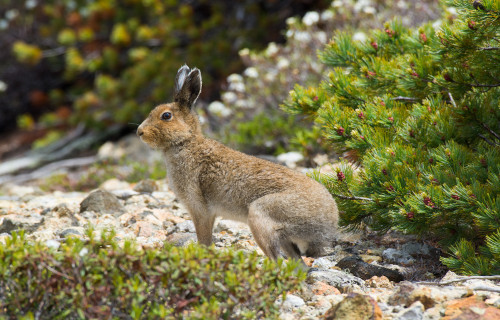
- Starting off this article about these 5 Incredible Mammals of Iceland comes the beautiful small creature named the Mountain Hare.
- This beautiful small mammal most frequently goes by the informative common name for good reasons in much of its range. Yet, the wonder of Nature does have several other general titles. These include tundra hare, blue hare, white hare, Irish hare, and alpine hare.
- Within the scientific community, however, the mammal’s possibly significantly better known by its purely technical designation. Fortunately for the layperson, that’s a comparatively simple one to pronounce. That’s because the marvel holds the official epithet of Lepus timidus.
- This beautiful creature received that designation due to the efforts of Carl Linnaeus himself. The highly esteemed Swedish researcher recorded the first acknowledgement of it as a separate and distinct species. He achieved that scientifically noteworthy deed in the year 1758.
- Thankfully, the remarkable Mountain Hare appears to be maintaining a population base that’s both stable and sufficient. This pleasant state also seems to hold true across its entire range. The IUCN thus currently shows it as Least Concern on its Red List of Threatened Species.
- The gorgeous animal nevertheless still faces the same potential threats to its continued existence as all species on earth today. Like the rest of us, most of those stem from the actions of man. They include the closely related perils of habitat loss and ongoing climate change.
CCL: https://tinyurl.com/bdes27an
Mountain Hare Physical Description
The amazing Mountain Hare, like many of its numerous relatives across the globe, captures the attention of most people lucky enough to encounter it. This specific example of its kind, though, does so for several reasons. That’s true since it’s not just lovely, but also slightly larger than average.
In regards to purely physical measurements, this beautiful creature follows the same evolutionary path as its countless brethren. That’s demonstrated by the fact that it displays a certain degree of the phsyiological characteristic of sexual dimorphism. In its case, though, it’s a small amount.
Technically, males of the species tend to achieve slightly greater average sizes than females. The total difference, however, remains so slight as to not always easily discernible without close examination. In general, males and females of this mammal thus exhibit similar characteristics.
In terms of overall length, individuals of both genders reach approximately the same mean range of head-and-body measurement. This trait varies somewhat, though, from about 18 – 26 in (45-65 cm). The short, relatively bushy tail also adds an average of about 1.5 – 3 in (4 – 8 cm) to this.
Body masses sometimes vary more noticeably between the sexes, however. Taken together, this aspect of the animal generally ranges from 4.5 – 11.75 lb (2 – 5.3 kg). On this scale, females typically tend to be on the higher end, while their male counterparts most commonly appear on the lower.
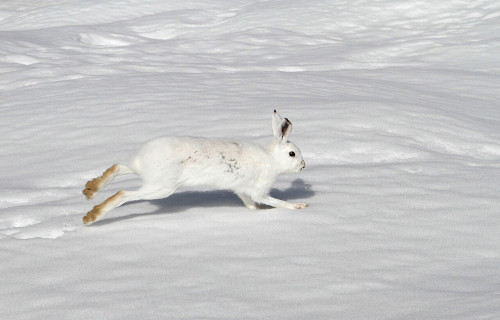
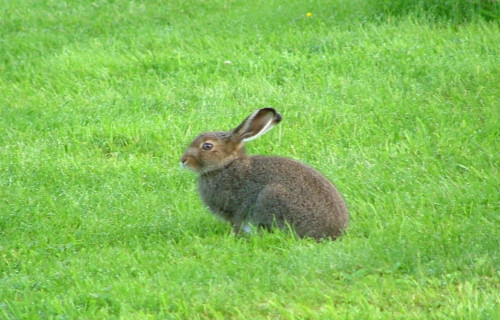
Yet, it’s doubtless the literally eye-catching coloring of the gorgeous Mountain Hare that usually garners the most interest among observers. During the summer months, this consists of various shades of brown. In winter, however, this changes to pure or mostly pure white for camouflage.
Otherwise, the stunning hare also possesses comparatively long, distinctive ears, often black-tipped. Its eyes develop as large and round, positioned on the sides of its head to provide a wide field of vision. Its feet also have a dense covering of fur, and the hind feet grow larger than the front.
- Kingdom: Animalia
- Phylum: Chordata
- Class: Mammalia
- Order: Lagomorpha
- Family: Leporidae
- Genus: Lepus
- Species: L. timidus
CCL: https://tinyurl.com/33psz7af
Mountain Hare Distribution, Habitat, and Ecology
The delicate marvel known as the Mountain Hare evolved as native to a relatively broad expanse of the surface of the earth. That large zone of habitation in fact covers a large portion of the Northern Hemisphere, in fact. Lamentably, however, its concentrations still remain rather scattered.
Luckily, it’s still widespread across much of Eurasia. The mammal inhabits regions from Scandinavia to Eastern Siberia, including countries such as Norway, Sweden, Finland, Russia, and Eastern Europe. It’s also found in Scotland and Ireland. In Asia, it’s also seen in China, and Mongolia.
Nature further blessed this natural wonder with a moderate degree of flexibility regarding its choice of habitat. It’s therefore found in a wide variety of habitats within its territorial range. These do, however, tend to share certain traits that the animal clearly prefers in its place of residence.
As its very name implies, this wonder of Nature and evolution obviously favors upland and mountainous areas. In these locations, the wonder seeks out habitats with a favorable mix of open spaces and cover. This includes such settings as heathland, moorland, alpine meadows, and tundra.
While it principally prefers open areas, the small mammal also requires at least some vegetation cover for shelter and protection from predators. It frequently appears in locations hosting sparse shrubs, grasses, heather, and various other low vegetation where it’s possible to both hide and nest.
Given its demonstrated preference for mountainous regions, altitude also plays an important factor in its selection of where to live. The amazing hare evolved as perfectly adapted to colder climates and often shows up at elevations ranging from sea level to over 9,800 ft (3,000 m) above that.
Given its very nature, the wondrous Mountain Hare also evolved as herbivorous in nature. The precise compostion of its diet varies, though, depending on the nature of the precise region of each individual. In some areas, this largely consists of grasses, while in others it’s mostly twigs and bark.
The hare’s also crepuscular, meaning it’s most active during the periods of dawn and dusk. It’s known for its amazing agility and speed, used to evade predators. During the day, it usually rests in forms, shallow depressions in the ground or under vegetation, where it remains well hidden.
Breeding season for this remarkble animal occurs from the month of January to August, with peak activity occurring in spring and early summer. Females generally give birth to litters of young known as leverets, which, intriguingly are born fully furred, and with their small eyes completely open.
Harbor Porpoise
CCL: https://bit.ly/2zR74up
Harbor Porpoise Facts
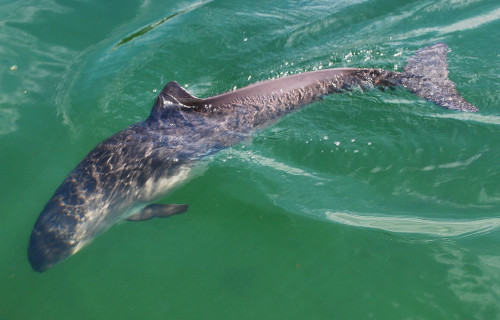
- Next up in this compendium of 5 Incredible Mammals of Iceland we present the remarkable creature best known as the Harbor Porpoise.
- Perhaps most notably, this relatively short term serves as the most frequently used of the common names for a stunning marine mammal. Like many species, though, the stunning creature also goes by a variety of other names, in various portions of its native range.
- These alternate terms include such diverse appelations as the nise, and, for unknown reasons, the somewhat humorous name of the puffing pig. Its official, scientific name, however remains that of the somewhat unique, and rather hard to pronounce, term of Phocoena phocoena.
- Regardless of which name one chooses to use to refer to it, though, this magnificent creature currently represents one of only six or seven known surviving species of porpoise. The current discrepancy occurs due to ongoing debates over whether or not one is a subspecies.
- The first known scientific description of this marvelous cetacean occurred in the year 1758. This comparatively important footnote in scientific history also holds yet another distinction. That’s because it occurred at the hands of the famous Swedish zoologist, Carl Linnaeus.
- However, the magnficent animal itself had long been known to specific portions of mankind. That awareness, in fact, dates back to ancient times. In modern our modern era, though, for the moment, the stunning Harbor Porpoise appears to be maintaining a fairly sizable population.
- The IUCN nonetheless presently lists the amazing mammal as Vulnerable. This status appears on its Red List of Threatened Species. This sad status occurs due to reasons such as concerns over the extreme vulnerability of the species to potential habitat loss and climate change.

CCL: https://bit.ly/2zR74up
Harbor Porpoise Physical Description
Although the Harbor Porpoise remains an impressive specimen of a marine cetacean, it does not earn that status due to size. Even among other porpoises, it’s smaller than average. Yet, it’s not the smallest of the recognized porpoises. That particular distinction currently belongs to the Vaquita.
This fascinating mammal additionally displays a very slight degree of the physiological characteristic known as sexual dimorphism. That remains a characteristic that the creature shares with most of its relatives. In its case, though, that natural characteristic manifests itself in terms of body mass.
That holds true since the females of this particular species manifest an average body weight equaling between 25 – 30 percent more than their male counterparts. However, both genders attain roughly the same body length. The females, therefore, have a much thicker-bodied appearance.
In fact, each of the sexes of this marvel typically reaches an average length that measures between 4.6 – 6.2 ft (1.4 – 1.9 m). In terms of weight, though, the males reach an average weight of about 134 lb (61 kg). Meanwhile, though, the notably bulkier females average a weight of 168 lb (76 kg).
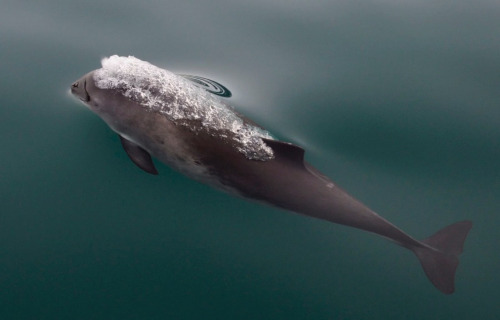
Visually, the genders appear remarkably similar otherwise. The body of the animal develops as robust, being widest near the dorsal fin. The sides display a light gray, with speckling. Yet, its tail fin, back, flippers, and dorsal fin show a dark gray. The underside, though, displays a white in color.
- Kingdom: Animalia
- Phylum: Chordata
- Class: Mammalia
- Order: Artiodactyla
- Family: Phocoenidae
- Genus: Phocoena
- Species: P. phocoena
Harbor Porpoise Distribution, Habitat, and Ecology
Quite amazingly, the beautiful Harbor Porpoise possesses a uniquely broad range of natural habitation. Despite this, it’s also simultaneously highly restricted in some ways, though. That somewhat confusing state of affairs occurs because of an extremely unique combination of factors.
For starters, the beautiful marine animal appears in certain parts of the Black Sea, the North Pacific, and the North Atlantic. Following this, however, the animal further only appears in narrow bands. These areas, as it happens, most often extend along the coastal regions of the continents.
The greatest concentration of its population appears along the coasts of northwest Europe. Its very name provides an indication of its habitat. That’s due to the fact that the cetacean only appears in shallow waters, often near, or even in, various harbors and bays in its region of habitation.
In point of fact, this captivating mammal rarely dwells in waters having a depth measuring greater than 500 ft (152 m). Incredibly, the magnificent Harbor Porpoise also frequently travels regions of inland waters. This extension of its range typically includes estuaries, and even far up rivers.
Throughout the entirety of its native territorial range, it feeds on a wide variety of prey. These mainly consist of small fish travelling in schools. But, it also consumes smaller squids and crustaceans on occasion. Understandably, though, its exact prey varies depending on individual location.
Very sadly, reliable data about much of the life cycle of this fabulous creature presently remains in lamentably short supply. Yet, that limited evidence does indicate that this animal prefers to stay within a limited area. This has the regrettable effect of leaving the marvel quite vulnerable.
The fabulous creation of Nature and evolution also appears that the impressive species lives a primarily solitary life. Most often, specimens appeared either alone, or in small groups of no more than 5 individuals. It also seems to possess a relatively short lifespan, measuring only 8 – 13 years.
Arctic Fox
Arctic Fox Facts
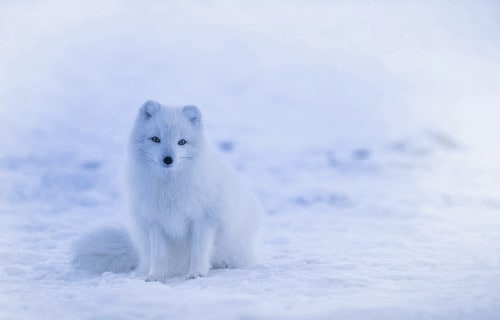
- Our next choice for inclusion in this gathering of these 5 Incredible Mammals of Iceland is the gorgeous canine known as the Arctic Fox.
- This magnificent creation of Nature and evolution most frequently goes by the descriptive and informative common name across its range. The animal has several other general names, though. These include the titles of polar fox, snow fox, and the appropriate white fox.
- Within scientific circles, however, it’s perhaps much better known by its technical name. Fortunately for the average layperson, that’s a relatively simple term, as such things go. That’s because this beautiful wild canine holds the fairly short scientific name of Vulpes lagopus.
- The mammal received that easy to pronounce name due to the efforts of the renowned Swedish zoologist, Carl Linnaeus. He achieved the first recorded acknowledgement of it as a separate and distinct species. That scientifically noteworthy deed occurred in the year 1758.
- It’s also renowned for a surprising number of reasons. One remains, of course, its sheer beauty. Another distinction it holds is the fact that it’s the only land mammal endemic to the country of Iceland. Four known subspecies of this true wonder of Nature also currently exist.
- Despite the extreme harshness of its native habitat, the Arctic Fox seems to be in relatively good shape as a species. The stunning mammal appears to have a population base that’s both sufficient and stable. The IUCN thus presently lists it as Least Concern on its Red List.
- Nevertheless, it must be considered to be facing at least some threats to its continued existence as a species. Despite being legally protected in parts of its range, illegal hunting of it persists. It also now faces the same threat of ongoing climate change as all creatures do.
Arctic Fox Physical Description
The stunning Arctic Fox clearly impresses those few individuals fortunate enough to encounter one in the wild. That’s when they can even see it, of course, given its incredible camouflage. The animal achieves that impression due more to its remarkable appearance than its sheer physical size.
That’s because, despite its other wondrous attributes, it only represents an average-sized variety of fox. It also follows another pattern common to its numerous relatives around the world. That’s true since this amazing animal displays the physiological characteristic known as sexual dimorphism.
In its specific case, this evolutionary trait manifests itself in terms of pure physical size. More specifically, males attain a larger average body size than their female counterparts. That difference, however, ranks as comparatively minor. Otherwise, the genders remain virtually indistinguishable.
The males of the species reach an average head-and-body length measuring approximately 22 in (55 cm). Exceptional specimens, however, do sometimes reach 27 in (68 cm). The females, meanwhile, grow to a mean length equaling roughly 20 in (52 cm), excluding the fluffy tail, of course.
In both sexes of the breathtaking Arctic Fox, the tail develops as relatively long compared to the body. This appendage reaches an average length of 12 in (30 cm). The animal also grows to 9.8 – 11.8 in (25 – 30 cm) at the shoulder. Males average 7.7 lb (3.5 kg), while females average 6.4 lb (2.9 kg).
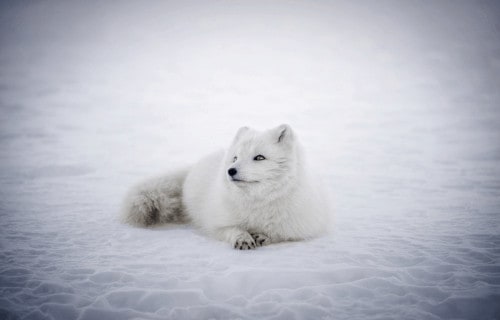
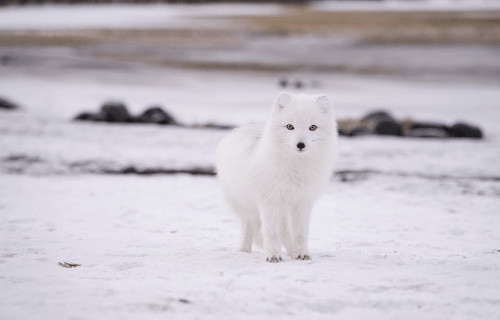
Yet its the undeniably mesmerizing coloring of the animal that typically garners the most attention. Although the young display dark colors, this changes quickly to a dazzling white as they mature. This shade covers the entirety of the body, all the way to the tip of the captivating animal’s tail.
- Kingdom: Animalia
- Phylum: Chordata
- Class: Mammalia
- Order: Carnivora
- Family: Canidae
- Genus: Vulpes
- Species: V. lagopus
Arctic Fox Distribution, Habitat, and Ecology
The beautiful Arctic Fox evolved as native to a surprisingly large region of the surface of the world. As its very name implies, this zone of habitation includes the Arctic Circle. But it’s not restricted to that area, though. It appears in the more northern portions of Europe, Asia, and North America.
That range even includes such extremely isolated locations as Iceland, Greenland, Svalbard, and other islands located in the Barents Sea. In Canada, it appears as far south as Hudson Bay. The animal was also previously introduced to the Aleutian Islands southwest of the state of Alaska.
Its habitat consists almost exclusively of regions of Arctic tundra. The biological wonder also favors sections of pack ice. The animal does manage to survive in a few other habitats, though. These mainly include boreal forests in such places as the Kenai Peninsula and several in Canada.
Within this type of environment, the intrepid canid also appears at a surprising range of altitudes. Many observed individuals live at altitudes of up to 9,800 ft (3,000 m) above sea level. Other specimens, though, have been spotted on collections of sea ice very close to the North Pole itself.
Protected by its warm, dense fur, the perfectly adapted Arctic Fox evolved as a pure predator. It feeds opportunistically, consuming virtually any prey it finds. This nourishment typically includes such species as voles, lemmings, birds, hares, eggs, small fish, and even carrion when available.
Intriguingly, it possesses very few known natural predators itself, despite its comparatively small size. The few creatures that do routinely prey on it include wolves, bears, and golden eagles in some parts of its range. In the wild, few examples live even one year, but some live as long as 11 years.
Common Bottlenose Dolphin

Common Bottlenose Dolphin Facts
- Now appearing in this compilation of 5 Incredible Mammals of Iceland we give you the other cetacean, the Common Bottlenose Dolphin.
- This magnificent ocean-dwelling creation of Nature and evolution generally goes by the intriguing name due to multiple logical reasons. It does have a very similar alternate general name, though. That’s the informative moniker of Atlantic bottlenose dolphin.
- Within scientific circles, however, it’s perhaps much better known by its purely technical title. Fortunately for the layperson, that’s the relatively easy to pronounce term of Tursiops truncatus. No matter which term one chooses, it remains a beautiful and impressive creature.
- It received that official designation due to the efforts of the highly respected English naturalist, George Mantagu. He accomplished the first recorded acknowledgement of it as a completely separate and distinct species. This scientifically noteworthy act occurred in the year 1821.
- The animal’s common name suits it perfectly, as it’s possibly the most numerous, widespread, and best-known of all its kin. It also has what may be the most extensive zone of habitation of its relatives. Sadly, the mammal’s also the most popular in marine parks and aquariums.
- Unlike a great many others of its kind, the Common Bottlenose Dolphin seems to be maintaing a sufficient population base. That further appears to hold true throughout the entirety of its known range. The IUCN therefore currently list it as Least Concern on its published Red List.
- The animal nevertheless does face potential threats to its existence, at least. In this, the same dangers exist as for other marine species. These include such factors as active hunting and accidental bycatch. Doubtless, though, its greatest threat continues to be climate change.

CCL: https://bit.ly/3n3PXy5
Common Bottlenose Dolphin Physical Description
One way in which the majestic Common Bottlenose Dolphin distinguishes itself from other dolphins around the world is sheer size. That’s due to the fact that this wonder of Nature ranks as the largest of all known beaked dolphins. That’s an extremely impressive claim to fame.
The marine marvel does follow the same pattern as other many other cetacea, though. That’s because the fabulous animal fully displays a moderate degree of the physiological trait of sexual dimorphism. In its specific case, this trait manifests itself in terms of simple physical size.
Males of the species generally attain a greater length and body mass than their female counterparts. In most instances, though, the difference isn’t greatly significant. Overall, both measurements vary significantly, often following different ranges. This tendency includes both genders, as well.
As a general rule of thumb, however, recorded individuals reach a length measuring somewhere between 6.6 – 13.1 ft (2 – 4 m). Weights also naturally vary accordingly. This ranges from 330 – 1,430 lb (150 – 650 kg). Exceptional specimens do occur, though, in both categories, regardless of gender.
In terms of coloring, the aptly-named Common Bottlenose Dolphin presents a nearly uniform gray shade. Slight variations on this theme occasionally present themselves in individuals, however. Upon close inspection, however, many present a slightly lighter shade on the underside of the body.
The amazing cetacea further possesses a comparatively short, well-defined nose. Often compared to a bottle, this serves as the source of the common name. Its neck evolved as more flexible than its cousins, too. That’s because five of their seven vertebrae aren’t fused, unlike other dolphins.
- Kingdom: Animalia
- Phylum: Chordata
- Class: Mammalia
- Order: Artiodactyla
- Family: Delphinidae
- Genus: Tursiops
- Species: T. truncatus
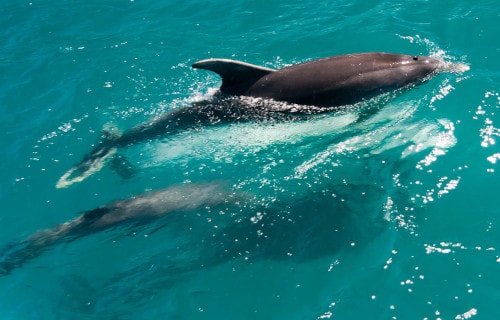
CCL: https://bit.ly/3FBbOU0
Common Bottlenose Dolphin Distribution, Habitat, and Ecology
Thankfully, the Common Bottlenose Dolphin evolved as native to a truly extensive natural range. In fact, thhis creature lives in marine waters across much of the globe. Incredibly, this mammal makes its home in every portion of the planet’s oceans, with the sole exception of the polar regions.
This means the water-based wonder remains equally at home in either tropical, subtropical, or temperate marine regions. Experts presently estimate its current global population to be roughly 600,000. It also migrates great distances, either individually or in groups of various size
Intriguingly, groups of the captivating cetacean live in collections both near the shore and further out to sea. In this repsect, the two differing concentrations display differing habitat preferences. Those diverse populations living further out tend to undertake the more significant migrations.
Those members of the species residing closer to shore typically migrate less often, and for shorter distances than the others. These same specimens also easily adapt to warm, shallower waters. This frequently includes such varied areas as lagoons, estuaries, bays, and even many harbors.
Again following the pattern established by its many kindred, the Common Bottlenose Dolphin lives as a very social species. Most known examples live in small groups called pods. These groups average 15 in number, but sometimes exceed 100 members. Lone individuals rarely occur.
Its diet typically consists of shrimp, squid, eels, and a wide range of fish species. The mammal hunts using echolocation, and does so effectively. The pods often hunt as a team, greatly increasing their effectiveness. It has few predators of its own. These threats mainly include orcas and sharks.
Harp Seal
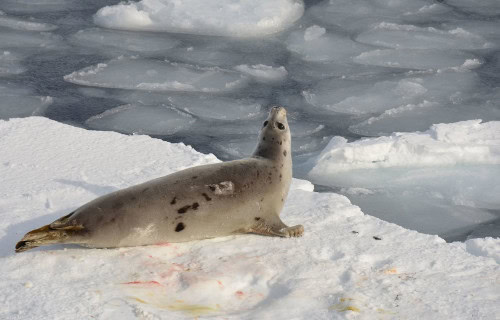
CCL: https://bit.ly/416nUwt
Harp Seal Facts
- Finishing up this article about these 5 Incredible Mammals of Iceland comes the beautiful work of nature best known as the Harp Seal.
- A true marvel of Nature and evolution, this majestic creature most frequently goes by the simple common name we’re using. It does have a few other, less often used titles, though. Those multiple alternates include the terms Greenland Seal and Saddleback Seal.
- Among scientific professionals, though, it’s more typically referred to by its current formal name. That particular moniker, however, remains extremely difficult for the layperson to pronounce. That’s true given that its official title is that of the Pagophilus groenlandicus.
- The remarkable Pinniped received that tongue-twisting appelation due to the efforts of the German naturalist, Johann Christian Polycarp Erxleben. The highly noted researcher accomplished the first official recognition of it as a separate and distinct species in 1777.
- This impressive masterpiece of Nature classifies as a variety of earless seal, otherwise known as a true seal. It also stands out for a somewhat surprising reason. That’s because this distinctive species of seal currently represents the only known extant member of its entire genus.
- Thankfully, however, the population base of the Harp Seal appears to have rebounded from the past, when it was hunted without restriction. It now has relatively stable and sizeable numbers. The IUCN thus lists the mammal as Least Concern on its Red List of Threatened Species.
- The amazing animal nevertheless still faces various threats to its continued existence as a species. This natually includes the existence of ongoing hunting practices. Yet it also must deal with the dual dangers posed by habitat loss and the ongoing effects of climate change.
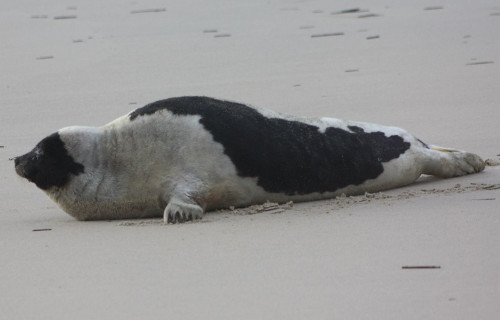
CCL: https://bit.ly/3M1DN2P
Harp Seal Physical Description
The stunning Harp Seal constitutes one of those fauna that effortlessly captures your attention when you encounter it. Unlike some species around the world, however, it does so for more than just one reason. This holds true due to the fact that it’s both beautiful and relatively sizeable.
Like the great majority of its kindred, though, it also displays a certain degree of the physiological characteristic of sexual dimorphism. In its specific case, however, the animal distinguishes itself further. For this seal, that attribute appears in terms of both size and basic appearance.
Males of this amazing mammal typically attain a slightly greater size than their female counterparts. These grow to an average length measuring approximately 6.2 ft (1.9 m). In terms of weight, the males generally reach around 298 lb (135 kg). These also end to have a larger hump on their back.
Females, meanwhile, usually reach sizes that, while smaller, aren’t significantly so. These individuals attain an average body length equaling about 5.9 ft (1.8 m). Their body mass likewise remains lighter, but, not surprisingly, not by much. They grow to an average weight of around 260 lb (120 kg).
In terms of coloring, though, both genders of the mesmerizing Harp Seal present roughly the same visual pattern. Mature specimens present a background composed of silver-gray fur, with distinctive black harp-shaped patterns on the upper back. Adults also generally have pure black eyes.
But the young of this wonder of Nature typically present a vastly different appearance. This slowly changes as the individual ages. Newborns show pure white for the first few weeks of life. During adolescence, though, this changes to a silver-gray, marked with multiple small black spots.
- Kingdom: Animalia
- Phylum: Chordata
- Class: Mammalia
- Order: Carnivora
- Family: Phocidae
- Genus: Pagophilus
- Species: P. groenlandicus
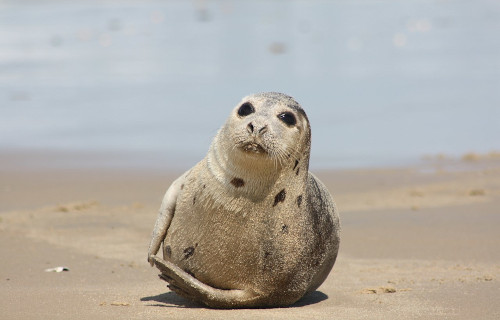
CCL: https://bit.ly/42aOg1D
Harp Seal Distribution, Habitat, and Ecology
The beautiful Harp Seal evolved as native to a moderately large portion of the earth’s surface for its kind. The precise location and nature of that zone of habitation will likely not surprise anyone, though. That’s because this marvelous species of seal lives in the upper Northern Hemisphere.
More precisely, the animal largely lives within sections of the Arctic Ocean. A smaller percentage, however, also make their home in the more northerly portions of the Atlantic Ocean, as well. For the moment, it’s unknown if it ever lived anywhere beyond that known territorial range.
Not surprisingly, given this indigenous zone of habitation, the gorgeous mammal displays decided preferences in its choice of habitat. Most specimens spend the great majority of their time in the open sea. They do spend a small portion of their lives on the surrounding ice, though.
Again following patterns common to Pinnipeds, the impressive animal lives as a highly social creature. Overall, examples typically live in extremely large colonies, often numbering in the thousands. Within this larger mass, however, smaller groups also usually form their own hierarchies.
Like most of its kind, the Harp Seal developed as a purely carnivorous species. It does have a surprisingly diverse diet, though. The creature feeds on a variety of invertebrate and fish species, totalling several dozen different species. Precise prey depends upon an individual’s location.
The animal in turn has its own fair share of predators, to be sure. Juveniles frequently fall victim to the attacks of several land-based hunters, such as wolves and Polar Bears. Mature adults, meanwhile, face attacks by various larger types of sharks, as well as Orcas across their entire range.
5 Incredible Mammals of Iceland
We sincerely hope that each of you thoroughly enjoyed reading, and hopefully learning something from, this article we’ve written about these 5 Incredible Mammals of Iceland. It’s also our hope that doing so has left you with either a new or renewed appreciation for such wonders of Nature.
Unfortunately, however, many other species around the world now find themselves facing strong threats to their continued existence as a species. Many of those various dangers, in fact, stem from the actions of mankind. We must each do everything we can to protect and preserve them all.
Check out our other articles on 5 Incredible Pacific Ocean Rays, North American Gulches and Canyons, 4 Herbaceous Plants of England, Earth’s Many Stunning Waterfalls










Leave a Reply