CCL: http://bit.ly/2xLZ0ap
We sincerely hope that each of you, our readers, will greatly enjoy and appreciate this article we present about these 5 Magnificent Mammals of the Himalayas. It was our great pleasure to compile the various information for you. May it provide you with both education and increased awareness.
Obviously, these few species listed herein represent only a small portion of the natural wonders found throughout the region, though. Yet, it’s our belief that they serve as excellent representations of the wonders found here. Check out some of our many other articles for similar marvels.
Tibetan Sand Fox
CCL: https://bit.ly/2WT7Cvg
Tibetan Sand Fox Facts
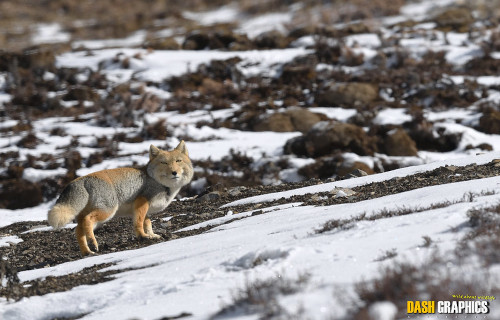
- Starting off this article about these 5 Magnificent Mammals of the Himalayas we present you with the only canine on the list, the Tibetan Sand Fox.
- With its distinctive appearance, this wild canine remains best known by the informative common name of for good reasons. Yet, it does have a few other general titles by which it’s called. These include the similar Tibetan Fox and Sand Fox, as well as the title Steppe Fox.
- Within the scientific community, however, it’s perhaps better known by its technical designation. Thankfully, that tag’s much easier for the layperson to pronounce than many such epithet. That’s because the remarkable mammal bears the formal moniker of Vulpes ferrilata.
- This marvel of Nature received that name due to the efforts of Brian Houghton Hodgson. The highly respected British naturalist accomplished the first official recognition of the animal as a separate and distinct species. He achieved that scientifically noteworthy deed in the year 1842.
- Though less known to the world at large, it’s a species of note among researchers in certain fields. That’s true since it evolved unique attributes that set it apart from others of its kind. Among the true foxes, its skull evolved as the most specialised in the direction of carnivory.
- Fortunately, the beautiful Tibetan Sand Fox appears to be maintaining a population base that’s both stable and sufficient. This pleasant state also seems to hold true throughout the entirety of its range. The IUCN therefore presently lists the canid as Least Concern on its Red List.
- The wonder nevertheless still faces numerous potential threats to its continued existence, at least. In this, it’s dealing with the same perils all forms of life on earth today must. Most of these stem from the actions of mankind, and include habitat loss and ongoing climate change.
CCL: https://bit.ly/3jxpJhU
Tibetan Sand Fox Physical Description
The impressive Tibetan Sand Fox rarely fails to capture the attention and fascination of those fortunate enough to encounter one. Yet, the mammal typically does so due more to its appearance than sheer size. In terms of that trait, it represents an approximately medium-sized variety of fox.
It also follows a patter common among most of its kindred around the world. That’s the fact that it displays a certain degree of the physiological characteristic of sexual dimorphism. In its case, however, that manifests to only a small degree, making distinguishing the sexes visually difficult.
Males of the stunning species generally attain a slightly greater body size than their female counterparts. This variation applies to both length and weight. In terms of its pattern of coloration, though, individuals of both genders present the same basic appearance to the casual observer.
Overall, the species reaches a length of body ranging from 24 – 28 in (60 – 70 cm). The tail itself adds an additional 10 – 14 in (25 – 35 cm) to this. Mature adults typically weigh between 9 – 12 lb (4 – 5.5 kg). Though exceptions do occur, males tend to measure on the higher end of both ranges.
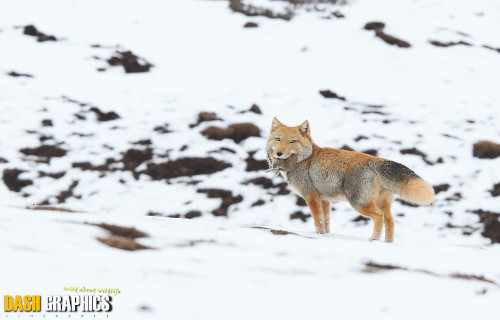
The aforementioned tail of the wild canine also usually develops as comparatively bushy in nature. Visually, it also evolved as quite prominently marked with a dark brown or black tip. The legs further augment its distinctiveness. These limbs also develop as relatively short and slender.
The most distinctive feature of the Tibetan Sand Fox, however, remains its broad, squarish face. The head manifests as large in relation to the body, and blocky, with high-set, triangular ears. The eyes appear narrow and slightly elongated, contributing to its somewhat stern, unusual appearance.
One musn’t forget its coat, though. This aspect of its physiology develops as quite dense and sandy-gray or buff-colore. This serves to provide the creature with camouflage in its natural environment. The underside, though, presents as significantly lighter, almost white or pale cream in color.
- Kingdom: Animalia
- Phylum: Chordata
- Class: Mammalia
- Order: Carnivora
- Family: Canidae
- Genus: Vulpes
- Species: V. ferrilata
CCL: https://bit.ly/3lDLmQG
Tibetan Sand Fox Distribution, Habitat, and Ecology
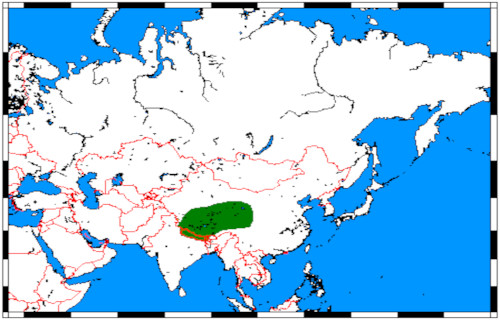
The mesmerizing Tibetan Sand Fox developed as indigenous to a moderately broad portion of the surface of the earth. That zone of habitation’s location probably won’t surprise anyone, though. That’s because the wonder of the animal kingdom evolved as native to a very specific part of Asia.
It’s mainly found across the vast expanse of the Tibetan Plateau, which covers much of Tibet. The animal also appears in China, where its range extends into the provinces of Qinghai, Gansu, and Sichuan. But, it’s also present in parts of northern Nepal, especially in the regions bordering Tibet.
Extending outward, though, it also lives in several other areas. These include India, where it lives in the Ladakh region, where the landscape’s similar to that of the Tibetan Plateau. Its range also includes portions of the Himalayan regions, as well as possibly the country of Bhutan.
This remarkable animal displays decidedly strong and clear preferences regarding its choice of habitat. Since it lives where it does, the nature of those comes as no surprise. Nature created the masterpiece as specially adapted to living its life in comparatively harsh, high-altitude environments.
Since it’s most commonly found on the Tibetan Plateau, it frequently inhabits elevations ranging from 11,500 – 17,000 ft (3,500 to 5,200 m). These high-altitude regions continually remain characterized by extremely cold, arid conditions throughout the year, and have sparse vegetation.
In some parts of its range, it often inhabits such regions as alpine grasslands and steppe ecosystems. These areas are generally dominated by short grasses, with little to no tree cover, providing the fox with an open environment including large numbers of widely scattered rocks and bushes.
It’s also found in semi-desert regions, which typically remain dry and rocky, with little rainfall or plant life. The fox’s habitat’s also marked by cold temperatures year-round, with freezing winters and mild summers. Precipitation’s usually low, and much of the water comes from snowmelt.
Like others of its kind, it evolved as carnivore. It’s also a highly specialized one, due to the nature of its environment. It primarily preys on small mammals, like pikas, which are abundant in its range. These form the bulk of its diet, but it also hunts rodents, hares, and occasionally birds and insects.
While it mainly feeds on small mammals, the mammal sometimes scavenges carrion, particularly during winter when prey’s often scarce. The species typically hunts as solitary hunters and relies on its stealth, using its keen sense of smell and sight to locate prey in the open, treeless grasslands.
The Tibetan Sand Fox itself, however, has few natural predators due to the nature of its extremely remote, high-altitude habitat. Yet, the beautiful canid does occasionally find itself threatened by a few varieties of larger predators such as Tibetan wolves and even birds of prey like golden eagles.
For breeding, it’s typically monogamous, with pairs bonding for life. These raise the pups together, sharing responsibilities for hunting and caring for the young. Both parents are involved in raising them, and the family often stays together until they’re old enough to hunt on their own.
Mating itself generally occurs in late winter, which usually happens around February. Females typically give birth to their litters in the spring. At that time, the birth generally produces between 2-4 pups, usually in underground dens, which offer protection from the cold and predators.
Bharal
CCL: https://bit.ly/1xMszCg
Bharal Facts
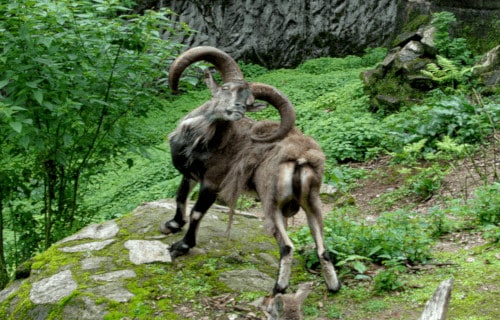
- Next up in this compilaton of 5 Magnificent Mammals of the Himalayas we give you the sure-footed beauty known as the Bharal.
- This deceptively short term easily represents the most frequently used common name for this truly remarkable mammal. The creature does possess several alternate titles by which it’s known, though. Those options include Blue Sheep, Naur, and even Himalayan blue sheep.
- Inside the halls of science, however, it’s probably much better known by its purely technical designation. That’s a comparatively simple one for the layperson to pronounce, at least compared to many others. This remains true since it holds the formal tag of Pseudois nayaur
- The impressive creation of Nature and evolution received that specific moniker due to the efforts of Brian Houghton Hodgson. The highly respected British naturalist accomplished the first official recognition of it as a separate and distinct species. He achieved that deed in 1846.
- The first serious scientific observations of this ruminant, though, did not occur until mu ch later, in 1973. Previously, this fascinating recluse of Nature had been thought to be a variety of sheep. Recent DNA analysis of the Bharal actually reveals a much closer relationship to goats.
- Interestingly, this surprising species of ruminant plays an extremely unique role in the culture of its region. The creature has long enjoyed a special relationship with the occupants of numerous Buddhist monasteries in its endemic range, who often protected the creatures.
- Sadly, however, in more recent times, concerns over Bharal-related crop damage have begun to arise in numerous portions of its natural range. This occurrence has had a most regrettable result. These events have, in fact, been putting great pressure on those who strive to protect it.
- For the moment, however, the IUCN lists this wonder of the natural world as Least Concern. This appears on the organization’s Red List of Threatened Species. Nevertheless, it must be considered to be at risk from the ongoing effects of climate change, like other forms of life.
Bharal Physical Description
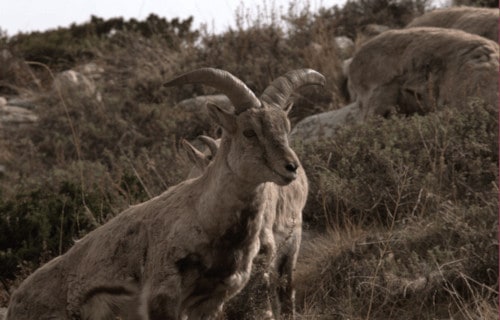
The beautiful Bharal rarely if ever fails to capture the immediate attention and appreciation of those individuals fortunate enough to encounter it in the wild. Unlike some of its relatives, though, it does so for several reasons. That’s because it’s not only lovely, but boasts respectable dimensions.
In multiple respects, it follows a pattern of natural development that mirrors that demonstrated by countless animals around the world. That’s the fact that it displays a certain degree of the physiological characteristic of sexual dimorphism. It, however, only does so to a very minor extent.
Intriguingly, the magnificent creature presents this trait solely in terms of simple size. As a general principle, males of the amazing species achieve greater measurements, in length, height, and mass. Obviously, though, exceptional individuals do sometimes occur, wholly regardless of sex.
Overall, the fascinating animal attains an average head and body length equaling approximately 65 in (165 cm). The short, relatively stubby tail adds, at most, an additional 7.9 in (20 cm) to its length. The largest individual observed to date measured roughly 36 in (91 cm) tall at the shoulder.
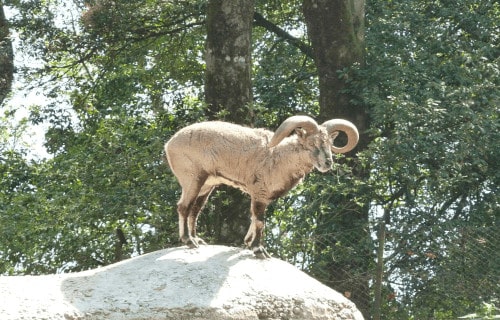
Meanwhile, the coat enthralling Bharal grows short and comparatively quite dense in nature. It also usually displays a slate gray color, commonly with a bluish sheen. The belly and part of the legs generally present an off-white color, while the chest and front of the legs usually show black.
Perhaps most surprisingly of all, both genders actually grow horns. In this manner, the awesome caprid distinguishes itself form the majority of related species. Impressively, among males, these grow to lengths of as much as 31 in (80 cm), while those of the female rarely exceed 8 in (20.3 cm).
- Kingdom: Animalia
- Phylum: Chordata
- Class: Mammalia
- Order: Artiodactyla
- Family: Bovidae
- Genus: Pseudois
- Species: P. nayaur
CCL: https://bit.ly/1p2b8Ke
Bharal Distribution, Habitat, and Ecology
The stunning Bharal also evolved as native to a harsh regionof the earth’s surface. That indigenous territory also constitutes a highly restricted portion of Asia. This range includes certain portions of what we now know as the five countries of India, Bhutan, Nepal, Pakistan, and Tibet.
Within that greater overall range, however, the attention-grabbing creature only inhabits a very specific type of habitat. For starters, it only lives on high mountain slopes. Secondly, though, the truly impressive large bovine typically lives on those that contain numerous rocky cliffs and ledges.
Safely residing within these, the animal quite effectively uses both characteristics of its environment for both camouflage and defense. Its natural coloring allows it to blend in extremely well with the coloring of the prevailing native stone. This provides it at least some protection from predators.
The intrepid Bharal also evolved remarkably good natural instincts. Individuals of this wonder rarely stray more than 650 ft (200 m) from the always present ledges and cliffs. Additionally, its highly surefooted nature commonly allows it to escape attacking predators by leaping onto tiny ledges.
The unforgettable species also holds yet another surprise for those who learn of the marvel. Within its native range, this fabulous creation of Nature actually has very few known natural predators. Unfortunately, however, it nevertheless does possess a few of them, as most creatures do.
To the knowledge of those engaged in ongoing research, its most common natural enemies primarily include the gorgeous Snow Leopard. Nonethelss, it also sometimes falls prey to human hunters. But, its main threat consists of competition from livestock for available food sources.
Snow Leopard
CCL: http://bit.ly/2xLZ0ap
Snow Leopard Facts
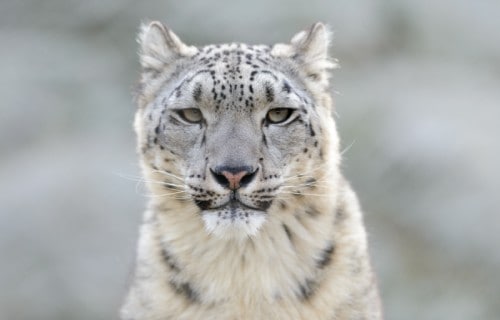
- Our next choice for inclusion in this gathering of these 5 Magnificent Mammals of the Himalayas is the breathtaking feline named the Snow Leopard.
- This breathtaking creation of Nature and evolution most frequently goes by the attention-grabbing common name across its range. Yet, the animal also has other general titles. These include Ghost of the Mountain, Mountain Leopard, and Barfani Cheetah, among others.
- Within the scientific community, however, the majestic creature’s perhaps much better known by its purely technical title. Luckily, that’s a much simpler one to pronounce than most such designations. That’s because this wonder of Nature holds the official epithet of Panthera uncia.
- Because of its majestic beauty, the gorgeous mammal presently holds a highly unique status. The stunning creature represents the National Heritage Animal in different two countries within its native territorial range. As a result, it’s now afforded a certain measure of protection.
- The amazing mammal additionally ranks among the most beautiful of the so-called big cats. It’s also the least aggressive towards humans. These stunning felines reportedly can easily driven away from livestock. The animal readily abandons its kills if approached by humans.
- Sadly, this remarkable wild feline now finds itself in danger of extinction. The IUCN lists the Snow Leopard as Threatened on its Red List of Threatened Species. For now, climate change and habitat loss represent the greatest threats to its continued existence as a species.
Snow Leopard Physical Description
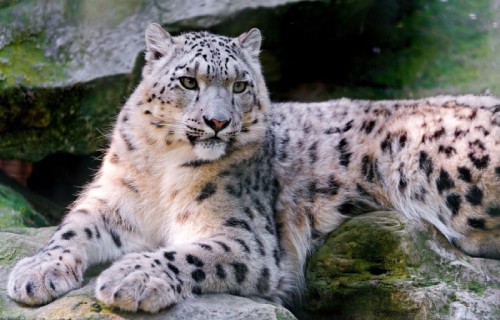
Perhaps most notably, the magnificent Snow Leopard, which never fails to captivate its viewers, differs from related creatures in an unexpected manner. This animal evolved as slightly smaller than other big cats. The body remains stocky in shape, averaging about 50 in (130 cm) in length.
This remarkable creation of Nature and evolution also achieves a usual weight of about 120 lb (55 kg). That’s notably less than most big cats. The legs of the feline also develop as relatively short. Complimenting this, the feline measures an average length of 24 in (60 cm) at the shoulder.
However, the relatively lush tail develops as quite long in relation to the body. This impressive appendage averages roughly 39 in (100 cm) in length. Intriguingly, its numerous evolutionary adaptations include the well-known stocky build, much thicker fur, smaller ears, and wider paws.
The eye-catching Snow Leopard possesses powerful leg muscles, making it capable of leaping as much as 50 ft (15.2 m). Meanwhile, its coloring varies a relatively large degree between individuals. This range of hues generally runs from a smoky gray to a tan color, with the ubiquitous spots.
These patterns serve to provide the magnificent creature with excellent camouflage within its endemic habitat. The eyes of the mammal additionally appear very distinctive, and typically develop as either a gray or pale green in color. Occasional individuals are born with a brilliant blue variant.
- Kingdom: Animalia
- Phylum: Chordata
- Class: Mammalia
- Order: Carnivora
- Family: Felidae
- Genus: Panthera
- Species: P. uncia
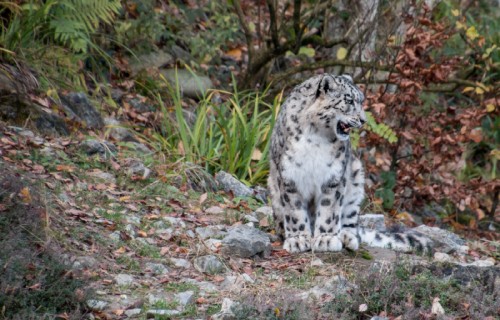
Snow Leopard Distribution, Habitat, and Ecology
The stunning Snow Leopard evolved as endemic to a somewhat limited and specific portion of the surface of the globe. More precisely, that habitat zone consists of Central and Southern Asia. Within that range, it remains restricted to the upper mountain ranges, in Afghanistan, and Pakistan.
Wherever it chooses to reside, however, the remarkable species commonly inhabits both the alpine and sub-alpine ranges. It also lives at impressive altitudes. These heights average between 9,800 – 14,800 ft (3,000 – 4,500 m). The species of big cat prefers terrain that is rocky or snow-covered.
This truly extraordinary feline further evolved a very distinct time of activity. This active period generally consists of several hours in length, occurring at or near twilight. The utterly fascinating species also evolved as primarily carnivorous in nature, and appears to be an excellent hunter.
Worth noting remains the fact that individuals typically take smaller types of prey, such as rabbits and birds. But, individuals do occasionally stalk and take prey several times their own size. This stunning animal also feeds opportunistically, even consuming carrion, when necessary.
The Snow Leopard also sets itself apart from others in one more way. It eats a larger percentage of vegetation than any other big cat. The feline leads a primarily solitary life. It usually only groups together to mate, or while a female is rearing her cubs. A typical lifespan measures 15-18 years.
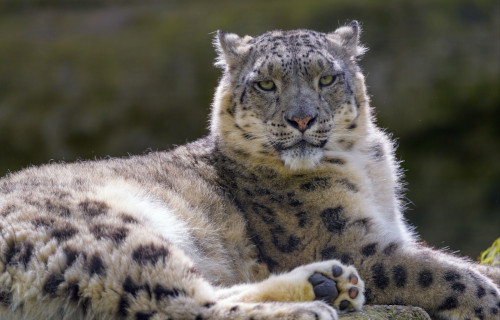
Snow Leopard Conservation Efforts
The hypnotically beautiful animal known as the Snow Leopard sadly faces the danger of extinction. Exact tallies of its numbers in the wild remain impossible to attain. This lamentable fact holds true given the remoteness of its habitat. Current estimates place its numbers at fewer than 8,700.
Fortunately, though, numerous organizations are now actively working in varying ways to preserve the fantastic species. In fact, in the year 2013, the governments of 12 of the countries the gorgeous feline inhabits signed the Bishkek Declaration, recognizing its place in regional culture
Preservation efforts of many kinds continue to remain underway, both large and small in scope, but all are greatly appreciated. The Declaration created numerous protected areas within the range the felines currently continue to inhabit. To date, a total of 23 of these protected areas now exist.
A few of these protected regions include Chitral National Park, located in Afghanistan, and Tumor Feng Nature Reserve, situated in China. Yet, still more must be done to protect it. Quite sadly, illegal poaching of the Snow Leopard still occurs, as well as a threat from ongoing habitat loss.
Yellow-Throated Marten
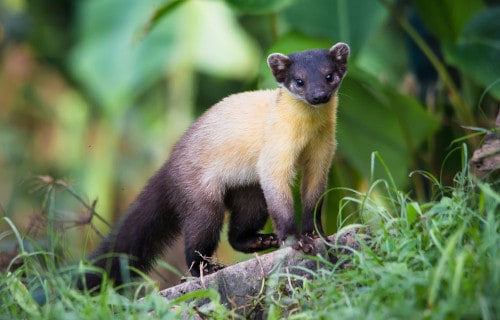
CCL: https://bit.ly/3AhK16v
Yellow-Throated Marten Facts
- Next up in this compendium of 5 Magnficent Mammals of the Himalayas we present to you the colorful creature named the Yellow-Throated Marten.
- For reasons that appear readily apparent to the oberserver, this colorful creature most frequently goes by this specific common name. That’s the english language term for the gorgeous mammal, though. It’s also known by the optional names of kharza and chuthraul.
- Professional scientists, however, such as numerous researchers, usually tend to use the official scientific name for the animal when referring to it. Fortunately, it’s a comparatively simple term, as such go. That’s because its formal name in technical circles is Martes flavigula.
- The first recorded recognition of the intriguing creature as a separate and distinct species, though, occurred back in the year1785. The Dutch naturalist and physician, Pieter Boddaert, holds the distinction of achieving this scientifically noteworthy accomplishment.
- Regardless of which term one chooses to employin reference to it, though, it’s a truly remarkable and visually impressive species. It also holds yet another distinction. That’s due to the fact that it constitutes the largest known variety of marten in its native habitation range.
- Fortunately, the Yellow Throated Marten appears to be maintaining a population base that’s both sufficient and stable. This also seems to hold true throughout the entirety of its natural range. The IUCN, therefore, list it as Least Concern on its Red List of Threatened Species.
- The remarkable creation of Nature and evolution nevertheless faces several potential threats to its continued existence, at least. Habitat loss understandably forms a possible danger, due to the expansion of man. Climate change, however, also poses a potential threat to it.
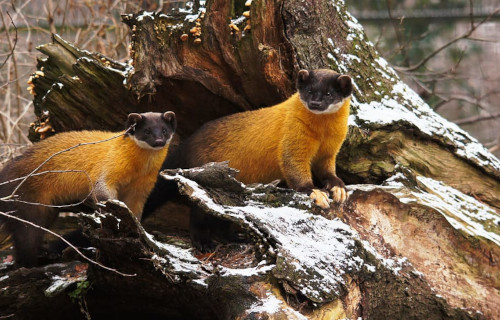
Yellow Throated Marten Physical Description
It bears noting that the gorgeous Yellow Throated Marten fully deserves the viewer’s appreciation for characteristics other than just its sheer visual appeal. That trait, however, nevertheless merits its own attention and mention, of course. It’s also an impressively large variety of marten.
Like many other of the mammals found around the world, though, it displays a moderate degree of the physiological characteristic of sexual dimorphism. In its specific case, however, this gender based difference manifests in terms of physical size, not overall appearance of the animal.
More specifically, the males of the intriguing species typically attain a greater size than their female counterparts. This tendency follows the more common pattern among mammals, including the other known species of marten. Moreover, this pattern includes both weight and length.
Weights, however, frequently vary quite significantly, typically due to various local environmental factors. Males generally reach an average weight that ranges from roughly 5.5 – 12. 6 lb (2.5 – 5.7 kg). Female individuals of the charming animal, though, only average about 3.5 – 8.4 lb (1.6 – 3.8 kg).
Males of this enchanting species also average approximately 19.7 – 28.3 in (50 – 72 cm) in terms of body length. Their female counterparts, meanwhile, actually reach average lengths equaling around 20 – 24 in (50 – 62 cm). Thefluffy tail also grows to as much as 65% of the extent of the body.
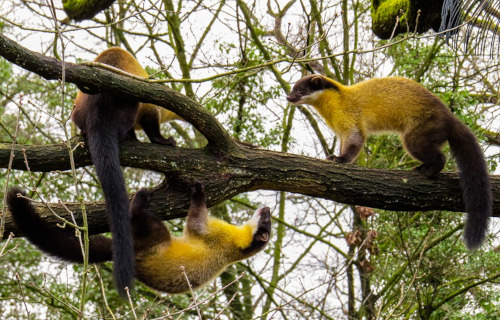
It’s the striking color pattern of the aptly-named Yellow Throated Marten that garners the most attention from observers, though. Much of the elongated body and neck develop the stunning yellw hue. The elongated face, legs, and tail, meanwhile, generally display a black or dark brown shade.
- Kingdom: Animalia
- Phylum: Chordata
- Class: Mammalia
- Order: Carnivora
- Family: Mustelidae
- Genus: Martes
- Species: M. flavigula
Yellow Throated Marten Distribution, Habitat, and Ecology
Fortunately, both for the stunning Yellow Throated Marten itself, and those of us who appreciate Nature, it apparently evolved as native to a moderately broad swathe of the globe. That’s due to the fact that this slightly smaller marvel of evolutionary processes evolved as native to part of Asia.
Moe precisely, though, this fascinating mammal appears to inhabit a comparatively broad section of the southern portion of that remarkable continent. There, the Mustelid appears in such scattered countries as Pakistan, Afghanistan, India, Bhutan, Nepal, China, and Taiwan, just to name a few.
The animal also evolved as highly flexible in nature, regarding its choice of habitat. That trait, in fact, continues to serve it well today. Due to this extreme versatility, it appears in a wide range of ecosystems. These include such regions as lowland swamps, alpine meadows, and forests.
Along with this evolved pattern of habitation also comes an impressive adaptability to a range of altitudes as well as other, related conditions. In some portions of its range, including Nepal, it lives at truly impressive altitudes. There, some individuals appear at up to 14,800 ft (4,510 m)!
Though primarily carnivorous in terms of its diet, the creature does occasionally supplement its diet with smaller quantities of plant matter, such as fruit and nectar. It mainly feeds on various animal prey, though. That prey generally consists of smaller creatures, such as lizards, snakes, and mice.
The highly evolved Yellow Throated Marten typically hunts as a diurnal animal, and further most often does so in pairs. Hunting parties of three or more sometimes form, however. It also feeds rather opportunistically on carrion, often consuming the leavings of larger hunters, like tigers.
Clouded Leopard
CCL: https://tinyurl.com/33psz7af
Clouded Leopard Facts
- Finishing up this article about these 5 Magnficent Mammals of the Himalayas we give you the other feline making an appearance, the Clouded Leopard.
- The relatively short term we’re using herein easily serves as the most often employed common name for this beautiful wild feline. Yet, the truly stunning mammal does have at least one other general title. That’s the extremely similar epithet of mainland clouded leopard.
- Inside of scientific circles, though, many individuals may know it better by yet another tag. That’s its purely technical designation. Fortunately, however, that’s a comparatively simple one for the layperson to pronounce. It holds the official moniker of Neofelis nebulosa.
- The amazing animal received its first official tag due to the concerted efforts of Edward Griffith. The highly respected British naturalist accomplished the first recognition of the creature as a separate and distinct species. He managed that scientifically noteworthy deed in 1821.
- He did not assign the creature the technical epithet it holds today, however. He originally named it Felis nebulosa. Since that time, it’s gone through several renamings, though, due to ongoing research. It finally received the one it holds presently at a much later date.
- Regrettably, the Clouded Leopard now finds itself in somewhat dire straits. It’s seen its population steadily reduced in more modern times, for a wide variety of reasons. That trend further holds true across its entire range. The IUCN thus now lists it as Vulnerable.
- The marvelous work of Nature currently faces multiple threats to its continued existence as a species. Most of these perils stem from the actions of man. Some include ongoing poaching, despite being a protected species. It also now faces the danger of climate change.
Clouded Leopard Physical Description
The gorgeous Clouded Leopard almost immediately captures the attention of all those who encounter it, as most wild felines do. Some, though, only do so due to their visual appeal. This mammal has more to offer, however, because it also boasts some quite respectable dimensions.
In that specific regard, though, the animal follows a pattern common to its many relatives. That’s in the fact that it displays a certain degree of the physiological characteristic of sexual dimorphism. In its specific case, this natural trait manifests itself purely in terms of overall physical size.
Slightly smaller in size, females of the species attain an average body length of approximately 27 – 37 in (68.6 – 94 cm). The tail also typically adds another 24 – 32 in (61 – 82 cm). Weights for this sex also remain less than the male. This usually ranges from roughly 22 – 30 lb (10 – 13.6 kg).
Males of this marvel, meanwhile, achieve moderately greater lengths and much more significant masses. For them a mean body length equals about 32 – 43 in (81 – 108 cm). Their tail adds an additional 29 – 36 in (74 – 91 cm). Masses for them, however, average 44 – 55 lb (20 – 25 kg).
Otherwise, both the genders of the awesome Clouded Leopard present the same outward appearance. Despite the notable length and weight differences, shoulder height for both averages 20 – 22 in (50 – 55 cm). The males thus have a significantly stockier build than the females.
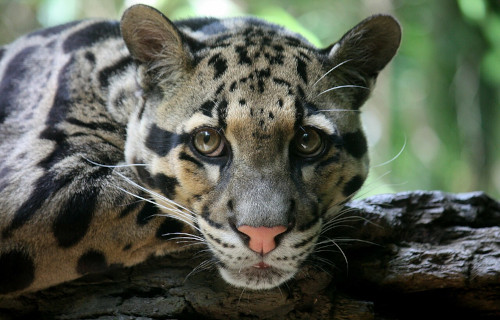
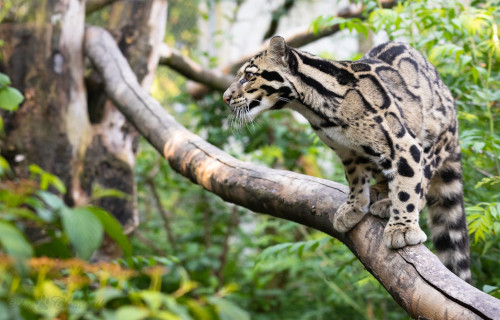
The wild feline also has a distinctive pattern of coloring. The background consists of either an ocher or dark gray. Yet, muliple splotches of dark gray or black mark the coat without pattern, and of random sizes and shapes. These even appear on the face, while the ears show purely black.
- Kingdom: Animalia
- Phylum: Chordata
- Class: Mammalia
- Order: Carnivora
- Family: Felidae
- Genus: Neofelis
- Species: N. nebulosa
Clouded Leopard Distribution, Habitat, and Ecology
The breathtaking Clouded Leopard apparently evolved as native to a comparatively broad swathe of the surface of the globe. The full extent of that zone of habitation might come as a surprise to some of our readers, though. That’s because the amazing animal occupies a large portion of Asia.
Within that larger overall range, however, it doesn’t appear in every part of the continent. It mainly resides in the souteastern sections. From there, though, its natural territory also expands into China. Yet, in another direction, its range also reaches deep into the Himalayan foothills in Nepal.
Fortunately, this incredible creature has an extremely high level of flexibility regarding its choice of habitat type. It therefore appears in a wide range of local ecosystems. This flexibility extends to altitudes, since it also lives at heights ranging from near sea level to 12,200 ft (3,720 m).
In some parts of its territory, the mammal lives in regions composed of sub-tropical, semi-deciduous forests. But, in other areas it also makes its home in largely evergreen woodlands. In some regions, such as Thailand, the intrepid feline also lives in sections of dry tropical forest.
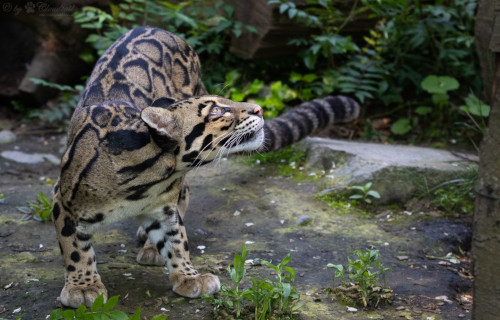
Like many of its kindred around the world, the stunning Clouded Leopard principally lives a solitary life. It’s also mainly nocturnal in nature, and even mostly arboreal in nature. The cat’s extremely reclusive, and thus rarely seen, except for being caught by the occasional camera trap video.
Being a feline, it’s also naturally entirely carnivorous in terms of diet. It’s surprisingly quite versatile, though. Somtimes it actively stalks its prey, yet at others it waits in ambush. It primarily consumes moderate-sized prey, including macaques, lorises, pangolins, and squirriels, among others.
5 Magnificent Mammals of the Himalayas
We hope that each of you fully enjoyed reading, and hopefully learning something from, this article we’ve written about these 5 Magnificent Mammals of the Himalayas. It’s also our fervent hope that doing so has left you with either a new or renewed appreciation for such wonders of Nature.
Unfortunately, however, many of their innumerable kindred around the world now find themselves facing strong threats to their continued existence as a species. Many of those dangers, in fact, stem from the actions of mankind. We must each do all we can to protect and preserve them all.
Check out our other articles on 4 Fabulous Geological Features of Texas, Earth’s 7 Mightiest Rivers, 5 Incredible Pacific Ocean Rays, Africa’s Many Geological Masterpieces, The Mighty Tornado










Leave a Reply