CCL: https://bit.ly/3ZoVuwz
We greatly hope that each of you, our readers, will fully enjoy and appreciate this article we present to you about these 5 Particularly Pleasing Pines. It was certainly our pleasure to compile the various information for you. May it serve to provide you with both education and increased awareness.
Of course, these few flora listed herein represent only a tiny portion of the related species found throughout the world, though. Yet, it’s our belief that they still serve as excellent representations of the wonders to be discovered. Check out some of our other articles for similar marvels.
Bristlecone Pine
CCL: https://bit.ly/1ryPA8o
Bristlecone Pine Facts
- Starting off this article about these 5 Particularly Pleasing Pines we give the extraordinary product of botanical evolution named the Bristlecone Pine.
- Without doubt, the remarkable flora known by this title ranks as the oldest known non-clonal living species on Earth. However, the truly descriptive common term actually applies to a total of three separate related plant species. Though not unknown, it’s uncommon.
- All three of these tree species grow extremely slowly, though, primarily due to the particularly dry soil, cold conditions, high winds, and short growing seasons. But, still another unique characteristic distinguishes these absolutely amazing trees from any similar species.
- That holds true due to a surprising condition of their nature. That’s the fact that they also never attain a very great height. Even the needles on this pine appear to be extremely long-lasting. That’s because many of them remain on the branches for as long as forty years.
- Genetically related and visually quite similar pines also happen to exist. Some of these creations of Nature and botanical evolution even coexist with them in the same habitat range. This fact, therefore, often renders it quite difficult to distinguish one species from the other.
- Due to this challenging situation, an exact tally of the numbers of the Bristlecone Pine remains impossible to determine with complete accuracy. The IUCN, however, currently lists all three species of the Bristlecone Pine as Near Threatened on its Red List of Threatened Species.
- Each of these wonders face multiple threats to their continued existence as species. Most of those perils stem from the actions of mankind, like most forms of life on earth today. These dangers include the closely related hazards of habitat loss and ongoing climate change.
Bristlecone Pine Physical Description
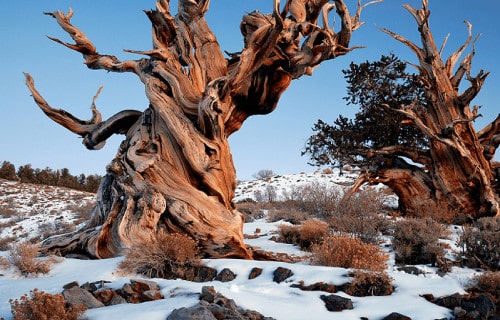
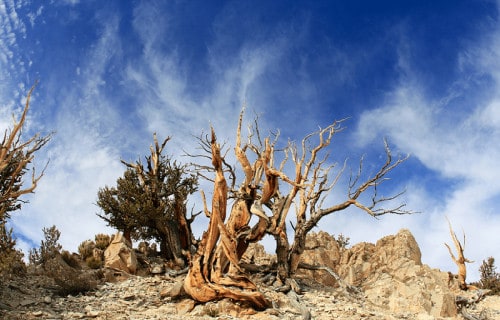
The amazing Bristlecone Pine truly remains one of the most unusual trees on the planet, and never fails to amaze those who view it. In fact, it develops a most distinctive shape. That holds true because the trunks of the amazing type of pine develop in extremely gnarled shapes and patterns.
This trend obviously has the net result of giving the intriguing plants an unmistakable shape. These truly breathtaking trees also manage to pack all of these mesmerizing qualities into a surprising package. That’s because these amazing flora remain relatively small compared to most relatives.
In fact, no known individuals of these wonders ever achieve a height measuring greater than 60 ft (18.3 m). Amazingly, most specimens actually remain considerably shorter than that. Even its root system develops in a highly unusual nature. This occurs because this grows extremely branched.
This particular component of the remarkable tree’s physical design also typically remains quite shallow in nature. Generally, however, only a surprising small number of the larger roots provide the needed stability. Even the wood of the stunning Bristlecone Pine stands out from most other pines.
In point of fact, this astonishing feature of the fascinating three species develops as extremely dense in nature. Yet, interestingly enough, it’s also typically quite resinous. This unexpected characteristic also has the benefit of providing the tree with resistance to insect pests, aiding in its longevity.
- Kingdom: Plantae
- Phylum: Pinophyta
- Class: Pinopsida
- Order: Pinales
- Family: Pinaceae
- Genus: Pinus
CCL: https://bit.ly/1p2b8Ke
Bristlecone Pine Distribution, Habitat, and Ecology
Of great interest to those observers who appreciate the resourcefulness and tenacity of Nature remains the habitat that the astonishing Bristlecone Pine evolved as indigenous to. That’s due to yet one more particularly amazing fact common to all three varieties of the highly unique plant.
That’s true because these stunning trees appear to live only on a few remote, notably dry mountaintops in six states in the United States, in North America. This awesome plant also typically grows at high altitudes ranging between 5,600 and 11,200 ft (1,700 and 3,400 m) in elevation.
Even within this habitat zone, however, the botanical wonder displays certain clear preferences. The vast majority of known individuals of each of the three species generally occur at the higher end of this altitude range. Incredibly, these examples appear at or above altitudes of 10,000 ft.
These marvels of evolution perfectly display the remarkable variety and resourcefulness of Nature in a very specific manner. They grow only in rocky, dolomitic soils with poor nutrient content, often on slopes and ridges. It also favors high amounts of sandstone, limestone, calcium, and magnesium.
Another astonishing fact remains about every form of the mesmerizing Bristlecone Pine. Known specimens average 1000 years old. In fact, the oldest one, bearing the name Methuselah, is currently 4,789 years old. But still one more fact remains to make these trees true marvels of Nature.
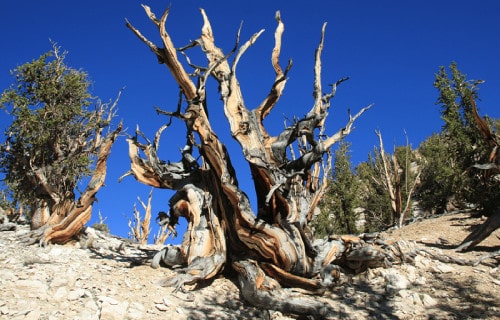
That’s due to the truth that, given their incredibly great density, dead trees frequently remain standing for centuries after their demise! Thankfully, most recognized surviving individual trees now reside within the confines of several National Parks and thus enjoy a certain amount of protection.
Balsam Fir
CCL: https://tinyurl.com/22y23f9m
Balsam Fir Facts
- Next up in this compilation of 5 Particularly Pleasing Pines comes the beautiful and popular tree known as the Balsam Fir.
- This magnificent product of botanical evolution is most frequently referrred to by the short common name given here in much of its range. Yet, it does have several other general titles, as well. These include the optional terms Canadian balsam and eastern fir, among others.
- Scientists, however, perhaps know the beautiful flora by yet another label. They possibly know it more often by its purely technical moniker. Thankfully, that’s a relatively simple one for the layperson to pronounce. It currently holds the formal epithet of Abies balsamea.
- The gorgeous tree received that appellation due to the efforts of Carl Linnaeus himself. The highly esteemed Swedish zoologist accomplished the first recognition of it as a separate and distinct species. He managed that scientifically noteworthy feat in the year 1768.
- Since that time, however, the remarkable plant’s gone through multiple renamings. In fact, various researchers have reclassified it over the ensuing years. Some of the other formal titles it previously held include Abies balsamifera and Abies hudsonia, to name just a few.
- Fortunately, the remarkable Balsam Fir continues to maintain a population base that’s both stable and sufficient. That pleasant state further to appears to hold true across its entire range. The IUCN thus currently lists the botanical wonder as Least Concern on its Red List.
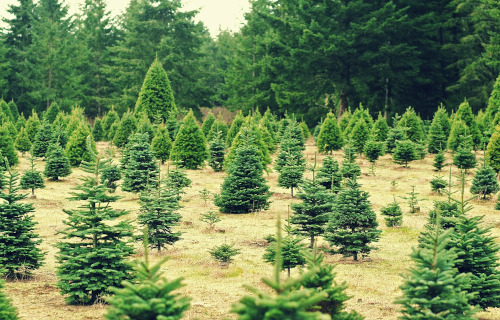
- Today, two extant varieties exist, both of which play surprisingly important roles within the culture of the region to which they evolved as native. That’s due to the fact that both forms of this marvel of Nature and evolution together serve as the most popular type of Christmas tree.
- Despite its relative stability in the wild, and its popularity in horticulture, the flora still faces the same potential threats to its continued existence as all other species on today. Most of these stem from the actions of man. These perils include habitat loss and looming climate change.
Balsam Fir Physical Description
The stunning Balsam Fir almost instantly captivates those individuals lucky enough to encounter it, most especially in the wild. Yet, the flora does so for more than just one reason. That’s because it’s not only lovely to behold, but the tree also boasts some respectable physical dimensions.
Depending on local environmental conditions, it develops as either a small or medium sized tree. Fully mature specimens range in height, usually due to variations in local environmental conditions. However, this measurement typically runs from roughly 46 ft (14 m) to approximately 66 ft (20.1 m).
Obviously, exceptional examples do naturally sometimes occur, though. A few confirmed examples even achieved measurements reaching 89 ft (27.1 m). Few individual plants of this remarkable evergreen reach such a great size, though. Envirinmental factors rarely favor such growth today.
The trunk itself generally grows in a primarily vertical direction, with very little deviation. When young, this aspect presents a light gray color and smooth texture. As it ages, though, this changes. Over time, the bark slowly becomes much darker, rougher, and often with deep fissures and cracks.
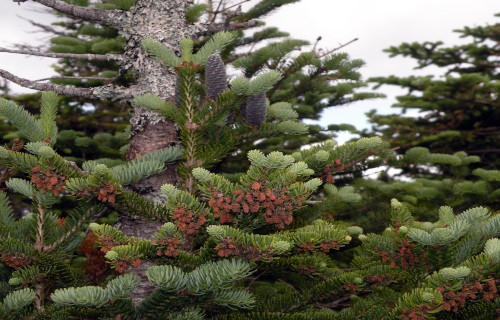
Typical of its kind around the world, the foliage of the beautiful Balsam Fir develop as flat and needle-like in structure. This verdure has a mean length of 0.63 – 1.13 in (1.5 – 3 cm). It also shows a deep green shade in color. Each limb produces multiple stems, each with hundreds of leaves.
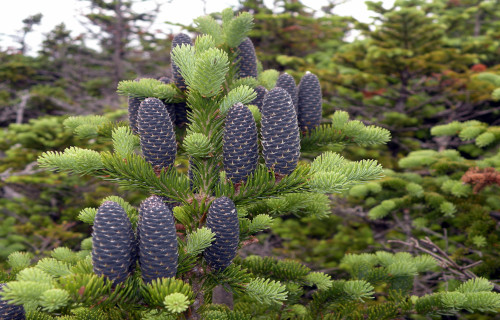
Nevertheless, it’s the highly distinctive seed cones that frequently receive the most attention. These develop as erect, and measure roughly 1.5 – 3.25 in (3.8 – 8.3 cm) in length. It’s their color, though, that most catches the eye. Each displays a dark purple at first, that changes to brown with age.
- Kingdom: Plantae
- Phylum: Tracheophyta
- Class: Pinopsida
- Order: Pinales
- Family: Pinaceae
- Genus: Abies
- Species: A. balsamea
CCL: https://tinyurl.com/22y23f9m
Balsam Fir Distribution, Habitat, and Ecology
The breathtaking and culturally important Balsam Fir evolved as native to a moderately limited section of the earth’s surface. The location of that zone of habitation isn’t much of a surprise, however. That’s because the beauty developed as endemic to part of North America.
But, within the confines of that continent, the captivating Gymnosperm only inhabits a very specific portion of the landmass. The vast majority of its natural territory appears inside the national boundaries of Canada. There, it lives in most of the eastern and central regions of the nation.
From this setting, however, it spreads southward, though in admittedly smaller concentrations. Inside of the United States, the flora mainly lives in the northeastern section. It’s seen from Maine to the Appalachian Mountains of West Virginia in the east, to as far west as Minnesota.
Fortunately, Nature blessed these intrepid species with an impressive degree of adaptability in its choice of habitat. The wonder thus appears in a comparatively wide range of ecosystems. This includes both mixed forests, holding deciduous trees, as well as forests formed purely of fir trees.
It also tolerates a wide variety of soil types, and even manages to thrive with a range of moisture levels. Altitudes also do not deter the intrepid flora from taking up residence. That’s true since the amazing plant resides anywhere from sea level to heights reaching all the way to the treeline.
The gorgeous Balsam Fir also plays a vitally important role in the wild, in addition to human culture. Its large seed cones disintegrate after laying on the ground for a time. While the wind disperses most, small mammals also consume some of them. Moose and deer also feed on the foliage.
Those same small creatures also assist in the dispersal of the seeds, via their droppings. Even under completely ideal conditions, though, only around half of all seeds remain viable. Once a tree does succed in taking root, barring outside interference, a typical lifepsan equals roughly 200 years.
Bristlecone Hemlock
CCL: https://bit.ly/3ZoVuwz
Bristlecone Hemlock Facts
- Our next choice for inclusion in this gathering of these 5 Particularly Pleasing Pines is the gorgeous flora best known as the Bristlecone Hemlock.
- This masterpiece of Nature and evolution most frequently goes by this deceptive common name across its territory. For the moment, the remarkable creation of Nature has no other broadly accepted general name. Though that’s not unknown, it’s still uncommon.
- Among scientific professionals, though, the amazing plant remains much better known by its official title. That’s a somewhat hard to pronounce term for the layman, however. That’s because it bears the extremely cumbersome technical name of the Nothotsuga longibracteta.
- It received that name due to the efforts of two noted researchers. They were Hu Xiansu and Christopher Nigel Page. They achieved the first formal acknowledgement of the plant as a separate and distinct species. This scientifically noteworthy deed occurred in 1989.
- Regardless of which term one chooses to use when referring to it, the flora remains an impressive species. The botanical wonder also stands out from the great majority of similar plants. That’s due to the fact that it currently represents the only known member of its genus.
- Sadly, the fabulous Bristlecone Hemlock appears to be steadily declining in numbers. This unfortunate situation further seems to hold true throughout its entire native range. The IUCN thus presently lists this floral marvel as Near Threatened on its published Red List.
- Given its present situation, it understandably faces various threats to its continued existence as a species. The most pressing one for the moment continues to come from ongoing deforestation. The ever-increasing effects of climate change, however, also now pose a danger.
CCL: https://bit.ly/3FZemvr
Bristlecone Hemlock Physical Description
The remarkable Bristlecone Hemlock reamains a variety of tree that captivates many lucky enough to encounter it. It also does so due to more than just one reason. Yes, it’s a visually appealing product of Nature, to be certain. Yet the species also attains a fully respectable physical size.
Individuals specimens of this marvel reach a maximum known height of roughly 98.4 ft (30 m). The trunk itself generally tends to grow relatively straight in most cases. The distinctive bark covering this part of the tree manifests a dark brown in color. It also displays deep longitudinal fissures.
Extending out from this, the branches develop as comparatively thin in nature. These particular features also develop in varying shades of brownish yellow or reddish brown, but only when young. As the individual ages, though, this usually changes to shades of brownish gray or dark brown.
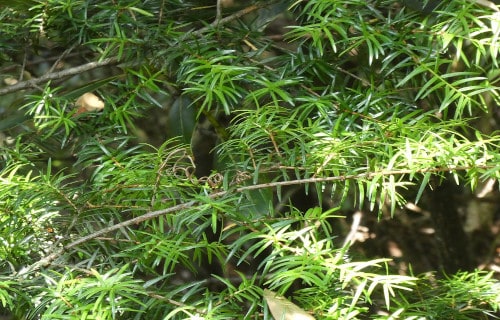
The foliage of the remarkaable Bristlecone Hemlock also merits a measure of attention. These evolved as evergreen in nature. Their flat, rather needle-like structure averages 0.5 – 1.5 in (1.2 – 4 cm) in length. The diameter of these leaves additionally only ranges from 0.04 – 0.08 in (1 – 2 mm).
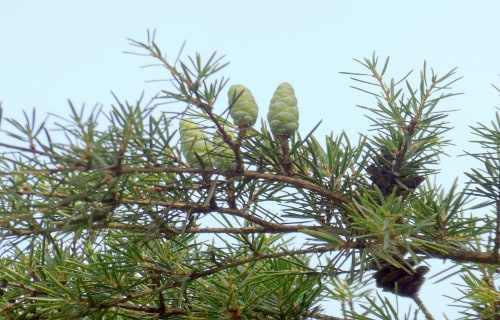
Nonetheless, it’s the seed cones of the tree that likely garner the most attention, however. These average just 1 -2 in (2.5 – 5 cm) in length. Despite their size, though, they display a visually striking tendency. That’s because they typically develop as vertical and erect in relation to the branch.
- Kingdom: Plantae
- Phylum: Pinophyta
- Class: Pinopsida
- Order: Pinales
- Family: Pinaceae
- Genus: Nothotsuga
- Species: N. longibracteta
CCL: https://bit.ly/3ZoVuwz
Bristlecone Hemlock Distribution, Habitat, and Ecology
Though comparatively limited, the zone of habitation of the amazing Bristlecone Hemlock isn’t surprising. That’s due to the fact that the plant evolved as native to a region of the globe renowned for its natural splendor. It’s currently unknown if the evergreen ever appeared beyond this range.
It’s presently found only in a very small portion of the continent of Asia. That setting happens to place the tree within the boundaries of the country of China. Even there, though, it only appears in a few select regions. Those are the four provinces of Hunan, Guizhou, Guangdong, and Fujian.
Further complicating its situation stands the fact that it also evolved specific habitat requirements. Part of this is its need for relatively acidic soil. The species also requires a cool, humid, and temperate climate, with abundant rainfall. The same native locale also features frequent, dense fog.
The marvel of Nature and evolution also makes its home on low or moderately high mountains in this range. The species, however, thrives well at a respectable range of altitudes. Due to this high degreeof flexibility, concentrations appear at altitudes ranging from 984 – 6,234 ft (300 – 1,900 m).
The fascinating Bristlecone Hemlock achieves pollination through the actions of a wide range of local insect species. Seed cones develop, and present as red or purplish at first. As these mature, they change to a dark brown shade. Pollination occurs between the months of March to April.
Intriguingly, these specially evolved structures typically persist on each individual tree for several years. When fully mature, these cones spread the seeds within them in one of two very different ways. Some break off from the tree entirely whole, while others disintegrate completely on the tree.
Wollemi Pine
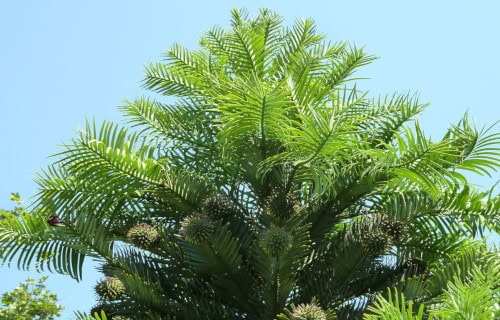
CCL: https://bit.ly/34KufSq
Wollemi Pine Facts
- Next up in this compendium of 5 Particularly Pleasing Pines we present the extremely rare vareity of flora named the Wollemi Pine.
- For the moment, the distinctive term we’re applying serves as the common name for a truly remarkable variety of coniferous tree. Meanwhile, it also bears the scientific name of Wollemia nobilis. By either name, though, this true wonder of Nature remains a fabulous species.
- Currently, this remarkable tree also constitutes the only recognized member of its genus. That holds true due to a highly lamentable situation. That’s due to the fact that its only established closely related species presently remain known only through uncovered fossil records.
- Remarkably, as so quite often happens to be the case, the discovery of this incredible species of flora occurred entirely accidentally. That’s because, in the year 1994, a hiker and botanist, named David Noble, along with two others, discovered the supposedly extinct flora.
- At that point in time, the intrepid trio stumbled upon the extremely unique trees while exploring canyons in its region of the world. The official identification of the species occurred later, of course. This happened subsequent to detailed study of several samples he took.
- The indisputabaly remarkable Wollemi Pine also currently appears on the IUCN published Red List of Threatened Species. There, it sadly holds the understandable status of Critically Endangered. This status occurs due to its scant numbers and extremely vulnerable habitat.
- Most unfortunately, the incredible find continues to remain highly vulnerable. This presently remains especially true due to the ongoing effects of climate change. Thankfully, during the devastating wildfires in the region in 2019-2020, valiant efforts managed to preserve it.
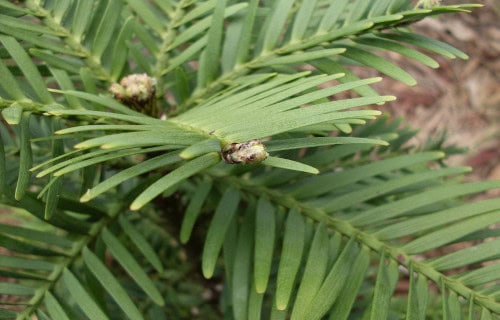
CCL: https://bit.ly/2ymCl7W
Wollemi Pine Physical Description
For wholly understandable reasons, the stunning Wollemi Pine never fails to captivate and amaze those individuals lucky enough to encounter one of them. This usually occurs due to a combination of factors, though. That’s true since it’s not only visually unique, but also of fairly decent size.
This particular product of eons of evolutionary processes developed in a manner fully deserving of appreciation. Nature created the botanical beauty as an especially fascinating variety of what science calls an evergreen. It’s also extremely noteworthy for several very special natural attributes.
For one, the surpsingly unique species of tree attains some highly respectable physical dimensions. This fascinating species attains a maximum measure height of roughly 131 ft (40 m). However, the great majority of specimens actually average a vertical reach of approximately 82 ft (25 m).
The magnificent Wollemi Pine also posseses numerous other well-known qualities to distinguish it from other types of trees across the globe. The bark of this wonder clearly qualifies as one of these. This aspect of its biology develops with a distinctive knobby texture, along with a deep brown color.
The foliage of this intriguing pine also merits its own level of respect from observers and researchers alike. These distinctive leaves appear as long, flat, and broad. They have the ability to attain as much as 3.1 in (8 cm) in length. These only average 0.08 – 0.2 in (2 – 5 mm) in total width, though.
Yet, still one more portion of the structure of this fabulous flora manages to garner its own share of interest. That’s the reproductive portion of its basic nature. The marvelous plant produces both male and female seed cones, with some of these occasionally reaching 4.7 in (12 cm) in length.
- Kingdom: Plantae
- Phylum: Tracheophytes
- Class: Pinopsida
- Order: Pinales
- Family: Araucariaceae
- Genus: Wollemia
- Species: W. nobilis
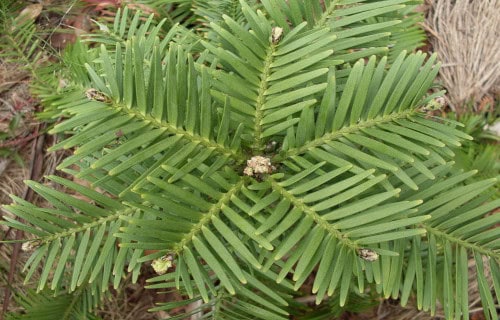
CCL: https://bit.ly/3biFyDP
Wollemi Pine Distribution, Habitat, and Ecology
To date, one unfortunate fact about the Wollemi Pine continues to work against the odds of survival for this awesome wonder of Nature. That’s the fact that the only known area in which the awesome tree appears remains limited to an extremely remote and quite rugged section of the world.
Impressively, this zone of habitation consists of a particularly rugged section of the surface of the earth. More precisely, though, this forms part of what now constitutes the Wollemi National Park. This sits in New South Wales, which forms a part of the continent and country of Australia.
Even within this already extraordinarily limited habitat range, however, this incredible work of Nature only lives in certain specific types of locations. In point of fact, the amazing evergreen appears to dwell only in one astonishingly small section of temperate rainforest within this area.
Though it may be dificult to believe, another factor further complicates things for the tantalizing species of tree even more, though. That pertains to the conditions of its particular habitat. Remarkably, the beautiful evergreen only inhabits a group of several steep, narrow sandstone gorges.
Lamentably, for the moment fewer than 100 known specimens of the mind-boggling Wollemi Pine exist in the wild. Fortunately, however, several active preservation programs currently exist. These constantly monitored efforts have so far succeeded in propagating a number of specimens.
As a result of this concerted and still ongoing effort, hopes for the species continue to remain high. Several botanical gardens around the world now possess scattered individuals of this remarkable tree in their possession. A few very carefully tended small groves also exist in other areas.
Sicilian Fir
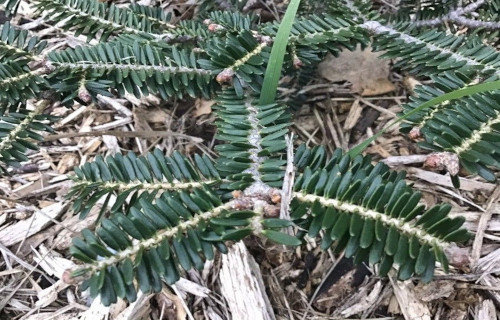
CCL: https://rb.gy/sjtms
Sicilian Fir Facts
- Finishing up this article about these 5 Particularly Pleasing Pines we present you with the stunning creation of Nature named the Sicilian Fir.
- This majestic example of botanical beauty is most typically referred to by the obviously informative common name for good reasons. For the moment, the flora has no other broadly accepted general title. Though unusual for a tree, that’s certainly not unknown.
- The term by which it’s likely better known among scientists, however, is quite different. Thankfully, though, it’s a comparatively easy name for the layperson to pronounce. That’s because this marvel of evolution presenttly holds the formal title of Abies nebrodensis.
- It owes that moniker to the combined efforts of two highly respected individuals. The Italian botanist, Michele Lojacono, began the work, and her countryman, Giovanni Ettore Mattei, completed it. Between them, they recorded its first recognition as a separate species.
- Sadly, the remarkable Sicilian Fir now finds itself in a dire predicament. Its population base, always limited, has now plummeted precipitously. Only 25 mature examples remain. Due to this fact, the IUCN now lists the beautiful tree as Critically Endangered on its Red List.
- The primary cause of its near disappearance stems directly from the actions of humans. That’s true since this plunge in population occurred due to deforestation of its habitat. Because of its tiny population, it’s also now especially vulnerable to the danger of ongoing climate change.
CCL: https://rb.gy/4kbhn
Sicilian Fir Physical Description
When viewed by those individuals fortunate enough to encounter it, the fabulous Sicilian Fir typically captures their instant attention. It does so, however, principally due to a combination of its own appearance and how it stands out amid its surroundings. It’s another of Nature’s wonders.
In terms of sheer size, though, it only ranks as approximately average-sized among the members of its Class. The mature specimens still in existence range in height from 49.2 – 82 ft (15- 25 m). For the present moment, no known records of the amazing tree ever exceeding this measurement exist.
Given its height, the width of the trunk remains comparatively impressive in relation. This part of the lovely Gymnosperm attains an average diameter equaling 3.3 ft (1 m) at what science calls the breast height. Taken at 4.5 ft (1.37 m) above ground, that’s a standard reference for botanists.
This aspect of the Tracheophyte holds its own distinctiveness. It displays a light gray color across its length. Though smooth when young, this slowly becomes scaly with age. At full maturity, this also becomes furrowed, most especially at or near the base of the fascinating natural wonder.
The leaves of the gorgeous Sicilian Fir also fully merit note. Like most of its kin, its foliage develop as needle-like structures. Flattened in shape, these average about 0.6 – 1.0 in (1.5 – 2.5 cm) in length. The surface shows a glossy dark green, with two greenish-white bands present on the underside.
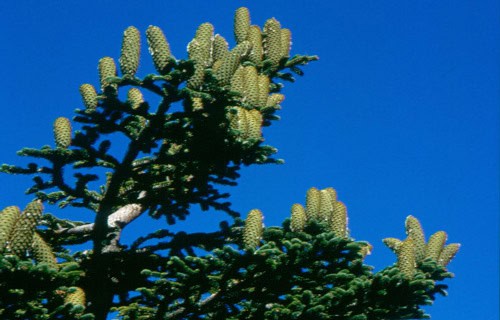
The seed cones it produces reach typical lengths equaling approximately 4 – 6.4 in (10 – 16 cm) in length. Their width, meanwhile, averages about 1.6 in (4 cm). Each of these typically presents around 150 scales. Typically winged in design, the seeds range in size from 0.32 – 0.4 in (0.8 – 1.0 cm).
- Kingdom: Plantae
- Phylum: Tracheophytes
- Class: Pinopsida
- Order: Pinales
- Family: Pinaceae
- Genus: Abies
- Species: A. nebrodensis
CCL: https://rb.gy/sjtms
Sicilian Fir Distribution, Habitat, and Ecology
The mesmerizing Sicilian Fir evolved as native to a region of the globe renowned for its numerous natural marvels. That includes both geological, and, as in this case, botanical. That’s due to the fact that this creation of Nature and evolution developed as endemic to the continent of Europe.
Yet within that greater area, its indigenous zone of habitation actually remains extremely small. The precise location of its presence, however, probably won’t surprise anyone. That’s because, as its name indicates, it’s native to the region of the country of Italy bearing the name of Sicily.
The species also shows decidedly strong preferences in regards to its choice of habitat. It’s a montane flora, evolved for the higher elevations. Presently, it only appears on Mt. Scalone, in the Madonie Mountains. All examples live at altitudes between 4,593 – 5,249 ft (1,400-1,600 m).
Even there, though, this truly remarkable flora only lives in a few very select areas. These consist of dry, steep slopes. Within these locations, it either grows alone in small stands, or scattered in with other trees. The latter specimens mix in with shrubs and other trees, most notably black pine.
The Sicilian Fir evolved as a variety of coniferous evergreen. As such, each tree produces both male and female seed cones. Following the complete ripening of the seeds inside the female cone, the container disintegrates. The exposed seeds then naturally fall to the surrounding terrain.
Replanting programs do currently exist, yet these show only limited success. Heavy grazing by the livestock of local faremrs, combined with the actions of indigenous animals, severely limits new growth. These efforts do continue, though, in an attempt to preserve the amazing species.
CCL: https://bit.ly/3ZoVuwz
5 Particularly Pleasing Pines
We greatly hope that each of you, our readers, will fully enjoy and appreciate this article we present to you about these 5 Particularly Pleasing Pines. It was certainly our pleasure to compile the various information for you. May it help to provide you with both education and increased awareness.
Of course, these few species listed herein represent only a tiny portion of the natural wonders found throughout the world, though. Yet, it’s our belief that they nevertheless serve as excellent representations of the wonders found here. Consider perusing our many pages for similar marvels.
Check out our other articles on 4 Fabulous Geological Features of Texas, Earth’s 7 Mightiest Rivers, 7 Incredible Insects of Europe, The Mighty Tornado, 3 Remarkable South American Reptiles










Leave a Reply